
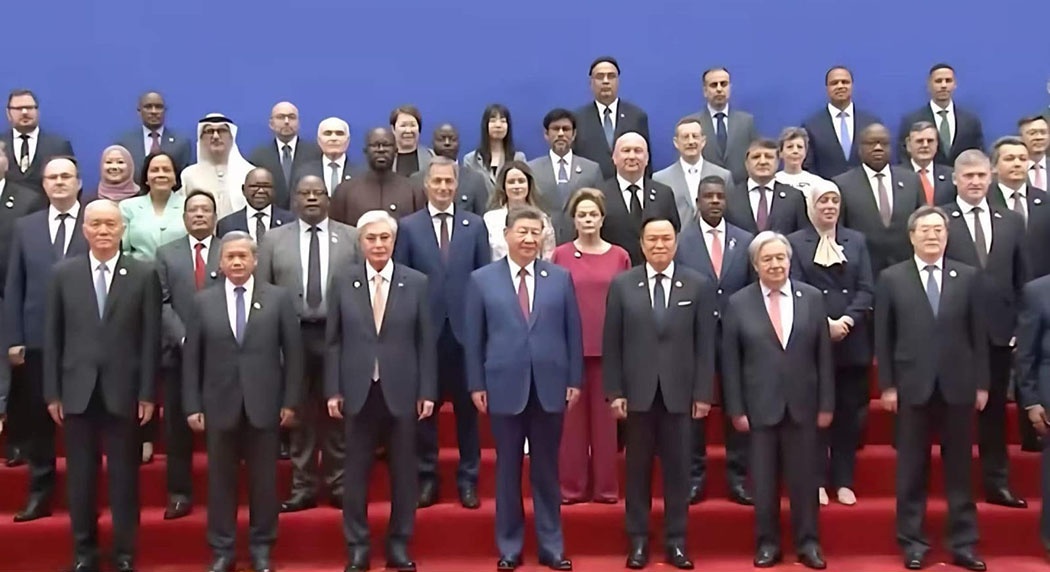
On July 16, twenty-nine countries signed the founding charter of the World Artificial Intelligence Cooperation Organization (WAICO) in Shanghai — a China-backed intergovernmental body that now stands as the most significant attempt yet to build a governance framework for AI outside Western institutional structures. It happened one day before the World AI Conference (WAIC) opened its doors to a staggering 300 product debuts and more than 100,000 square meters of exhibition space. And it marks a moment where the global AI landscape formally split into two tracks.

If you build software for a living, this matters more than you might think. Not because of politics — but because the rules, the infrastructure, and the economic incentives shaping the AI tools you use every day — something I explored in depth when looking at the two AI economies forming right now are about to diverge in ways that will affect everything from which open-weight model you can download to which chips your cloud provider can buy.
Let me break down what happened, what it actually means, and why I think developers should pay attention — even if the headlines sound like diplomatic news rather than tech news.
What Exactly Is WAICO?
WAICO stands for the World Artificial Intelligence Cooperation Organization. Its founding members include Brazil, Indonesia, Russia, Pakistan, South Africa, Cuba, Kazakhstan, and two dozen other nations from Asia, Africa, and Latin America. What it conspicuously does not include is any major Western democracy — no United States, no United Kingdom, no Germany, no France, no Japan, no Australia.
Chinese President Xi Jinping appeared at WAIC for the first time in the conference’s nine-year history to announce the body, calling it “an important milestone in the history of AI development” and pledging to provide 5,000 AI training slots to developing nations. The tone was deliberate: WAICO is positioning itself as the voice of the Global South — nations that feel existing AI governance frameworks (the EU AI Act, the OECD AI Principles, the G7 Hiroshima Process) were built by and for wealthy Western democracies without their input.
Premier Li Qiang first floated the idea at WAIC 2025, and China spent a full year securing commitments before the signatures landed on July 16. That timeline tells you this wasn’t a snap decision — it was a carefully orchestrated institutional play.
The Split That’s Already Here
The practical consequence is straightforward: the world now has two competing institutional frameworks for AI governance — much like the EU just forcing Google to open Android to AI rivals represents one side of that regulatory coin. Countries aligned with WAICO will develop AI regulations that do not need to be compatible with the EU AI Act or the Hiroshima Process guidelines. For any company operating globally — and that includes most of the tech ecosystem — AI compliance just got more complicated.
UN Secretary-General António Guterres attended the signing ceremony, lending the occasion institutional weight without formally committing the UN to either side. That careful neutrality tells its own story: even international bodies are watching to see which framework gains traction before picking a lane.
What makes this interesting from a developer’s perspective is the timing. Western regulators have spent the last two years focused on AI safety — model evaluations, red-teaming requirements, watermarking, and kill-switch provisions. WAICO’s framing is different. Xi’s speech explicitly warned against “overstretching the national security concept in the field of AI” — a direct jab at US export controls and chip sanctions. The message is less about safety and more about access.
Huawei’s Atlas 950: A Supercomputer With No US Parts
Beyond the diplomacy, the hardware on the WAIC exhibition floor tells a more technical story. Huawei’s Atlas 950 SuperPoD is the most significant piece of AI infrastructure China has ever displayed publicly — and it’s designed to run entirely without American components.
The system connects 8,192 Ascend 950DT AI processors using Huawei’s proprietary UnifiedBus 2.0 protocol. The clever bit is that UnifiedBus functions as a memory fabric rather than a conventional network — each chip maps the memory of every other chip into its own local address space, so all 8,192 processors operate as a single logical machine. Think of it like taking the unified memory concept from a single workstation and scaling it to data-center proportions.
Huawei claims 8 exaflops of FP8 compute and 16 petabytes per second of interconnect bandwidth, and says the system delivers 6.7 times the compute of Nvidia’s NVL144. I should note that none of these figures have been independently verified by a third party — something to keep in mind when evaluating the claims. What’s verifiable is that DeepSeek, one of China’s leading AI labs, has confirmed its models run on Ascend clusters at production scale. The CANN software ecosystem (Huawei’s answer to CUDA) still trails Nvidia’s in library depth and developer community size, but the gap is closing.
The broader signal is harder to ignore: the exhibition floor featured more than ten competing domestic GPU architectures from companies including Sugon, Alibaba, and ZTE. This was the largest single display of non-Nvidia AI infrastructure ever assembled. The message from Shanghai is that China is building an AI compute stack that doesn’t depend on US supply chains — and it’s far enough along to show it publicly.
MiniMax M3: Open-Weight With a Million Tokens
On the software side, MiniMax’s M3 model deserves attention even if you’ve never heard of the company. It’s the first open-weight model to combine three capabilities that until now were only available in proprietary closed-source models: a one-million-token context window, native multimodal input (images and video, not just text), and computer use capability — the model can control a desktop interface to complete tasks.
The architecture that makes this possible is MiniMax’s Sparse Attention (MSA), which avoids the quadratic computational complexity that makes standard transformer attention impractical at a million tokens. The model is available for anyone to download, modify, and deploy — no API fees, no data sharing with a commercial provider. If you’ve been following the open-weight vs. closed-source debate, M3 is a significant milestone for the open side.
The First AI Agent Smartphone
Nubia, a ZTE sub-brand, launched what it describes as the world’s first AI agent smartphone at WAIC. The device runs StepFun’s Agent OS — a system-level AI that observes the phone’s screen the way a human would and controls any UI element across any application. The demo scenario involves telling the phone to “book the cheapest flight to Tokyo for next Tuesday and add it to my calendar” — and the device handles the entire workflow across multiple apps autonomously.
The practical hurdle is that WeChat and Taobao blocked the predecessor device’s automated UI interactions because the screen-observing agent could capture content those platforms consider sensitive. No Western launch is planned, and ByteDance’s regulatory friction in the US makes one unlikely anytime soon.
What This Means for Developers
I’ve been watching the AI landscape long enough to recognize a pattern shift when I see one. The WAICO launch, combined with the hardware and software announcements at WAIC, tells me three things:
First, the open-weight ecosystem is about to get a lot more interesting. China has strong incentives to push open-weight models as an alternative to Western closed-source APIs. MiniMax M3 is just the beginning. More models with competitive capabilities under permissive licenses are likely coming, and that means developers will have more choice — not less — about which models to build on.
Second, AI compute is bifurcating. If you’re building infrastructure decisions today, the assumption that Nvidia GPUs are the only realistic option may not hold for the full lifecycle of your project. The Atlas 950 and its competitors won’t replace CUDA anytime soon, but they create a second lane — and competition in the chip market is almost always good for developers.
Third, regulatory complexity is going up. If your company operates or sells in both Western and WAICO-aligned markets, you’ll eventually need to navigate two sets of AI governance rules. The divergence hasn’t crystallized yet — WAICO’s concrete regulatory outputs are still to come — but the institutional architecture is now in place for a split.
Bottom Line
I don’t think WAICO changes what you’re building tomorrow. But it changes the environment you’re building in. A second center of gravity for AI development — with its own hardware supply chain, its own open-weight model ecosystem, and its own governance framework — means the monoculture we’ve been operating under is ending.
For a Filipino developer watching from the sidelines, the most interesting question is which framework the Philippines and other Southeast Asian nations will align with. Neither side has made joining the other a condition of technological access. That may not last forever. But for now, the competition between two AI worlds is creating more options — and more complexity — for everyone building in this space.