
The 14th Philippine Electric Vehicle Summit wrapped up on October 24, and it left a lot of new metal on the floor. Kia launched the PV5 Cargo van. Dongfeng brought the Mage EV. And Deepal — a brand most Filipinos had never heard of six months ago — launched the S07 BEV, a P2.448 million electric SUV with a 79.97 kWh battery and a claimed 500 km of range.
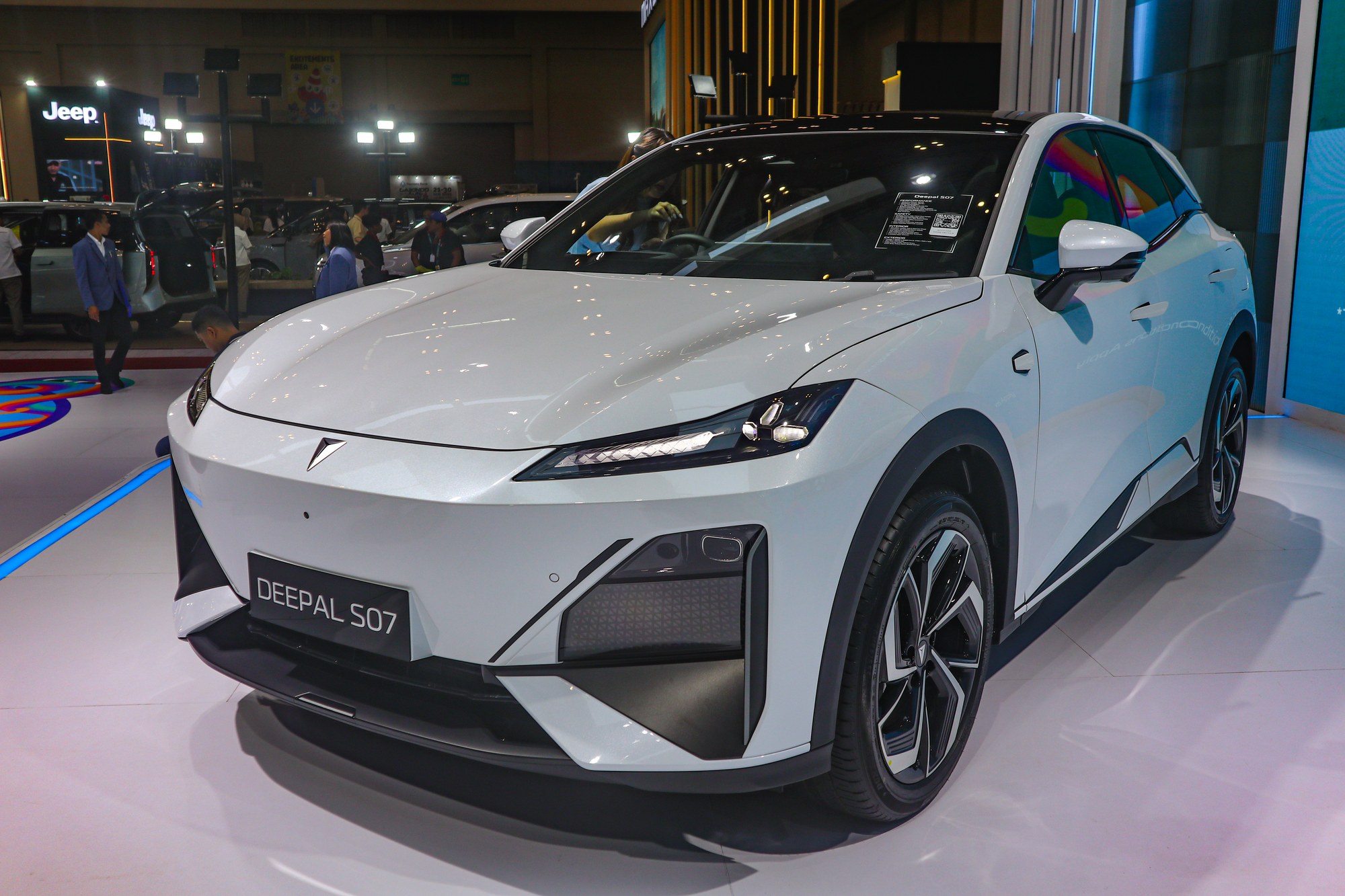

That is a big battery at a price point where most rivals are still selling 50-something kWh packs. It is also the clearest sign yet that the mid-price EV fight here is no longer just BYD, Kia, and MG.
Deepal Is Changan, and It Is Moving Fast Here
Deepal is the electric vehicle subsidiary of Changan Automobile, one of China’s oldest and largest carmakers. Changan entered the Philippines through the Autohub Group in early 2026, opened a Mandaluyong showroom by May, and launched with the S05 — P1.688 million for the battery-electric variant, P1.788 million for the range-extended one. The S07 is its second act.
The S07 was previewed in range-extended form at Deepal’s MIAS 2026 brand launch, so the bodywork is not new. What is new is the powertrain the Philippines is getting: a pure battery-electric setup in a single rear-wheel-drive variant, launched at PEVS 2026 at the SMX Convention Center in Pasay.
The Specs That Matter
Deepal’s Australian and UK homologation sheets, plus EVKX’s independent data, give the most complete picture. A few Philippine-specific numbers are still unconfirmed, and I have flagged those.
| Motor | Single permanent magnet synchronous (PMSM), rear-wheel drive |
| Power | 160 kW (218 PS) per Deepal AU/UK; Top Gear Philippines quoted 255 hp at the PH launch |
| Torque | 320 Nm |
| 0-100 km/h | 7.9 seconds |
| Top speed | 180 km/h |
| Battery | 79.97 kWh NMC (CALB); 77.57 kWh usable |
| Range | 500 km as quoted at the PH launch (cycle unspecified); 475 km WLTP per Deepal AU/UK |
| AC charging | 11 kW Type 2 (7 kW minimum), about 8 hours |
| DC fast charging | Up to 92-93 kW CCS2; 30-80% in about 35 minutes per Deepal AU |
| Vehicle-to-load | 3.3 kW / 220 V |
| Dimensions (L x W x H) | 4,750 x 1,930 x 1,625 mm |
| Wheelbase | 2,900 mm |
| Ground clearance | 145 mm (140 mm fully laden) |
| Cargo | 445 L rear + 125 L frunk; 1,385 L seats folded |
| Curb weight / GVW | 2,073 kg / 2,490 kg |
| Turning circle | 11.5 m |
| Suspension | MacPherson front / multi-link rear |
| Wheels | 19-inch alloys, 235/55 R19 GitiControl P10 |
| Display | 15.6-inch central screen; no instrument panel behind the wheel |
| Seating | 5 |
| Platform | Changan EPA1 |
Two things stand out. The battery is NMC — ternary lithium from CALB — not the lithium iron phosphate most Chinese rivals here are pushing. And Deepal’s own website lists an S7 page at a different price with 340 kW, figures that do not match the unit launched at PEVS, so confirm the final numbers with a dealer.
Pricing: P2.448M, With a P2.35M Intro Window
Deepal is asking P2,448,000 for the S07 BEV. The first 50 customers who ordered at PEVS 2026 got P2,350,000 — a P98,000 discount with a shelf life built in.
| Currency | Price |
| Philippine Peso (PHP) | P2,448,000 (official SRP); P2,350,000 introductory |
| US Dollar (USD) | about $38,470 (at 63.63 PHP/USD) |
| Indian Rupee (INR) | about Rs 36.6 lakh (at 95.07 INR/USD) |
Where does that put it? Here is the field as it stands today, drawn from earlier coverage on this site and the launch reporting.
| Model | PHP | Range |
| MG4 Urban | P1,198,888 | 403 km NEDC |
| BYD Atto 2 EV | P1,338,000 | 380 km NEDC |
| MG S5 EV | P1,448,888 | 415 km |
| XPENG L03 EV Standard | P1,548,000 | 445 km |
| FAWCAR JOYEE S04 | P1,750,000 (estimated) | 565 km CLTC |
| Kia EV3 | P1,898,000 | 511 km NEDC |
| Suzuki e-Vitara | P2,020,000 | 475 km WLTP |
| Deepal S07 BEV | P2,448,000 | 500 km claimed / 475 km WLTP |
| BYD Sealion 7 | P2,498,000 | 523 km |
Read that table carefully, because the S07’s pitch is range-per-peso. It undercuts the Sealion 7 by P50,000 while carrying a bigger battery than the Kia EV3 and the e-Vitara, and it is the only car in this group with a 79.97 kWh pack under P2.5 million. The trade-off is a thin local footprint — Autohub is still building its dealer network.
City Driving: Instant Torque, a Wide Turning Circle
The S07’s 320 Nm arrives with no hesitation, and being rear-wheel drive on a 2,900 mm wheelbase gives it a planted feel in stop-and-go crawling rather than the front-drive push some rivals exhibit.
The number to know for Makati and BGC is the 11.5 m turning circle. That is wide for a mid-size SUV, and it makes tight U-turns and basement ramps a two-move affair. Parking sensors and a reverse camera are standard, but at 4,750 mm long you will feel it in tight slots. If dense urban is your daily route, the Kia EV3 is 450 mm shorter and far easier to place, at roughly P550,000 less.
The cabin runs a 15.6-inch central screen that handles instruments and infotainment, with nothing behind the steering wheel — a clean look, but your speed lives slightly left of your natural line of sight. Leather, a panoramic sunroof, frameless windows, and a power tailgate all come standard, equipment that costs extra on most Japanese and Korean rivals.
Long-Distance Travel: Manila to Baguio, Comfortably
The claimed 500 km is almost certainly a Chinese-cycle number. Philippine coverage has already flagged that CLTC-style figures typically run 20 to 30 percent higher than EDSA-NLEX running with the aircon at full blast, and on the more conservative WLTP homologation Deepal rates the same car at 475 km.
Even pessimistically, that clears a 250 km Manila-Baguio run with room to spare, and a round trip is plausible on one charge. The 30 to 80 percent DC top-up takes about 35 minutes on a 92 kW charger. What matters more is where those chargers are — the Department of Energy counted 1,569 charging points nationwide as of March 31, 2026, and provincial coverage outside the Luzon corridor is still thin.
One honest caveat: the 15-minute fast-charge figure in some Philippine launch coverage matches the smaller LFP-pack variants sold in China and Thailand, not the 79.97 kWh NMC pack the Philippines gets. Plan on 35 minutes and you will not be disappointed.
Flooding: The 145 mm Question
This is the section that matters most here, and where the S07 asks the most of its buyer. At 145 mm — 140 mm fully laden — ground clearance is low for a crossover, and well below the Suzuki e-Vitara’s 180 mm. Deepal has published no wading depth or battery enclosure ingress-protection rating for the Philippine unit, so there is no official number to lean on.
The physics still favour you over an internal-combustion vehicle: no intake to hydrolock, no exhaust to back up. But a sealed battery pack is not a licence to wade, and 145 mm means a flooded C5 or a submerged Marikina side street is a genuine risk rather than an inconvenience. If your commute regularly turns into a wading course, this is not your car.
Heat: An NMC Pack in 36 Degree Weather
NMC chemistry carries more energy per kilogram than LFP but is less thermally forgiving. Deepal fits liquid cooling, but a 36 to 38 degree day plus a full cabin load plus highway speed is the worst case for any NMC pack.
Expect the aircon to be the biggest single consumer of your range on a hot afternoon, with the thermal management system spending some of that energy keeping the pack in its comfort zone. I walked through the broader chemistry trade-offs in my piece on why batteries might be the answer nobody is talking about — but for this car, NMC buys you capacity and performance and asks for a little more care in return.
What Others Are Saying
Top Gear Philippines covered the launch from the SMX floor, highlighting the 500 km claim and the single RWD variant. Astig took the more skeptical view, estimating a realistic 350 to 400 km in local conditions — worth keeping in mind next to the 475 km WLTP figure.
The S07 reached Thailand in late 2023 and Australia and Mexico in 2024, with Indonesia and South Africa added in late 2025. Deepal also highlights a Torino Automotive Design Award for it, and the design is a genuine strength: a 0.258 Cd drag coefficient, flush door handles, and a rear lightbar with an illuminated emblem.
The Bottom Line
The Deepal S07 BEV is neither the cheapest electric SUV here nor the safest bet for a flood-prone commute. What it is, is the most battery you can buy for under P2.5 million — 79.97 kWh of NMC, a 475 km WLTP rating, 320 Nm, and a well-equipped cabin at P2.448 million, or P2.35 million if you were among the first 50 at PEVS.
If you drive mostly city and highway, can charge at home overnight, and want range headroom rather than badge prestige, it is a compelling package. If you want more power and a bigger battery still, the BYD Sealion 7 sits just above it at P2.498 million with an 82.6 kWh LFP Blade pack.
Deepal is new here, and new brands earn trust one service appointment at a time. On paper, though, the S07 BEV just made the mid-price EV argument considerably harder for everyone else.