
Chery’s latest sub-brand is about to land in the Philippines, and it is bringing two boxy, retro-styled SUVs with very different powertrains. The iCaur V23 is a fully electric compact SUV, while the iCaur V27 is a larger range-extended electric vehicle (REEV) that pairs battery power with a gasoline generator. Both are arriving in October 2026 under Omoda & Jaecoo Philippines, and they are targeting price points that undercut most of the electrified SUV competition.
I got a chance to see both vehicles up close at a preview event in Dasmariñas, Cavite, and the first impression is that iCaur is not trying to blend in. The V23 looks like a miniature Land Rover Defender with its upright stance, circular headlights, and squared wheel arches. The V27 goes bigger and bolder, with a factory tow hitch, 21-inch wheels, and a presence that rivals the Toyota Land Cruiser Prado.
iCaur V23: The Compact Electric SUV
The V23 is the smaller of the two, measuring 4,220 mm long, 1,915 mm wide, and 1,845 mm tall, with a 2,725 mm wheelbase. It seats five and rides on 21-inch five-spoke wheels. Ground clearance is 200 mm for the RWD version and 210 mm for the AWD variant.
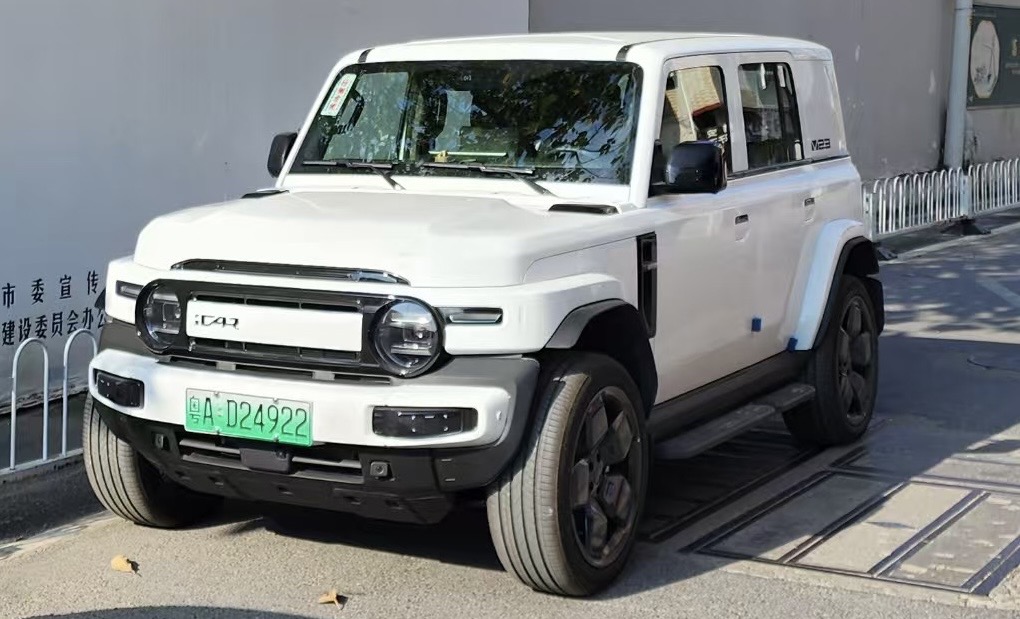

Two powertrains are on offer. The RWD uses a single rear motor producing 134 hp and 180 Nm, drawing from a 59.93 kWh lithium iron phosphate (LFP) battery that delivers up to 360 km of NEDC range. The AWD variant upgrades to dual motors with a combined 207 hp and 292 Nm, powered by an 81.8 kWh nickel manganese cobalt (NCM) battery good for up to 430 km of NEDC range. At the preview event, iCaur claimed the AWD could stretch to 501 km under ideal conditions.
Inside, the V23 keeps things simple. A 15.4-inch central touchscreen serves as the control center for most vehicle functions, including the 540-degree camera system. There is no traditional instrument cluster, which takes some getting used to. Trunk space is a modest 234 liters, though the rear seats fold 50/50 to expand cargo capacity to 744 liters.
iCaur V27: The Range-Extended Flagship
The V27 is a different beast entirely. At 5,045 mm long, 1,976 mm wide, and 1,894 mm tall, it competes in the midsize SUV segment with a 2,900 mm wheelbase and 220 mm of ground clearance. It also seats five, but the interior feels significantly more premium than the V23.
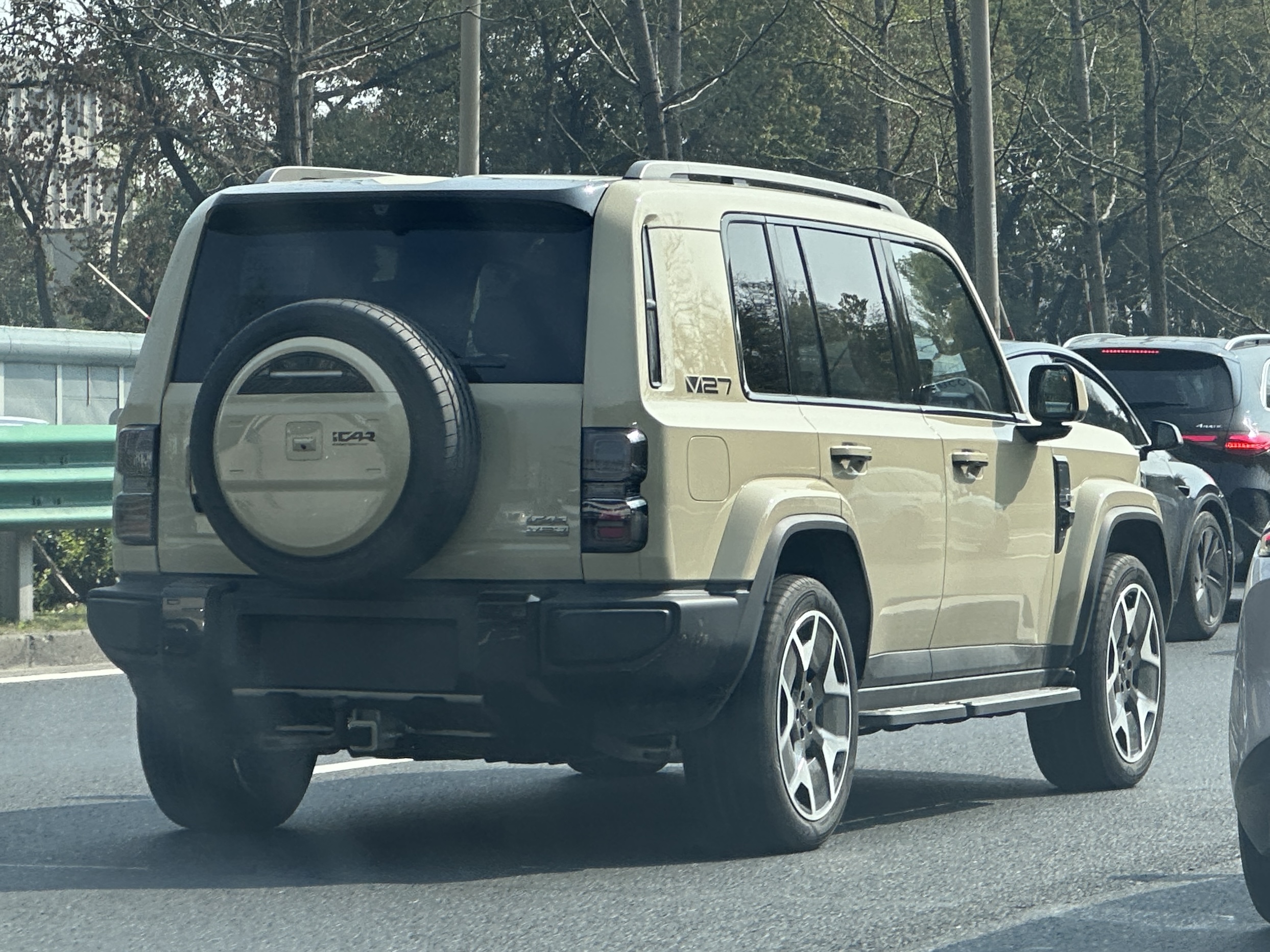

The V27 uses what iCaur calls the Golden REEV powertrain. A 1.5-liter turbocharged gasoline engine producing 143 hp acts solely as a generator, charging the battery pack. It never drives the wheels directly. The RWD variant uses a 20.4 kWh LFP battery with a single rear motor making 248 hp and 300 Nm. The AWD variant upgrades to a 34.3 kWh LFP battery with dual motors producing a combined 449 hp and 505 Nm.
Electric-only range is 95 km (NEDC) for the RWD and 150 km (NEDC) for the AWD. With the 60-liter fuel tank, the combined range stretches to 1,100 km for the RWD and 1,000 km for the AWD. That is the kind of number that eliminates range anxiety entirely, at the cost of carrying a gasoline engine you will eventually need to refuel.
The V27 also gets an 8.88-inch digital instrument cluster, a 15.4-inch central touchscreen, a 15-speaker Pioneer sound system, and a factory-fitted tow hitch with a towing capacity of up to 1.6 tons. The suspension uses front struts and a rear multi-link setup, riding on 265/45 R21 Goodyear Eagle F1 SUV tires.
Specifications at a Glance
| Specification | iCaur V23 RWD | iCaur V23 AWD | iCaur V27 RWD | iCaur V27 AWD |
|---|---|---|---|---|
| Powertrain | BEV | BEV | REEV | REEV |
| Motor Output | 134 hp / 180 Nm | 207 hp / 292 Nm | 248 hp / 300 Nm | 449 hp / 505 Nm |
| Battery | 59.93 kWh LFP | 81.8 kWh NCM | 20.4 kWh LFP | 34.3 kWh LFP |
| EV Range (NEDC) | 360 km | 430 km | 95 km | 150 km |
| Combined Range | 360 km | 430 km | 1,100 km | 1,000 km |
| Engine | None | None | 1.5L turbo (generator) | 1.5L turbo (generator) |
| Fuel Tank | None | None | 60 L | 60 L |
| Drive | RWD | AWD | RWD | AWD |
| Length | 4,220 mm | 4,220 mm | 5,045 mm | 5,045 mm |
| Width | 1,915 mm | 1,915 mm | 1,976 mm | 1,976 mm |
| Height | 1,845 mm | 1,845 mm | 1,894 mm | 1,894 mm |
| Wheelbase | 2,725 mm | 2,725 mm | 2,900 mm | 2,900 mm |
| Ground Clearance | 200 mm | 210 mm | 220 mm | 220 mm |
| Wheels | 21-inch | 21-inch | 21-inch | 21-inch |
| Seating | 5 | 5 | 5 | 5 |
Pricing and Variants
iCaur has not announced official Philippine SRP yet, but Omoda & Jaecoo Philippines Vice President Weijia Luo shared a target range during a media briefing: the V23 is aimed at PHP 1.6 to 1.9 million, while the V27 is targeted at PHP 2.2 to 2.6 million. These are tentative figures and could shift by launch day.
At those price points, the V23 would undercut the Tesla Model Y L (PHP 2.849M) by nearly a million pesos and the Denza Z9 GT by an even wider margin. The V27, meanwhile, would sit below the Jaguar Type 01 (estimated PHP 8-10M if it arrives) and the Mazda CX-80 PHEV, while offering more power and range than both.
Here is how the target pricing converts at current exchange rates (62.99 PHP/USD, 96.95 INR/USD as of October 9, 2026):
| Model | PHP (Target) | USD (Approx.) | INR (Approx.) |
|---|---|---|---|
| iCaur V23 (entry) | PHP 1,600,000 | $25,400 | ₹24.6 lakh |
| iCaur V23 (top) | PHP 1,900,000 | $30,200 | ₹29.2 lakh |
| iCaur V27 (entry) | PHP 2,200,000 | $34,900 | ₹33.9 lakh |
| iCaur V27 (top) | PHP 2,600,000 | $41,300 | ₹40.0 lakh |
Philippine Driving Conditions: What to Expect
City Driving
The V23 is the better city car. Its compact dimensions make it easier to navigate tight parking lots in Makati and BGC, and the instant torque from the electric motor makes stop-and-go traffic on EDSA less draining. The 21-inch wheels, however, will transmit every pothole and speed bump directly into the cabin. The V27, at over 5 meters long, is a different proposition in the city. It is manageable, but you will feel its length on narrow side streets and in crowded parking structures.
Long-Distance Travel
This is where the V27 shines. With over 1,000 km of combined range, you can drive Manila to Baguio (roughly 250 km) and back without refueling or recharging. Even the V23 AWD, with 430 km of NEDC range, handles the same round trip comfortably. For longer trips to Legaspi or Ilocos, the V27’s generator means you never have to plan around charging stations. The V23, meanwhile, will need a DC fast charge stop on routes beyond 300 km.
Flooded Situations
Ground clearance is a mixed bag. The V23 RWD sits at 200 mm, which is respectable but not class-leading. The V27’s 220 mm is better, though still not in the same league as a true off-roader. Neither vehicle has a published wading depth, which is a significant gap for a market where monsoon flooding is a regular occurrence. The sealed battery packs should handle water exposure better than a combustion engine’s air intake, but I would not wade through anything deeper than the bottom of the wheel rims without more data.
High Temperature
The V27’s LFP battery chemistry is inherently more thermally stable than the NCM pack in the V23 AWD. LFP cells are less prone to thermal runaway in the 36-38°C heat we experience from March to May. The V23 RWD also uses LFP, which is a smart choice for our climate. The V23 AWD’s NCM pack will rely more heavily on the battery thermal management system, and that system will be working harder during summer months. Neither vehicle has published cooling system specifications, so this remains an open question until we get real-world data.
What Others Are Saying
Coverage of the iCaur preview event has been positive but cautious. RideBuy.ph noted the V27’s “impressive power figures” and “premium interior” but flagged the lack of official pricing as the biggest unknown. The Manila Times highlighted the V23’s “rugged, boxy appearance” and the V27’s “off-road-inspired styling” as key differentiators in a crowded market. Top Gear Philippines reported that both models will be offered in three variants each, with the V23 getting Classic, Premium, and Luxury trims, and the V27 getting Flagship as its top tier.
The Bottom Line
iCaur is entering the Philippine market with a clear value proposition: rugged design, serious power, and pricing that undercuts the competition by a wide margin. The V23 is the city-friendly electric option, while the V27 is the long-distance, do-everything family SUV that happens to be electrified. Neither vehicle is perfect, the lack of published wading depths and cooling specs being the most obvious gaps, but at these target prices, they are hard to ignore.
If Omoda & Jaecoo can deliver on their pricing targets and build out a service network to match, iCaur could carve out a real following in the Philippine EV market. The Kia PV5 Cargo is arriving the same month with a commercial focus, and the Geely Monjaro EM-i is targeting the same midsize SUV segment. October is shaping up to be a very busy month for electrified vehicles in the Philippines.