
Two years after that controversial rebrand — you know the one, the “Copy Nothing” campaign that divided the internet — Jaguar has finally pulled the covers off the car that proves they were serious. The Type 01 is a four-door electric grand tourer, the first production model built on Jaguar’s dedicated Electric Architecture (JEA), and at 1,015 horsepower, it’s the most powerful road car the British marque has ever built.
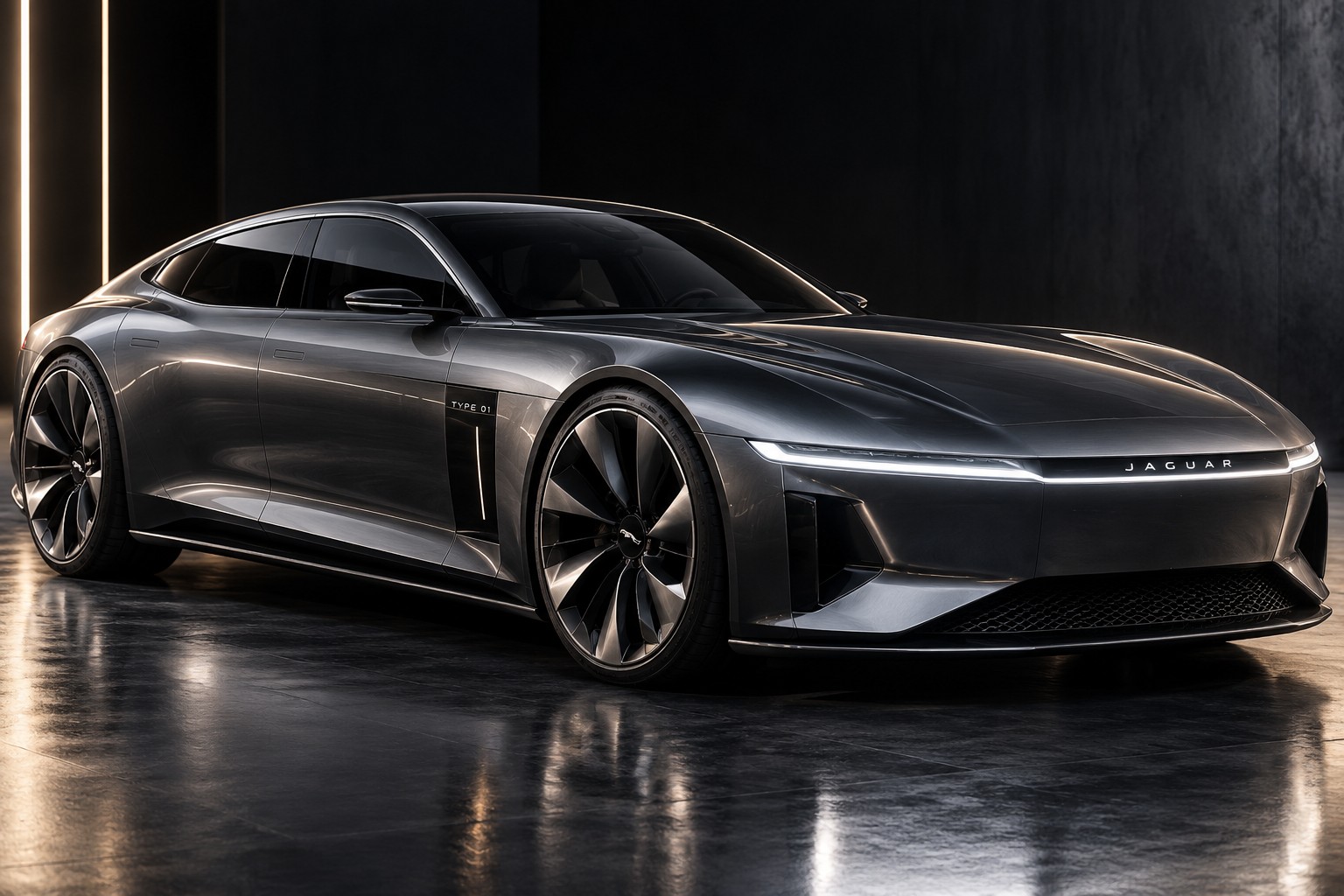
Unveiled in New York on October 7, 2026, the Type 01 is a dramatic statement of intent. It’s low, wide, and unapologetically bold — a fastback with an ultra-long bonnet, frameless doors, and a camera instead of a rear window. But the real question for us in the Philippines is simpler: should Jaguar bring it here?
What Is the Jaguar Type 01?
The Type 01 is a four-door, four-seat grand tourer that rides on 23-inch wheels and has a drag coefficient of just 0.23 — the lowest ever for a Jaguar road car. Under the skin, it’s powered by three electric motors: one at the front producing 260 kW and two at the rear producing 310 kW each, for a combined 758 kW (1,015 hp) and 1,365 Nm of torque. The battery is a 118 kWh usable NMC pack running on an 850-volt architecture.
The numbers are staggering. Zero to 100 km/h in 3.2 seconds. A further 4.0 seconds to go from 100 to 180 km/h. A top speed of 250 km/h. This is a car that out-accelerates most supercars while seating four adults in individual chairs separated by brass-effect anodized aluminum finishers.
Specifications
| Motor | Tri-motor AWD (1 front + 2 rear) |
| Combined Power | 758 kW (1,015 hp / 1,030 PS) |
| Torque | 1,365 Nm |
| Battery | 118 kWh usable (120 kWh gross) NMC |
| Architecture | 850 V |
| Range (WLTP) | Up to 720 km |
| DC Charging | 350 kW, 10-80% in ~22 min |
| AC Charging | 19.2 kW |
| 0-100 km/h | 3.2 seconds |
| Top Speed | 250 km/h |
| Length | 5,235 mm |
| Height | 1,403 mm |
| Wheels | 23-inch |
| Drag Coefficient | 0.23 |
| Battery Warranty | 8 years / 100,000 miles |
Pricing
The Type 01 starts at $130,500 in the United States and £120,000 in the United Kingdom. Orders open in early 2027, with first deliveries in the second half of 2027. Using the BSP reference rate of 62.75 PHP/USD as of October 8, 2026:
| Currency | Price |
| USD (US MSRP) | $130,500 |
| PHP (converted) | ~₱8,190,000 |
| INR (converted) | ~₹124 lakh |
These are estimates based on US pricing. Jaguar has not announced Philippine availability, and the Type 01 would likely carry a premium over the US figure if it arrives here — import duties, taxes, and our market’s luxury vehicle surcharges would push it well past ₱10 million.
Philippine Driving Conditions
City Driving
Here’s where the Type 01 gets complicated for Manila. At 5,235 mm long and just 1,403 mm tall, this is an extremely low-slung car. The air springs can drop it further at speed. Ground clearance hasn’t been published, but a car this low will struggle with the speed bumps, potholes, and steep driveways that define Philippine urban driving. The 23-inch wheels won’t help — they’re beautiful on a smooth New York street but punishing on EDSA’s patched-up surface.
On the plus side, the instant torque from the tri-motor setup would make stop-and-go traffic effortless. The rear-wheel steering would help with tight U-turns. And the 850-volt architecture means you could top up at a DC fast charger during a lunch break.
Long-Distance Travel
The 720 km WLTP range is more than enough for a Manila-to-Baguio run (roughly 250 km). Even with air conditioning running at full blast in our heat, you’d comfortably make it on a single charge. The 350 kW DC charging means a 20-minute stop adds 321 km of range — enough to get you to your destination with margin to spare.
The real question is charging infrastructure. The Philippines had 1,876 registered EV charging stations as of the end of August 2026, but they’re concentrated in Metro Manila and major cities. A Type 01 road trip to, say, Ilocos or Bicol would require careful planning.
Flooding
This is the elephant in the room. The Type 01 is a low-slung grand tourer — the opposite of what you want in a flooded street. Jaguar hasn’t published a wading depth or IP rating for the battery pack, but a car that sits this low will be the first to stall in a heavy downpour. The battery pack is in the floor, which helps, but the electronics and motors are still vulnerable.
For context, the Porsche Cayenne Electric — another luxury EV that just launched here — has adaptive air suspension that can raise the car for flood clearance. The Type 01’s air springs are designed to lower at speed, not raise for wading. This is a fundamental mismatch with Philippine conditions.
Heat
The 850-volt architecture and NMC battery chemistry are well-suited to high temperatures. Jaguar’s thermal management system moves energy between the cabin and battery to cool the cabin in hot weather — a feature that would be welcome in 36-38°C Manila summers. The liquid-cooled battery should handle our climate better than air-cooled alternatives.
But the 23-inch wheels and low profile mean less rubber between you and the road. Tire temperatures in Philippine heat, combined with the car’s performance envelope, would demand premium tires — and replacement costs for 23-inch rubber aren’t cheap.
The Philippine Luxury EV Market
The Type 01 would enter a market that’s heating up fast. The Porsche Cayenne Electric just launched on October 7 with 408 hp and a 113 kWh battery. The BMW iX3 50 xDrive offers 469 hp and up to 805 km of range. The Tesla Model Y L gives you three rows and 681 km of range for ₱2.849 million. And the Denza Z9 GT is now taking reservations as BYD’s luxury play.
At an estimated ₱8-10 million, the Type 01 would sit above all of these — closer to the Porsche Taycan or Mercedes EQS territory. That’s a narrow niche in the Philippines, but it’s one that exists. The question is whether Jaguar’s brand cachet, still recovering from the rebrand controversy, is strong enough to justify the premium.
Should Jaguar Bring the Type 01 to the Philippines?
Honestly? I’d love to see it here. The Philippine EV market has matured past the “compliance car” phase — buyers are now choosing EVs on their merits, not just for coding exemptions. A halo car like the Type 01 would give Jaguar Philippines something to talk about beyond the F-Pace and E-Pace.
But the practical concerns are real. The low ground clearance, the unproven after-sales network for a brand still rebuilding its reputation, and the eye-watering price tag all work against it. If Jaguar is smart, they’d bring it as a low-volume halo — a few dozen units for collectors and enthusiasts who want something different from the usual German and American luxury EVs.
The Type 01 is a statement car. It says Jaguar is back, and it’s not playing it safe. Whether that statement resonates in a market where a battery’s thermal stability matters more than a 0.23 drag coefficient — that’s a different question entirely.