
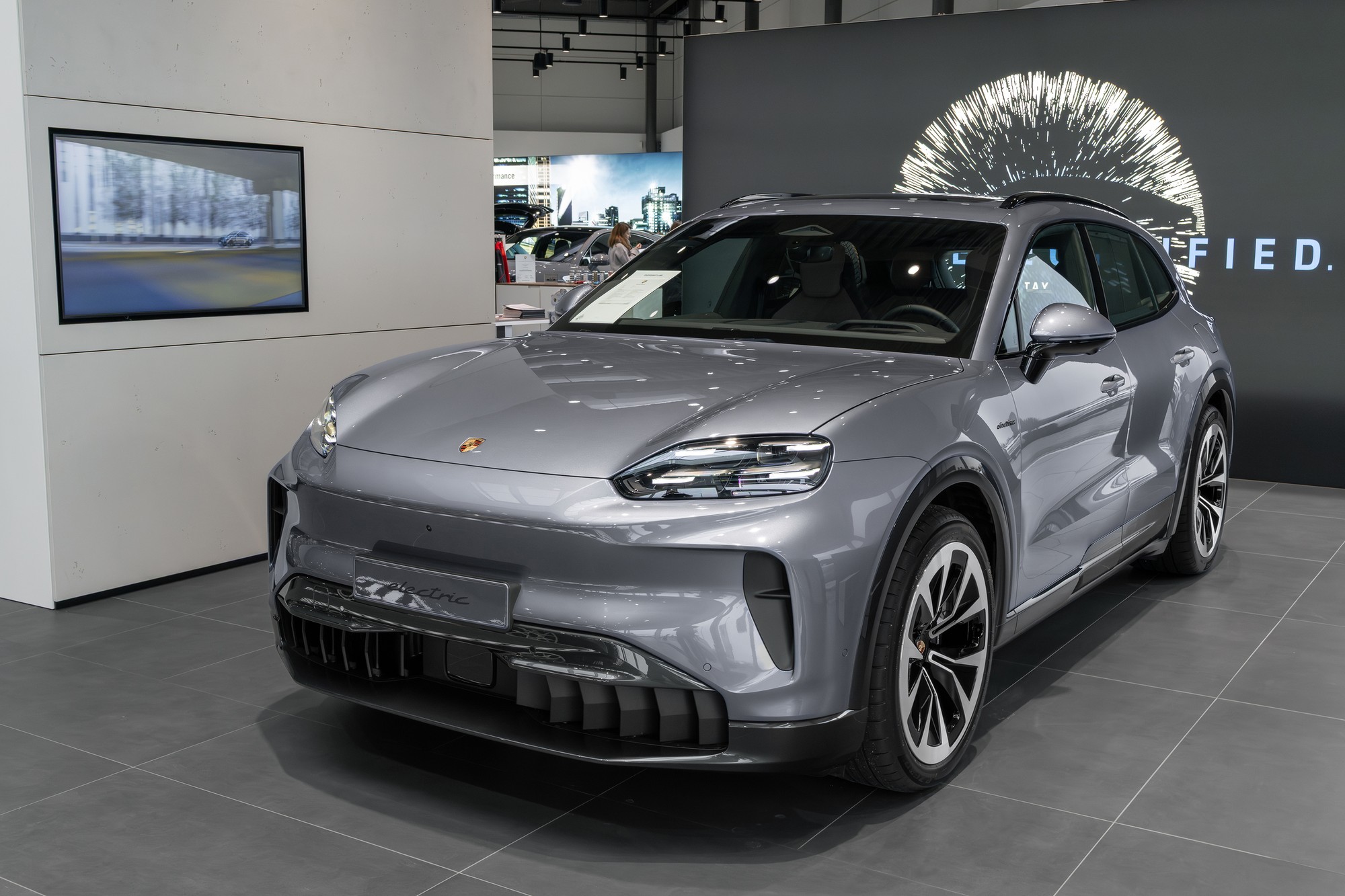
Porsche Philippines just celebrated 30 years with a pair of special 911s. But the car that might matter more for the brand’s electric future quietly showed up on the Department of Energy’s recognized EV list this month: the all-new Cayenne Electric.
.jpg)
The DOE added both the Cayenne Electric and the more powerful Cayenne Turbo Electric as 2026 model year vehicles back on August 4. For Porsche watchers, that’s the same pre-launch signal we’ve seen with the Kia EV3, the BMW iX3, and the Nissan Primera EV — the listing usually means a reveal is close.
Porsche Cayenne Electric specs at a glance
The Cayenne Electric made its regional debut at the Bangkok International Motor Show earlier this year, and it’s a completely different vehicle from the gas Cayenne still on sale. Think of it as a taller, roomier Macan Electric — a dedicated EV on a stretched platform, not a converted SUV.
| Spec | Porsche Cayenne Electric (PH listing) |
| Body | Luxury mid-size electric SUV, 4,985 x 1,980 x 1,680 mm |
| Wheelbase | 3,023 mm |
| Motor | Dual electric motors, all-wheel drive |
| Power (base) | 408 PS, up to 442 PS with Launch Control |
| Power (Turbo) | 857 PS, up to 1,156 PS with Launch Control |
| Torque | 835 Nm (base) / 1,500 Nm (Turbo, Launch Control) |
| Battery | 113 kWh gross (108 kWh usable) |
| Range | Up to 642 km WLTP (623 km Turbo); ~520-530 km real-world |
| DC fast charge | Up to 400 kW, 10-80% in ~16 min; +300 km in 10 min |
| AC charge | Up to 22 kW |
| 0-100 km/h | 4.8s (base) / 2.5s (Turbo) |
| Top speed | 230 km/h (base) / 260 km/h (Turbo) |
| Charge ports | NACS (Tesla-compatible) + home port, one per rear fender |
| Suspension | Adaptive air suspension standard; rear-axle steering optional |
| Towing | Up to 7,700 lbs (~3,500 kg) |
| Cargo | ~780 L behind rear seats + 3.2 cu ft frunk |
| Ground clearance | Not officially published — air suspension adjusts ride height |
That 1,156-PS Turbo figure makes the Cayenne Turbo Electric the most powerful production Porsche ever built — it beats the 918 Spyder and the Taycan Turbo GT. Cars.com called it exactly that when the car debuted, and early tests back up the madness: Car and Driver timed the Turbo to 60 mph in 2.1 seconds and a 9.5-second quarter mile.
What others are saying
Edmunds’ first drive review of the Cayenne Electric was glowing but honest. Reese Counts wrote that “Porsche has built an excellent premium electric SUV” — agile for its size thanks to rear-axle steering, with a 328-mile (528 km) informal range result and fast charging. His main gripe: air vent controls buried inside the touchscreen, which I’m guessing will annoy just about everyone, Filipino drivers included.
MotorTrend titled their review “Physics May Have Met Its Match” and came away impressed that a 5,850-pound SUV corners pancake flat. They also noted Porsche claims up to 600 kW of regenerative braking, with roughly 97 percent of normal braking handled by the electric motors alone — that’s a huge deal for pad and rotor life.
Car and Driver summed it up in their usual blunt way: “Brilliant ride-handling balance, quality interior with advanced tech, Turbo’s vision-blurring acceleration. LOWS: Pricing that will bring tears to your eyes.”
Price in PHP, USD, and INR
There’s no Philippine SRP yet, so everything below is either official US pricing or clearly labeled estimates. The base Cayenne Electric starts at $111,350 in the US, the Cayenne S Electric at $128,650, and the Turbo Electric at $165,350. In the UK it’s £83,200; in Germany, around €105,200.
| Market | Price (base) | Notes |
| United States | $111,350 | Official MSRP |
| Philippines | P11-13M (estimate) | Est. landed price incl. taxes |
| India | ~Rs 1.9 crore (estimate) | Based on PH estimate |
For context: $111,350 converts to about P6.83 million at current rates (61.34 PHP/USD) — but that’s before Philippine duties, excise, and PGA Cars’ typical luxury markup. Expect the base to land somewhere between P11 and P13 million when it arrives, with the Turbo well above P16 million. I’ll update this the moment there’s an official SRP.
How does that compare with the premium EV field? The DOE-listed BMW iX3 50 xDrive is projected around P4.9-5.5M, and the LTO-cleared Lexus RZ 600e F Sport at roughly P5.7-6.2M. The Cayenne Electric sits in a class above both — it’s closer in spirit to the BMW iX or Mercedes EQS SUV territory, though those aren’t formally here yet.
Is the Porsche Cayenne Electric right for the Philippines?
City driving
Honest answer: this is a big, heavy SUV for EDSA and Makati. The 5,700-5,850 lb curb weight is real, and parking in BGC or Greenhills will need some care despite the standard 360-degree cameras. That said, the rear-axle steering tightens the turning circle noticeably, and the air suspension can lower the body for easier entry. Range is a non-issue — a week of Metro Manila commuting on one charge is easy math.
Long-distance travel
This is where the Cayenne Electric shines. Manila to Baguio is about 250 km; the Cayenne does that with more than half its range to spare. Even Manila to Vigan (~400 km) is a single-charge trip for the base model in normal conditions. And when you do stop, 400 kW charging adds roughly 300 km in 10 minutes — a coffee break on the NLEX is genuinely all you need. The Nissan Primera EV and other Chinese-market arrivals are chasing the same long-range story, but few will match this charging curve.
Flooded streets
This is the big one for Filipino buyers, and it’s mixed news. The air suspension raises the ride height in Off-Road mode — Porsche says total vehicle height can go as high as 1,735 mm, which implies serious ground clearance when raised. The underfloor battery is sealed, and there’s no engine to hydrolock, which is a genuine EV advantage. But Porsche hasn’t published an official clearance figure, so treat the wheel-center rule as law: if the water looks deep, don’t test it. No EV is a submarine, no matter how German the engineering is.
High temperatures
The 113 kWh pack uses active liquid cooling, and the fact that Porsche confidently quotes 400 kW charging means the thermal management is serious — you don’t sustain those charge rates without it. Expect some real-world range loss in our 36-38 degree summers when the aircon is fighting the heat, same as every EV. The 0.25 drag coefficient helps at highway speeds, and if battery tech is something you geek out about, I’ve written before about why battery chemistry and thermal management matter so much in this climate.
The charger question
Here’s the sleeper feature: the Cayenne Electric has two charge ports, one per rear fender — a NACS port (Tesla Supercharger compatible) and a standard home-charging port. That means access to the growing Supercharger network in the Philippines, which is a real edge over CCS-only rivals. At 22 kW AC, an overnight charge at home fills the pack comfortably; a 400 kW DC stop does the rest on long trips.
Bottom line
Let’s be clear-eyed about this one: the Cayenne Electric is a halo car, not a volume play. Most Filipino households are shopping the Chery QEV and BYD Seagull end of the market — that’s where the real EV adoption is happening, and it’s exciting in its own way. But the Cayenne’s arrival matters beyond the people who can actually afford it. It tells us the premium segment is going electric here, that the DOE listing pipeline is working, and that Porsche — the most conservative of the German brands — sees a future for big, fast EVs in the Philippines.
If you’ve got the budget and you want your electric SUV to also embarrass a 911 Turbo at the lights, this is the one to wait for.