
Some names you just don’t expect to see again. The Nissan Primera is one of them. For Filipinos who grew up in the nineties, the Primera was that understated mid-size sedan your tito swore by, the one that felt a notch above the Camry and Accord crowd without demanding the same attention. It quietly disappeared after three generations, and nobody really expected it back. Then the Department of Energy dropped a name on its recognized EV list that made car people do a double take: Nissan Primera EV.
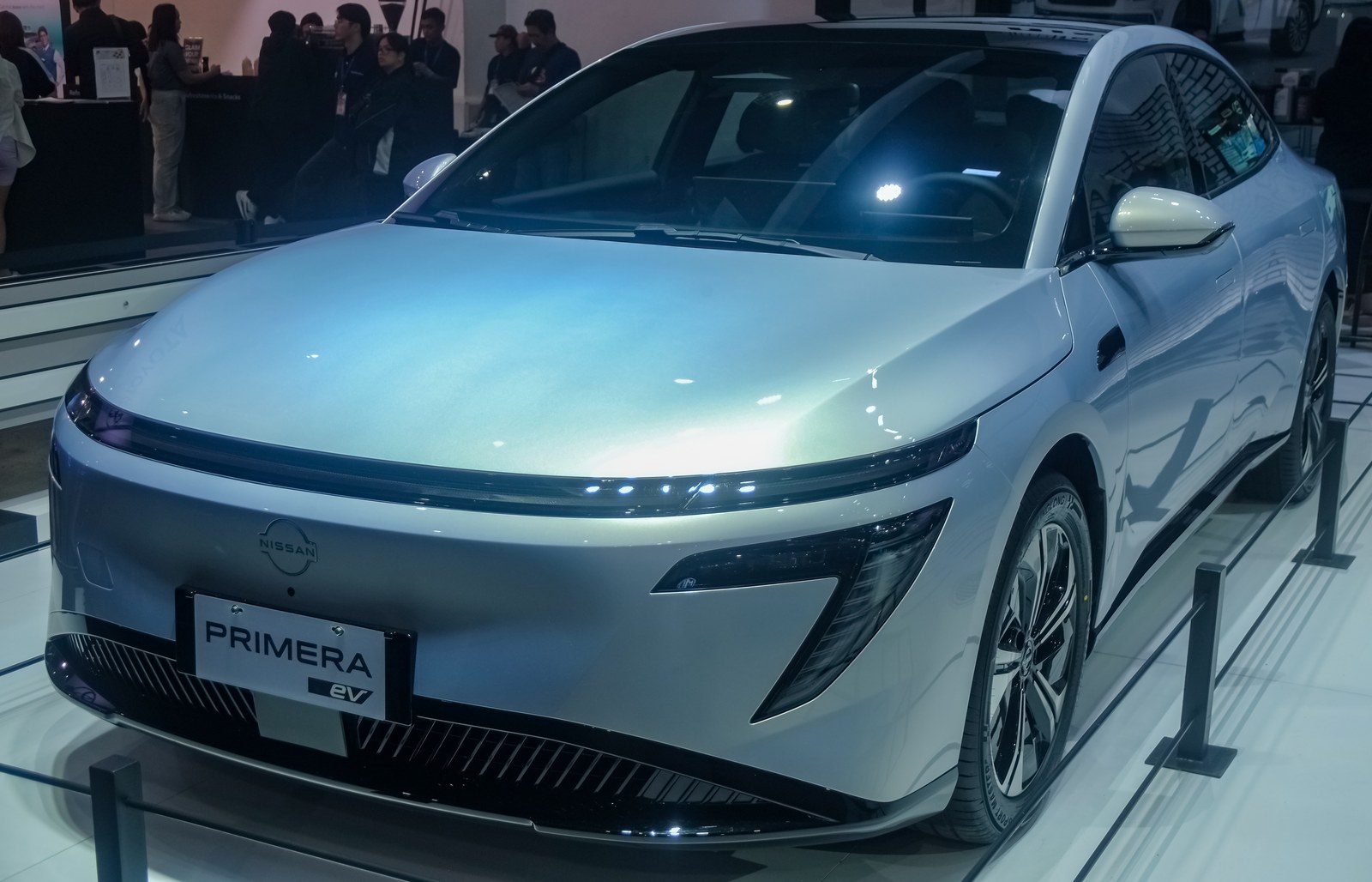

Yes, Nissan is bringing the Primera nameplate back in the Philippines — and it’s coming back as a fully electric sedan built in China. The new Primera EV is the local version of the Dongfeng Nissan N7, an electric mid-size sedan that’s been selling surprisingly well in China since its April 2025 launch. And the Philippines is the first market outside China where Nissan will sell it. That’s a bigger deal than it sounds, because it also makes Nissan the first Japanese brand in the country to import vehicles from China.
Why the Primera Name Matters
The original Primera spanned three generations from the early nineties to the mid-2000s, sold as a sedan, a wagon, and a liftback. It was Nissan’s answer to the family sedan segment in Asia and Europe, known for solid build quality and a slightly sportier character than its rivals. For a generation of Filipino drivers, it was the car that felt “imported” even when it was everywhere.
Reviving that name for a battery-electric sedan is a clever bit of brand strategy. Old nameplates carry emotional weight that a fresh model name can’t buy, and Nissan Philippines clearly wants the Primera EV to feel familiar even as it pushes the brand into unfamiliar territory: selling China-made EVs locally.
Nissan Primera EV Specs (PH DOE-Listed Variant)
The Department of Energy listing spells out the Philippine variant’s key numbers. It measures 4,930 mm long, 1,895 mm wide, and 1,487 mm tall, riding on a 2,915 mm wheelbase — squarely in Camry territory, edging out the current Camry’s footprint by a hair. Gross vehicle weight lands near 2,300 kg.
| Specification | Nissan Primera EV (PH variant) |
|---|---|
| Body | Mid-size electric sedan, 5 seats |
| Dimensions | 4,930 x 1,895 x 1,487 mm |
| Wheelbase | 2,915 mm |
| Motor | Single electric motor (front), 218 PS / 305 Nm |
| Battery | 60 kWh lithium-ion |
| Range | Up to 500 km per charge (DOE listing) |
| Charging | CCS2 (AC + DC fast charging) |
| Drive type | Front-wheel drive |
| Wheels | 19-inch alloy wheels |
| Infotainment | 15.6-inch touchscreen, Apple CarPlay, Android Auto |
| Driver assist | ProPilot semi-autonomous driving |
| Other features | Full LED lights w/ sequential signals, leather upholstery, 12-speaker audio, panoramic sunroof |
For context, the China-market N7 comes in two battery flavors: a 58 kWh pack good for 510-540 km and a 73 kWh pack rated at 625-635 km under CLTC. The Philippine DOE listing shows a 60 kWh pack with up to 500 km of range, which sits between the two — a sensible middle ground for a market still building out its fast-charging network.
Price in PHP, USD, and INR
Here’s the honest part: Nissan Philippines has not announced a local price yet. The Primera EV was shown at the Philippine International Motor Show in June as a preview, with the official launch targeted for the fourth quarter of 2026. So what we have are the China prices, plus a reasonable estimate for local pricing.
| Market / Estimate | PHP | USD | INR |
|---|---|---|---|
| China N7 entry (RMB 119,900) | ~P1,000,000 | ~$16,450 | ~Rs 15.7 lakh |
| China N7 top (RMB 149,900) | ~P1,270,000 | ~$20,900 | ~Rs 19.9 lakh |
| PH estimate (my projection) | P1.9M – P2.3M | ~$31,200 – $37,800 | ~Rs 29.8 – 36.1 lakh |
My projection is based on what rivals already cost here. The Tesla Model 3 now starts at P1.838 million, the BYD Seal Advanced sits at P1.998 million, and the Geely EX5 electric SUV is P1.799 million. A Nissan with a 60 kWh pack, 500 km of claimed range, and ProPilot tech would reasonably slot in that P1.9-2.3 million band. Take that as an estimate, not a promise — Nissan could surprise us on either side. Rates used: ~60.8 PHP/USD and ~95.4 INR/USD (August 2026).
What Others Are Saying
AutoIndustriya was first to flag the DOE listing back in April, noting the revived nameplate and the “lounge on wheels” interior with its 15.6-inch screen, 12-speaker sound, leather upholstery, and panoramic sunroof. Top Gear Philippines ran with the same paperwork, pointing out that the new Primera’s dimensions put it in the same class as the Tesla Model 3 and the Mazda 6e.
When Nissan unveiled it at PIMS 2026 in June, the reaction was mostly pleasant surprise. Paul Tan’s Automotive News confirmed the local models are based on China’s N7 and Frontier Pro, with a market launch expected around the fourth quarter. Electrive highlighted the strategic significance: the Philippines is the first overseas market for the China-made N7, part of Nissan’s “From China” export strategy that positions China as a global hub for innovation and exports.
There’s also momentum behind the donor car itself. CarNewsChina reported the N7 hit 10,000 deliveries in just 45 days in China, competing directly with the Xpeng Mona M03 at a similar price point. Chinese buyers have voted with their wallets; now we’ll see how Filipino buyers respond to a Japanese badge on Chinese bones.
How It Stacks Up Against the Competition
| Model | Type | Price |
|---|---|---|
| Nissan Primera EV | BEV sedan, 500 km | P1.9M – P2.3M (est.) |
| Tesla Model 3 | BEV sedan | P1,838,000 |
| BYD Seal Advanced | BEV sedan, 61 kWh | P1,998,000 |
| Geely EX5 | BEV SUV, 60 kWh | P1,799,000 |
| Lexus ES 350e | Luxury BEV sedan | From P4.108M (ES range) |
The Primera EV’s real fight is against the Model 3 and BYD Seal for the electric-sedan buyer’s peso. If Nissan prices it under P2 million, it becomes a serious alternative to the Model 3 — with a bigger cabin, more physical switchgear, and the ProPilot suite. The Lexus ES 350e that just launched this month targets a completely different, far pricier segment, so they’re not direct rivals despite both being EV sedans.
Filipino Driving Conditions: The Real Test
City driving
This is where the Primera EV should shine. Five hundred kilometers of range means EDSA traffic, Makati stop-and-go, and BGC errands won’t even dent the battery meaningfully. A typical Metro Manila commuter covers maybe 40-50 km a day, so a full charge would last a week and a half of pure city driving. The instant torque also makes merging and overtaking on cramped avenues far less stressful than in a gas sedan.
The one caveat is size. At 4.93 meters, the Primera EV is a big car for Philippine parking. Tight basement parking in old Makati buildings and narrow provincial streets will test your patience. If you’re used to the compact dimensions of a city EV like the VinFast VF 2, this is a very different kind of vehicle — a proper family sedan with the footprint to match.
Long-distance travel
The claimed 500 km range makes Manila-Baguio (~250 km one way) comfortably doable on a single charge, even with the climb and air conditioning running. Same for Manila to Batangas, Subic, or La Union. The CCS2 charging support means you can use the growing fast-charging network from ACMobility and other operators along major routes.
Real-world range will land lower than the claim — expect 400-450 km in mixed driving — but that’s still more than enough for weekend trips. Charging stops become a coffee break rather than a planning headache. If the N7’s 3C fast-charging tech carries over, the China spec can go from 10 to 80 percent in about 19 minutes on a suitable DC charger, which is genuinely quick for this class.
Flooded situations
The Philippines’ monsoon reality means flood resistance matters. Here’s where an EV actually has an advantage: no engine air intake means no hydrolock, and the battery pack sits sealed under the floor. But a low-slung sedan like the Primera EV still shouldn’t wade through deep water — the practical rule is don’t drive through anything deeper than the bottom of the doors, same as any car.
The N7’s LFP battery chemistry (in the China spec) is generally considered more stable and heat-tolerant than NMC packs, which is a plus in a country that sees 36-degree days and flooded streets in equal measure. Nissan has decades of experience selling the Leaf globally, so the thermal and battery safety engineering should be solid.
High temperature conditions
Philippine heat is relentless, and it affects EVs in two ways: battery performance and air conditioning load. LFP chemistry degrades slower in heat than NMC, which matters for long-term battery health in tropical climates. The 60 kWh pack with 500 km of range gives enough headroom that running the AC hard in 38-degree traffic won’t wreck your range anxiety — you’d still have 400+ km on a full charge.
If you’re weighing battery chemistry and heat behavior, it’s worth remembering the bigger picture around energy storage — I wrote about why batteries are quietly becoming the backbone of everything from EVs to AI data centers, and the same thermal physics applies to both.
Should You Wait for It?
If you’re in the market for an electric sedan and can wait until the fourth quarter, the Primera EV is worth putting on your shortlist. It brings a trusted Japanese badge, a proven China-market platform, and class-leading range to a segment currently dominated by Tesla and BYD. The Nissan dealership network is also far more established than most EV-only brands, which matters for service and parts.
The big open questions are price and final local specifications — Nissan has yet to confirm whether the PH unit gets the N7’s full tech suite, and the exact trim lineup. Keep an eye on the DOE recognized EV list; that’s where the brand’s next electrified moves, like the Navara Pro PHEV that’s also slated for a Q4 launch, show up first. The same list is how we spotted the JAECOO J8 PHEV and other China-made electrified models arriving this year.
For a nameplate that’s been dormant for nearly two decades, the Primera is making one heck of a comeback — and it’s fitting that it returns as an EV, at the exact moment the Philippine market is finally taking electric cars seriously. This is the same market shift that’s brought us everything from the MG G50 PHEV and MG4 Urban to the flood of China-made EVs we covered this week, and Nissan just made its intentions clear: they’re all in.