
Xiaomi 18 Pro Max Review: The Global Version Explained
The Xiaomi 18 Pro Max arrived in China in late September with a number that made the spec sheets sit up: an 8,500mAh silicon-carbon battery, the largest ever stuffed into a flagship Android phone. It also carried a second screen on the back, twin 200MP Leica cameras, and the Snapdragon 8 Elite Extreme Gen 6. On November 17, it goes global in Paris.
But the phone that lands in European and international stores is not the same phone that Chinese reviewers have been testing. The global unit’s battery is 17% smaller, and the price is far higher. If you have been reading the Chinese reviews and saving up, you need to read this first.
Confirmed vs Unconfirmed: The Global Unit
Xiaomi has confirmed the global launch date and the headline features. Almost everything else about the international hardware comes from regulatory filings and retailer listings. Here is where things stand.
| Spec | Status |
|---|---|
| Global launch, November 17 in Paris | Confirmed by Xiaomi |
| Battery capacity, 7,050mAh nominal | EU energy-label filings, not officially announced |
| 100W wired, 50W wireless, 27W reverse | Expected from filings, not officially announced |
| Colours: Black, White, Velvet Red, Cosmic Blue | Retailer and leaker lists, not officially announced |
| Global pricing, €1,599 to €1,849 | Leaked, not officially announced |
| 12GB RAM only in Europe | Leaker and retailer lists, not officially announced |
| Google Mobile Services on the global ROM | Expected, not confirmed |
| Update commitment | Not announced |
| Philippine availability and pricing | Not announced |
Design & Build Quality
The 18 Pro Max is a big phone. At 163.4 x 77.6 x 8.4mm and 235 to 240g, it sits closer to a small tablet than a daily driver, and the weight is noticeable in a pocket. Xiaomi uses a glass front with its Dragon Crystal Glass 3, an aluminum frame, and a back that changes character depending on the colourway.
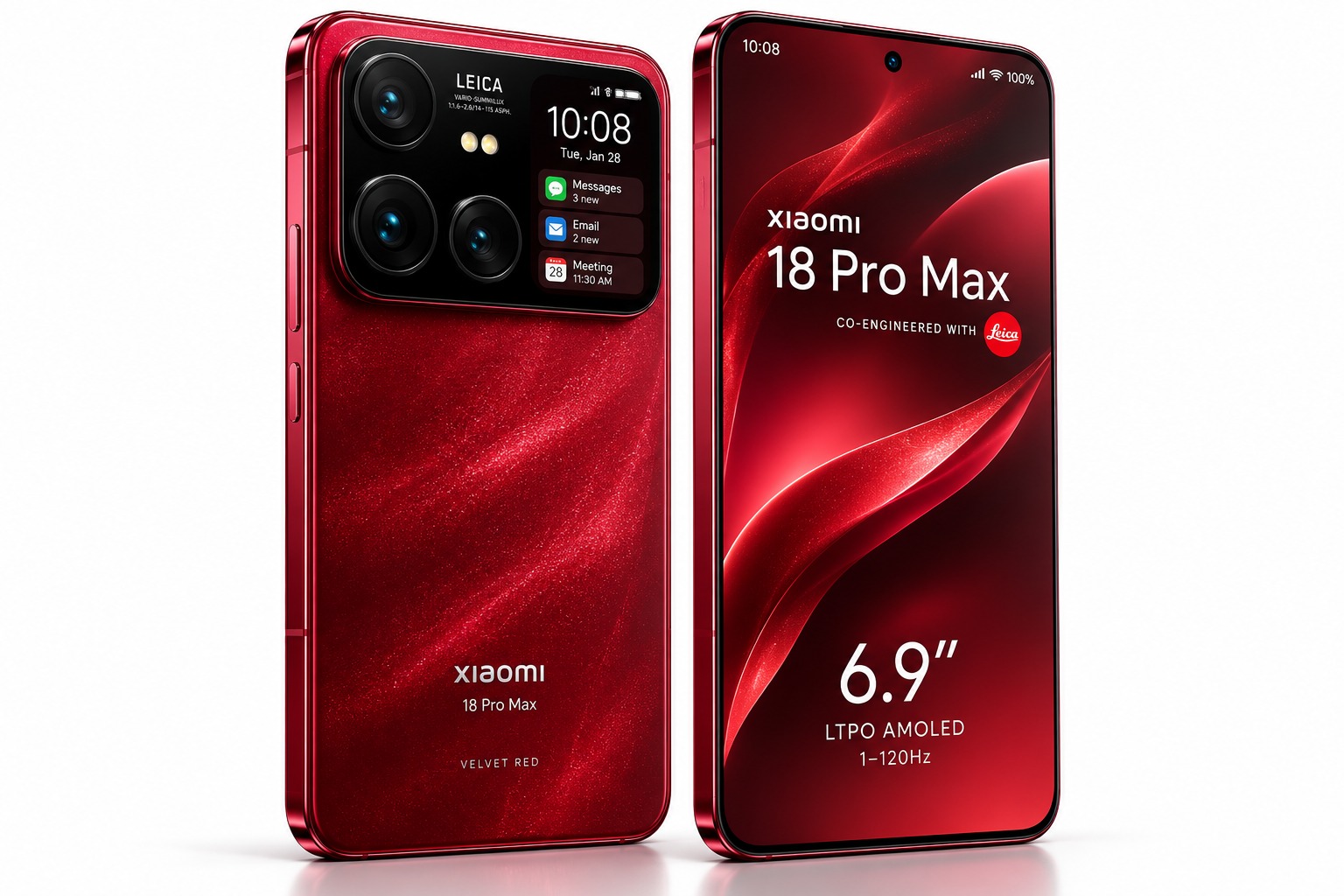
The design story is the camera island. It is a large rectangular slab across the top of the back that houses the triple cameras, the flash, and a 2.9-inch LTPO AMOLED secondary display. That rear screen is not a gimmick you will tire of in a week. It shows notifications, the weather, your calendar, timers, and music controls, and it lets you frame selfies with the 200MP main camera instead of the 50MP front one.
Durability is strong. GSMArena lists IP68, which means dust-tight and immersible up to 6m for 30 minutes, while other launch coverage lists both IP68 and IP69. The phone has an under-display ultrasonic fingerprint reader, a barometer, and three speakers with Dolby Atmos. There is no 3.5mm jack and no FM radio.
Colour options differ by region. China gets Black, White, Pink, Blue, and a Transparent Red Special Edition. The global lineup is expected to be Black, White, Velvet Red, and Cosmic Blue, with the pink option not planned for Europe and the transparent edition staying in China.
Display
The main panel is a 6.9-inch LTPO AMOLED at 1208 x 2624 pixels, which works out to about 418ppi and a 91.6% screen-to-body ratio. It runs at 120Hz with 2160Hz PWM dimming and supports Dolby Vision, HDR Vivid, HDR10+, and the BT.2020 colour space.
Xiaomi advertises 4,000 nits peak brightness. Treat that as a marketing peak, not a sustained full-screen figure. The panel is bright enough for direct sun, but the number on the spec sheet is measured at a spot, not across the whole display.
The rear display is a 2.9-inch LTPO AMOLED at 596 x 976 pixels and 120Hz. It uses the same panel technology as the front, and it is always available without waking the main screen. This is the most practical second display I have seen on a phone, because it does not ask you to flip the device over and squint at a tiny window.
Performance
The 18 Pro Max runs the Snapdragon 8 Elite Extreme Gen 6 (SM8975), built on TSMC’s 2nm N2P process. It has two 5.01GHz prime cores, three 4.03GHz performance cores, and three 3.74GHz performance cores, paired with the Adreno 850 GPU.
This is the same silicon that powers the Motorola Signature 27, and it is the current flagship ceiling. Xiaomi pairs it with 12GB or 16GB of LPDDR5X RAM and 256GB, 512GB, or 1TB of UFS 4.1 storage. There is no microSD slot.
One thing to flag: the Extreme Gen 6 platform supports LPDDR6 memory and UFS 5.0 storage, but Xiaomi lists UFS 4.1. That is a cost and supply decision, not a limitation of the chipset. It will not matter for most users, but it is worth knowing if you are comparing spec sheets.
European models are expected to come with 12GB of RAM only; the 16GB variants are not planned for the region. No independent benchmark numbers exist yet for the global unit, so I am not going to quote performance figures from the Chinese hardware as if they apply here.
Camera
The camera system is a triple Leica setup: a 200MP main sensor at f/1.7 with a 1/1.28-inch format and OIS, a 200MP periscope telephoto at f/2.4 with a 1/1.56-inch sensor, OIS, and 3.2x optical zoom, and a 50MP ultrawide at 102 degrees. The front camera is 50MP.
That is a serious hardware package. The 200MP periscope is the standout, because it gives you real optical reach instead of a cropped sensor. The rear display makes it usable for selfies too.
Video recording tops out at 8K at 30fps and 4K at 120fps, with 10-bit Dolby Vision HDR and 10-bit LOG. There is laser autofocus, a colour spectrum sensor, and a dual-LED dual-tone flash.
I do not have independent image samples from the global unit yet. The Chinese hardware is identical, so the camera experience should be the same, but I will wait for the global review units before making a final judgement. For context, the Oppo Find X10 Pro Max and the vivo X500 Pro Max are the closest rivals in this camera tier.
Battery & Charging
This is the section that matters most. The Chinese 18 Pro Max has an 8,500mAh silicon-carbon battery. The global unit has a 7,050mAh cell, according to European energy-label filings. That is a 17% cut, and it is the single biggest difference between the phone you have read about and the phone you can actually buy.
The typical capacity Xiaomi is likely to advertise is around 7,200mAh, based on the same filings. To put that in perspective, the global battery is closer to the 7,000mAh cell in the Chinese Xiaomi 18 Pro than to the 8,500mAh cell in the Chinese 18 Pro Max.
Charging is unchanged from the Chinese Pro Max: 100W wired, 50W wireless, and 27W reverse wireless. The smaller cell means a full charge should be quicker, not slower. The standard 18 Pro, by contrast, drops from 100W to 90W in Europe.
Xiaomi has not explained the battery cut. Industry reporting points to air freight regulations and shipping logistics as a likely cause, but that is speculation. What is confirmed is that the global battery is smaller, and the reason is not public.
Software
The 18 Pro Max ships with Android 17 and HyperOS 4. The rear display has its own software layer with notifications, call handling, music controls, weather, calendar, and timer widgets.
The global ROM is expected to ship with Google Mobile Services, which would make it a different software proposition from the Chinese unit, where the China ROM has no Google Play Services out of the box. Xiaomi has not published the global software details yet, so treat this as expected rather than confirmed.
Update commitment is unconfirmed. Xiaomi has not said how many major Android upgrades the 18 Pro Max will receive, and it has not given a security update window. For a phone at this price, that is a fair question to ask before you buy.
Pros and Cons
| Pros | Cons |
|---|---|
| 7,050mAh is still a huge battery | Global battery is 17% smaller than the Chinese version |
| 100W wired and 50W wireless charging retained | Global price is roughly 1.7x the Chinese price in peso terms |
| Dual 200MP Leica cameras with 3.2x periscope | No official PH launch or local warranty |
| Snapdragon 8 Elite Extreme Gen 6 is the flagship ceiling | Update commitment is unconfirmed |
| Rear 2.9-inch display is genuinely useful | 4,000 nits is a peak figure, not sustained brightness |
| IP68/IP69 and Dragon Crystal Glass 3 | UFS 4.1, not the UFS 5.0 the chipset supports |
| 50W wireless and 27W reverse charging | No 3.5mm jack and no microSD |
| Three speakers with Dolby Atmos | 235 to 240g is heavy |
Should You Buy This?
Buy it if
- You want the biggest battery in a flagship Android phone that is actually available in your market.
- You shoot a lot of zoom photos and want a 200MP periscope.
- You like the idea of a rear display for selfies, notifications, and music controls.
- You want the current top-tier Snapdragon silicon and do not want to wait for the next generation.
Skip it if
- You are in the Philippines and need a local warranty and after-sales support.
- You want the full 8,500mAh Chinese battery and are willing to import.
- You are sensitive to weight and want a phone under 200g.
- You want a confirmed long-term update commitment before paying flagship money.
Final Verdict
The Xiaomi 18 Pro Max is a genuine flagship, and the global version is still one of the most interesting phones of the year. The dual 200MP Leica cameras, the Extreme Gen 6 chipset, and the rear display give it a clear identity. The 7,050mAh battery remains large, and the 100W wired and 50W wireless charging are unchanged from the Chinese phone.
But the global version is not the phone that made headlines. The 17% battery cut is real, the price is far higher than in China, and Xiaomi has not explained either. If you are buying internationally, you are paying a premium for a phone that is slightly less than the one reviewers tested in September.
For most buyers, the 18 Pro Max makes sense only if the camera system and the rear display are things you will actually use. If they are not, the standard 18 Pro or the OnePlus Ace 7 Pro will give you a similar experience for less money. If they are, and you live in a market where Xiaomi sells officially, this is the flagship to beat right now.
The 18 Pro Max goes global on November 17 in Paris. Expect European pricing in the €1,599 to €1,849 range, depending on the configuration. Philippine availability and pricing are unconfirmed, so anyone buying here will be looking at a gray-market import without local warranty.