
Xiaomi 18 Pro Review: Leica’s 200MP Twins and a Privacy Shutter at CNY 5,999
Published on Bleuken.com — September 24, 2026
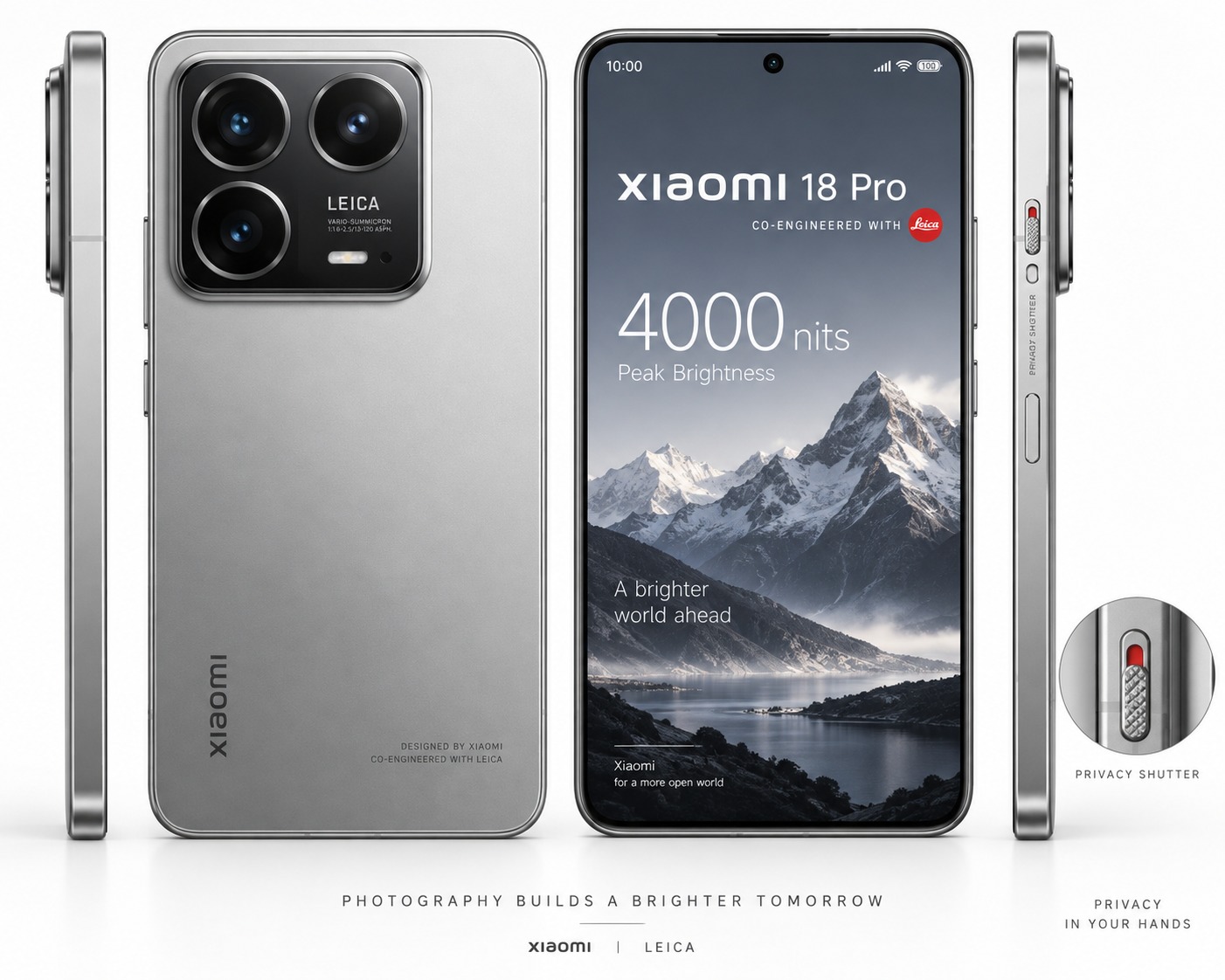
Xiaomi just dropped its 18 Pro series in China, and if you thought the 17 Pro lineup was aggressive, the 18 generation raises the bar in ways that matter — and in ways that don’t. The headline grabbers are a pair of 200MP Leica cameras (yes, two of them), a hardware-level privacy shutter on the display, and a 2nm Snapdragon chip that’s among the first to ship in any phone. But the base Xiaomi 18 Pro — not the bigger, heavier, more expensive Max — is the one most people will actually consider, and it’s the one worth a closer look.
I’ve spent the last few days piecing together everything Xiaomi and GSMArena have published about this phone ahead of any global launch. What follows is a full review based on confirmed specifications, official pricing, and benchmark data — with honest flags where information is still thin. This is a China-launch device with no confirmed international release date, so this review is written with that context front and center.
Design & Build Quality
The Xiaomi 18 Pro follows the contour language Xiaomi has refined over the past two generations: a flat display framed by ultra-thin 0.99mm bezels, a metallic aluminum frame, and a glass back (Dragon Crystal Glass 3, the same naming convention as the Pro Max). The phone is 163.4mm tall, 77.6mm wide, and 8.4mm thick — dimensions that place it right at the upper boundary of what feels comfortable in one hand for extended periods. At an estimated 210-220g it’s lighter than the Pro Max (235-240g), which matters more than the spec sheet suggests when you’re holding a phone with this much glass and metal.
The most visible design feature is the camera module. Xiaomi has confirmed a Leica-tuned triple rear camera setup with two 200MP sensors — a main and a periscope telephoto — plus a 50MP ultrawide. The module sits in the top-left corner in the classic vertical stack. The phone ships in Black, Galaxy Blue, and White. There’s a dedicated hardware privacy shutter button — part of the “M11 luminescent panel” Xiaomi mentioned in its launch announcement — which physically covers or reveals the display area for privacy use. It’s a genuinely novel feature that Apple and Samsung have approached only with software toggles; Xiaomi’s hardware approach is more deliberate, though it’s too early to say how well the mechanism holds up over thousands of cycles.
Build durability is solid on paper: IP68 dust and water resistance (immersible up to 6 meters for 30 minutes), which matches the Pro Max and the iPhone 18 Pro Max — both of which GSAMArena has also reviewed this month. No official MIL-STD rating has been published for the 18 Pro specifically, though Xiaomi’s premium line has historically carried it.
One thing worth flagging: there’s no 3.5mm headphone jack. That’s standard for this tier now, but worth noting for buyers upgrading from older devices.
Display
The Xiaomi 18 Pro carries a 6.73-inch LTPO AMOLED display — slightly smaller than the Pro Max’s 6.9-inch panel, which is the most visible differentiation between the two models. GSMArena’s launch coverage confirms the series-level specs: 120Hz adaptive refresh rate, 2160Hz PWM dimming (meaning flicker-free low-brightness operation, a real comfort feature for night-time scrolling), Dolby Vision, HDR Vivid, HDR10+, and BT.2020 color gamut coverage. Peak brightness hits 4,000 nits, which Xiaomi claims is enabled by the new M11 luminescent panel — a 20% efficiency improvement over the previous generation.
Those are marketing numbers that deserve a qualifier: 4,000 nits is a peak figure measured at an isolated spot, not full-screen sustained brightness. GSAMArena has flagged this pattern before on other devices — see the Huawei nova 16s Pro review for the exact same footnote treatment of peak-brightness claims. In practice, outdoor visibility at 4,000-nit peak is excellent, but don’t expect the entire screen to sustain that output in direct sun.
The 0.99mm bezels are genuinely thin, and the 19.5:9 aspect ratio gives the phone a tall, narrow feel that works well for single-hand use. The display also carries the hardware-level privacy feature, which is a first for a non-Concept phone — it’s not just a software dimming mode but a physical shutter integrated into the panel, similar in concept to what Samsung introduced on the Galaxy S26 Ultra.
Performance
Under the hood, the Xiaomi 18 Pro runs Qualcomm’s Snapdragon 8 Elite Gen 6 Pro — note the “Pro” suffix on the chipset name, which distinguishes it from the “Extreme Gen 6” variant in the Pro Max. This is a 2nm chip with an octa-core CPU clocked up to 5.01GHz and an Adreno GPU. The Geekbench 7 scores from the prototype (model M154FF, 16GB RAM) came in at 2,871 single-core and 8,836 multi-core. Those are pre-production numbers from a device with unfinished software — treat them as directional, not definitive — but they put the 18 Pro firmly in the top tier of Android performance, bracketed between the Snapdragon 8 Gen 3 and the newer Elite chips in raw throughput.
Xiaomi has certified the 18 Pro series for 100W wired charging (PD3.0, QC3+, and 100W PPS support), which matches the Pro Max. The battery is a 7,000mAh silicon-carbon cell — the same capacity class as the Pro Max’s 8,500mAh, but scaled down for the smaller body. Xiaomi hasn’t published independent battery endurance tests yet; the 7,000mAh figure is the company’s claimed capacity. The phone also supports 50W wireless charging and 27W reverse wireless charging.
For context: the vivo X500 Pro (reviewed on Bleuken September 22) also targets the 2nm flagship segment with a Dimensity 9600 and a similar camera-first philosophy. The iPhone 18 Pro (reviewed September 10) uses Apple’s in-house A20 Pro on a 2nm node as well — so the 18 Pro lands in a genuinely competitive performance window this fall.
Camera
This is the section that justifies the “Pro” name. The Xiaomi 18 Pro carries a Leica triple-camera system where both the main and telephoto sensors sit at 200MP — a configuration that no major Android phone has shipped before.
Main camera: 200MP, f/1.7, 23mm (wide), 1/1.28-inch sensor, 0.61µm pixel size, dual pixel PDAF, OIS. The large sensor area (1/1.28″) is the real story here — it’s the same class as the iPhone 18 Pro Max’s main sensor and the Xiaomi 18 Pro Max’s own main sensor. Xiaomi claims the telephoto captures 280% more light than the one on the 17 Pro.
Periscope telephoto: 200MP, f/2.4, 75mm (3.2x optical zoom), 1/1.56-inch sensor, PDAF with focus range from 10cm to infinity, OIS, macro focus from 12cm. The 3.2x optical zoom is the same class as the iPhone 18 Pro’s telephoto — a reader on GSAMArena’s camera preview article explicitly asked why Xiaomi went back to 3.2x from a higher zoom ratio, which suggests this was a conscious trade-off for the larger sensor format.
Ultrawide: 50MP, f/2.4, 17mm (102°), 1/2.88-inch sensor. Standard ultrawide specs — serviceable, not remarkable.
Front camera: 50MP, f/2.2, 21mm (wide), 1/2.88-inch sensor. Solid selfie hardware for a flagship.
Video: 8K@30fps with HDR, 4K@30/60/120fps with HDR10+ and 10-bit Dolby Vision HDR and 10-bit LOG, 1080p at up to 960fps, plus gyro-EIS. The 4K120 with Dolby Vision LOG is the kind of footage format that videographers actually care about — it’s rare at this price point outside of the ultra-premium foldables.
Leica branding covers the entire rear array, with Leica lenses, dual-LED dual-tone flash, and Leica color science modes. The camera samples Xiaomi shared on Weibo ahead of launch (retrieved via GSAMArena’s coverage) show strong detail retention on the main sensor and good telephoto sharpness at 3.2x — though these are pre-launch samples and real-world consistency across lighting conditions will need hands-on verification.
Battery & Charging
The 7,000mAh silicon-carbon battery is the 18 Pro’s headline power spec. For context, the iPhone 18 Pro Max reviewed this month also uses a large silicon-carbon cell (GSAMArena reported Apple used a clever shipping-workaround to get the large battery internationally), and the vivo X500 Pro reviewed on Bleuken a couple of days ago targets similar endurance. Silicon-carbon chemistry allows higher energy density than traditional lithium-ion, which is how Xiaomi fits 7,000mAh into a phone that’s only 8.4mm thick.
The 100W wired charging (PD3.0, QC3+, PPS) should fill that battery in roughly 30-35 minutes under ideal conditions. 50W wireless is competitive. 27W reverse wireless charging lets the 18 Pro top up earbuds or a watch. None of this is revolutionary on its own — the OnePlus 13 and Redmi Note 17 Pro have landed higher wired numbers — but combined with the large battery, the overall power story is strong.
I’d flag that silicon-carbon batteries can have different discharge characteristics than traditional Li-Ion cells at high loads, and Xiaomi hasn’t published independent endurance test data yet. The Battery section of this review should be read as “specs confirmed, real-world endurance unverified” until third-party testing appears.
Software
The Xiaomi 18 Pro ships with HyperOS 4 on Android 17. HyperOS 4 was officially unveiled by Xiaomi in September 2026 with a new glass-look UI, customization options, and expanded AI features — the beta rolled out around the same time as the 18 Pro series launch. Xiaomi has not published a specific Android update commitment for the 18 Pro yet; given that this is a flagship-tier device, a 4-5 year OS update window would be the expected pattern based on recent Xiaomi flagship behavior, but that’s an inference, not a confirmed spec. Flag it as unconfirmed rather than asserting a number.
On the AI side, HyperOS 4 includes Xiaomi’s expanded AI feature set — the rear display can run user-built AI apps (Xiaomi announced this specifically for the 18 Pro series), and there’s Gemini-adjacent integration given the global OEM trend toward Google’s AI stack. The hardware privacy shutter is also a software-controlled feature — the physical mechanism is triggered by software, which means it can be toggled, unlike a purely mechanical cover.
For readers outside China: HyperOS 4 is the global successor to MIUI, and Xiaomi has been converging its China and global software closer with each generation. However, the 18 Pro series has no confirmed global release date, so the availability of Google Play Services, regional app compatibility, and local warranty support are all open questions for now.
Pros and Cons
| Pros | Cons |
|---|---|
| Dual 200MP Leica cameras with large 1/1.28″ main sensor and OIS on both primary lenses | No confirmed global release date — China-only launch so far, Google Services availability unknown outside China |
| 4,000-nit LTPO AMOLED with 2160Hz PWM dimming and hardware privacy shutter — a genuinely novel feature | 7,000mAh silicon-carbon battery lacks independent endurance verification — real-world results may differ from capacity claims |
| Snapdragon 8 Elite Gen 6 Pro on 2nm — among the first phones to ship with this chip | 3.2x optical zoom is a step down from higher-zoom competitors — the periscope is sensor-forward, zoom-backward |
| 100W wired + 50W wireless + 27W reverse charging — full charging ecosystem in one phone | No official Android update commitment published yet — readers planning to keep the phone 4+ years are flying blind |
| 4K120 Dolby Vision LOG video recording — rare at this price point, useful for content creators | No 3.5mm headphone jack — expected in this tier but worth noting for upgraders |
| IP68 rating — solid water and dust resistance for a flagship-class phone | Pricing at CNY 5,999 (~$830) for the base variant puts it above some global flagship pricing in certain markets |
Should You Buy This?
Buy it if:
- You’re in China or have a reliable way to import — the phone is available now from Xiaomi’s China stores and select retailers
- Camera hardware is your top priority and you want two 200MP Leica sensors before anyone else ships them
- You value the hardware privacy shutter as a real physical security feature, not just a software toggle
- You’re a mobile content creator who wants 4K120 Dolby Vision LOG recording in a non-foldable form factor
- You want 2nm flagship performance today and don’t want to wait for the global launch of competing devices
Skip it if:
- You need a confirmed global release with full Google Play Services and local warranty support — that’s not available yet
- You want a higher-zoom telephoto (5x or more) — the 3.2x periscope is sensor-forward but zoom-range-backward
- You’re upgrading from a Xiaomi 17 Pro and the camera improvement alone doesn’t justify the price delta for your use case
- You need verified battery endurance data before buying — the capacity is confirmed but real-world drain hasn’t been independently tested
- The CNY 5,999 starting price is above your budget and you’d rather wait for the Galaxy S27 series (rumored for early 2027) or the global 18 Pro launch
Final Verdict
The Xiaomi 18 Pro is the most camera-forward non-foldable flagship Xiaomi has shipped in years, and the dual 200MP Leica configuration is a genuine hardware story — not a spec-sheet arms race where one number goes up and everything else stays the same. The 1/1.28-inch main sensor paired with a 200MP periscope that captures 280% more light than the 17 Pro’s telephoto is the kind of generational leap that shows up in real photos, not just in marketing decks.
The hardware privacy shutter is the most genuinely novel feature on the phone — it’s not a gimmick in the way that rear display apps can be, because it addresses a real privacy concern with a physical mechanism. Whether that mechanism survives daily use over two or three years is an open question that only time and user reports will answer.
The biggest caveat is the same one that applies to most China-launch flagships: there’s no confirmed global release. The phone is available now if you’re in China or willing to import, but Google Play Services availability, regional LTE/5G band support, warranty coverage, and local pricing are all unconfirmed. For Filipino readers specifically: no PH launch has been announced, and Xiaomi’s global rollout typically follows China by 2-4 months for premium flagships. The vivo X500 Pro reviewed on this site September 22 faced the same situation and eventually reached select international markets — the 18 Pro may follow a similar path.
At CNY 5,999 (roughly PHP 47,000-49,000 at current exchange rates, though that’s a direct conversion and the actual PH price would differ if and when Xiaomi brings it here), the 18 Pro is priced above the iPhone 18 Pro at global launch in some markets. That’s a premium positioning that’s justified by the camera hardware but not by the rest of the spec sheet, which is largely in line with what competitors offer. The phone is a strong buy for camera enthusiasts who can access it — and a “watch for the global launch” for everyone else.