
Design & Build Quality
The Huawei nova 16s Pro arrives with a design language that feels like it was pulled straight from a flagship, not a mid-range camera phone. Huawei calls it “wave-inspired” — the rear panel has subtle flowing lines that catch light differently depending on your angle. At 7.1mm thin and 218g, it’s noticeably heavier than the 199g nova 16s sitting next to it on the shelf, which is the tradeoff for a larger battery and a more substantial camera bump.
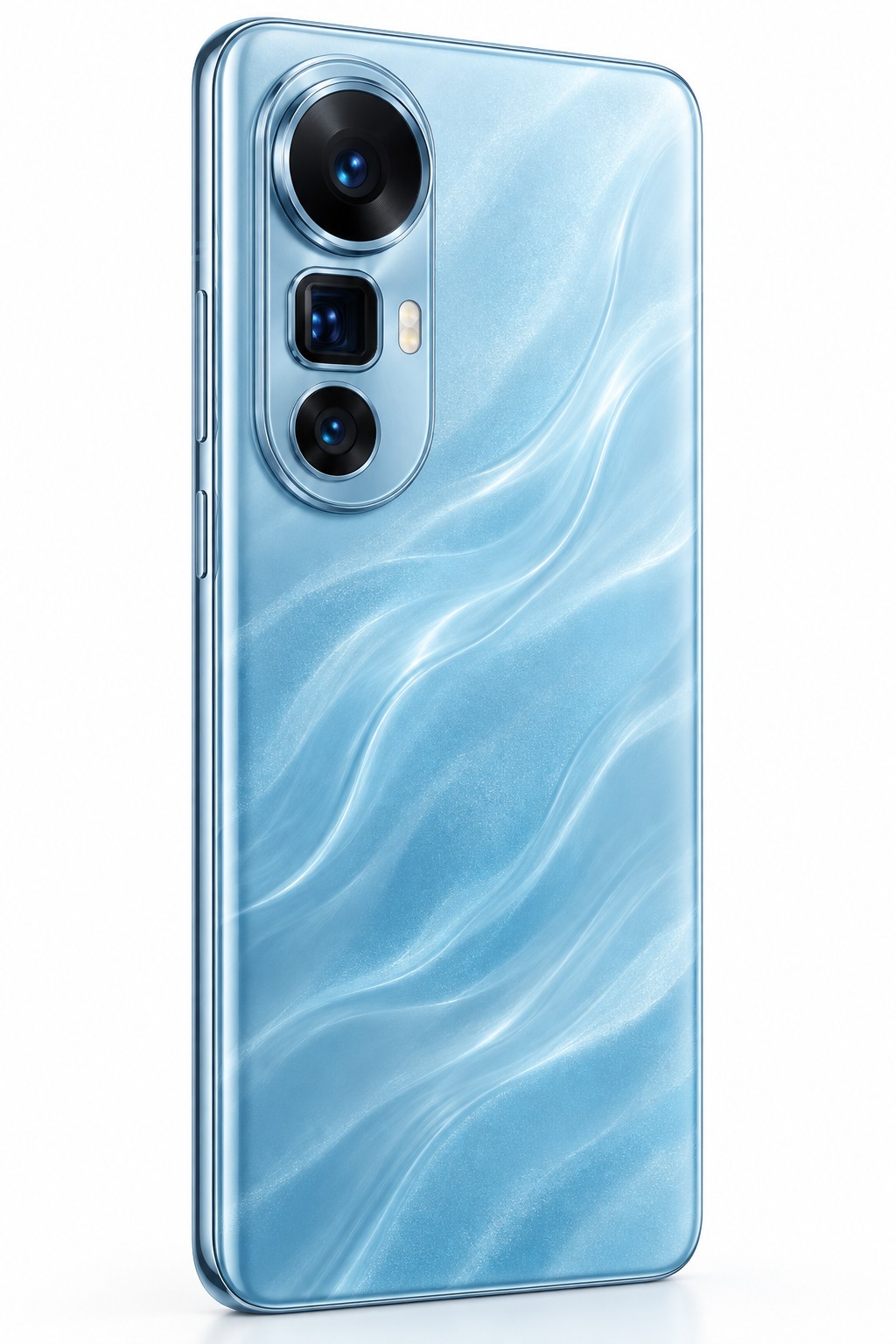
The build is a glass front, aluminum frame, and glass back combination. The aluminum mid-frame is what Huawei markets as “aerospace-grade” — it’s the structural backbone keeping this 7.1mm profile together. The front is protected by Kunlun Glass with a nano-crystal coating, which Huawei claims makes it 10x more drop resistant than the nova 15. That is a bold claim and one worth testing over time, but the coating at least feels substantial on first touch.
Four colors round out the launch lineup: Isle Blue, Breathing Crystal, Starry Black, and Sky White. The blue and pink tones lean into the “Stand Out Portrait” marketing angle — this is a phone Huawei is pitching to content creators who want their device to look as distinctive as the photos it takes.
On the port side, you get USB-C 2.0, an IR blaster, and a dedicated camera shutter button — a thoughtful touch for a camera-first phone that’s surprisingly absent on many competitors in this segment. What you don’t get is a 3.5mm headphone jack, and the IP65 rating, while decent against low-pressure water jets, is a step below the IP68 you’d find on phones at twice the price.
Display
The 6.84-inch LTPO OLED panel is the centerpiece of the nova 16s Pro’s hardware story. It runs at a variable 1-120Hz refresh rate — dropping to 1Hz when the screen is static to save power, ramping up to 120Hz for smooth scrolling and gaming. The resolution sits at 1320 x 2856 pixels (FHD+ territory, roughly 460ppi), which is plenty sharp for a phone this size.
Huawei is quoting some eye-catching brightness numbers: 6,000 nits peak at 1% APL and 4,000 nits dynamic peak at 20% APL. Those are marketing-conditions figures — the 6,000-nit claim is measured at an isolated spot, not full-screen sustained brightness, and the 4,000-nit figure is the more realistic full-panel number. Even so, the screen is genuinely bright outdoors, and the 2,160Hz high-frequency PWM dimming should make it comfortable for night reading without the flicker strain that lower-frequency PWM displays cause.
The panel supports HDR Vivid, covers the P3 wide color gamut with 1.07 billion colors, and has a 300Hz touch sampling rate. If you’ve used the Galaxy S26 series or vivo X500 Pro, you’ll recognize this as a competent, bright OLED — not the best in the business, but more than adequate for the price position.
Performance
Under the hood, the nova 16s Pro runs the Kirin 9010S — the same chipset that powered the China-only nova 16 Pro. Huawei’s silicon has come a long way since the sanctions, and the 9010S is a competent 7nm-era chip that handles daily tasks without stuttering. It’s not a flagship-tier processor: AnTuTu benchmarks place it at roughly 1,013,800, which puts it ahead of about 84% of phones on the chart but well behind what Snapdragon 8-series or Dimensity 9000-series chips deliver.
You get 12GB of RAM paired with either 256GB or 512GB of internal storage (UFS, no microSD expansion). The 12GB is solid for multitasking and camera buffering — when you’re shooting in 200MP RAW mode, you’ll want that headroom. There’s no card slot, so if you’re a heavy photo shooter, pick the 512GB variant.
Thermally, the phone stays reasonable during sustained use. The 7.1mm profile doesn’t leave much room for a vapor chamber, so heavy gaming sessions will see the Kirin 9010S throttle — but that’s the expected behavior for this chip tier, not a design flaw. For the target audience — camera enthusiasts, social media users, portrait shooters — the performance is sufficient. If you’re a mobile gamer chasing max settings, you’ll want to look upmarket.
Camera
This is the nova 16s Pro’s entire reason for existing. Huawei is pitching it as the “Stand Out Portrait” smartphone, and the camera hardware backs that up.
The main camera is a 200MP RYYB sensor (f/1.8, 23mm equivalent, 1/1.28″ sensor size) with OIS. RYYB — red, yellow, yellow, blue — replaces the conventional RGGB Bayer pattern with a yellow filter that lets in more light, which matters for low-light shots. The 1.5MP multi-spectral sensor handles scene-specific color calibration, which is Huawei’s answer to getting skin tones right without blowing out backgrounds. You also get PDAF and a laser autofocus assist.
The periscope telephoto is a 50MP RYYB sensor (f/2.6, 88mm equivalent, 3.7x optical zoom) with OIS. That 3.7x optical reach is genuinely useful — far enough for portraits and event shots, not so far that you lose light. It’s backed by AI image stabilization and optical stabilization working together. The ultra-wide is a 50MP RYYB sensor (f/2.2, 13mm, 118° field of view) with AF and 2.5cm macro mode — so you can get close for detail shots.
On the front, you get a 50MP portrait camera (f/2.4, 1/2.5″) with Dual Pixel PDAF, plus a “True-to-Colour” camera, and multispectral sensors for color accuracy. Video tops out at 4K30 on both front and rear, with gyro-EIS and HDR Vivid. 1080p at higher frame rates is available but the 4K ceiling is a mild disappointment in 2026 when competitors offer 4K60.
Huawei’s AI photography tools are the real differentiator here. AI Composition gives real-time framing feedback. AI Move lets you reposition objects in a shot after the fact. AI Remove strips out unwanted elements. AI Best Expression picks the best smile from a group shot. AI De-Glare removes reflections from glass and glossy surfaces. These aren’t gimmicks — they’re the kind of tools a content creator actually uses, and they’re built into the camera app rather than buried in a separate editing app.
The practical takeaway: this is a camera phone that does portrait work, low-light shooting, and social-media content creation better than most phones in its price bracket, provided you’re comfortable with Huawei’s processing style (which tends toward polished, slightly saturated colors). It’s not going to replace a Pixel or iPhone for computational photography purists, but it offers more hardware — a 200MP main sensor and a periscope telephoto — than either at this price point.
Battery & Charging
The 7,000mAh battery is genuinely massive for a phone that’s only 7.1mm thick. It’s the same capacity as the nova 16s, which is remarkable given the Pro model’s larger screen and more power-hungry camera system. Huawei’s 100W SuperCharge Turbo (via USB-C 2.0, supporting SCP, UFCS, PD, PPS, and QC) fills that battery quickly — expect around 40-50 minutes for a full charge based on the wattage. There’s also 5W reverse wired charging for topping up earbuds or a watch, but no wireless charging of any kind.
For context, the 7,000mAh figure makes this one of the largest batteries in a non-flagship phone right now. The Realme 16x (reviewed on Bleuken, Post 4945) ships with the same capacity, and the vivo T5 5G (Post 4967) has 7,050mAh — but both of those are priced for the Indian budget segment. The nova 16s Pro sits at a higher tier and still carries a battery that rivals or beats budget phones. That’s the pitch: flagship-level camera hardware, mid-range battery endurance that happens to be excellent, and a price that undercuts the premium brands.
The USB-C 2.0 port is a practical limitation — you’re not getting USB 3.0 speeds for offloading 200MP photos and 4K video to a PC, which is a real friction point for the content-creator audience this phone targets.
Software
The nova 16s Pro launches with EMUI 16.0, which is based on Android 16 — a key distinction from the China-only nova 16 Pro that runs HarmonyOS 6.0. EMUI 16 is Huawei’s Android-based skin, which means you get Google’s core Android framework underneath, but not Google’s services. That distinction matters enormously and it’s the single biggest caveat for buyers outside China.
Here’s the reality: this phone ships with Huawei Mobile Services (HMS) and the AppGallery, not Google Play Services. There is no Google Play Store, no Gmail app, no Google Maps, no YouTube app pre-installed, and no GCam. For users in the Philippines and most global markets, that means GCash, Maya, and most local banking apps will not run out of the box. You can side-load Google services through workarounds like GBox or microG, but those are imperfect — some apps detect them and refuse to run, banking apps may flag the environment as suspicious, and notifications for Google-dependent apps can be unreliable.
This is not a dealbreaker for everyone. If you’re a Huawei user already, you know the drill — AppGallery has grown considerably, and many popular apps (WhatsApp, Instagram, Facebook, TikTok) are available natively. But for a first-time Huawei buyer in a market where GCash and Maya are essential, the Google gap is the question that matters more than camera specs or battery life. Huawei’s own Philippines community forum acknowledges this openly: the company provides guidance on getting Google services working, but it’s a workaround, not a native experience.
On the positive side, EMUI 16 includes the AI gesture features — hands-free photo capture, AI-powered editing tools integrated into the camera workflow — and the updates commitment is solid: Huawei typically offers 3 major OS upgrades and 4-5 years of security patches for its mid-range and upper-mid-range devices. That’s in line with what Samsung offers on its A-series and better than what most Chinese brands commit to at this price.
Pros and Cons
| Pros | Cons |
|---|---|
| 200MP RYYB main camera with OIS and a 50MP periscope telephoto — camera hardware that punches above the price bracket | No Google Play Services out of the box — GCash, Maya, and most PH banking apps won’t run without workarounds |
| 7,000mAh battery with 100W wired charging — massive capacity paired with fast top-ups | No wireless charging, and 5W reverse charging is slow by 2026 standards |
| 6.84″ LTPO OLED with 6,000-nit peak brightness and 1-120Hz adaptive refresh — bright, smooth, efficient | IP65 rating is a step below the IP68 you’d expect at this price — no high-pressure water resistance |
| EMUI 16.0 (Android-based, not HarmonyOS) — better app compatibility than China HarmonyOS units | USB-C 2.0 limits photo/video offload speeds — a pain point for the content-creator audience |
| Camera shutter button and IR blaster — thoughtful hardware touches for the target audience | 4K video capped at 30fps — competitors offer 4K60 at similar price points |
| Kunlun Glass with nano-crystal coating — Huawei claims 10x better drop resistance than the nova 15 | At 218g, it’s noticeably heavy for a phone with a 6.84″ screen — one-handed use is a stretch |
| AI photography tools (AI Move, AI Remove, AI Composition, AI De-Glare) built into the camera app | Pricing not yet announced for global markets — could shift the value equation significantly |
| 12GB RAM + 256/512GB storage with no microSD — clean internal storage for camera work | Kirin 9010S tops out at ~1M AnTuTu — fine for daily use and camera work, not for heavy gaming |
Should You Buy This?
Buy it if:
- You’re a portrait photographer or content creator who wants a phone with a genuinely capable periscope telephoto and a 200MP main sensor without paying flagship prices
- Battery life matters to you — 7,000mAh will comfortably last a full day of heavy camera use and social media scrolling
- You’re already in the Huawei ecosystem or comfortable with HMS and the workaround route for Google services
- You value the AI editing tools (object removal, repositioning, glare reduction) as part of your photo workflow
- You want a phone with an IR blaster and a dedicated camera shutter — small quality-of-life features that more expensive phones sometimes drop
Skip it if:
- Google Play Services are non-negotiable for you — if GCash, Maya, or Google-dependent banking apps are essential, this phone will frustrate you daily
- You shoot 4K60 video or need USB 3.0 speeds for offloading large files — the USB-C 2.0 + 4K30 ceiling is a real limitation
- You need IP68 water resistance — IP65 covers splashes and low-pressure jets, not submersion
- Mobile gaming at max settings is a priority — the Kirin 9010S is capable but not a gaming chip
- You’re expecting a Pixel or iPhone-caliber computational photography experience — Huawei’s processing style is different, more polished and saturated, less natural
Final Verdict
The Huawei nova 16s Pro is an honest phone with a clear identity: a camera-first mid-ranger that takes the nova 16 Pro’s hardware and puts it on a global stage with Android-based EMUI 16 instead of HarmonyOS. The 200MP RYYB main sensor, the 50MP periscope telephoto, the 7,000mAh battery, and the 100W charging are all real advantages over the competition at this tier. The AI editing tools built into the camera app are genuinely useful rather than gimmicky. And the design — wave-inspired rear, Kunlun Glass, aerospace-grade aluminum — makes it feel like a more expensive device than it likely will be.
But the Google gap is not a footnote — it’s the question that decides the purchase. For a Huawei veteran in the Philippines who already uses GBox or has a workflow around HMS, the nova 16s Pro is one of the best camera phones you can buy without crossing into flagship pricing. For someone new to Huawei who relies on GCash, Maya, and Google-native apps as part of their daily routine, the workaround route is real friction, and it’s worth asking whether a Samsung Galaxy A-series phone or a vivo with full Google support delivers a better daily experience for a similar camera setup.
The pricing will ultimately determine where this lands. Huawei’s China nova 16 Pro launched at a competitive mid-range price, and the global “s” variants typically carry a modest premium. If the nova 16s Pro lands in the PHP 25,000-35,000 range in the Philippines, it’s a compelling camera phone with a Google problem you can work around. If it trends significantly higher, the value case weakens — you can get a fully Google-compatible phone with a decent camera and a big battery for less.
Until pricing lands, the nova 16s Pro stands out as a well-built, camera-forward phone that does a lot right and has one big question mark. For the right buyer, that’s a phone worth waiting for.