
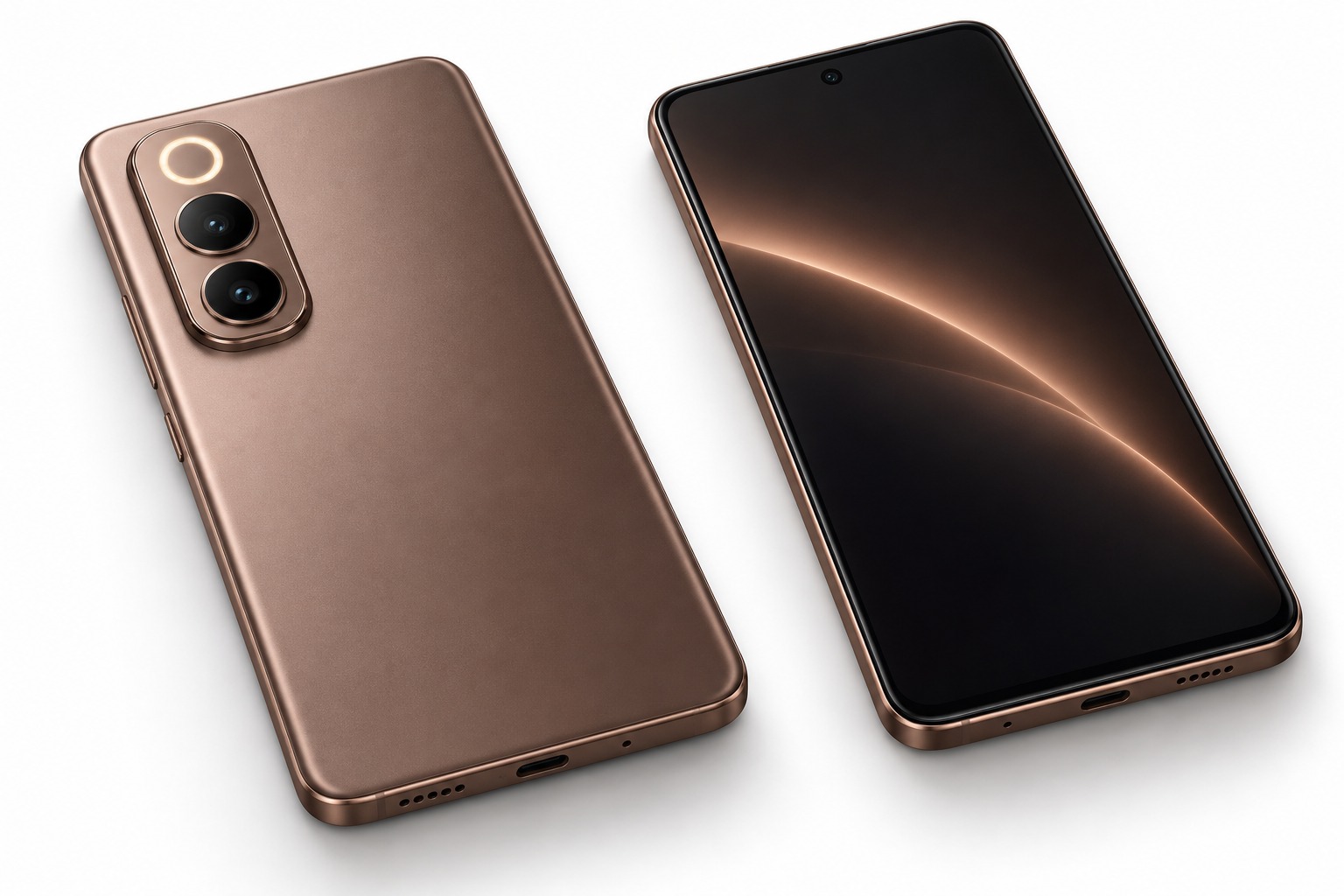
Design & Build Quality
The vivo T5 5G arrives with a quiet kind of identity crisis. GSMArena — not exactly known for sensational language — calls it “a version of the iQOO Z11 that went on sale in India last week.” That is the honest starting point for this review: vivo took the iQOO Z11 hardware, slapped a different brand badge on it, and launched it as a new phone under the T5 line. vivo and iQOO share parent company BBK Electronics, so this kind of repackaging is not unusual in the Chinese smartphone industry. But it does mean buyers need to know what they are actually getting.
Physically, the T5 5G is a big phone. It measures 164.4 x 75.3 x 8mm and weighs 199g. That is chunky without being heavy — you will notice it in a jeans pocket, but it is not a brick. The body uses a glass front, a plastic frame, and a plastic back. There is no metal unibody here, no cold-touch aluminium rails. The Royal Bronze colour I picture has a glossy finish that will attract fingerprints; Silver Green is the second option.
The “Skyline Camera Module” is vivo’s name for the rear camera island — a circular flash sits above two lenses, giving the back a stepped profile rather than a flush rectangle. It looks intentional without being exciting. A punch-hole for the 32MP selfie camera sits in the top-left corner of the display, and the under-display optical fingerprint scanner sits right below it.
Durability is where this phone earns its keep. It carries IP68 and IP69 ratings — dust-tight, water-resistant up to 1.5m for 30 minutes, and able to handle high-pressure water jets. That IP69 addition is rare at this price and genuinely useful. The T5 5G is also MIL-STD-810H certified and drop-resistant up to 1.2m. vivo adds wet-touch support so the screen still responds with wet fingers — not a headline feature, but the kind of thing you appreciate during monsoon season or after an accidental coffee spill.
The phone includes stereo speakers and an IR blaster, which lets it double as a TV remote — a small convenience that is disappearing from phones at this price. What it does not have is NFC, which matters if you use contactless payments. There is also no 3.5mm headphone jack. Both omissions are increasingly standard, but they still matter to budget buyers who rely on wired earphones.
Display
The 6.83-inch 3D curved AMOLED display is the panelidious highlight of this phone. Resolution is 2800 x 1260 pixels (1.5K), which works out to roughly 450ppi. That is sharp enough — especially on a curved screen where the edges fade into the bezels rather than ending at a hard line. The 144Hz refresh rate is a step above the 120Hz panels that most rivals in this bracket ship.
Brightness numbers are strong: 2,000 nits HBM (high brightness mode) and 3,000 nits peak. The peak figure needs a qualifier — that is a local-peak number, not full-screen sustained brightness, and the difference matters in direct sunlight. Still, outdoor visibility should be fine for a phone in this class. The panel supports HDR, carries SGS Low Blue Light and Low Flicker certifications, and has a Five-Star Sunlight Display rating.
The 3D curve is a style choice. Some people love curved screens; others find them a smudge magnet and a distraction that pulls your gaze toward the edges. If you are in the second group, this will not convert you. The 300Hz touch sampling rate is adequate for daily use and casual gaming, though competitive gamers may want higher.
Performance
The MediaTek Dimensity 7500 Turbo is the silicon that defines this phone. A 4nm chip with an octa-core layout — 4×2.6GHz Arm C1 Pro cores paired with 4×2.0GHz Arm C1 Nano cores — and a Mali-G625 MC GPU. This is a mid-range chip, not a flagship. It sits comfortably above entry-level silicon like the Snapdragon 4 Gen 5 or Dimensity 6300, but it is a step below the Dimensity 8300/9000 class or Snapdragon 7+ Gen 4. In AnTuTu v11 terms, expect scores in the 1.0 to 1.2 million range, which is decent for the price.
Memory configurations range from 6GB to 12GB of LPDDR4X RAM paired with 128GB or 256GB of UFS 3.1 storage. Four combinations: 6GB/128GB, 8GB/128GB, 8GB/256GB, and 12GB/256GB. LPDDR4X is a generation behind LPDDR5X, and UFS 3.1 is fine but not UFS 4.1 fast. There is no microSD slot, which will frustrate users who want to expand storage cheaply.
The 3,800 square mm vapour chamber is vivo’s selling point here — it claims this is the first time the Z-series has gotten VC cooling. That matters for a phone pushing a 144Hz display and a mid-range chip. Thermal throttling can cut into sustained gaming performance, and a larger VC pushes that threshold higher. For everyday use — social media, video, messaging, light gaming — the T5 5G should feel smooth. For sustained heavy workloads, expect the chip and cooling to do their best and then gradually step down.
Camera
The 50MP main camera uses the Sony IMX882 sensor with an f/1.79 aperture and optical image stabilisation (OIS). The IMX882 is a well-regarded mid-range sensor — it is not a flagship IMX989 or comparable large-sensor chip, but it has a solid track record in phones like the iQOO Z11 and other mid-range devices. OIS helps with low-light stability and smoother video.
The ultrawide is an 8MP f/2.2 lens with a 115-degree field of view. That is a standard entry-level ultrawide spec — enough for landscapes and group shots, not ideal for detail-critical shots where a 12MP or higher sensor would be better. There is no telephoto lens, which is typical at this price but still a limitation if you zoom often. Digital zoom fills the gap up to a point, but quality drops off sharply beyond 2x or 3x.
The 32MP front camera covers selfies and video calls at f/2.0 with an 84-degree field of view. Both the main and front cameras support 4K video recording at 30fps with gyro-EIS. The lack of 60fps 4K is not a deal-breaker for a phone in this bracket, but it is worth noting if video is important to you.
Without hands-on samples, I am relying on the sensor pedigree and the OIS spec for low-light expectations. The IMX882 has a decent track record, so the baseline should be good rather than great — daytime shots should look clean, and low-light shots should benefit from the stabilisation. But this is not a camera-first phone, and buyers who prioritise photography should look higher up the ladder with something like the vivo X500 Pro.
Battery & Charging
The 7,050mAh battery is the headline number — and it deserves the attention. That is a large cell by 2026 standards, and it is the kind of capacity that can comfortably stretch across a full day of moderate use and potentially into a second day for lighter users. Heavy users pushing the 144Hz display at high brightness all day will still need a charge by evening, but the baseline endurance here is strong.
Charging is 44W wired, with vivo rating it at 44% in 30 minutes. That is competent but not class-leading. Rivals in this bracket push 67W (Poco M8 Power (Poco’s closest reviewed sibling)) to 100W (Redmi Turbo 5), so the T5 5G’s 44W will feel slow if you are used to faster charging. It is still enough to get you to a useful charge during a coffee break, and the inclusion of bypass charging — which routes power directly to the motherboard without cycling through the battery — helps preserve long-term battery health during gaming sessions.
Reverse wired charging is supported, so you can use the T5 5G to top up earbuds or a secondary phone in a pinch. That is a convenience feature rather than a primary selling point, but it is welcome to have.
Software
The T5 5G ships with Android 16 and vivo’s OriginOS 6 skin. OriginOS 6 is a mature, polished custom layer — think colour themes, a customisable control centre, and vivo’s productivity tools layered on top of a clean Android base. It is not as heavy as some Chinese skins, and it does not carry the same bloatware baggage that some rivals do.
The update commitment is solid for this price bracket: vivo promises three major Android OS upgrades and five years of security updates. Three OS upgrades from Android 16 would carry the phone to Android 19 — a meaningful lifespan if vivo delivers on the promise. Budget phones in this segment typically offer two to three years of OS support, so three years is a genuine plus. Whether vivo follows through is a different question, but the commitment is there on paper.
Unlike Huawei devices on HarmonyOS, the T5 5G runs standard Android with full Google Mobile Services. GCash, Maya, YouTube, Chrome, Google Maps — all of them work out of the box. For Filipino buyers, this is a non-trivial advantage over HarmonyOS devices where local banking and payment apps will not run without workarounds.
Pros and Cons
Pros
|
Cons
|
Should You Buy This?
Buy it if
- You want a big battery and a premium-feeling display in a budget bracket
- Durability matters to you — IP68/IP69 and MIL-STD-810H are rare at this price
- You like 144Hz refreshers and do not mind curved screens
- You can find it at a discount below the INR 34,999 starting price
- You want a phone with a credible update commitment for the price
- You are a Filipino importer looking for a China-market phone with GMS
Skip it if
- You already have access to the iQOO Z11 — they are the same phone
- You need NFC for transport cards or mobile payments
- You want faster charging (67W+ options exist in this bracket)
- You prefer flat displays over curved ones
- You need a telephoto lens for zoomed shots
- You need expandable storage via microSD
- You want a metal or glass back for a premium feel
Final Verdict
The vivo T5 5G is a phone with good bones wearing an awkward identity. On paper, it has legitimate strengths — a large 7,050mAh battery, a fast 144Hz curved AMOLED display, serious durability certifications (IP68, IP69, MIL-STD-810H), and a respectable Sony IMX882 camera setup with OIS. The Dimensity 7500 Turbo is a capable mid-range chip, and the 3,800mm² vapour chamber shows vivo is thinking about thermal management. The three-OS-upgrade and five-year-security promise is a genuine plus at this price point.
But the rebadge is the story here. GSMArena states it plainly: the T5 5G is “a version of the iQOO Z11” — the same chassis, the same display panel, the same internal layout, repackaged under a different brand. vivo and iQOO share BBK Electronics as their parent company, so this is not a scandal. But it does raise an honest question for buyers: if you can get the iQOO Z11 at the same specs for the same money, why pay for the vivo badge? The T5 5G’s value proposition rests on the vivo brand, the T5 lineage, and OriginOS 6 — not on any hardware advantage over the iQOO Z11.
For Filipino readers, the T5 5G is not officially available in the Philippines. It launched in India on September 9, 2026 through Flipkart and vivo India stores, with pricing starting at INR 34,999 (roughly PHP 57,000) for the base 6GB/128GB model and reaching INR 49,999 (about PHP 82,000) for the top 12GB/256GB variant. Importers may bring it into the country, but there is no official local price or warranty. At Indian pricing, it competes with phones like the Poco M8 Power and the Realme 16x — and whether it wins depends on what you value.
If you care about battery capacity and durability certifications above all else, the T5 5G makes a legitimate case. If you care about charging speed, NFC, or a clean flat display, look at alternatives in the same bracket like the Realme 16x. And if you were hoping for a genuinely new device rather than a re-labelled iQOO Z11 — this is not it.