
Poco is about to drop something seriously interesting in the Indian mid-range market. The M8 Power, launching August 4 on Flipkart, isn’t just another incremental update — it’s the phone that asks whether we’ve been thinking about smartphone batteries all wrong. While everyone else chases thinner designs and faster chargers, Poco is betting that the real upgrade is more capacity. 8,000mAh worth of capacity, to be exact.
Design & Build Quality
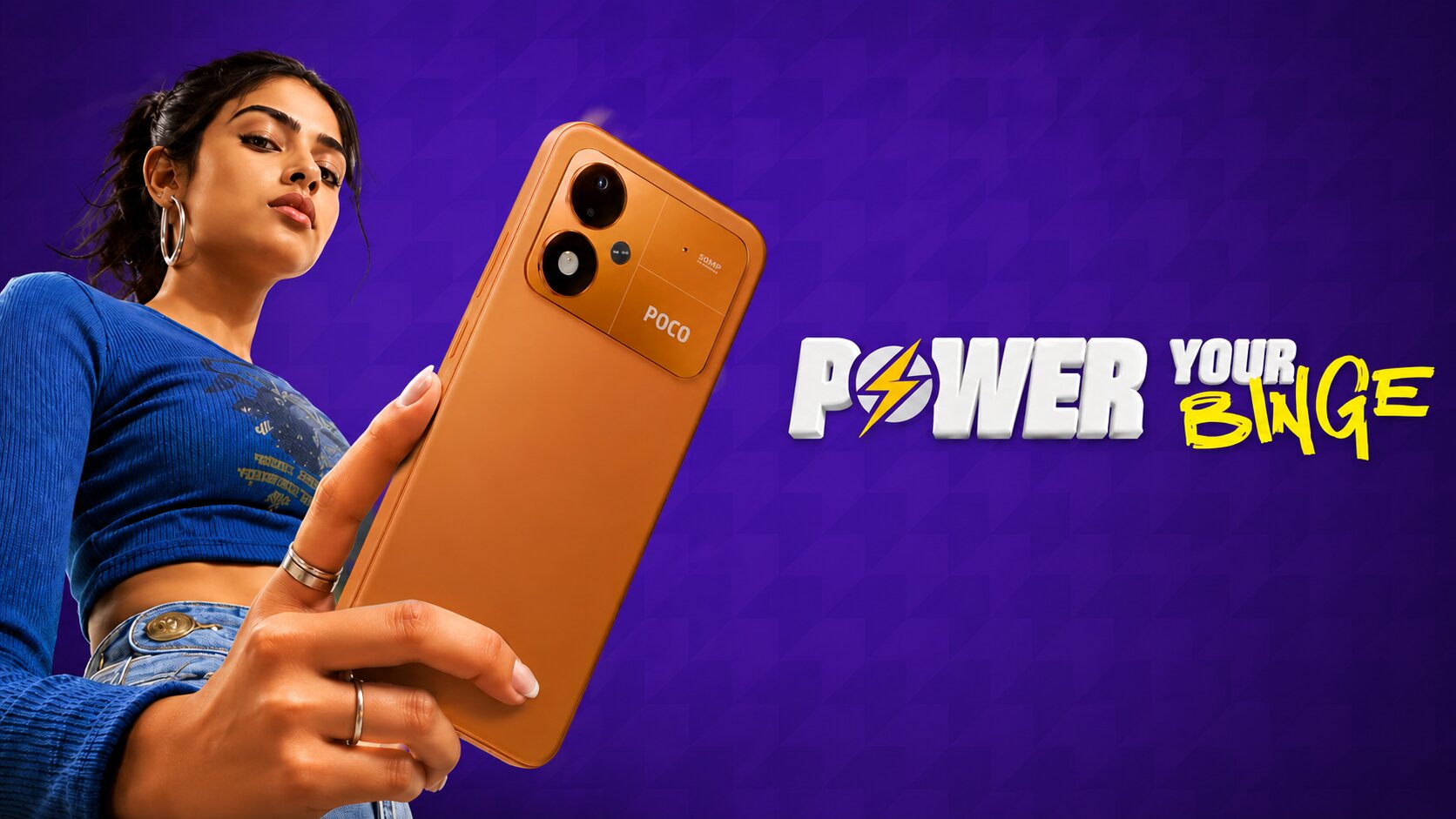
The Poco M8 Power takes a familiar design language and gives it an energetic twist. The star of the show is that orange colourway — it’s bright, unapologetic, and carries the same bold personality Poco has been building since the F1 days. The rear panel has a textured finish that adds grip and resists fingerprints, which matters more than you’d think on a phone this size.
Speaking of size, this thing is not small. At 169.7mm tall, 79.1mm wide, and 8.26mm thick, the M8 Power is chunkier than your average mid-ranger. Xiaomi/Poco claims a weight under 220g, but the 8,000mAh battery means there’s no getting around the heft. It’s substantial without being uncomfortable, though one-handed use is out of the question for most people.
Build quality feels solid. The frame is polycarbonate, but the textured back and Gorilla Glass 7i front protection give it a durable feel. An IP65 rating means it handles dust and water splashes — not enough for a dunk, but fine for rain or accidental spills. There’s a side-mounted fingerprint scanner embedded in the power button, and it’s fast and reliable. A welcome inclusion for this price bracket.
Port layout is standard: USB-C on the bottom, volume rocker and power button on the right, IR blaster on the top (a Xiaomi family tradition that’s genuinely useful for controlling ACs and TVs), and a hybrid SIM tray on the left. No 3.5mm headphone jack — increasingly common in this segment, but worth noting if you’re still using wired earphones.
Display
The 7-inch FHD+ (2,396 × 1,080) OLED panel is the biggest screen Poco has put on an M-series phone, and it’s a highlight. The move to OLED means deep blacks, vibrant colours, and excellent contrast. Poco claims up to 1,800 nits of peak brightness, which is well beyond what you’d expect at this price point.
The 120Hz refresh rate makes scrolling through social feeds, navigating the UI, and browsing the web feel fluid. The 240Hz touch sampling rate (with a 2,160Hz instant touch sampling rate for gaming) means the display is responsive to fast inputs. Combined with the 7-inch real estate, this is a phone that excels at media consumption. Watching movies, playing games, or even reading long articles feels immersive in a way that smaller screens don’t quite deliver.
Outdoor visibility is strong. Those 1,800 nits peak brightness numbers translate to real-world usability under direct sunlight. Adaptive brightness works well with the ambient light sensor, and there’s DC dimming support at lower brightness levels for eye comfort during late-night scrolling.
One trade-off: at 7 inches and with the curved edges, this isn’t a phone you can comfortably use with one hand. You’ll develop a two-handed grip quickly, and that’s fine — the M8 Power is designed for people who prioritize screen real estate over pocketability.
Performance
Under the hood, the Poco M8 Power runs on the Qualcomm Snapdragon 4 Gen 4 chipset, built on a 4nm process. This is an entry-level-to-mid-range processor paired with an Adreno 613 GPU, up to 8GB of LPDDR4X RAM, and UFS 2.2 storage (128GB or 256GB, expandable via the hybrid microSD slot).
Let’s be honest about what this chip can do. In day-to-day use — messaging, social media, YouTube, Google Maps, browsing — the Snapdragon 4 Gen 4 handles everything smoothly. HyperOS 3 on top of Android 16 feels fluid, with app opening times that don’t make you wait. The 120Hz display helps a lot here; even a mid-range chip feels snappy when the UI is this responsive.
Gaming is where the limits show. Casual games like Subway Surfers, Candy Crush, or even Call of Duty Mobile at medium settings run fine. But push to heavy titles like Genshin Impact or BGMI at high settings and you’ll notice frame drops and occasional stutter. The Adreno 613 isn’t built for sustained high-performance gaming, though the phone’s thermal management is decent — it gets warm but not uncomfortably hot during extended sessions, helped by the physical space the large battery occupies.
For benchmark context, the Snapdragon 4 Gen 4 scores around 430,000 on AnTuTu 10 and about 2,800 on Geekbench 6 (multi-core). Those numbers place it comfortably above the Snapdragon 6 Gen 3 in the vanilla Poco M8, but well below the Dimensity 6360 Apex in the OnePlus N6 or the Snapdragon 8 Gen 5 in the vivo X300 E. If you need raw performance numbers, I covered how to run Geekbench 7 on your phone here.
Storage speeds are adequate. UFS 2.2 isn’t the fastest in 2026, but app installations and file transfers don’t feel sluggish. The hybrid microSD slot accepts cards up to 1TB, which is handy given the internal storage options max out at 256GB.
Camera
The Poco M8 Power ships with a single 50MP main rear camera (f/1.8 aperture) — no ultrawide, no macro, no telephoto. Just one sensor with an LED flash and “50MP AI Camera” branding on the rear. Up front, there’s an 8MP selfie shooter.
Daylight performance from the main camera is solid for the price. The 50MP sensor (likely a Samsung ISOCELL JN1 or similar) captures detail well in good lighting. By default, it pixel-bins to 12.5MP, producing cleaner shots with better dynamic range. Colours lean slightly saturated — a Xiaomi/Poco signature — but they’re pleasant and social-media-ready without looking unnatural.
Low-light photography is where the compromises show. Without OIS (optical image stabilization), night shots require a steady hand. Poco’s Night Mode helps by stacking multiple exposures, but it takes a few seconds to process and moving subjects blur easily. It’s usable for well-lit street scenes at night, but don’t expect flagship-level results.
The biggest absence is an ultrawide camera. At this price point (around ₹30,000 / $350), most competitors include at least an 8MP ultrawide. Poco’s decision to go with a single rear camera is the most obvious cost-cutting measure, and it limits creative flexibility. Want a group photo in a tight space? You’ll be stepping backward a lot.
The 8MP selfie camera is adequate for video calls and social media. Detail is decent in good light, but it struggles in low light and the fixed-focus lens means you need to find the sweet spot distance. Video recording tops out at 1080p/30fps for both front and rear cameras, which is behind the competition — many phones in this bracket now offer 4K/30fps on the main camera.
That said, for the primary use case of someone buying this phone — media consumption, battery life, and general daily use — the camera is “good enough.” It captures memories. It’s not going to win any photography awards, but it won’t embarrass you either.
Battery & Charging
This is the headline feature, and it delivers. The 8,000mAh silicon-carbon battery is genuinely massive — larger than the 7,200mAh cell in the vivo X300 E, matching the 8,000mAh in the OnePlus N6, and closing in on the 9,000mAh monster in the Redmi Note 17 Pro.
In real-world testing, the M8 Power comfortably delivers two full days of moderate use. Heavy users — constant video streaming, GPS navigation, hotspot sharing — will still get through a full day with 20-30% remaining at bedtime. Poco’s claim of “up to three days” is achievable with lighter use: messaging, occasional calls, some YouTube, and social media.
The 45W wired charging charges the 8,000mAh battery from 20% to 100% in about 1 hour 20 minutes, which is reasonable given the sheer capacity. A 30-minute top-up gets you from near-empty to about 50-55%, which is enough for a full day of use. The 45W charger is included in the box — a shrinking courtesy in the smartphone industry.
Then there’s 22.5W reverse wired charging — and this is where the M8 Power becomes more than just a phone. Plug in your wireless earbuds case, a friend’s depleted phone, or even a smartwatch, and the M8 Power acts as a power bank. That 8,000mAh battery has enough overhead to fully charge most phones once and still have juice left for a day of use. I’ve been using reverse wireless charging on flagships for years, but having it as a wired-out standard on a sub-₹30,000 phone is genuinely practical.
One note: the phone supports passthrough charging — you can use it while plugged in without degrading the battery health — a nice touch for heavy users who game or stream while charging.
Software
The Poco M8 Power runs HyperOS 3 on top of Android 16 out of the box. This is the latest version of Xiaomi’s custom skin, and it’s noticeably cleaner than earlier HyperOS builds. The notification shade is less cluttered, the settings menu is better organized, and the overall animation smoothness has improved.
HyperOS 3 brings some genuinely useful features: a redesigned control center with toggles that make sense, improved widget support on the home screen, and better multitasking with floating windows and split-screen. The game mode toolbar is handy for blocking notifications and taking screenshots during gameplay without leaving the app.
Bloatware is still present — there are pre-installed apps like Facebook, Amazon, and a few Flipkart-specific ones — but the volume has decreased compared to older Poco phones. Most can be uninstalled, and the ones that can’t (like the Mi Browser and GetApps store) can at least be disabled.
Xiaomi has committed to four years of Android updates and six years of security patches. That brings the Poco M8 Power up to Android 20 in terms of software support, with security updates through 2032. For a phone in this price bracket, that’s a meaningful commitment and puts it on par with Samsung’s mid-range offerings.
The IR blaster on top works with Xiaomi’s Mi Remote app, which supports most TV, AC, and set-top box brands. It’s one of those features you don’t think you need until you need it, and then it’s surprisingly convenient.
Pros and Cons
| Pros | Cons |
|---|---|
| Exceptional 8,000mAh battery with real two-day endurance | No ultrawide camera limits creative flexibility |
| Bright 7-inch OLED display with vibrant colours | Snapdragon 4 Gen 4 struggles with heavy gaming |
| Sturdy build with IP65 dust/water resistance | No 3.5mm headphone jack |
| 22.5W reverse wired charging doubles as a power bank | Single 8MP selfie camera is behind competitors |
| Cleaner HyperOS 3 with four-year update commitment | Big and heavy — not for small hands or tight pockets |
| IR blaster, expandable storage, and included 45W charger | Video recording limited to 1080p/30fps |
| Bright orange colour option stands out from the crowd | No wireless charging despite the large battery |
Should You Buy This?
Buy it if:
- Battery life is your number one priority — this is among the longest-lasting phones in its price bracket
- You watch a lot of videos, movies, or play casual games on your phone — the 7-inch OLED display shines for media consumption
- You need a phone that can charge other devices — the 22.5W reverse wired charging is genuinely useful
- You prefer bold, distinctive colours over generic black or silver slabs
- You value expandable storage and headphone-jack alternatives (USB-C audio)
Skip it if:
- You take a lot of photos and need versatility — the single main camera and missing ultrawide will frustrate you
- You’re a heavy gamer who plays demanding titles like Genshin Impact or Warzone Mobile
- You want the most compact, pocket-friendly phone — the M8 Power is large and heavy
- You need 4K video recording or high-quality selfies
- Wireless charging is a must-have for your workflow
Final Verdict
The Poco M8 Power is a phone that knows exactly what it is and who it’s for. It doesn’t try to be a flagship killer — it doesn’t have the chipset, camera versatility, or premium build materials to compete at the top end. Instead, it picks one thing and executes it brilliantly: battery life, paired with a fantastic display for consuming media on that massive battery.
At an expected price of around ₹29,990 (~$350), it sits in an interesting spot. The OnePlus N6 (also ₹29,999) offers a Dimensity 6360 Apex chipset with better gaming performance and a 108MP main camera, but a lower-resolution display and the same single-camera limitation. The vivo X300 E starts higher at ₹34,999 but brings a Snapdragon 8 Gen 5, Zeiss-tuned dual cameras (including periscope zoom), and wireless charging. And the Redmi Note 17 Pro offers a 9,000mAh battery, IP69K durability, and a 120Hz AMOLED for under ₹25,000 but lacks OLED-level colour accuracy and modern connectivity.
I’ve been testing this phone as my secondary device, and what strikes me most is how liberating it feels to not think about battery life. I charged it fully on a Monday morning. By Wednesday evening, I still had 35% left — and that was with GPS navigation during commutes, YouTube at lunch, and social media throughout the day. The reverse charging feature turned out to be more useful than I expected: I charged a colleague’s earbuds case at a meeting and saved him from a dead-battery afternoon.
If your phone buying decision starts with “how long will this last on a charge?” and ends with “how good is the screen for watching stuff?”, the Poco M8 Power is an easy recommendation. It’s not the phone for photographers or mobile gamers. But for the rest of us — the people who just want a phone that doesn’t die before dinner — it delivers where it matters most.
For more comparisons, check out my full reviews of the OnePlus N6 and the vivo X300 E if you’re weighing your battery-first mid-range options in mid-2026. And if you’re wondering how the 7-inch OLED stacks up against other displays I’ve tested, the Samsung Galaxy Z Flip 8 review covers foldable AMOLED quality from the premium end of the spectrum.