
Design & Build Quality
The HMD Pulse Pro 2nd Edition does not try to hide its lineage. From the front, it is indistinguishable from the 2024 original — a 6.56-inch slab with centered punch-hole, slim bezels that feel generous by 2026 standards, and a flat frame that eschews the curved-glass trend. The back is where the budget DNA shows: a glossy polycarbonate panel that picks up fingerprints immediately, paired with a vertical pill-shaped camera island housing two lenses and a flash. At 196 grams and 8.55mm, it sits comfortably in the hand without ever feeling premium.
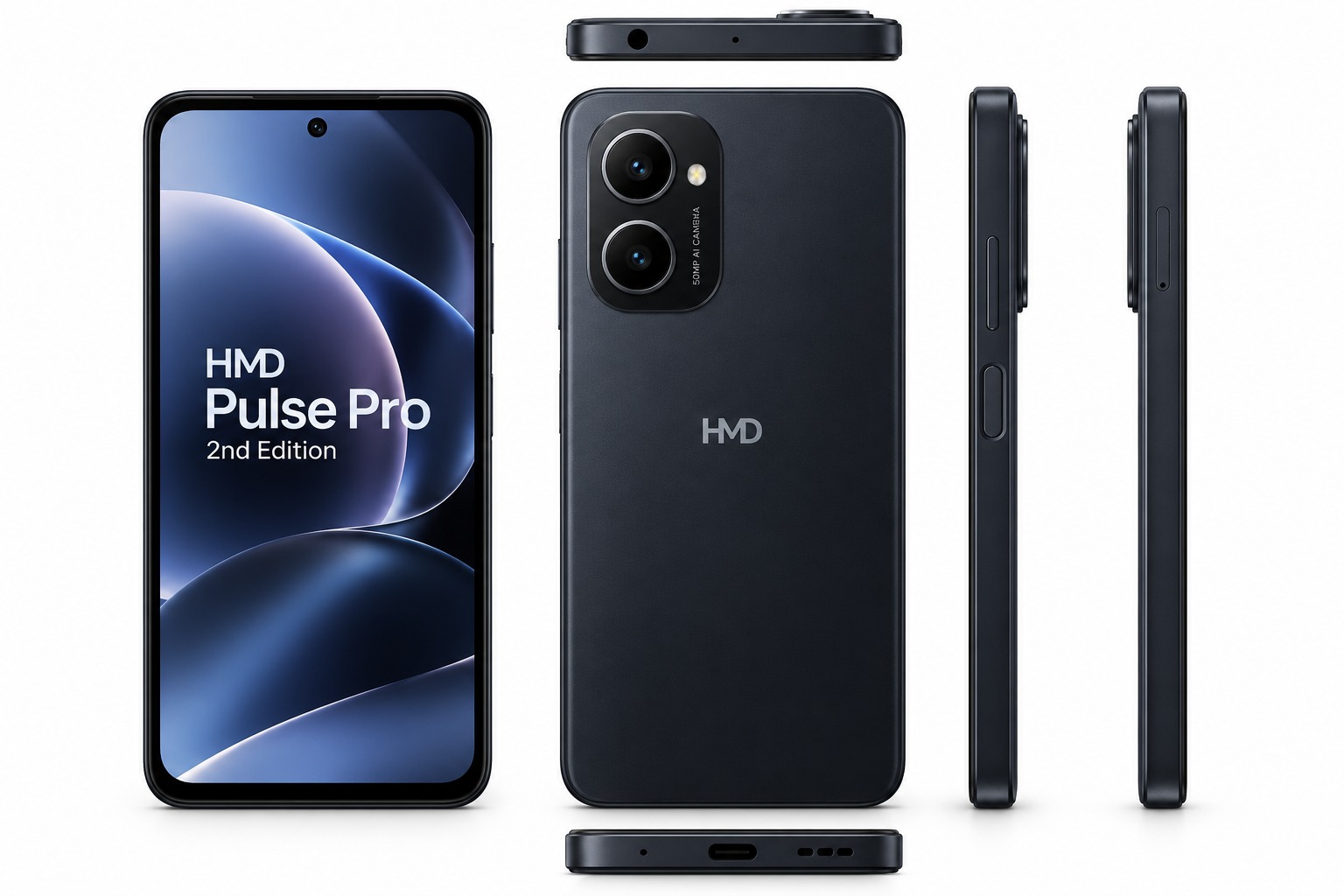
Three colour options are expected — Black Ocean, Twilight Purple, and Glacier Green — based on the original lineup. The Thai retailer listing shows only black so far, but HMD has historically kept the palette stable across refreshes. One detail HMD got right is the 3.5mm headphone jack, a rare sight at any price in 2026. You also get a USB-C 2.0 port with OTG support and a side-mounted fingerprint sensor built into the power button.
Durability is where compromises appear. The original Pulse Pro carried an IP52 rating — basic splash resistance against dripping water, but no dust-tight claim and no immersion rating. There is no reason to expect the 2nd Edition to improve on that, and HMD has not said otherwise. For a device aimed at emerging markets and cost-conscious buyers, that is acceptable, but do not mistake it for flagship-grade protection.
Display
The screen is the biggest upgrade. HMD is bumping the refresh rate from 90Hz on the 2024 model to 120Hz here, which makes scrolling and casual gaming noticeably smoother. The panel remains a 6.56-inch IPS LCD with a 1612 × 720 HD+ resolution. That is still soft by modern mid-range standards — the 270 ppi pixel density means text edges are visible if you look for them — but the jump from 90Hz to 120Hz is the change users will feel every day.
Brightness is unchanged at 480 nits typical, with a 600-nit boost mode. That is adequate indoors and under shade, but direct sunlight will force you to squint. HDR support is not advertised, so treat this as a standard LCD for media consumption. PWM dimming details have not been disclosed, but the original used DC dimming without a high-frequency option — budget IPS panels rarely do.
Performance
Under the hood, the Helio G99 is the star of the refresh. It is a 6nm chip with an octa-core CPU — two Cortex-A76 performance cores at 2.2 GHz and six Cortex-A55 efficiency cores at 1.8 GHz — paired with a Mali-G57 MC2 GPU. HMD claims it is 45 percent faster than the Unisoc T606 in the original. That figure sounds dramatic until you remember the T606 was a 12nm entry-level part; the G99 is simply moving this phone from the bottom of the mid-range pile into the lower-middle tier.
Day-to-day use is smooth enough for social media, messaging, light browsing, and casual games like Candy Crush or Subway Surfers. The 8GB RAM is the real enabler here — the original started at 4GB — and 256GB of storage means you will not be juggling apps to free space. There is no microSD slot mentioned in the retailer listing, but the original supported expansion up to 256GB, and that is a safe assumption to carry forward unless HMD says otherwise.
Benchmark data is not yet available for the 2nd Edition, but the G99 typically scores around 210,000–220,000 in AnTuTu. That places it well behind the Snapdragon 8 Elite Gen 5 found in the OnePlus Ace 7 Pro and the Snapdragon 7s Gen 3 expected in rivals like the Motorola Signature 27. If raw speed is your priority, the Pulse Pro 2nd Edition will feel adequate, not exciting.
Camera
The camera story is muddled, and that is the review’s biggest frustration. The Thai retailer listing says the 2nd Edition pairs a 50MP main with a 50MP selfie camera and “AI Camera” branding. The original Pulse Pro had a 50MP main plus a 2MP depth sensor and a 50MP front camera. A separate leak from the same tipster suggests the rear array might include OIS on the main sensor alongside a 2MP auxiliary — a meaningful upgrade if true.
Without official confirmation from HMD, the honest read is this: expect a 50MP main with OIS, likely paired with a 2MP depth sensor, and a 50MP front camera. The 2MP sensor is almost certainly a depth mapper rather than a macro, so do not expect versatile second-eye photography. In good light, the 50MP main should capture decent detail for social media. Low-light performance will be limited by the sensor size and the G99’s modest ISP. Video tops out at 1080p 30fps, which is par for this price bracket in 2026.
The front-facing 50MP camera is a genuine highlight at this price. HMD marketed the original as a “selfie-lover’s phone,” and the sequel keeps that identity with AI Super Portrait, Night Selfie, and gesture controls. If you buy this phone for TikTok and Instagram, the front camera will satisfy.
Battery & Charging
Here is the review’s honest core: the 5,000mAh battery and 20W charging are unchanged from the 2024 original. HMD claims “up to 59 hours” of battery life on the original, and the 2nd Edition’s more efficient 6nm chip should stretch that slightly, but the charger in the box will take well over two hours for a full top-up. In a market where sub-$200 phones from Xiaomi and Realme ship with 67W or 100W adapters, 20W feels nostalgic rather than practical — the Honor X9e Pro 5G already proves that budget builds can carry 11,000mAh cells without compromising durability.
The battery is user-replaceable via HMD’s QuickFix program — a genuine differentiator. HMD sells replacement batteries and ships them with tools, so if your capacity degrades after two years, you are not forced into a new phone. That is a sustainability win that most budget brands ignore.
Software
The original Pulse Pro launched with Android 14 and a promise of two OS upgrades. That path leads to Android 16, which means the 2nd Edition could either launch with Android 16 out of the box or land on Android 15 with one upgrade remaining. HMD has not confirmed the software story for the refresh.
Given that the original is already eligible for Android 16 via update, the 2nd Edition should ship with Android 16 or newer. HMD also promises three years of quarterly security updates. That is solid for a $148 phone, though it lags behind the five-year security commitments from Samsung and Google’s A-series. If you keep this phone for three years, you will stay current; beyond that, you are on your own.
Pros and Cons
| Pros | Cons |
|---|---|
| 120Hz display finally arrives on the Pulse Pro line | HD+ resolution still looks soft compared to FHD+ rivals |
| Helio G99 is a meaningful step up from the T606 | 20W charging is well below the 67W+ norm in 2026 |
| 8GB RAM + 256GB storage is excellent value at $148 | IP52 is only basic splash protection |
| User-replaceable battery via QuickFix program | No 5G — this is a 4G-only device |
| 3.5mm headphone jack and microSD slot retained | Camera specs are still unconfirmed by HMD |
| Three years of security updates promised | No wireless charging or reverse charging |
Should You Buy This?
Buy it if
- You need a no-fuss secondary phone for calls, WhatsApp, and social media
- A 3.5mm jack and microSD slot are non-negotiable
- You value repairability and plan to keep the phone for several years
- Your budget is strictly under $150 and you want 8GB of RAM
Skip it if
- You expect 5G connectivity or fast charging
- You want a sharp display for reading and media
- Camera versatility matters — there is no telephoto lens here
- You can stretch your budget to $250–300 for a Snapdragon 7-series device
Final Verdict
The HMD Pulse Pro 2nd Edition is a textbook mid-cycle refresh: it fixes the original’s biggest weakness — the sluggish 90Hz screen and entry-level chipset — while keeping everything else identical. The Helio G99, 120Hz panel, and doubled storage make this a genuinely usable budget phone in 2026, not just a placeholder. At THB 4,990, it undercuts most competing 4G budget phones on RAM and storage alone.
But the unchanged 5,000mAh battery and 20W charging are hard to swallow when the rest of the industry has moved on. If HMD had bumped the charging to 45W and added IP52 dust-tight certification, this would be an easy recommendation. As it stands, the Pulse Pro 2nd Edition is the right phone for a very specific buyer: someone who wants a simple, repairable, jack-equipped handset for under $150 and does not mind waiting for a full charge. For everyone else, the extra $100 spent on a Snapdragon 7s-gen device with 5G and faster charging will pay dividends within the first month — especially when the Poco X8s already offers IP68 and a periscope telephoto at $399.
The “AI Camera” branding is marketing fluff, and the unconfirmed rear camera spec is a reminder that HMD has not yet officially acknowledged this phone exists. Treat the 2nd Edition as a leak-backed buying decision for now, and wait for an official announcement before committing if you need absolute spec certainty. The hardware foundation is sound; the execution is just shy of what the price could have delivered.