
The Primera Nameplate Returns — As an Electric Sedan From China
Nissan is bringing back the Primera. After an 18-year absence from the market, the familiar nameplate reappears on November 6, 2026 — not as a gasoline sedan, but as a fully electric executive car. The Nissan Primera EV debuts alongside the Navara Pro PHEV at a time when Filipino buyers finally have credible EV alternatives to the usual imports. What makes this launch different is where it comes from: the Primera EV is built in China through Nissan’s joint venture with Dongfeng, marking the first time a Japanese brand imports a passenger car from China for the Philippine market.
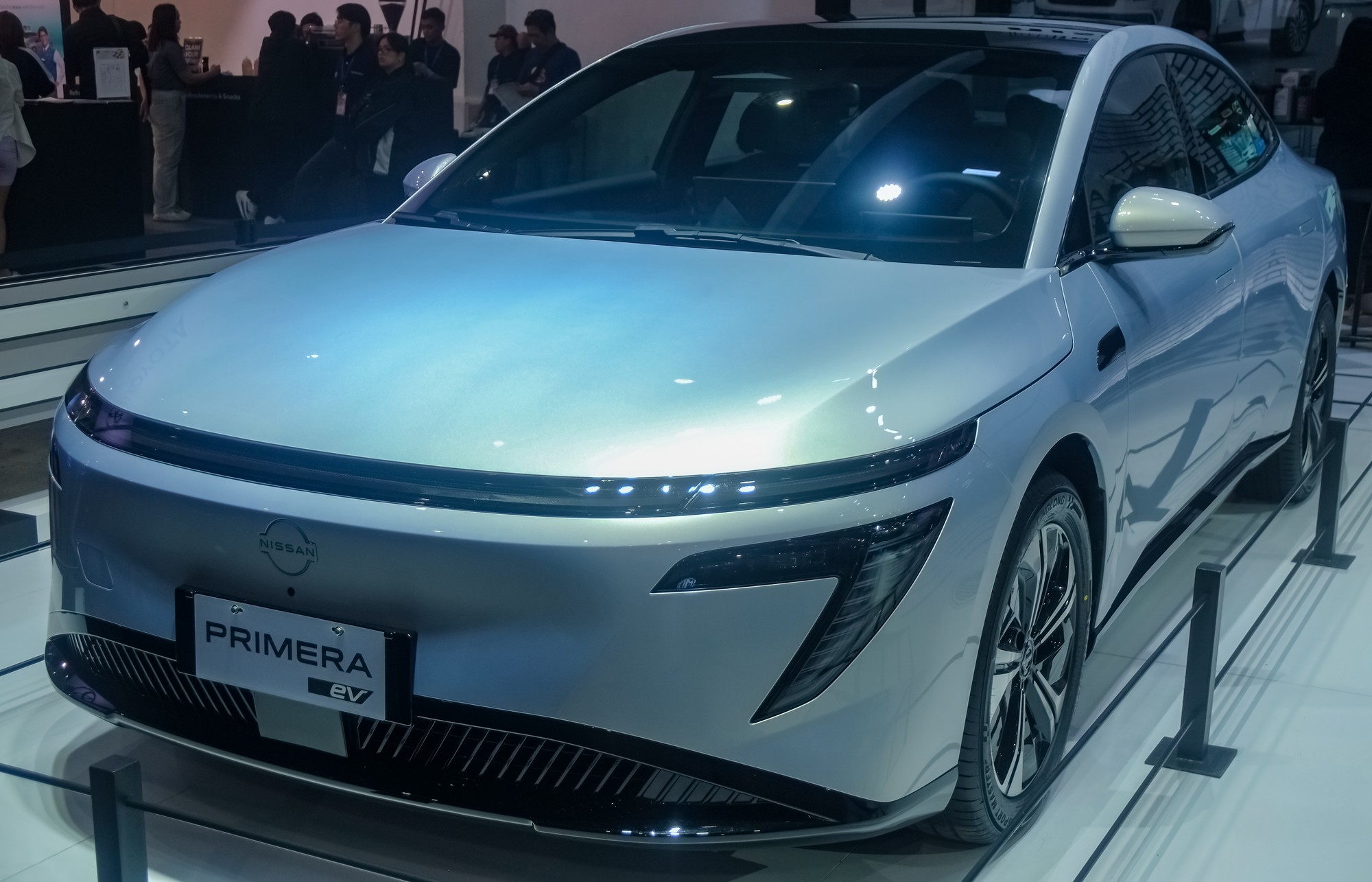

The strategy is deliberate. Nissan’s leadership explained that domestic Japanese production no longer supports large sedans and pickup trucks in the volumes the company needs. By developing the Primera EV and Navara Pro PHEV through the Dongfeng Zhengzhou plant, Nissan taps into China’s faster development cycles and established battery supply chains — while insisting the vehicles still meet global Nissan engineering standards. For Filipino buyers, the practical question is whether that Chinese-built badge actually matters behind the wheel.
Primera EV Specs at a Glance
The Primera EV is a mid-size executive sedan with a focus on comfort and technology. Below are the key figures Nissan has confirmed for the Philippine market, sourced from the Department of Energy listing and Nissan’s official spec sheets.
| Specification | Detail |
|---|---|
| Motor | Front-mounted permanent magnet synchronous |
| Power | 218 PS (160 kW) / 215 hp |
| Torque | 305 Nm |
| Drive | Front-wheel drive |
| Battery | 58–60 kWh LFP |
| Range | Up to 500 km (NEDC / DOE figure) |
| DC Fast Charging | 150 kW peak, 10–80% in 14–19 min |
| AC Charging | Not yet published for PH variant |
| Dimensions | 4,930 x 1,895 x 1,487 mm |
| Wheelbase | 2,915 mm |
| Ground Clearance | Not yet published for PH variant |
| Cargo | Not yet published for PH variant |
| Platform | 400V architecture |
| Infotainment | 15.6-inch 2.5K touchscreen, Snapdragon 8295P |
| ADAS | Nissan ProPilot |
| Audio | 12-speaker system |
Note: Some figures — particularly ground clearance, cargo volume, and AC charging speed — have not been released by Nissan Philippines as of this writing. The 500 km range figure is the DOE-listed number; the cycle used is not specified.
Pricing: No Official SRP Yet, but Here Is the Math
Nissan Philippines has not announced pricing for the Primera EV ahead of its November 6 launch. Based on its size, battery size, and feature set, industry observers expect an introductory price between ₱1.9 million and ₱2.3 million. That would place it between the Hyundai Ioniq 5 and the Porsche Cayenne Electric, while undercutting the Tesla Model 3 Long Range by roughly ₱100,000–₱300,000 if Nissan lands near the lower end.
For buyers comparing currencies, here is how that range converts at approximate mid-market rates (PHP/USD ≈ 64.0, USD/INR ≈ 95.2 as of late October 2026):
| Currency | Low End | High End |
|---|---|---|
| PHP | ₱1,900,000 | ₱2,300,000 |
| USD | ~$29,700 | ~$35,900 |
| INR | ~₹28.3 lakh | ~₹34.2 lakh |
These are estimates only. Exchange rates and the final SRP will differ. Verify at launch.
What Makes the Primera EV Different From the Navara Pro PHEV
Nissan is launching two electrified nameplates on the same day, but they target completely different buyers. The Navara Pro PHEV is a body-on-frame pickup with a 32.85 kWh battery, 408 horsepower, and 135 km of electric-only range — built for buyers who need a workhorse that can also commute emission-free on weekends. The Primera EV, by contrast, is a unibody sedan aimed at professionals and families who want a smooth, tech-forward daily driver with genuine highway range.
Think of it this way: the Navara Pro is the rugged sibling you take to job sites; the Primera EV is the sophisticated sibling you take to dinner and weekend drives to Baguio. They share the same China-born engineering philosophy, but their missions are opposites.
Filipino Driving Conditions: City, Province, Floods, and Heat
City Driving
The Primera EV’s 305 Nm of instant torque is perfectly suited for EDSA stop-and-go traffic. EVs excel in the city because they recapture energy during deceleration, and the Primera’s 500 km range means you will not be hunting for a charger between Alabang and Makati. The 18-inch wheels and frameless doors give it a sleek profile, but buyers should watch the ground clearance figure closely once Nissan publishes it. The Philippines’ notorious potholes and flooded underpasses can eat into low-slung sedans.
Long-Distance Travel
A 500 km range covers Manila to Baguio in a single charge with margin to spare, assuming climate control is used moderately. The 150 kW DC fast charging capability means a 10–80% top-up in roughly 14–19 minutes — fast enough to stretch your legs at a NLEX or SCTEX charging stop without turning a three-hour trip into a five-hour one. That puts the Primera EV in the same charging league as the Suzuki e-Vitara and ahead of many lower-voltage competitors.
Flooded Situations
Nissan has not published an IP rating for the Primera EV’s battery enclosure, nor a wading depth specification. This is a critical gap. The EV advantage — no intake manifold to hydrolock — means you are less likely to destroy the motor in deep water compared to a gasoline car, but the battery pack’s seals and low-voltage electronics remain vulnerable. Until Nissan clarifies this, treat the Primera EV like any other sedan: avoid flooded underpasses deeper than the bottom of your door sill.
High Temperature
The Primera EV uses a lithium iron phosphate (LFP) pack, which is inherently more thermally stable than NMC chemistry. LFP batteries handle 36–38 °C ambient heat better and are less prone to degradation from repeated fast charging in hot weather. That matters here. The 12-speaker audio system, panoramic glass roof, and ventilated front seats will add cabin comfort during peak summer, but they also draw power. In extreme heat with full AC, real-world range will drop below the 500 km claim — expect 400–430 km in worst-case scenarios, which is still ample for daily use.
What Others Are Saying
CleanTechnica’s Raymond Tribdino, who covers ASEAN mobility extensively, frames the Primera EV as part of a larger strategic pivot: “Nissan is anchoring its Philippine electrified lineup on products developed in China, turning to its joint venture with Dongfeng Motor to bring the Navara Pro Plug-in Hybrid and Primera EV sedan to the local market.” He notes that the Philippines was chosen as the lead ASEAN destination because both countries operate on left-hand-drive systems, enabling immediate deployment.
Autocar Philippines points out that the Primera EV gives Nissan “a much-needed revamp” and a challenger in a segment dominated by VinFast and Tesla in CAMPI sales tracking. The reviewer highlights the illuminated emblem, frameless doors, and Zero Gravity seats as premium differentiators, while noting the two-airbag limitation as a downside for a sedan in this price bracket.
The Bigger Picture: Nissan’s China Export Playbook
The Primera EV is not an isolated product. It is the first wave of Nissan’s “From China” export strategy — a plan to use China as a development hub and production base for markets where domestic Japanese manufacturing does not make economic sense. The Dongfeng Zhengzhou plant churns out vehicles at lower cost and faster cycle times than Japanese domestic plants, and Nissan is betting that global engineering standards will reassure buyers who might otherwise dismiss a “Made in China” badge.
For the Philippines, this strategy could reshape the EV landscape. If the Primera EV lands near ₱1.9 million with 500 km of range, ProPilot, and a 12-speaker audio system, it will be one of the most feature-dense executive sedans in the market. The battery chemistry and power demand discussion becomes real here: an LFP pack in a large sedan means Nissan is prioritizing cost and thermal stability over energy density — a sensible trade for Filipino buyers who care more about surviving afternoon traffic and weekend drives than setting Nürburgring lap times.
Bottom Line
The Nissan Primera EV arrives in nine days with confirmed specs, no official price, and a compelling story about how the auto industry is restructuring its supply chains. If you are in the market for an executive EV and want something distinct from the usual Tesla and BYD options, this is a genuinely fresh entry. Just wait for the November 6 launch before signing anything — the price could shift the whole segment.