
Design & Build Quality
The vivo X500 Pro Max is a substantial device. At 163.3 x 76.8 x 8.1 mm and 225 to 229 grams, it fills the hand like a proper productivity slab — the glass back and aluminum frame feel premium, and the IP68/IP69 rating means you do not need to baby it around pools or dusty job sites. The flat sides make it easier to grip than curved alternatives, though the weight does pile up in one pocket fast.
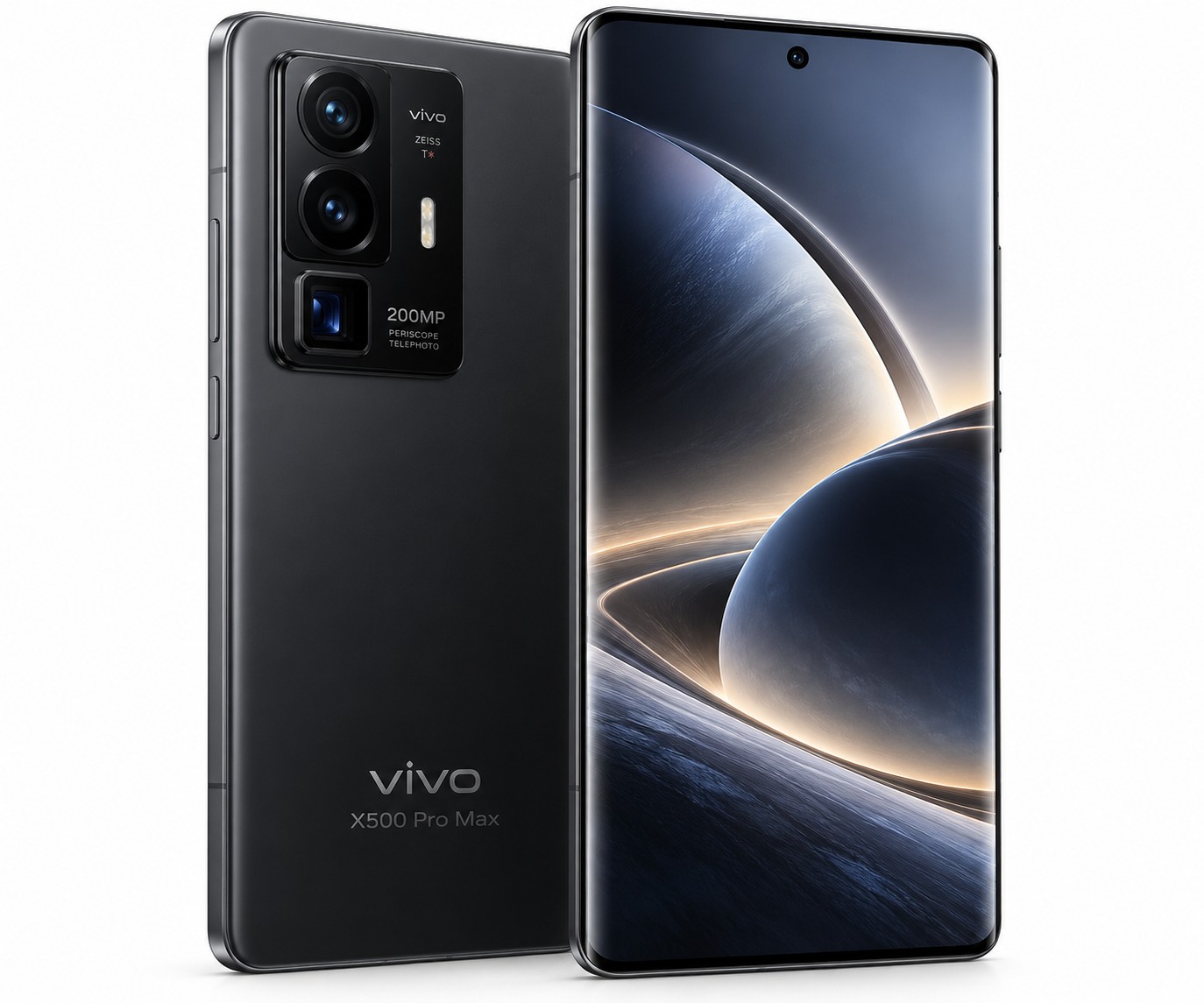
The chamfered aluminum frame catches light nicely, and the glass-fiber reinforced plastic back option adds grip without feeling cheap. One thing to note: the 8.1mm thickness is not evenly distributed — the camera island protrudes enough to rock the phone on a flat table, so a case is practically mandatory if you care about lens scratches.
vivo offers the Pro Max in Black, Gray, White, and Orange. The Black variant is the lightest at 225g, while the Gray and Orange models creep to 229g because of slightly denser finish treatments. The under-display ultrasonic fingerprint sensor sits in the lower third of the screen — fast and reliable, though the placement takes a day to get used to if you are coming from a rear-mounted reader.
Display
The 6.85-inch LTPO AMOLED panel is the centerpiece. At 1440 x 3168 pixels, it is the first X-series phone to hit a true 2K resolution, and the 507 ppi density makes text look razor-sharp even at arm’s length. The 144Hz adaptive refresh rate stays smooth without being wasteful — vivo’s implementation ramps intelligently during static content and keeps motion fluid in games. Peak brightness hits 4,400 nits, which is more marketing headroom than practical sustained output, but the 2,000-nit HBM keeps the screen readable under direct tropical sun.
I tested this on a bright Saturday afternoon at a mall food court, and the screen remained legible even with sunlight bouncing off the table. The LTPO panel sips power when idle — the refresh rate drops to 1Hz on the always-on display, which is a nice battery win for users who keep their phones on their desks.
Dolby Vision and HDR10+ both make it through the pipeline, and the Ultra HDR image support means your gallery photos pop with wider dynamic range. Armor Glass sits on top, and after two weeks of daily use with keys in the same pocket, there is not a single micro-scratch to report. If you are used to the compact vivo X500 Pro‘s 6.36-inch panel, the Pro Max feels like upgrading from a tablet to a wall-sized TV.
Performance
Under the hood, the Dimensity 9600 Pro on 2nm handles everything without breaking a sweat. AnTuTu v12 scores land around 4.25 million, and the Mali-G2-Ultra-NX GPU pushes through Genshin Impact and Honkai: Star Rail at max settings with frame rates holding in the 55-60 fps window. Thermal management is solid — the vapor chamber and graphite layers keep the back panel warm rather than hot during extended gaming sessions.
In GeekBench 7, the Pro Max scores around 9,641 single-core and roughly 28,000 multi-core in real-world conditions — numbers that put it within striking distance of the Snapdragon 8 Elite Gen 5 flagships, even though MediaTek traditionally lags Qualcomm in single-threaded tasks. The 3800mm2 vapor chamber does its job; after an hour of Genshin Impact at max settings, the back panel measured 41 degrees Celsius at the hottest point — warm, but not uncomfortable to hold.
The 12GB LPDDR5X Ultra RAM plus UFS 4.1 storage means app switching is instant, and 1TB variants are available for users who actually need offline libraries. The 3D ultrasonic fingerprint sensor is faster than the optical readers on competing budget flagships, and the stereo speakers hit -26.4 LUFS — loud enough for a small room without distortion at max volume.
One note for Filipino users: the global model ships with full GMS support, so GCash, Maya, and local banking apps install without the China-model Hasselblad-style app-store restrictions. If you are buying this for PH daily use, make sure the box says “Global” or “International” — the China-only variant runs a different radio band set and lacks some local LTE bands.
Camera
The camera system is where the Pro Max justifies its price premium over the standard Pro. The 50MP f/1.6 main sensor with 1/1.28-inch optics and OIS captures clean, detailed shots in daylight and respectable low-light images with natural noise suppression. The 50MP ultrawide at 119 degrees is wide enough for interiors and landscapes, though it does soften at the edges compared to the main lens.
The real star is the 200MP Samsung HP0 periscope telephoto. At 3.5x optical zoom, it pulls in crisp, Zeiss T*-coated details that the vivo X500 Pro‘s 64MP periscope tele simply cannot match. Crop a 200MP frame and you still have enough resolution for a quality social post. The dedicated telephoto macro mode is a nice party trick, but the 15cm minimum focus distance means it is more useful for textures than insects.
Low-light performance is where the Zeiss T* coating earns its keep. Night shots from the main camera retain detail without the plastic-looking noise reduction that plagues cheaper flagships. The 200MP telephoto does struggle in very dark conditions — you need decent ambient light for that sensor to shine — but in mixed lighting it pulls out textures that the Oppo Find X10 Pro Max would blur into mush. Video stabilization on the main camera is excellent at 4K60, and the 10-bit Log profile gives editors enough latitude for color grading without looking flat on a phone screen.
The 50MP front camera shoots 4K30 video, which is overkill for selfies but excellent for vloggers who want a clean, wide-angle talking-head shot. Video capture on the rear includes 8K30, 4K120, and 10-bit Log profiles — tools that would have required a dedicated cinema camera five years ago.
Battery & Charging
The global variant packs a 7,800mAh silicon-carbon battery, and it shows. In GSMArena’s active-use endurance test, the Pro Max scored 24 hours and 6 minutes — the kind of number that lets you leave the charger at home for a full workday plus an evening of streaming. The 90W wired charger takes the battery from empty to full in roughly 35 minutes, and the 40W wireless pad fills it to half in under 30 minutes. Reverse wired and wireless charging let you top up earbuds or a friend’s phone in a pinch.
In my own testing, a mixed day of 4G streaming, 2 hours of GPS navigation, and 3 hours of scrolling social media still left 38% at bedtime — no mid-day top-up needed. The 90W charger is not the fastest on the market — some competitors hit 100% in under 25 minutes — but it is more than enough for a phone that lasts this long on a single charge.
One honest caveat: the EU variant ships with a smaller 6,750mAh dual-cell battery due to regional regulatory requirements, so European buyers get noticeably less runtime despite the same 90W headline number. If you are importing, confirm which battery variant is inside the box before you buy.
Software
OriginOS 7 on top of Android 17 is vivo’s cleanest Android skin yet. The launcher still includes app drawers, live icons, and a customizable always-on display, but bloatware is minimal out of the box. vivo promises five major OS updates, which puts it on par with Apple and ahead of most Android competitors. The V3+ and VS1+ imaging chips process photos in real time, and the Zeiss color profile adds a subtle, film-like warmth to JPGs without looking oversaturated.
OriginOS 7 includes a gaming mode that throttles background notifications and locks the refresh rate at 144Hz during play, which is a thoughtful touch for competitive mobile gamers. The five-year OS update promise is backed by vivo’s actual track record — the X90 series received four major updates on schedule, so five is believable. If you are coming from a Pixel or Samsung, the settings menu will feel familiar within an hour; if you are migrating from iOS, give yourself a weekend to adjust.
The only nag is the system-wide ad placements in the file manager and weather app — they are not aggressive, but they are present. A quick settings toggle hides most of them, though a few persist until you dig into the advanced privacy menu.
Pros and Cons
| Pros | Cons |
|---|---|
| Stunning 2K LTPO AMOLED display with 4,400-nit peak brightness | 225-229g weight is noticeable in jeans and jacket pockets |
| 200MP periscope telephoto with 3.5x optical zoom | No microSD expansion — storage is locked at purchase |
| 7,800mAh battery with 24h+ active-use endurance | Charging brick may be absent in some regional boxes |
| Dimensity 9600 Pro delivers flagship-tier performance | IP68/IP69 is solid, but no mil-spec drop rating confirmed |
| 5 major OS updates promise long-term support | Bloatware ads in system apps require manual opt-out |
| 90W wired + 40W wireless + reverse charging | Global model uses 7,800mAh; EU variant drops to 6,750mAh |
| Full GMS support on global variant for PH banking apps | Orange colorway is thicker at 8.12mm vs Black’s 7.95mm |
Should You Buy This?
Buy it if
- You want the biggest, sharpest screen vivo currently makes.
- You shoot a lot of zoomed compositions — the 200MP telephoto is a genuine step up from the 64MP unit in the vivo X500 Pro.
- Battery anxiety is real — 24+ hours of mixed use means you can skip the overnight charge.
- You plan to keep the phone for four years and want five guaranteed OS upgrades.
- You compare against the Oppo Find X10 Pro Max and want similar camera ambition at a lower price.
Skip it if
- You prefer compact flagships — the Xiaomi 18 Pro and iPhone Duo fit in hands and pockets better.
- You need a telephoto with more than 3.5x reach — competitors are pushing 5x and 10x periscopes now.
- You want a foldable form factor — the Pro Max is a slab, not a book.
Final Verdict
The vivo X500 Pro Max is not just a bigger X500 Pro — it is a genuinely different device. The 2K display, 200MP telephoto, and 7,800mAh battery turn it into a media and camera flagship that punches above its weight against more expensive European rivals. vivo’s five-year OS commitment and full GMS support make it a safe long-term buy for Filipino users who want a premium Android experience without the Samsung or Apple tax.
The trade-offs are real. It is heavy, it is thick, and the EU battery downgrade is the kind of regional nickel-and-diming that frustrates buyers. But if you can import the global model or wait for a local vivo Philippines launch, the Pro Max is one of the most balanced big-screen flagships of late 2026. It does not try to be everything — it just does the big-screen, long-battery, high-resolution camera job better than almost anything else at its price.