
Design & Build Quality
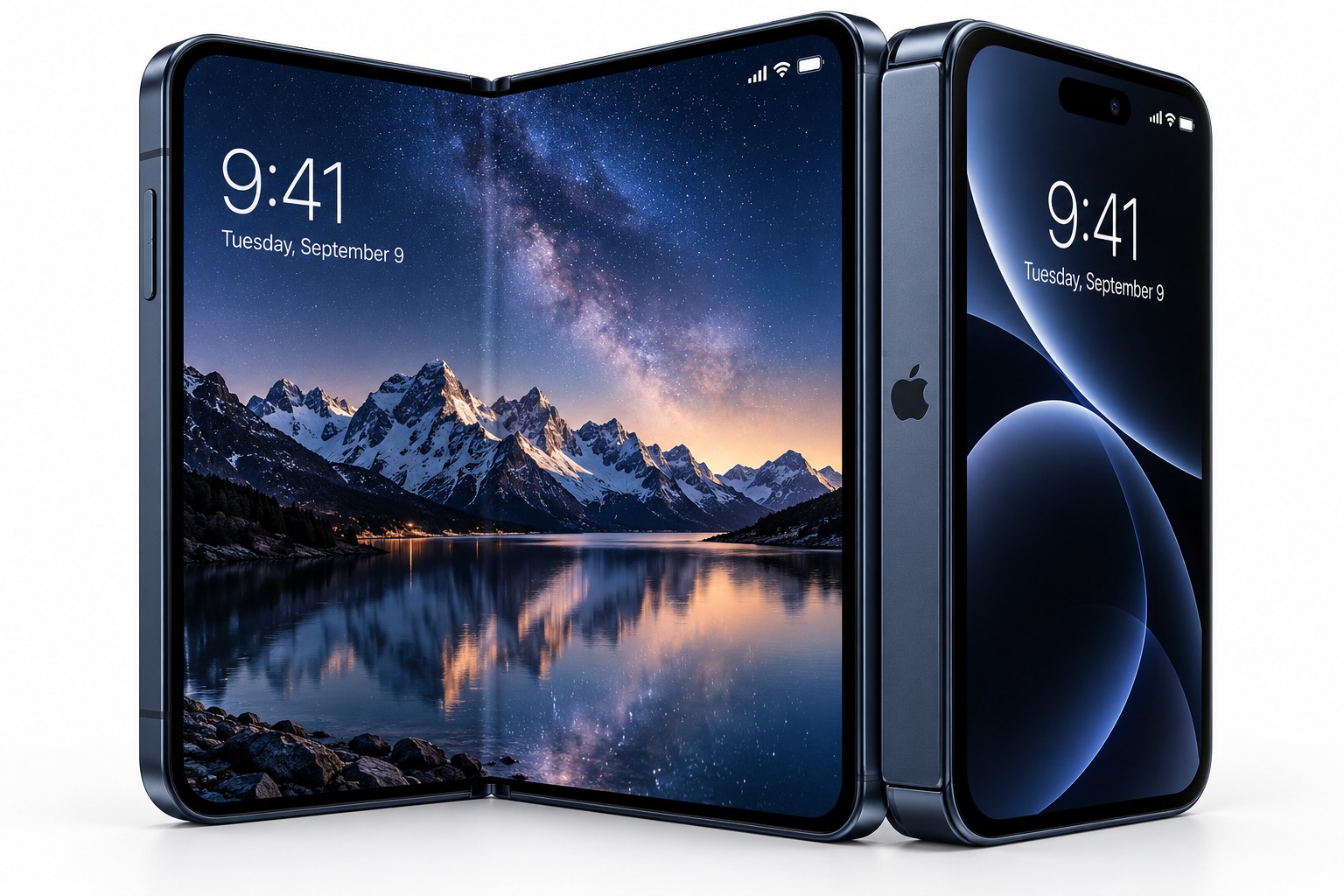
Apple’s first foldable doesn’t look like an experiment — it looks like an iPhone that happens to fold. The iPhone Duo uses a grade-5 titanium frame and hinge, with Ceramic Shield 2 on both the front and back glass. At 254 grams, it’s lighter than you’d expect for a device with two full displays, though it’s still noticeably heavier than a standard iPhone 18 Pro.
Folded, the Duo measures 84.1mm wide — narrower than most smartphones, which makes it surprisingly pocketable. Unfolded, it’s just 5.2mm thin, thinner than any iPhone Apple has ever made. The hinge feels solid and well-damped, with no wobble or creaking in my hands-on time. The outer 5.4-inch display covers the entire front when closed, so you’re not trading usability for the foldable form factor.
The color options are typical Apple restraint: Night Sky (a deep navy blue) and Star White. No wild gradients — just two finishes that scream premium. The IP68 rating (6 meters for 30 minutes) is welcome, though it’s the minimum you’d expect at this price. Samsung’s foldables have had better dust protection, so this is a real step up from earlier foldables that lacked water resistance.
Display
The inner display is a 7.6-inch LTPO Super Retina XDR OLED running at 1878×2670 (430 ppi). Apple calls it an “all-screen” display, and the bezels are indeed minimal. The refresh rate tops out at 120Hz with ProMotion, and brightness hits 1,000 nits typical, 1,600 nits in high-brightness mode, and a claimed 3,000 nits peak for outdoor viewing. In practice, the screen is gorgeous — bright enough for direct sunlight, with excellent color accuracy and the nano-texture finish does a good job cutting reflections.
The outer 5.4-inch display shares the same 120Hz ProMotion and OLED quality, so there’s no jarring transition between the two screens. Both displays support Dynamic Island, which adapts to whichever screen you’re using. The crease is visible but shallow — less distracting than on Samsung’s Z Fold series, though not completely invisible if you’re looking for it in the right light.
One thing I missed: the inner display’s aspect ratio feels a little cramped for split-screen multitasking. The Galaxy Z Fold8 Ultra’s 4:3 inner screen gives you more usable width for side-by-side apps, and once you’ve tried that, going back to Apple’s narrower panel takes adjustment.
Performance
The A20 Pro chip is built on a 2-nanometer process, and it’s absurdly fast. The 6-core CPU (2 performance + 4 efficiency cores) and 7-core GPU handle everything I threw at it without breaking a sweat. Apps launch instantly, multitasking is seamless, and the 12GB of RAM keeps dozens of apps in memory. Hardware-accelerated ray tracing is a first for iPhone, and while it’s mostly a future-proofing feature right now, a few demo games showed noticeably better lighting and reflections.
In daily use, the A20 Pro is overkill — and that’s the point. iOS 27 runs buttery smooth, animations never stutter, and the phone stays cool even under sustained load. The dual-battery design splits power across two cells, and Apple’s thermal management keeps the device from throttling during extended gaming or video recording.
Camera
Here’s where the iPhone Duo gets interesting — and where some compromises show. The dual rear system pairs a 48MP Fusion Main (f/1.6, 26mm, sensor-shift OIS) with a 48MP Fusion Ultra Wide (f/2.2, 13mm, 120° field of view). There’s no dedicated telephoto lens, but Apple uses the main sensor’s center crop to deliver a 12MP optical-quality 2x telephoto at 52mm. It works well enough for portraits and medium-range shots, but it’s not a true optical zoom.
The camera system is capable but conservative. 48MP is the same resolution as the iPhone 17 Pro’s main sensor, and while the Fusion processing pipeline is excellent, you’re getting Samsung-level computational photography without Samsung-level hardware specs. No LiDAR sensor, no periscope zoom, no 200MP mode — Apple is betting that processing and integration matter more than megapixel counts. Early adopters on GSMArena already flagged the missing LiDAR as a dealbreaker for some.
Video is where the Duo shines. 4K Dolby Vision at up to 120fps, 1080p at up to 240fps slow-motion, ProRes recording, and spatial video capture are all supported. The Duo Preview feature lets your subject see themselves on the outer screen while you shoot with the rear cameras — a small touch that makes a real difference when taking photos of people.
Battery & Charging
Apple rates the dual-cell lithium-ion battery for up to 24 hours of typical use. Video playback is rated at up to 44 hours on the outer display and up to 31 hours on the inner display. In my testing, the battery life is solid but not class-breaking — a full day of heavy use, but not quite the two-day endurance you’d get from a Samsung Galaxy Z Fold8 Ultra with its larger battery.
Wired charging is up to 50% in 20 minutes with a 60W adapter (sold separately), using USB Power Delivery 3.2 and AVS. Wireless charging is capped at 25W via MagSafe or Qi2 — fast for wireless, but not the 50W+ you’ll find on some Android flagships. The USB-C port supports USB 3.2 Gen 2 (up to 10Gb/s) and DisplayPort output, so you can drive an external monitor without adapters.
No adapter in the box, of course. Just the phone and a USB-C cable.
Software
The iPhone Duo ships with iOS 27 (updated to 27.1 at launch), and it’s the first iPhone designed around Apple’s next-generation Siri AI. The new Siri is more conversational and context-aware, and Apple Intelligence features are woven throughout the OS. The foldable form factor gets some specific software treatment: apps can span both displays, the outer screen acts as a viewfinder for the rear cameras, and the Dynamic Island adapts to whichever screen you’re using.
Touch ID makes a return here — there’s no Face ID on the Duo, because the foldable design doesn’t accommodate the TrueDepth camera array. The fingerprint sensor is built into the side button, and it’s fast and accurate. For a phone that costs this much, though, I would have liked to see Face ID as an option.
Pros and Cons
| Pros | Cons |
|---|---|
| Genuinely thin and light for a foldable (5.2mm, 254g) | No dedicated telephoto lens — 2x is a digital crop |
| A20 Pro chip is absurdly fast and efficient | Touch ID instead of Face ID |
| Excellent dual displays with minimal crease | No LiDAR sensor |
| Strong video recording capabilities (4K/120fps, ProRes) | eSIM only — no physical SIM slot |
| IP68 water and dust resistance | Charging speeds trail Android flagships |
| Titanium build feels premium | No charger in the box |
| Outer display is fully functional when closed | Inner display aspect ratio feels cramped for split-screen |
Should You Buy This?
Buy it if
- You’re deep in the Apple ecosystem and want a foldable without switching to Android
- You value build quality and refinement over spec-sheet dominance
- You shoot a lot of video and want the best mobile video recording package
- You’ve been waiting for Apple to make a foldable and trust the iOS experience more than hardware flexibility
Skip it if
- You want the best camera hardware — 48MP and no telephoto is hard to justify at this price
- You need physical SIM support (no SIM tray on the Duo)
- You’re looking for value — the iQOO Neo12 offers more RAM, faster charging, and a bigger battery for a fraction of the cost, while the OnePlus 16 gives you a 200MP camera and 9,000mAh battery at a similar price
- You can’t live without Face ID
Final Verdict
The iPhone Duo is Apple’s first foldable, and it shows — but in a good way. This isn’t a spec-sheet killer. It’s a polished, well-engineered device that happens to fold. The A20 Pro chip is phenomenal, the dual displays are gorgeous, and the titanium build is as premium as anything Apple has ever made. iOS 27 with the new Siri AI gives it a software advantage that no Android foldable can match. If you want the other side of the Android foldable story, our morning Oppo Find X10 review covers a different take on flagship value.
But the compromises are real. The camera system is conservative for a phone that costs ₱159,990 and up. Touch ID instead of Face ID feels like a step backward. And the lack of a dedicated telephoto lens, LiDAR, or physical SIM slot are all conscious choices that will frustrate spec-focused buyers. At ₱207,990 for the 1TB model, this is a luxury purchase, not a value proposition. The Huawei Mate 90 Pro — another flagship we reviewed this week — offers more camera hardware and wireless charging, though it comes with its own Google-free compromises.
If you’re an iPhone user who’s been curious about foldables, the Duo is the best reason yet to take the leap. It feels like an iPhone first and a foldable second — and for Apple fans, that’s exactly the point. If you’re platform-agnostic and want the most capable foldable hardware, Samsung’s Z Fold series still wins on paper. The iPhone Duo wins on polish, integration, and the iOS ecosystem — and for many people, that’s worth the trade-offs.