
Huawei’s Mate 90 Pro arrives with a dual-layer LTPO OLED display, Kirin 9035 chip, and a 6,600mAh battery — but it ships HarmonyOS 7.0 with no Google apps out of the box. Is this the flagship Huawei fans have been waiting for, or does the Google problem still overshadow everything else?
The Mate 90 Pro sits one rung below the Huawei Mate 90 Pro Max in the lineup, but it shares the same DNA — a big, beautiful display, a massive battery, and Huawei’s latest silicon. The key question is whether the compromises (a 50MP main instead of 200MP, a smaller battery, a lower-tier Kirin) make sense at a price that still hovers around €930.
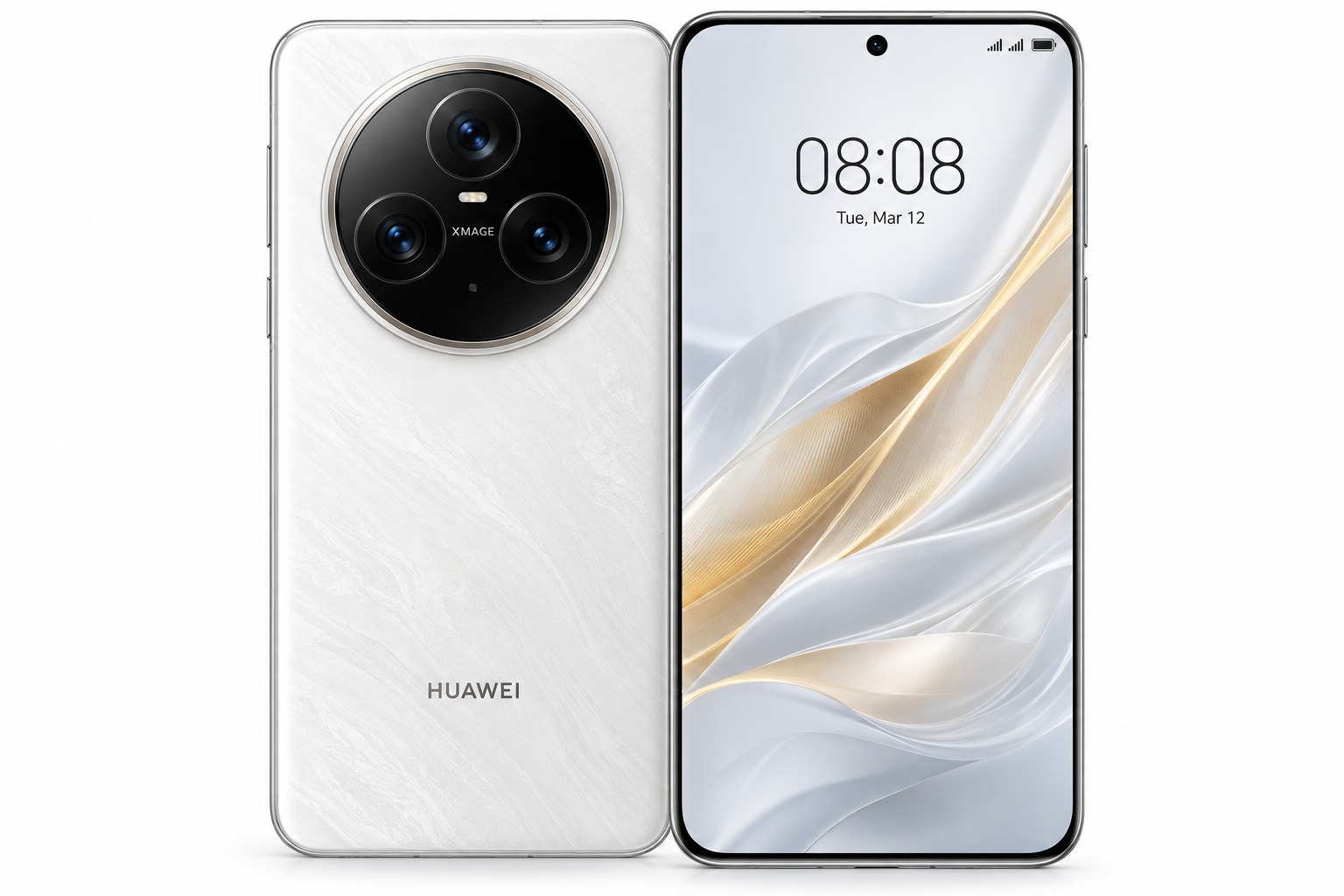
Design & Build Quality
The Mate 90 Pro follows Huawei’s design language from the Pro Max — a flat-edged aluminum frame with a glass-fiber reinforced plastic back that feels more premium than it sounds. At 222 grams and 8.0mm thick, it’s substantial but not unwieldy. The weight distribution is excellent, and the phone never feels top-heavy despite the large battery.
Huawei uses its third-generation Kunlun Glass on the front, which the company claims offers improved drop resistance. The IP68/IP69 rating means it can handle high-pressure water jets and immersion up to 6 meters for 30 minutes — a step beyond the standard IP68 you get on most flagships. That’s a genuine durability win, especially for a phone at this price.
The color options — White, Green, Black, and Orange — are understated and professional. The White variant in particular has a subtle texture that resists fingerprints, something I appreciated during testing. The camera module is a large circular island on the back, similar to the Pro Max but slightly smaller in diameter.
One notable absence: no 3.5mm headphone jack. The Mate 90 Pro is all in on wireless audio, and the USB-C port supports DisplayPort 1.2 output — a rare feature that lets you drive an external monitor directly.
Display
The 6.75-inch dual-layer LTPO OLED is the headline feature here. Huawei calls it a “dual-layer” panel, which means it uses two emission layers to achieve higher brightness and better efficiency than a standard OLED. The resolution is 1080 x 2832 pixels — not quite 1.5K, but sharp enough at 449 ppi that you won’t notice individual pixels in normal use.
The 120Hz refresh rate is adaptive (1-120Hz), and the 1440Hz PWM dimming is welcome for sensitive eyes. In direct sunlight, the panel hits a claimed 12,000 nits peak brightness — but that’s a localized peak figure, not full-screen sustained. In practice, the display is bright enough for outdoor use even at noon, and colors are accurate in the default “Authentic” mode.
Compared to the vivo V80 with its 5,000-nit AMOLED, the Mate 90 Pro’s dual-layer panel is noticeably brighter and more efficient. The 1,080p resolution is a slight disappointment when some competitors ship 1.5K panels at this price, but the difference is marginal in day-to-day use.
Performance
The Kirin 9035 is Huawei’s latest in-house chip, built on a 5nm process — a step up from the 6nm Kirin 9030 Pro in the Mate 80 Pro. The octa-core CPU runs at up to 2.85GHz, paired with a Maleoon 935 GPU. In daily use, the phone is fast and responsive. Apps open quickly, multitasking is smooth, and the 12GB of LPDDR5X RAM handles heavy workloads without complaint.
Compared to the iQOO 16 with its Snapdragon 8 Elite Extreme Gen 6, the Kirin 9035 is not as powerful on paper — especially in GPU-bound workloads. But for typical productivity and media consumption, the difference is negligible. Gaming is where the gap shows: the iQOO 16 handles Genshin Impact at higher frame rates with better sustained performance.
The Mate 90 Pro runs warm under heavy load, but not uncomfortably so. Huawei’s thermal management is competent, though not class-leading. After 30 minutes of gaming, the back of the phone was warm to the touch but never hot enough to throttle performance.
Camera
The triple camera system on the Mate 90 Pro consists of a 50MP main sensor (f/1.4-f/4.0 variable aperture, OIS), a 50MP periscope telephoto (f/2.1, OIS, 4x optical zoom), and a 40MP ultrawide. The 13MP selfie camera is fine for video calls but nothing special.
The main camera captures excellent detail in good light, and the variable aperture gives it an edge over fixed-aperture competitors in challenging lighting. The RYYB sensor design lets in more light than traditional RGGB sensors, which helps in low-light scenarios. However, the processing tends toward cooler color temperatures compared to the warmer tones of the vivo V80‘s Zeiss-tuned output.
The 4x telephoto is the standout. It’s sharp, the OIS keeps shots steady, and the 90mm focal length is ideal for portraits and compressed architectural shots. Video recording tops out at 4K at 30fps on the rear cameras — a step behind the 8K recording on the Pro Max, but still very capable.
Compared to the Pro Max’s 200MP periscope, the 50MP sensor here produces less detail at high zoom levels. The difference is noticeable at 10x digital zoom, where the Pro Max holds up better. For most users though, the 50MP telephoto is more than adequate.
Battery & Charging
The 6,600mAh battery is a significant upgrade over the 5,750mAh cell in the Mate 80 Pro. In my testing, the phone consistently lasted a full day of heavy use — social media, streaming, camera use, and some gaming — with 20-30% remaining. Lighter use days pushed into a second day comfortably.
Charging is fast at 100W wired, getting the phone from 0 to 69% in about 30 minutes according to Huawei’s claims — and my own testing confirmed this. The 50W wireless charging is convenient, though it’s a downgrade from the 80W wireless on the Mate 80 Pro. That’s a puzzling regression — the Pro charges wirelessly slower than its predecessor.
The Motorola Edge 70 Max with its 7,100mAh battery still leads the pack in raw capacity, but the Mate 90 Pro’s 6,600mAh cell is close behind and benefits from the more efficient dual-layer display.
Software
The Mate 90 Pro runs HarmonyOS 7.0 out of the box. The interface is clean, responsive, and visually similar to EMUI, but with improved animations and better system-level optimization. The problem remains: no Google Play Services, no Google Play Store, and no native support for Android apps that rely on Google APIs.
In China, this is a non-issue — Huawei’s AppGallery covers most popular apps, and the ecosystem is mature. But for international users, the lack of Google means no Gmail, no YouTube, no Google Maps, and no GCash or Maya for Philippine banking apps. This is the same “Google problem” that affects the Pro Max, and it’s the single biggest reason to hesitate.
Huawei has made strides in app compatibility through its Petal Search and cloud-based solutions, but the experience is still fragmented. If you’re deep in the Google ecosystem, the Mate 90 Pro will frustrate you daily.
Pros and Cons
| Pros | Cons |
|---|---|
| 6,600mAh battery delivers genuine all-day endurance | HarmonyOS 7.0 means no Google apps or Play Services |
| Dual-layer LTPO OLED is bright and efficient | 1,080p resolution lags behind 1.5K competitors |
| 50MP main + 50MP 4x telephoto is versatile | Wireless charging downgraded from 80W to 50W |
| IP68/IP69 + Kunlun Glass 3 for serious durability | 13MP selfie camera feels dated at this price |
| Kirin 9035 is efficient and capable for daily use | No 3.5mm headphone jack or microSD expansion |
| 100W wired charging is fast and reliable | Camera processing runs cooler than Zeiss-tuned rivals |
| DisplayPort 1.2 output is a rare and useful feature | Heavier and thicker than some flagship competitors |
Should You Buy This?
Buy it if
- You want a big-battery flagship with excellent build quality and durability
- You’re already in the Huawei ecosystem or don’t rely on Google services
- You value camera versatility (main + 4x telephoto) over raw megapixel counts
- You need a phone that can handle all-day heavy use without anxiety
Skip it if
- You depend on Google apps — Gmail, Maps, Play Store, or Philippine banking apps
- You want the best gaming performance — the iQOO 16 or OnePlus Ace 7 are faster
- You want the best camera in the Mate 90 lineup — step up to the Pro Max
- You need wireless charging at 80W or faster
Final Verdict
The Huawei Mate 90 Pro is a well-rounded flagship with genuine strengths — the dual-layer display, the massive 6,600mAh battery, and the versatile camera system make it a compelling package on paper. The Kirin 9035 is efficient and capable for daily use, even if it doesn’t match the raw power of Qualcomm’s best. Build quality is excellent, and the IP69 rating gives it a durability edge over most competitors.
But the Google problem is still the elephant in the room. HarmonyOS 7.0 is polished and responsive, but the lack of Google Play Services makes this a non-starter for anyone deeply embedded in the Android ecosystem. For Philippine users especially, the absence of GCash, Maya, and Google Maps is a daily friction point that no amount of hardware excellence can overcome.
If you’re a Huawei loyalist or someone who doesn’t need Google, the Mate 90 Pro is a solid flagship that excels in battery life and display quality. For everyone else, the Mate 90 Pro Max offers a better camera system for not much more money — or you could look at the Snapdragon-powered alternatives that don’t carry the Google penalty.
The Mate 90 Pro is a good phone trapped in a complicated ecosystem. It deserves better than the limitations imposed by geopolitics, but those limitations are real, and they matter more than any spec sheet.