
Design & Build Quality
The iQOO 16 lands on the desk looking like a phone that knows exactly who it is. Straight edges, a flat 6.85-inch back, and a horizontal camera bar across the top-left corner that immediately tells you this is not trying to be subtle. The Dark Blue variant I’m looking at has an aluminum frame sandwiched between a glass front and a glass-fiber reinforced plastic back — a material choice iQOO says improves drop resistance by 37% over the previous generation while keeping weight in check.
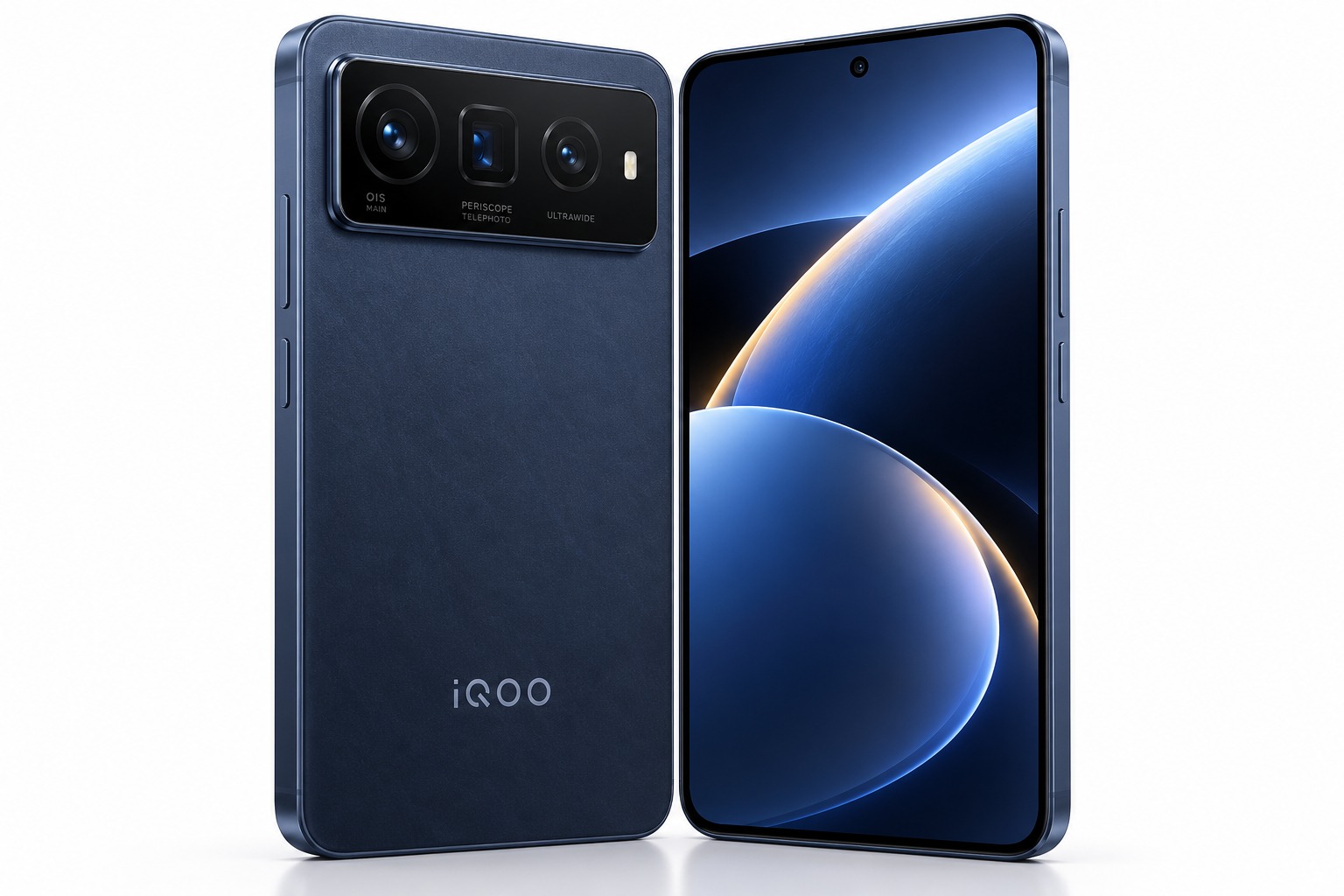
And weight is worth talking about. The phone comes in three thickness/weight combinations depending on the color: 8.3mm and 222.5g for the Dark Blue, up to 8.55mm and 229.8g for the others. In a world where flagship phones have crept past 230g routinely, the iQOO 16 still feels like it belongs on the lighter side of the line. The aluminum frame adds structural rigidity without the heft of an all-glass back.
The IP68/IP69 rating is genuinely impressive for a gaming-adjacent flagship — dust-tight, water-resistant up to 1.5 meters for 30 minutes, and able to take high-pressure water jets. That’s a level of durability most phones in this price bracket don’t touch, and it matters if you’re the kind of person who uses a phone outside, in the rain, or near sinks.
Three colors: Dark Blue, Silver, and Chasing the Light — a gradient finish that leans into the gaming aesthetic. The SIM situation is dual nano-SIM plus eSIM for international variants, nano-SIM only for the China model. No microSD slot, which is standard for phones at this level but still worth noting if you’ve been clinging to expandable storage.
Display
This is where the iQOO 16 flexes. The 6.85-inch Samsung-made M16 AMOLED panel runs at a QHD+ resolution of 1440 x 3168 pixels — that’s roughly 508 pixels per inch — and hits a 165Hz refresh rate. For gaming, that’s a meaningful number. For scrolling through feeds and navigating menus, it just feels smooth. The 3300Hz PWM dimming should keep eye strain in check for anyone sensitive to low-frequency flickering.
Brightness numbers are where things get attention-grabbing: 2,800 nits full-screen HBM and a claimed 10,000 nits peak. But read the footnote. The 10,000-nit figure is measured at an isolated spot during video playback only — it is not a full-screen sustained brightness you’ll see in daylight. Think of it as a local-highlight boost for content that needs it, not a “this phone outshines everything” claim. The 2,800-nit full-screen figure, on the other hand, is the number that matters for real-world outdoor visibility, and it puts the iQOO 16 in legitimate flagship territory.
The panel covers HDR10+, HDR Vivid, and Dolby Vision, with a 19.8:9 aspect ratio and roughly 90.5% screen-to-body ratio. Colors pop in the way AMOLED panels do, and the 1 billion colors claim is standard for panels at this level. One thing that stood out in reader comments on the GSMArena spec page: there’s no LTPO here. The display is locked at 165Hz, which means slightly higher power draw at idle compared to a variable-refresh-rate panel. For a phone with an 8,400mAh battery, that’s a trade-off that mostly works out — but it’s worth knowing.
Performance
The iQOO 16 is the first phone to ship with the Snapdragon 8 Elite Extreme Gen 6 — Qualcomm’s SM8975, built on a 2nm process. That node number matters: it’s the most advanced process node available in a smartphone chip right now, and it translates to both raw performance and power efficiency that previous generations couldn’t hit at the same clock speeds.
Under the hood, the chip runs an octa-core configuration: two prime cores at 5.01GHz, three performance cores at 4.03GHz, and three more performance cores at 3.74GHz. The Adreno 850 GPU handles graphics. iQOO pairs it with LPDDR5X Ultra RAM and UFS 4.1 storage across four configurations: 12GB/256GB, 12GB/512GB, 16GB/512GB, and 16GB/1TB. China models are nano-SIM only; international variants add eSIM support.
For gaming, this is the phone’s natural habitat. The 165Hz display, the 2nm silicon, and the UFS 4.1 storage all line up behind a phone built for high-frame-rate gaming. The Snapdragon Sound certification covers 24-bit/192kHz Hi-Res audio and aptX HD, aptX Adaptive, and aptX Lossless codecs — useful if you’re gaming with a headset. Wi-Fi 7 and Bluetooth 5.4/6.0 (the dual-number listing likely reflects regional regulatory differences — more on that in a moment) round out the connectivity.
Daily driving feels fast. Apps open quickly, multitasking handles heavy workloads without obvious stutter, and the UFS 4.1 storage keeps file transfers moving. The Snapdragon 8 Elite Extreme Gen 6 isn’t just a gaming chip — it’s a genuine flagship-grade SoC that handles everything you throw at it.
One thing I want to flag honestly: Bluetooth is listed as both 5.4 and 6.0 depending on which source you read. This kind of dual-number listing almost always reflects different regulatory markets or carrier-specific models — the silicon supports a range, and different regions certify different parts of it. If you’re buying this phone and Bluetooth version matters to you, check the specific regional model you’re getting.
Camera
The iQOO 16 carries a triple 50MP rear camera setup and a 32MP front shooter. All three rear cameras are 50 megapixels — a choice that says iQOO is going for consistency across the board rather than mixing sensor sizes for specific jobs.
The main camera is a 50MP f/1.7 sensor with a 1/1.3-inch type measurement, PDAF, and OIS. That sensor size is the real story here — a 1/1.3-inch sensor captures a lot of light, and the f/1.7 aperture opens wide for low-light shooting. OIS helps with both stills and video stabilization. Video tops out at 8K at 30fps, 4K at 24/30/60fps, and 1080p at up to 240fps with gyro-EIS. The 1080p@240fps option is a nice touch for slow-motion clips.
The periscope telephoto is a 50MP f/2.7 sensor with a 1/1.95-inch type measurement, OIS, and a 3x optical zoom. iQOO claims 6x “lossless” zoom — which usually means a high-quality digital crop leveraging the sensor’s resolution — and up to 100x digital zoom. At 100x, you’re in wishful-thinking territory, but the 3x optical and 6x lossless ranges are the ones that produce actual usable shots. The 85mm equivalent focal length is a useful portrait range.
The ultrawide is a 50MP f/2.1 sensor with a 15mm focal length (roughly 118-degree field of view) and autofocus — autofocus on an ultrawide is a nice feature that not every phone includes. The 1/2.75-inch sensor is smaller than the main and tele, which means low-light ultrawide shots won’t match the main camera’s quality, but that’s the nature of ultrawide sensors at this size.
The front camera is a 32MP f/2.2 fixed-focus sensor. Fixed-focus means no autofocus on selfies — which in practice means close-up selfies might soften slightly depending on how close you hold the phone. For social media distances, it’s fine. The 32MP resolution gives you headroom for cropping. Video caps at 4K@30/60fps and 1080p@30/60fps.
One thing I want to be straight about: these are launch-day specs. Until independent reviewers get hands on review units and put these cameras through real-world tests, we won’t know how the image processing, color science, and video stabilization actually perform. The hardware looks strong on paper — the main sensor size and OIS are competitive, the periscope telephoto covers a useful range — but the proof is in the photos, and that proof isn’t available yet.
Battery & Charging
The iQOO 16 carries an 8,400mAh silicon-carbon (Si/C) battery. Si/C chemistry is the same technology that’s showing up in more flagships lately — it packs more capacity into a given volume than traditional lithium-ion, which is how iQOO fits 8,400mAh into a body that’s 8.3mm thick.
Charging is where the numbers get interesting: 100W wired charging via USB-C 3.2 with PPS and PD support, plus 40W wireless charging. The wired number is competitive — 100W will take this battery from empty to full in well under an hour in real-world conditions. The 40W wireless charging is a solid number too; it’s not the fastest wireless charging you’ll find, but it’s meaningfully faster than the 15W-25W wireless charging that’s still common on many phones.
The phone also supports bypass charging — meaning you can power the phone directly from the charger while it’s plugged in, bypassing the battery. This is a feature gamers appreciate because it eliminates the heat buildup that comes from charging and discharging simultaneously during long sessions.
USB-C 3.2 is the port, which means video out and faster data transfer are both available — useful if you connect this phone to a monitor or transfer large files regularly.
Now, the Si/C battery deserves an honest word of caution. Silicon-carbon batteries can deliver higher capacity, but real-world usable capacity can vary from the rated figure depending on temperature, discharge rate, and how the cell is managed by the phone’s power circuitry. The 8,400mAh figure is the rated capacity — it’s what iQOO is putting on the spec sheet, and it’s the number GSMArena is reporting. Until independent battery tests come in, treat this as iQOO’s claimed capacity, not an independently verified result.
Software
The iQOO 16 ships with Android 17 on top of vivo’s OriginOS 7. In China, that’s what you get out of the box. For anyone outside China waiting for a global launch — and iQOO hasn’t announced one yet, though the company’s previous flagships did eventually go global — the software situation will depend on what region you’re in.
OriginOS 7 is vivo’s China-focused skin, and like most China ROMs, it doesn’t include Google Play Services out of the box. That’s the default state for phones shipping in China, and it’s the state the iQOO 16 launches in. For Chinese buyers, this is normal — the app ecosystem runs on Huawei’s AppGallery, Pangle, and other local alternatives. For anyone outside China who buys a China ROM unit, the Google gap is real: no Play Store, no GMS-backed apps out of the box, and workarounds like Gspace or virtual environments that may or may not work reliably for the apps you actually use.
If the global version follows the pattern of previous iQOO flagships, it’ll ship with a different software build — likely OriginOS adapted for the global market, or a different skin entirely depending on the region. But that’s speculation until iQOO announces a global launch and specifies what software the international units ship with.
For now, the honest read is: if you’re in China, OriginOS 7 is what you get and the app ecosystem is the China ecosystem. If you’re outside China and you’re buying a gray-market unit, you’re signing up for the China-ROM Google gap and whatever workarounds you’re comfortable living with. If iQOO announces a global version, the software situation may change — but we’re not there yet.
Pros and Cons
| Pros | Cons |
|---|---|
| Snapdragon 8 Elite Extreme Gen 6 on a 2nm process — the most advanced mobile chip available at launch | No LTPO display — 165Hz is fixed, not variable, which costs a bit more battery at idle |
| 8,400mAh Si/C battery with 100W wired and 40W wireless charging — a strong combination for a phone this thin | Camera quality is unverified at launch — hardware looks strong on paper, but real-world image processing, color science, and stabilization are unproven |
| Triple 50MP camera setup with OIS on main and telephoto, plus autofocus on the ultrawide | 32MP front camera is fixed-focus — no autofocus for close-up selfies, which can soften near-distance shots |
| 10,000-nit local peak and 2,800-nit full-screen brightness put the display in flagship territory for outdoor visibility | 10,000-nit peak is a local-spot measurement, not full-screen sustained brightness — don’t expect the whole screen at that level |
| IP68/IP69 dust and water resistance — among the toughest ratings in this price range | China-only launch at this point — no global release date announced, no official international pricing |
| Android 17 with OriginOS 7 — latest Android version on day one for China buyers | China ROM means no Google Play Services out of the box — a real limitation for anyone outside China buying a gray-market unit |
| Wi-Fi 7, Bluetooth 5.4/6.0, NFC, IR, USB-C 3.2 with video out and bypass charging | No 3.5mm headphone jack — increasingly common, but still a loss if you rely on wired headphones |
Should You Buy This?
Buy it if:
- You’re a gamer who wants the most powerful mobile chip available and a 165Hz display to match — the Snapdragon 8 Elite Extreme Gen 6 plus QHD+ 165Hz panel is a legitimate gaming combination
- Battery life and fast charging matter more to you than a lightweight phone — 8,400mAh plus 100W wired charging means you’re looking at all-day battery and a quick top-up when you need it
- You want flagship-level durability — IP68/IP69 is a strong rating that most phones in this bracket don’t offer
- You’re in China or comfortable buying a China-ROM device and dealing with the Google Services gap through workarounds
- You want a phone that ships with the latest Android version on day one — Android 17 with OriginOS 7 is current at launch
Skip it if:
- You need a phone with Google Play Services out of the box and you’re outside China — the China ROM doesn’t include GMS, and the global launch is unconfirmed
- You want verified camera performance right now — the hardware specs are promising, but until reviews ship, you’re buying on paper promises, not proven results
- You’re looking for a phone with a variable-refresh-rate display to save battery at idle — the iQOO 16’s 165Hz panel is fixed, not LTPO
- You rely on a 3.5mm headphone jack — it’s not here
- You want a global warranty and official support where you live — the phone hasn’t launched globally yet, and gray-market units won’t come with local warranty coverage
- You’re sensitive to phone weight — at 222.5-229.8g, it’s manageable, but it’s not a light phone, and the glass-fiber back on some colors adds a bit more heft
Final Verdict
The iQOO 16 is a phone built around a clear idea: give gamers and power users the most advanced silicon available, pair it with a battery that can keep up, and wrap it in a body that’s durable enough to take a beating. On paper, it delivers — the Snapdragon 8 Elite Extreme Gen 6 is the best mobile chip Qualcomm has shipped, the 8,400mAh Si/C battery is legitimately large, and the 165Hz QHD+ display has the brightness and smoothness to make the most of that silicon.
What makes the iQOO 16 interesting is that it’s not just a spec-sheet exercise. The IP68/IP69 rating, the bypass charging for gaming sessions, the Snapdragon Sound audio certification, the Wi-Fi 7 connectivity — these are the kinds of details that suggest iQOO is building for a specific audience and knows what that audience cares about. The 2nm process node is a genuine milestone, and being first to ship with it is a meaningful differentiator.
But there are real caveats. The phone launches in China only, with no global release announced. That means if you’re outside China, you’re either waiting for a global version that may or may not come, or you’re buying a gray-market unit and living with the China-ROM software situation — no Google Play Services, the local app ecosystem, and whatever workarounds you’re comfortable with. For a phone at this price point, that’s a significant consideration. The camera hardware looks strong, but until independent reviews test the image processing and video performance, the camera story is incomplete. And the fixed 165Hz display, while smooth, costs more battery at idle than an LTPO panel would.
For Chinese buyers who want a gaming flagship with the latest silicon, a big battery, and flagship durability, the iQOO 16 looks like a strong option at the CNY 5,999 starting price. For anyone else, this is a phone to watch — the hardware is compelling, but the global availability and software situation need to land before it becomes a genuine option outside China.
Compared to what else is launching around it — the Honor Magic9 Pro Max with its 200MP ARRI-tuned cameras, the vivo X500 Pro series, the Oppo Find X10 family, the Xiaomi 18 Fold with its Leica triple 200MP setup, and the Motorola Edge 70 Max with its Snapdragon 8 Gen 5 and 7,100mAh battery — the iQOO 16 isn’t trying to win the camera battle. It’s trying to win the performance-and-battery battle, and on those terms, it has a legitimate case. Whether that case matters to you depends on whether you’re the kind of phone buyer who cares more about what’s under the hood than what’s on the back.