
Design & Build Quality
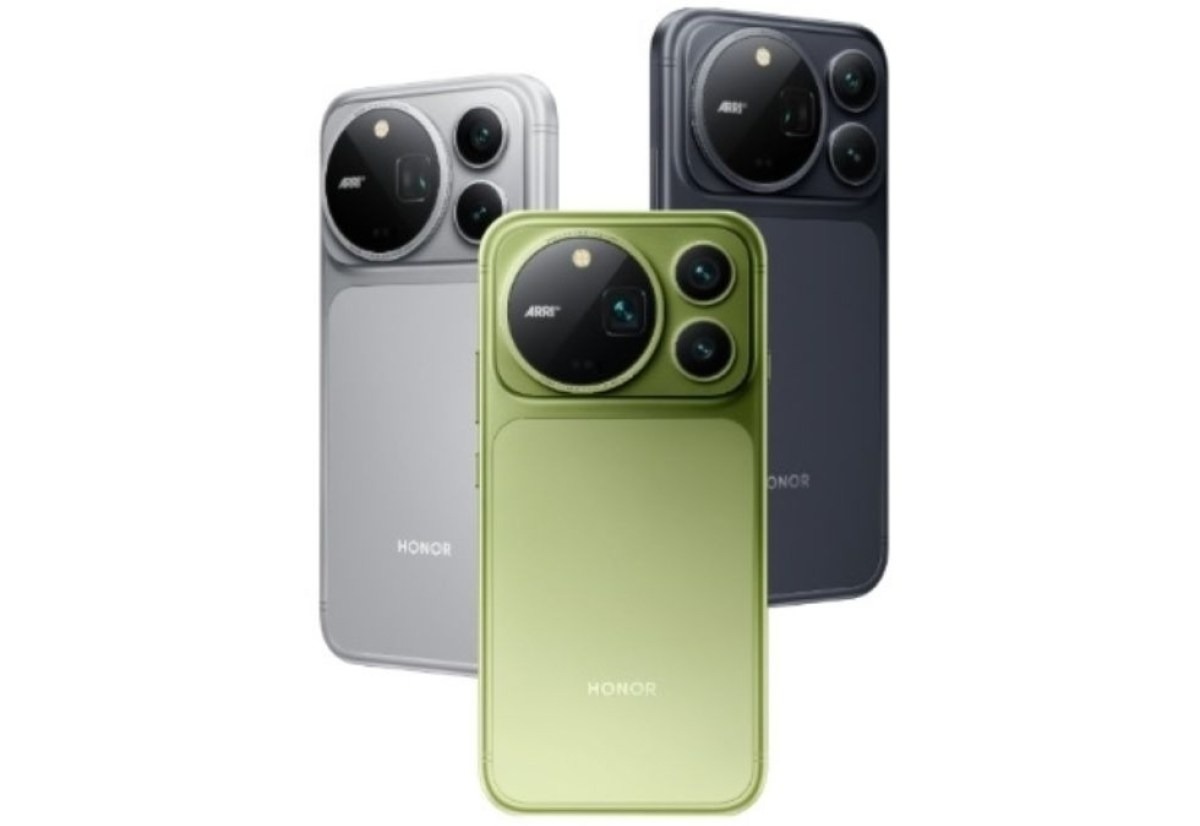
The Honor Magic9 Pro Max lands with a rear camera island so wide it nearly spans the full width of the phone — a bold design statement that puts the camera system front and center. Honor has given the module an ARRI branding badge, a nod to the German cinema-camera manufacturer that co-developed the imaging system with Honor. The body uses an aluminum frame with a glass back, coming in Gray, Silver, and Olive Green for the Pro Max. It’s a premium-feeling package at roughly 163 x 76 x 8.3mm and around 220g — substantial but not unreasonable for a phone carrying an 8,800mAh battery.
Durability gets serious attention: IP68, IP69, and IP69K ratings mean the Pro Max can handle high-pressure water jets, immersion up to 1.5 meters for 30 minutes, and dust tight sealing. That’s a full suite — most phones stop at IP68. There’s no official MIL-STD rating mentioned in the pre-launch materials, but the IP69K certification alone puts it ahead of most flagship phones. The aluminum frame and glass back are the standard premium construction, though some reports suggest an aluminum-back variant as well.
No 3.5mm headphone jack — standard for flagships at this level, but worth noting for anyone still clinging to wired headphones. What you do get: an IR blaster (useful for Philippine TV setups), ultrasonic under-display fingerprint sensing, and Honor’s 3D face unlocking. The ultrasonic fingerprint sensor is faster and more reliable than optical alternatives, especially with wet hands — a useful feature given the phone’s IP69 water resistance. Honor has also confirmed the Magic9 series will feature an AI button for quick access to on-device AI features, and a camera shutter button on the Pro Max for quick camera launches.
Display
The Magic9 Pro Max’s screen is a 6.8-inch LTPO OLED panel with a 2868 x 1320 resolution at 120Hz. LTPO is the key spec here — it means the refresh rate can drop well below 120Hz when you’re reading static content, saving real battery life. The 2868 x 1320 resolution works out to roughly 464 pixels per inch, which is plenty sharp for a phone this size. The panel supports 1 billion colors, Dolby Vision, and HDR Vivid, so video playback should look the way content creators intended. Honor tunes the PWM dimming to 4320Hz, which is in the range that flicker-sensitive users can tolerate — a thoughtful touch that matters more than it sounds, especially in a phone with this much brightness to manage.
The standard Magic9’s 6.37-inch LTPS OLED is smaller and less power-efficient at low refresh rates, so the Pro Max’s LTPO panel is a meaningful upgrade if display quality and battery life both matter to you. Peak brightness figures haven’t been independently verified yet (the phone launches today), so treat any marketing numbers with caution until lab tests come in. What I can say is that Honor has been pushing high-brightness panels across its recent flagships, and the Pro Max’s LTPO OLED with Dolby Vision support should be among the better display experiences in this price tier.
Performance
The Magic9 Pro Max is powered by Qualcomm’s Snapdragon 8 Elite Extreme Gen 6, built on TSMC’s 2nm process. A prototype unit (model WKL-AN20) ran through Geekbench 6.7.1 with a score of 3,448 single-core and 9,353 multi-core on Android 17 — solid numbers that put it ahead of the 3nm Snapdragon 8 Elite Gen 5 chips in last year’s flagships — and ahead of the iPhone 18 Pro’s A20 Pro on Apple’s side. The CPU config on the prototype showed two cores at 5.01GHz, three at 4.03GHz, and three at 3.74GHz — an Oryon-based layout that favors burst performance.
The GPU is the Adreno that ships with this chipset tier, which should handle modern games at high settings. Memory tops out at 16GB of RAM paired with 1TB of UFS 4.1 storage, so app retention and large file transfers should feel fast. The 2nm process is the real story here — same or better performance at lower power draw than the previous generation, which matters for battery life in a phone with this much going on under the hood.
For context, the standard Magic9 uses the 3nm Snapdragon 8 Elite Gen 5 — still very fast, just not the bleeding-edge node. The Super Edition also uses the Gen 5 chip but adds an active cooling fan, which is unusual at this level and suggests Honor expects heavy sustained workloads on that variant. The Pro Max sits in the sweet spot: the newest 2nm silicon, no active fan needed for normal use, and the performance headroom to handle anything you throw at it.
As with any pre-launch review, the Geekbench numbers come from a prototype device that may not reflect final retail performance — software optimization, thermal tuning, and final silicon revision can all shift real-world results. The 2nm process and Oryon core architecture are genuine upgrades over the Gen 5, though the exact magnitude will only be clear once reviewers with controlled testbeds publish their numbers.
Camera
This is the reason the Magic9 Pro Max exists. The triple-camera system is co-developed with ARRI, the German cinema-camera maker whose name carries real weight in professional imaging. The main sensor is a 200MP device in a 1/1.28-inch format with an f/1.57 aperture — that sensor size is larger than the 1/1.4-inch sensors you see on many competing flagships, which translates to better light capture and less noise. The periscope telephoto is also 200MP, in a 1/1.4-inch format at f/2.6 with 3.7x optical zoom and OIS. The ultrawide is a 50MP sensor at f/2.0 covering 122 degrees.
Video recording covers 4K at 24, 30, 60, and 120fps, plus 1080p at up to 240fps for slow motion. Gyro-EIS and OIS handle stabilization, and 10-bit video gives editors more color information. The 50MP ultrawide can record 4K video, which is a nice bonus — many phones limit the ultrawide to 1080p.
The front camera is where Honor does something genuinely different: a 55MP square sensor at f/2.0. Square sensors capture more of the scene vertically, which matters for selfies and vlogs held in portrait. The 3D face unlocking system doubles as a depth sensor for portrait-mode selfies, so edge detection should be cleaner than phones that rely on software alone. The square format also gives more framing flexibility for social media crops.
The ARRI partnership isn’t just a logo. Honor says the two companies worked on color science that brings cinema-grade rendering to a phone camera, and the dual-200MP configuration with large sensors on both main and telephoto is a combination that competes with anything Samsung, Apple, or Xiaomi are shipping. The production sample images Honor has shared show strong detail and color rendering, though the full comparison against other flagships will only be clear once independent reviewers publish their test shots.
One important caveat: this is a China-first launch. Honor’s image processing in China-market phones sometimes differs from global variants — different color science defaults, different AI scene detection. If a global version ships later, the camera behavior may not be identical to what you see on the China unit. That’s worth keeping in mind if you’re reading this from outside China and planning to wait for a global release.
Battery & Charging
The Magic9 Pro Max carries an 8,800mAh silicon-carbon battery — a significant bump from the 8,000mAh in the standard Magic9 and the 7,100mAh in last year’s Magic8 Pro. Silicon-carbon chemistry lets Honor pack more capacity into a cell of similar physical size, which is how you get 8,800mAh without the phone becoming a brick. The practical expectation is a two-day phone for moderate users and a very solid single-day phone for heavy users, especially given the 2nm chip’s efficiency gains — a meaningful difference from budget phones like the Realme 16x that pair large batteries with less efficient silicon.
Charging is 100W wired with PPS support, plus 40W UFCS (a newer charging standard Honor and a few partners are pushing). That’s a meaningful bump from the Magic8 Pro’s 80W global charging. Wireless charging is 80W, which is fast enough that you won’t be waiting around. Reverse wireless charging is included, and there’s 5W reverse wired charging as a fallback. The Super Edition’s 11,000mAh battery is the extreme option for people who genuinely need days of battery life — field workers, travelers, anyone who can’t charge during the day.
No independent battery-life test data is available yet — the phone is launching today. The combination of 2nm silicon, LTPO display, and 8,800mAh capacity points toward class-leading endurance, but the proof is in the drain test. Treat any endurance claims as marketing numbers until reviewers with testbeds publish their results.
Software
The Magic9 Pro Max launches with Android 17 and MagicOS 11, Honor’s latest OS build. Honor has committed to up to 7 major Android OS upgrades and 7 years of security patches — matching the long-support promises from Samsung and Google, and a genuine advantage over budget and mid-range phones that get far fewer updates. If you keep your phones for three or four years, that commitment matters.
MagicOS 11 leans into AI features. The Magic9 Pro Max has an AI button on the side for quick access to on-device AI functions, and there’s a camera shutter button that doubles as a shortcut for camera features. The OS also supports a desktop mode that lets you connect the phone to a monitor and use it like a lightweight computer — genuinely useful if you travel light and don’t want to carry a laptop for basic work.
The Google Mobile Services question is the big asterisk. Honor phones sold in China do not ship with GMS pre-installed — they rely on Huawei’s AppGallery approach and sideloading for Google apps. For the China launch, this is the status quo. If and when a global version ships, it will almost certainly include GMS, but that timeline isn’t confirmed yet. For buyers outside China, this is the single biggest thing to watch: a China-unit Magic9 Pro Max without GMS means no Google Play, no Gmail, no Google Maps, no YouTube app — and in markets like the Philippines, it also means GCash, Maya, and most local banking apps won’t run without workarounds.
Pros and Cons
| ✓ Pros
✓ Dual 200MP ARRI co-developed camera system with large 1/1.28-inch main sensor |
✗ Cons
✗ China-only launch — no confirmed global release date or GMS status |
Should You Buy This?
Buy it if:
- You’re in China or can import one, and you want the most camera-ambitious Android phone available at launch — the dual 200MP ARRI system is genuinely competitive with anything Samsung, Apple, or Xiaomi are shipping
- Battery life is your top priority and you want a flagship that can plausibly last two days — the 8,800mAh cell plus 2nm efficiency is a strong combination
- You keep phones for years and the 7-year update promise matters to you — this puts Honor in the same long-support conversation as Samsung and Google
- You shoot a lot of video and want a phone where the ultrawide can record 4K — not every flagship lets the UW sensor do that
- You’re a mobile photographer who cares about color science and wants an ARRI-branded tuning on a phone — this is the first phone to make that pitch seriously
- You want the newest 2nm silicon and don’t mind paying a premium for it — the Snapdragon 8 Elite Extreme Gen 6 is a genuine generation jump from the Gen 5
Skip it if:
- You need a phone that works out of the box with Google services outside China — until a global GMS version is confirmed, this is a China-unit purchase with all the friction that implies
- You’re outside China and need local banking apps, e-wallets, or region-locked streaming services — the GMS gap is a dealbreaker for daily use in most markets
- You want a phone that fits easily in one hand or small pockets — at roughly 163 x 76mm, the Pro Max is a large phone
- You were hoping for a cooling fan in the Pro Max — that feature is reserved for the Super Edition, which uses the older Gen 5 chip
- You’re happy with your current flagship and don’t need a 200MP camera — if your current phone’s camera is already excellent, the upgrade to dual 200MP may be more spec-sheet than practical difference
- You want a confirmed price in your currency today — Honor has only announced the Magic9 starting price (CNY 6,499 standard model), and the Pro Max pricing isn’t public yet
Final Verdict
The Honor Magic9 Pro Max is the kind of phone that makes you sit up and pay attention, even if you can’t buy one in your market yet. Dual 200MP cameras co-developed with ARRI, a 2nm Snapdragon 8 Elite Extreme Gen 6 chip, an 8,800mAh battery, and a 7-year update commitment — on paper, this is a flagship that checks every box Honor’s target buyer cares about. The camera system in particular is the strongest pitch: two large-sensor 200MP lenses with cinema-grade color tuning is a combination no other phone maker has made this convincingly.
But “on paper” is doing a lot of work here. This is a China launch, and until Honor confirms a global release date and GMS support, the Magic9 Pro Max is a phone for people who can actually use it in China — or who are willing to deal with the friction of importing a GMS-free device. For buyers in the Philippines, Southeast Asia, or anywhere else outside China, that GMS gap is the single most important fact on this entire page. A phone this capable is wasted if you can’t run the apps you need every day.
The standard Magic9 at CNY 6,499 (with a 10th-anniversary price of CNY 5,999 and a subsidized CNY 5,499 for eligible buyers) is the more accessible entry point if you just want the ARRI camera system without paying Pro Max premiums. The Super Edition’s 11,000mAh battery and active cooling fan are niche appeals for people who need extreme endurance or sustained performance — most buyers won’t need either. And if you’re in the market for a China-flaghip photography phone right now, the vivo X500 Pro (Dimensity 9600, Zeiss cameras, 7,000mAh, already reviewed on Bleuken) is the comparison that matters — same camera ambition, different implementation, potentially different global availability timeline.
If Honor follows through with a global release that includes Google Mobile Services, the Magic9 Pro Max will be one of the most competitive Android flagships of late 2026 — alongside the Xiaomi 18 Pro with its dual 200MP Leica system and the Oppo Find X10 Pro Max with its triple 200MP setup. Until then, it’s a phone to watch — impressive on every axis, but not yet a phone you can actually buy in most of the world.