
The Phone That Doesn’t Want You Touching the Screen
The nubia NaviX Ultra is not a phone you pick up to check notifications. It is a phone you pick up to tell an AI to do something for you. Launched on September 16 by ZTE’s nubia sub-brand, it carries the bold claim of being the world’s first “AI agentic smartphone” — a device where the assistant doesn’t just answer questions but actually operates your apps, fills forms, books services, and completes multi-step tasks while you watch.
I’ve spent time with the specs, the launch coverage, and the available hands-on reports, and here is my honest take: the NaviX Ultra is a fascinating experiment wrapped in genuinely impressive hardware. Whether that experiment translates to something useful outside China is a very different question — and the one most reviewers are skipping.
Design & Build Quality
The NaviX Ultra lands at 162.1 x 75.7 x 7.6mm and 208 grams — thick and substantial, but not absurdly so for a phone packing a 7,100mAh battery. The build uses a glass front and aluminum frame, which keeps the weight reasonable given the battery capacity inside. It is not a featherweight device. You will notice it in your hand.
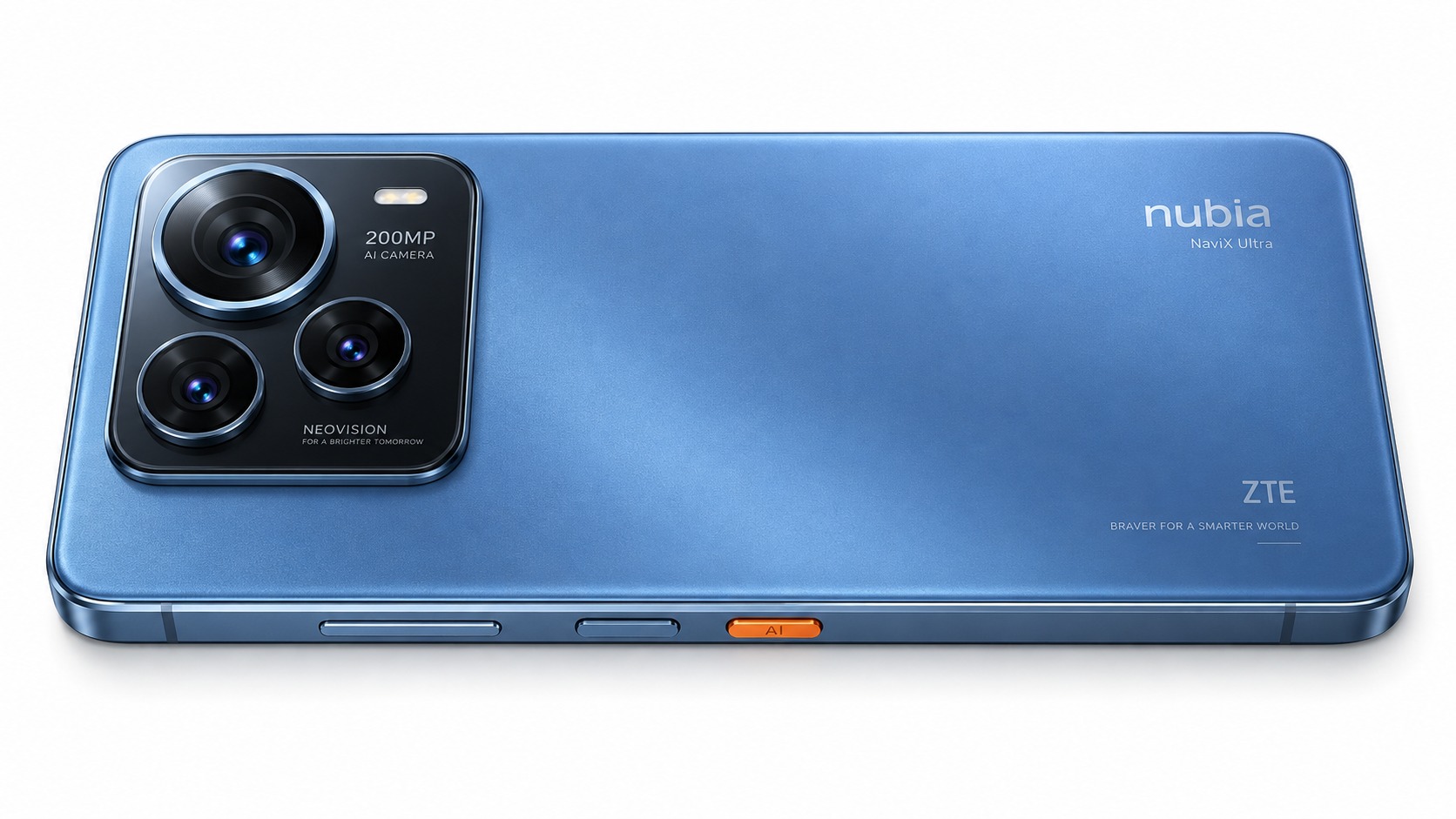
The right side houses the power button and a dedicated orange AI button positioned just below it. This button is the device’s signature design element — a physical actuator for the Doubao AI assistant. nubia offers four colourways: Black, Blue Horizon, Silver, and Pink. In the Blue and Pink variants, the camera island matches the phone colour; on Black and Silver, the camera module stays neutral.
The camera module sits on the upper-left corner and carries the triple-camera layout — a design choice that makes the phone instantly identifiable. There is also an orange AI button that stands out against any colourway. The phone has a side-mounted fingerprint sensor dedicated to AI authentication, plus an ultrasonic under-display fingerprint for regular app logins. Two fingerprint readers. That is unusual.
Display
The 6.78-inch LTPO OLED panel is one of the better displays on a 2026 flagship — and the specs back that up. Resolution sits at 1,260 x 2,800 pixels (roughly 1.5K) on a 20:9 aspect ratio, giving a pixel density around 453 ppi. The LTPO backplane drives a variable refresh rate from 1Hz all the way up to 144Hz — that 144Hz ceiling is higher than what Samsung or Apple ship at, and it is noticeable in scroll smoothness and gaming responsiveness.
Peak brightness hits 4,500 nits, which is an eye-catching number. For context, the iPhone 18 Pro Max is around 3,000 nits. The caveat with any peak-brightness figure this extreme is that it is measured at a small spot, not full-screen sustained output — treat it as a “sunlight readable under harsh conditions” number, not a gaming brightness figure. HDR Vivid is supported, and the panel covers 1 billion colours. DC dimming is included for low-brightness usage, which matters if you read at night.
Performance
Under the hood sits the Qualcomm Snapdragon 8 Elite Gen 5 — not the “Gen 5 V” variant that appears in some Poco/Redmi rebadges, but the standard flagship silicon on Qualcomm’s 3nm process. The CPU is an octa-core Oryon V3 setup: two Phoenix L cores at 4.6 GHz and six Phoenix M cores at 3.62 GHz, paired with the Adreno 840 GPU. This is a top-tier chip by any measure.
Memory options are 12GB or 16GB of LPDDR5X RAM, paired with either 512GB or 1TB of UFS 4.1 storage. There is no microSD expansion — a standard trade-off at this price tier. Storage speeds on UFS 4.1 are fast enough that app launches and file transfers feel instantaneous. AnTuTu scores on this chipset routinely push past 2 million, which puts the NaviX Ultra in the same performance bracket as the Xiaomi 18 Pro and Oppo Find X10 Pro Max — all three launched within days of each other in mid-September in China.
Thermally, the 7.6mm body gives the chipset room to breathe, but real-world thermal behaviour under sustained loads is something we have limited independent data on at this point — the phone only launched 12 days ago and review units are still rare.
Camera
The camera system is a triple setup that covers the bases without winning any spec-sheet arms race on paper. Here is the breakdown:
- Main camera: 200MP, f/1.6 aperture, 1/1.4-inch sensor, PDAF, OIS. The large sensor and wide aperture are the headline here — at 1/1.4″, this is a genuinely large sensor that should deliver solid low-light performance and good dynamic range. The 200MP resolution lets you crop aggressively and still retain detail.
- Telephoto: 64MP periscope, 3x optical zoom, OIS, DCG HDR. A 3x periscope is the right zoom for portrait work and mid-range reach. Not a 10x or 100x monster, but 3x is the focal length people actually use.
- Ultrawide: 50MP, f/2.0, 115-degree field of view, AF. A competent ultrawide that should hold its own in landscape and group shots.
- Front camera: 32MP punch-hole, centered placement. Decent for selfies and video calls, though not class-leading at this price.
Video recording is supported across the rear cameras at up to 2160p. The OIS on both main and telephoto helps with handheld video stability.
Here is the honest assessment: none of these sensors are individually class-leading at this price point. The Oppo Find X10 Pro Max launched with a triple-200MP setup in the same week. The Xiaomi 18 Pro has Leica-tuned 200MP twins. The NaviX Ultra’s camera story is not “best in class” — it is “balanced, versatile, and good enough that most people will not complain.” The 200MP main sensor with OIS is the strongest element, and for a phone pitched as an AI device, that is probably the right priority.
Battery & Charging
The 7,100mAh silicon-carbon battery is the NaviX Ultra’s most talked-about hardware feature. To put that in perspective: the Galaxy S26 Ultra carries 5,000mAh. The iPhone 18 Pro Max is around 5,400mAh. Nubia has packed roughly 30 to 40 percent more capacity into a chassis that is only marginally thicker than those phones. Silicon-carbon chemistry is what makes that possible without ballooning the physical size.
Charging specs are comprehensive: 90W wired (roughly 0 to 100 percent in about 40 minutes according to nubia’s claims), 50W wireless, and both reverse wireless and reverse wired charging for accessories like earbuds or a watch. The 90W figure is fast but not class-leading — the Huawei nova 16s Pro does 100W, and some Xiaomi devices push higher still. The wireless 50W, however, is genuinely good and not common at this tier.
Real-world endurance will depend heavily on how the 144Hz display and the always-on AI processing affect power draw. At 7,000mAh on the Realme 16x, you get a sense of what a larger battery looks like — but the NaviX Ultra goes further with its 7,100mAh Si/C cell, but a 144Hz LTPO panel and a Snapdragon 8 Elite Gen 5 driving local AI workloads are also power-hungry. An independent endurance test would be welcome — we have not seen one from major review outlets yet.
Software
The NaviX Ultra launches with Android 16 and nubia’s Nebula AIOS 2 on top. That is notable — most 2026 flagships are still shipping Android 15 with one UI layer on top. Android 16 is the latest, and having it out of the box is a meaningful software-maturity signal.
The real software story, though, is Doubao — ByteDance’s AI assistant. Doubao Mobile Assistant is the centrepiece of the NaviX Ultra experience, and it is what justifies the “world’s first AI agent phone” claim. The assistant supports four capabilities nubia emphasises: deep reasoning (breaking complex tasks into sub-steps), self-correction (recovering when an app UI changes mid-task), extended-context adherence (staying on track through 100-step operations), and generalization (transferring knowledge across apps).
The AI button gives you three activation modes: single tap for a quick prompt overlay, long press for voice commands, and double tap to start a camera-powered “video call” with the AI — point at something and let the multi-modal model interpret it. Doubao handles text, images, audio, and video. There is a continuous dialogue mode in beta for back-and-forth conversations, and a widget to track long-running AI tasks.
The assistant can operate third-party apps, call online service APIs, handle incoming calls with response scripts, transcribe voice notes, search your screenshots, and recognise products on screen. This is significantly more capable than Samsung Galaxy AI or Apple Intelligence, both of which still require you to do the tapping — they suggest, summarise, and enhance. Doubao does the tapping for you.
Pros and Cons
| Pros | Cons |
|---|---|
| 7,100mAh Si/C battery — largest in any mainstream 2026 flagship, 30-40% more than Samsung or Apple equivalents | China-only availability with no announced global release — Doubao AI integration is deeply tied to Chinese apps (WeChat, Taobao, Didi, Meituan) |
| Snapdragon 8 Elite Gen 5 (standard variant, not Gen 5 V) — genuine flagship silicon with Adreno 840 | Camera system is competent but not class-leading; Oppo Find X10 Pro Max and Xiaomi 18 Pro both launched triple-200MP setups the same week |
| Dedicated physical AI button with three activation modes — single tap, long press, double tap for camera — eliminates voice-assistant wake lag | Runs Android 16 out of the box (not Android 17) — newer, but the AIOS 2 layer is untested outside China and long-term update commitment is unconfirmed |
| 144Hz LTPO OLED with 4,500-nit peak brightness — higher refresh ceiling than Samsung/Apple 120Hz panels, DC dimming included | 208g weight and 7.6mm thickness — substantial in hand, not a subtle phone |
| Dual fingerprint system: ultrasonic under-display for apps plus side-mounted reader dedicated to AI authentication — genuinely novel | No microSD expansion, no 3.5mm headphone jack, and only nano-SIM (no eSIM confirmed) — older connectivity choices at this price |
| 90W wired + 50W wireless charging with reverse support — wireless speed is genuinely competitive | RMB 5,999 base price (~$895 / ~780 EUR) undercuts nothing at this spec level — the Galaxy S26 Ultra and iPhone 18 Pro Max sit at similar pricing with broader global support |
| 16GB/1TB top configuration available — UFS 4.1 storage with LPDDR5X RAM for heavy multitasking and local AI workloads | Limited independent review data available 12 days post-launch — real-world thermal behaviour, sustained camera performance, and AI reliability outside lab demos remain unverified |
Should You Buy This?
Buy it if:
- You live in China or have a Chinese app ecosystem footprint — Doubao’s agentic AI is genuinely useful when it has WeChat, Taobao, Didi, and Meituan to work with
- You want the largest battery in any mainstream 2026 flagship and a phone that can go two days without charging under normal use
- You are a tech enthusiast interested in where smartphones are heading — agentic AI is the direction Apple, Google, and Samsung are all heading toward, and the NaviX Ultra is the first real-world implementation
- You want Android 16 out of the box on a flagship chipset with near-stock software experience from Nebula AIOS 2
- You are comfortable with a phone that prioritises AI capability over camera supremacy — the camera is good, but not the best in its price tier
Skip it if:
- You live outside China and need a phone that works with your local apps out of the box — Doubao’s agentic capabilities are essentially inert without the Chinese app ecosystem. For a US or European user, the AI button is a smart assistant, not an autonomous agent
- Camera quality is your top priority — the Oppo Find X10 Pro Max and Xiaomi 18 Pro both beat this on paper with triple-200MP systems, and both launched within days in the same market
- You want a phone with a confirmed global release, English-language customer support, and clear warranty terms — none of these exist for the NaviX Ultra right now
- You need eSIM support, a headphone jack, or expandable storage — the NaviX Ultra offers none of these
- You are looking for a proven update commitment — nubia has not publicly stated how many Android version upgrades or years of security patches the NaviX Ultra will receive
Final Verdict
The nubia NaviX Ultra is one of the more interesting phones to land in 2026, and not entirely because of its spec sheet — though that sheet is strong. The Snapdragon 8 Elite Gen 5, 7,100mAh Si/C battery, 144Hz LTPO display, and 200MP main camera make it a well-rounded flagship on hardware alone. Those specs would be worth covering even if the AI story were a gimmick.
But the AI story is not a gimmick. The Doubao agentic assistant on the NaviX Ultra represents a genuine shift in how phones might work — not in five years, but now, today, in a phone you can buy in China. The dedicated AI button, the multi-modal camera-AI interactions, the ability to operate third-party apps autonomously — these are real features that distinguish the NaviX Ultra from every other 2026 flagship I have reviewed this year. Samsung’s Galaxy AI and Apple Intelligence are still assistive; Doubao is agentic. That distinction matters.
The problem is geography. If you are in Manila, London, New York, or anywhere outside China’s app ecosystem, the NaviX Ultra’s defining feature is largely inert. You get a very good hardware flagship with an impressive battery — but the thing that makes it unique does not work for you. For a global buyer, the phone becomes a RMB 5,999 (roughly $895 / 780 EUR) hardware play without the software story that justifies the “world’s first AI agent phone” headline. That is a hard sell against a Galaxy S26 Ultra or iPhone 18 Pro Max that actually works with your local apps, carriers, and warranty infrastructure.
The vivo X500 Pro showed what a 2nm China flagship looks like earlier this month; the NaviX Ultra takes a different path with agentic AI instead of camera supremacy. For now, it is a phone for China. That may change as ByteDance expands Doubao’s app integrations, and it may not — but the hardware foundation ZTE has built here is solid enough that a future global variant would be worth paying attention to. Until then, the NaviX Ultra is a fascinating window into the future of smartphones, rather than a phone you should actually buy.