
It’s official: Tesla is selling the Cybercab, its steering-wheel-free two-seater, but the car isn’t really for sale. It’s on sale the way a reserved table at a restaurant is on sale — by invitation, in certain cities, and only if you keep paying. Tesla opened Cybercab pre-orders to “select customers” on Friday, with each unit priced at $29,990 and a mandatory monthly fee of $299 just to make the thing move. Elon Musk, as usual, was quick to add color: the monthly fee, he said, is “too high.”

What the Cybercab Actually Is
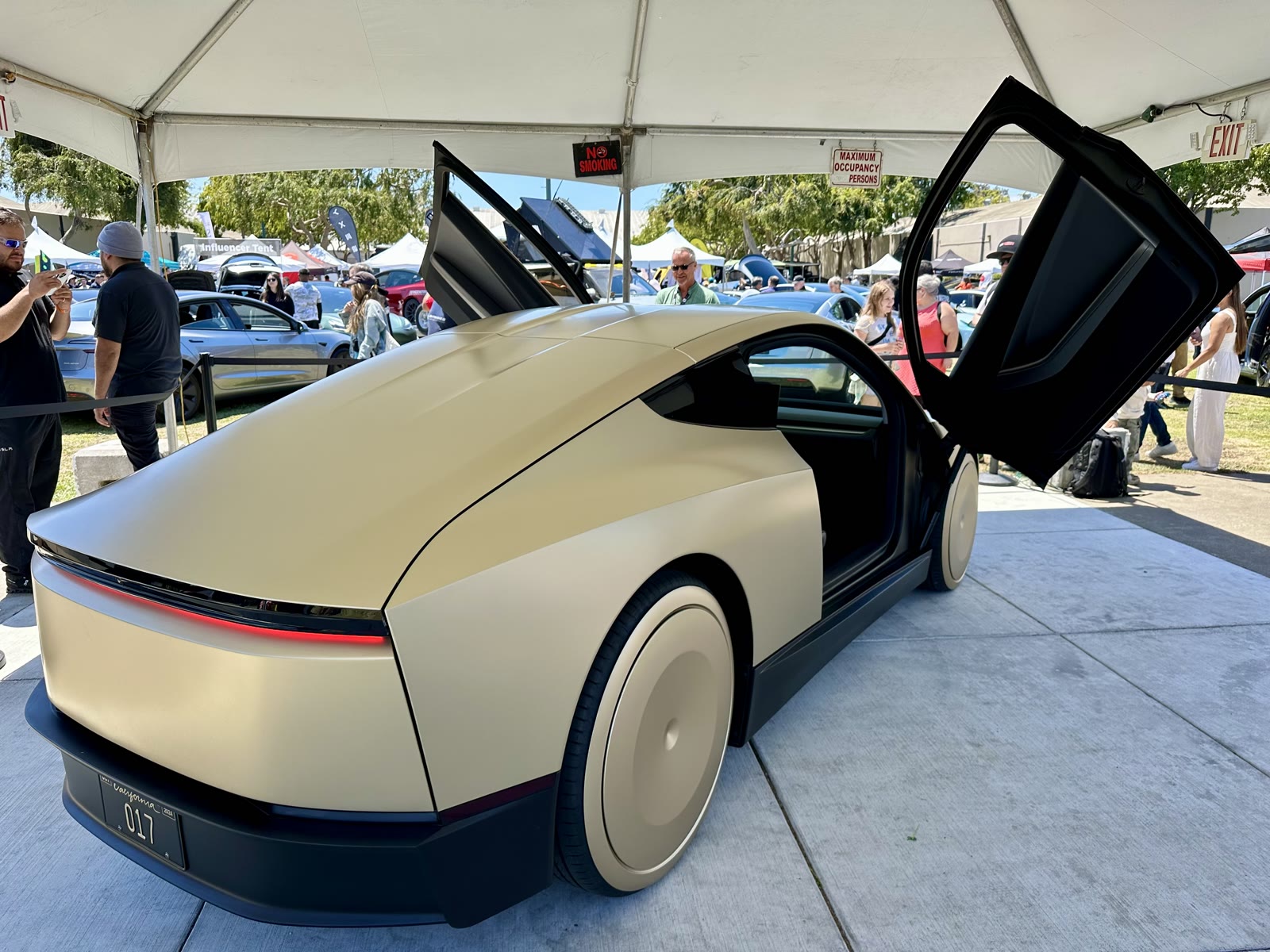
The Cybercab is Tesla’s answer to the self-driving future: a two-seat, fully autonomous car with no steering wheel, no pedals, and butterfly doors that open upward like a chrysalis. It has a 22-inch center display, stands at about four feet tall, and is being marketed as Tesla’s cheapest car at $29,990 before taxes. Unveiled in October 2024, it hit its first production unit in February 2026, formal production started in April, and paid robotaxi rides began in Austin in September 2026 on the older Model Y fleet. The personal Cybercab order page, which went live on Friday, promises estimated delivery in December 2026, starting in Austin.
But “buy” is the wrong verb. To own a Cybercab, you must be one of the select customers invited, you must accept delivery in one of a handful of Texas cities (with Florida cities joining the rollout), and you must subscribe to the “Autonomy Subscription” — $299 a month, first month included — which unlocks the self-driving software inside Tesla’s geofenced robotaxi areas. The car will not move without it.
The Math That Broke Me
Let’s talk numbers, because the subscription is not a small add-on. At $299 a month, the Autonomy Subscription costs $3,588 a year. Over five years, that’s roughly $47,631 — and that’s before you pay insurance, registration, charging, parking, and cleaning. Tesla’s order terms also require a $1,000 non-refundable deposit just to get in line.
And here’s the part that should make any rational buyer pause: the personal Cybercab cannot be used commercially. No Uber, no DoorDash, no joining Tesla’s own Robotaxi network to earn back that $299. Tesla’s AI chief, Ashok Elluswamy, has floated the second quarter of 2027 as the earliest date a customer’s car could join the network. Until then, you are paying full freight on a vehicle that has zero way to make money for you. It’s a race car you’re permitted to drive only on one private track, and only while paying a premium to keep the ignition on.
“Too High”: What Elon Actually Said
Musk’s “too high” comment on Friday was about the $299 monthly fee. He suggested the price should match the cost of Full Self-Driving and connectivity on Tesla’s other models — roughly $115 a month. That’s a drop of about 60 percent from the launch figure.
Taken at face value, it’s a strong signal: Tesla itself believes the subscription is inflated for its first wave of buyers. Whether the company will hold the price down when the geofence grows and the market normalizes is anyone’s guess, but the fact that the CEO himself says the current number is too high is worth remembering next time someone calls the Cybercab a “just another car.”
Why the Robotaxi Network Matters More
Here’s the honest framing: the personal Cybercab is the side show. The main event is the Robotaxi network that the personal car is supposed to plug into. Tesla’s Robotaxi service is currently operating in a handful of metros — Austin, Dallas, Houston, Fort Worth, and San Antonio in Texas, plus Miami, Orlando, and Tampa in Florida. It launched paid rides in Austin in September 2026, expanded to Dallas and Houston in April, and rolled out to Miami in July.
This is the same playbook that has driven Tesla’s driver-assistance rollout: start small, prove it out, then expand the map. The challenge is that the geofences have historically been smaller than Tesla advertises, and the required investment in supervised autonomy — the kind that doesn’t need a safety driver — is enormous. The personal Cybercab’s only clear path to a return on investment is joining the network, and Tesla has already said that’s at least Q2 2027. Early buyers are, in effect, paying for a feature they can’t yet use to earn back their money.
My Honest Take
Is the Cybercab worth it? For almost everyone, not yet. A $3,588-a-year subscription on top of a $30,000 car doesn’t pencil out until the price comes down and the geofence expands to cover a meaningful share of the country. Until then, it’s an expensive statement of faith in Tesla’s road map, not a practical purchase.
But as a bet on where autonomy goes next, it’s genuinely interesting. Tesla is shifting autonomy from something you buy as a feature to something you subscribe to as a service — the same curve that is already playing out with AI agents. Bleuken ran a piece last week on AI agents that shop for you, and the next step is agents that do things for you — including, eventually, a fleet of robotaxis that runs itself. The Cybercab is where that ends up in car form. It’s the physical edge of the same subscription economy that is quietly remaking software.
I don’t envy the early adopters. Buying a $29,990 car with a $299/mo leash on it, told to “wait for the network,” is a hard sell even in a bull market. You’re not buying a car; you’re buying into a roadmap.
What It Means for the Rest of Us
The Cybercab’s launch is a good example of how autonomous driving is becoming a subscription product rather than a checkbox option. It parallels the broader shift where AI agents are doing things for you — even, as United Airlines recently learned the hard way, booking flights without asking — and where convenience itself is being metered: AI agents performing tasks, cloud compute billed by the hour, and now a car that refuses to run without a monthly fee. If the price Musk says it “should” be — around $115 a month — ever lands, the economics change dramatically. If it stays at $299, the Cybercab is going to feel less like a car and more like an expensive, slow-to-deliver software subscription with wheels.
The energy question is here too. Every robotaxi on the road, personal or not, draws from the same grid that already costs us dearly. Bleuken has written about how AI data centers now carry a heavy share of the power bill; the robotaxi rollout will add another large, always-on load to the system. That’s not an argument against autonomy — it’s an argument for the grid and the price signals that come with it.
The Bottom Line
The Cybercab is a beautiful, competent, and expensive piece of hardware that doesn’t yet work the way a car should. You have to be invited to buy it, you can’t use it commercially, you can’t monetize it, and the subscription that makes it move is, by the company’s own admission, priced too high.
The real story isn’t the car. It’s the network. Tesla is building toward a future where autonomy is a service you pay for continuously, and the Cybercab is the consumer-facing chapter. The question that matters isn’t whether the Cybercab is a good car — it’s whether the robotaxi network can grow faster than the subscription fee, and whether the price comes down before the early-adopter window closes. Until then, the network is the better buy.
Quick FAQs
How much does a personal Cybercab cost?
$29,990 before taxes, plus a mandatory $299 a month Autonomy Subscription (the first month is included). A $1,000 non-refundable deposit is required to place an order.
Where can I take delivery?
Initially in Texas (Austin, Dallas, Houston, Fort Worth, San Antonio), with Florida cities joining and Arizona and Nevada planned. Tesla says the car will be available nationwide as regulatory approvals come through.
Can I use my Cybercab as a taxi?
No. Order terms for personal use prohibit commercial purposes, so you can’t drive it for rides, delivery, or join the Robotaxi network.