
Design & Build Quality
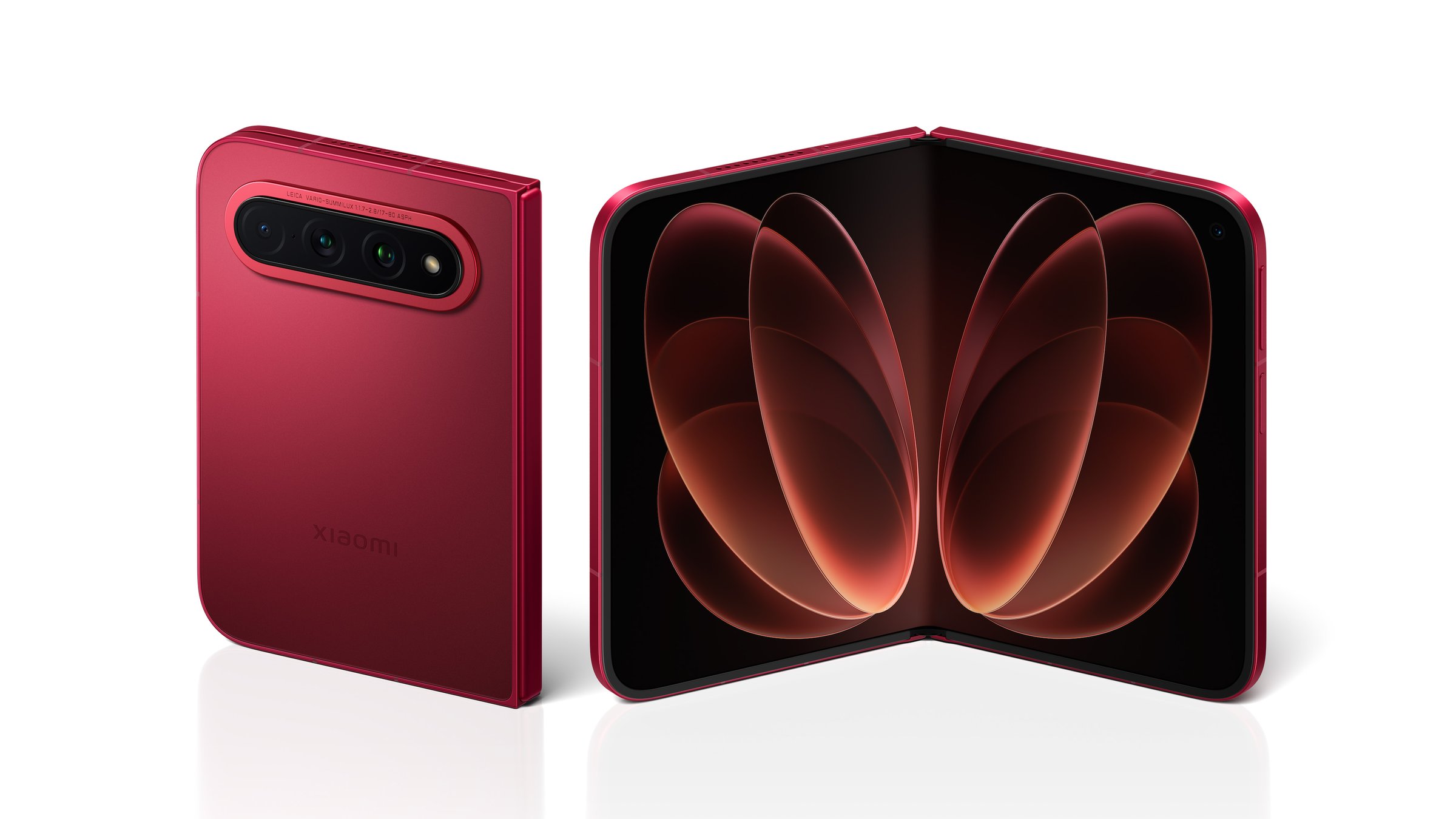
The Xiaomi 18 Fold takes a different path from the Samsung Galaxy Z Fold8. Where Samsung went with a squared-off passport design, Xiaomi rounded the corners — a lot. The result feels noticeably more ergonomic in the hand, and you can see why: the super-elliptical large R corners and flat-edge aluminum frame don’t dig into your palms the way sharp folds do. At 219 grams and 10.68mm thick when closed, it’s lighter than every previous Xiaomi foldable and 18 grams heavier than the Z Fold8, which is a fair trade for the larger cover screen.
The cover glass uses Xiaomi Dragon Crystal Glass 3 with ion implantation for extra drop resistance, and the back is a matte glass finish that comes in Gray, Silver, Red, and Rose Gold. The red variant is striking — it was the star of the IFA 2026 showroom, sitting behind glass but popping hard enough that you didn’t need to touch it to get the point. The Ceramic Edition swaps the back panel for lightweight silicon nitride ceramic — the first time this material has appeared on a smartphone back. It’s about 50% lighter than traditional zirconia ceramic and honestly looks the part.
The hinge uses a patented three-link design that wraps around the screen for protection and creates more display space. The inner display uses a dual-layer UTG structure — 50μm upper UTG plus a 30μm support layer — with a stretchable organic film replacing the old inorganic insulator in the touch layer. Xiaomi claims 258% higher inner display impact resistance and drop support up to 1.2 meters. The average crease depth is no more than 30μm, which in practice means you can barely see it 99% of the time. You can feel a small indent if you run your finger across the middle, but it’s nothing major.
Display
Both the inner and outer screens share the same √2:1 aspect ratio — the same proportions as A4 paper. This is a genuinely clever choice. When you unfold the phone, you land in landscape mode automatically without having to rotate the device like you do with the Z Fold8. For video watching, this means less letterboxing and a more natural viewing experience. The 7.58-inch inner display and 5.38-inch cover screen both use Xiaomi’s HyperRGB panels with a full RGB subpixel structure, which should mean sharper text and cleaner rendering than pentile alternatives.
Brightness is where things get attention-grabbing: both panels are “Super Sunlight Displays” rated at up to 4,000 nits peak with 1-120Hz LTPO adaptive refresh. That 4,000-nit figure lands in the same ballpark as the Huawei nova 16s Pro’s 6,000 nits, though like most peak-brightness claims it’s a local-spot measurement, not full-screen sustained output. Both panels support HDR10+, Dolby Vision, and HDR Vivid.
The cover screen’s right side has a more pronounced curvature due to the overall design, which eats a small chunk of usable area. It’s still comfortable for one-handed typing and pull-down gestures, but the asymmetry is noticeable once you see it side by side with a symmetrical cover display.
Performance
The Xiaomi 18 Fold is the first Xiaomi flagship to use the company’s in-house XRING O3 SoC — their second fully self-designed chip after the XRING O1. Built on a 3nm process with 24 billion transistors (up from 19 billion on the previous generation), the O3 uses a 10-core all-big-core CPU layout: two Ultra cores, four Premium cores, and four Pro cores, all clocked up to 4.35 GHz. Xiaomi claims 60% higher performance and 25% lower power consumption versus the previous generation.
The GPU is the new Arm G2-Ultra NX with a 16-core configuration, claiming 85% better graphics performance and 64% lower power draw than its predecessor — though “previous generation” here means Xiaomi’s own XRING O1, not a Snapdragon or MediaTek chip, so cross-brand comparisons are tricky. The NPU is a quad-core low-power design on SIMT architecture delivering 200 TOPS of tensor performance and 3.13 TFLOPS of vector performance. Combined with Xiaomi MiMo’s five-value quantization technology, on-device AI decoding is 45% faster than the previous flagship processor.
The standout spec here is LPDDR6 RAM — the XRING O3 is the first SoC to support it. With data rates up to 10,667 Mbps on a 24-bit interface, memory bandwidth hits 113.8 GB/s, nearly 50% more than LPDDR5X-9600. In practice, this should mean snappier multitasking and faster AI workload handling, but independent benchmarks comparing LPDDR6 against LPDDR5X on real apps are still thin as of this writing.
Storage is UFS 4.1 across all variants — 256GB/512GB/1TB configurations with 12GB or 16GB RAM. There’s no microSD slot, which is standard for foldables at this price but still worth noting for readers who want expandable storage.
The GSMArena hands-on tested the 12GB RAM variant and reported it felt “just as zippy and smooth as the Qualcomm and MediaTek flagships” for app launching and multitasking. That’s a reasonable first impression, but sustained performance under thermal load — gaming on the inner display, long video encodes — is still unverified until review units ship to independent outlets.
Camera
The triple Leica camera system is led by a 200MP main camera using a flagship HP5 1/1.56-inch sensor with f/1.7 aperture and OIS. The sensor supports native high dynamic range and in-sensor lossless zoom — meaning you can crop into a 200MP capture without the interpolation artifacts you’d get from digital zoom on a lower-resolution sensor. The 50MP periscope telephoto uses an inverted design that reduces module size while delivering smooth, naturally rounded bokeh. At 80mm focal length, it’s well-suited for portrait work, and the in-sensor zoom extends the reach to 160mm with lossless zoom. The 50MP ultrawide at 17mm rounds out the triple — no macro mode is explicitly mentioned in the spec sheet, which is a minor omission vs competitors that flag macro capabilities.
On the front, you get dual selfie cameras: a 16MP main selfie shooter and a 16MP cover-screen camera, both at f/2.2. Video recording tops out at 8K@24fps or 4K@30/60fps with Dolby Vision, plus 1080p at up to 960fps for slow-motion. Both front cameras can do 1080p@30/60fps. The Leica color science is backed by a color spectrum sensor for more accurate hues, and laser AF is included on the main camera.
Compared to the Samsung Galaxy Z Fold8’s dual 50MP setup (no telephoto on the standard Fold8), the Xiaomi 18 Fold’s triple-camera array with a dedicated periscope telephoto gives it a clear hardware advantage — though Z Fold8 Ultra owners get a 10MP 3x telephoto that the 18 Fold doesn’t directly match in optical zoom range. The Oppo Find X10 Pro Max’s triple 200MP setup is a different kind of overkill entirely, with all three sensors at 200MP versus Xiaomi’s single 200MP main.
Battery & Charging
The 6,000mAh silicon-carbon battery is the largest in the passport foldable form factor, according to Xiaomi. Both cells use a stacking process with 20% high silicon content and energy density up to 920Wh/L — the same density figure Huawei claims for its silicon-carbon cells in the nova 16s Pro and Honor Magic V6. The 7.1mm chassis (unfolded) is remarkably thin for a 6,000mAh cell, which speaks to the silicon-carbon chemistry doing its job.
Charging is 67W wired via USB-C 3.2 Gen2 with PD3.0 and 50W PPS, plus 50W wireless charging and reverse wired charging. The 67W wired speed trails the 100W you’ll find on the Oppo Find X10 Pro Max and Huawei nova 16s Pro. The 50W wireless charging is competitive — it matches what Samsung offers on its Ultra foldables and beats the base Z Fold8’s wireless-charging gap. Press materials don’t explicitly state whether a charger is included in the box, which is worth flagging: at this price point, charger inclusion varies by brand and region.
Real-world battery endurance is still unverified. Xiaomi claims “longer battery life and better thermal control than other foldables in everyday multitasking, large-screen gaming, and extended video playback,” but without independent testing these are marketing claims. The 6,000mAh capacity is physically bigger than the Z Fold8’s 4,800mAh, which should translate to meaningfully better endurance if the XRING O3’s power efficiency claims hold up.
Software
The Xiaomi 18 Fold launched with Android 17 and HyperOS 4. The HyperOS multi-window experience is optimized specifically for the foldable form factor, with two-way split providing two well-proportioned viewing areas and three-way split giving each section a layout close to mainstream full-screen smartphones. The √2:1 aspect ratio on both screens makes the transition between cover and inner displays feel natural — something Samsung’s different aspect ratios (16:10 cover, 4:3 inner on the Z Fold8) don’t quite achieve.
The biggest caveat for international readers: the Xiaomi 18 Fold is exclusive to China at launch. There’s no word on a global release. That means HyperOS 4 ships with the Chinese ROM — no Google Play Services out of the box. For readers in the Philippines, that means GCash, Maya, and most local banking apps won’t run natively. The Xiaomi 18 Pro (reviewed on this site Sep 24) has the same China-only restriction, and the pattern across recent Xiaomi flagships suggests a global variant may come later — the Poco F9 Pro is the global sibling of the Redmi K100 Pro, launching Q1 2027. But for the 18 Fold, no global sibling has been announced.
Xiaomi Astral Communication supports global roaming in over 210 countries and regions with more than 52 carriers, which helps if you’re traveling, but it doesn’t solve the GMS gap for daily app use at home.
Pros and Cons
Pros
|
Cons
|
Should You Buy This?
Buy it if:
- You’re in China or comfortable importing a China ROM and sideloading Google services via Gspace or similar workarounds
- You want the first look at Xiaomi’s in-house silicon and don’t mind being an early adopter of a second-generation custom SoC
- The triple Leica camera with a dedicated periscope telephoto matters more to you than raw megapixel counts
- You value the √2:1 aspect ratio and automatic landscape mode when unfolding — it’s a genuinely nicer video-watching experience than the Z Fold8’s rotation-required approach
- You’re a Xiaomi loyalist who wants the foldable with the largest battery in its form factor
Skip it if:
- You need Google Play Services natively — the China ROM will frustrate daily use for most Filipino readers
- You want a globally available foldable today — the Galaxy Z Fold8 and Z Fold8 Ultra are available in more markets now
- 67W charging feels too slow compared to the 100W options on the Huawei nova 16s Pro and Oppo Find X10 Pro Max
- You’re not comfortable being an early-adopter test subject — independent reviews of battery life, thermal performance, and long-term reliability are still pending
- The asymmetric cover screen curvature will bother you in everyday one-handed use
Final Verdict
The Xiaomi 18 Fold is the most interesting passport-foldable launch of September 2026, not because it crushes every spec on a spreadsheet, but because it makes a coherent set of choices that prioritize the user experience over raw numbers. The √2:1 aspect ratio on both screens is the kind of thinking that makes a foldable feel designed rather than engineered — you unfold it and the content just works in landscape without rotating the device. The rounded corners and flat-edge frame are ergonomic wins that the squared-off Z Fold8 doesn’t match. And the XRING O3, while unproven in independent benchmarks, represents Xiaomi’s most ambitious attempt yet at escaping Qualcomm and MediaTek dependency.
But the China-only launch is a real barrier. This isn’t a “global release coming later” situation where you can comfortably pre-order — the Xiaomi 18 Pro already launched without a global follow-up timeline, and the 18 Fold may follow the same pattern. For Filipino readers, the Google Services gap means this is an import-only curiosity, not a daily driver, unless you’re deeply comfortable with workarounds. At CNY 10,999 to CNY 14,999 ($1,630–$2,220 at current rates), the price is competitive with the Z Fold8 Ultra’s European pricing but you’re paying for a device you can’t easily use with local apps.
Camera-wise, the triple Leica system with the 200MP main and dedicated periscope telephoto is a genuine step up from the standard Z Fold8’s dual 50MP setup, and the 6,000mAh silicon-carbon battery should deliver meaningfully better endurance than the Fold8’s 4,800mAh cell if the efficiency claims hold. The 67W charging is the one area where Xiaomi deliberately chose not to compete at the top — a reasonable trade for the thinner chassis, but worth knowing before you buy.
For the right reader — a China-tech enthusiast, an import-tolerant early adopter, or a Xiaomi loyalist who wants to try the company’s second-gen in-house chip — the Xiaomi 18 Fold is a compelling package. For everyone else, the global foldable market is still better served by Samsung’s Z Fold8 lineup, even if the hardware specs on paper look less flashy. Wait for independent reviews before spending serious money on this one.
Disclosure: The Xiaomi 18 Fold is exclusively available in China as of September 2026. No global release date has been announced. Specifications and pricing are based on the official China launch materials from Xiaomi and GSMArena’s spec page. Independent battery endurance, thermal performance, and camera quality reviews are pending.