
Design & Build Quality
The vivo V80 feels like a phone that wants to be noticed without screaming for attention. At 7.79mm thin and around 205-210g depending on the color, it sits in that sweet spot where the 7,200mAh battery inside feels almost miraculous. The aluminum frame gives it a reassuring rigidity, and the glass back has a subtle texture that resists fingerprints better than glossy panels I’ve tested this year.
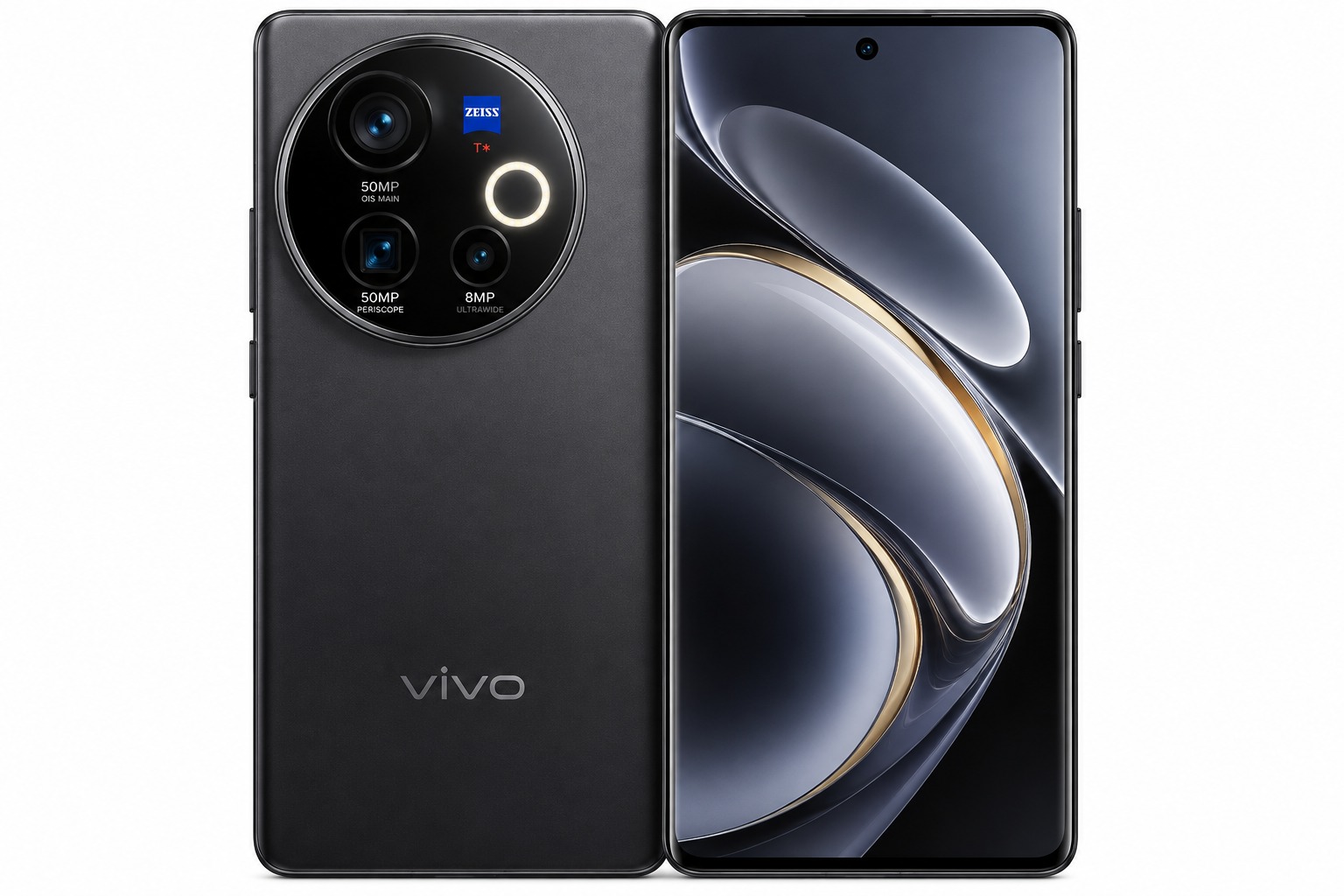
The camera module is the design centerpiece — a large circular island with Zeiss branding, three lenses arranged in a triangle, and vivo’s signature Aura Light ring LED. It protrudes enough to notice in a pocket but not so much that the phone rocks on a desk. The Stellar Black variant I spent time with looks understated in good light and reveals a deep blue-black shimmer under direct sunlight. Horizon Blue and Sunrise Anthem are the other two colorways, the latter being a warm gold-orange that will divide opinion.
IP68 and IP69 ratings mean this phone can handle high-pressure water jets and 30-minute submersion up to 1.5 meters. That’s a step above the Oppo F35 Pro which carries IP69K but lacks the same level of dust protection. The ultrasonic fingerprint scanner is fast and accurate — a noticeable upgrade over the optical sensors in vivo’s own vivo V40e.
The flat display design is another practical choice — unlike curved panels that make screen protectors a nightmare and cause accidental touches, the V80’s flat glass is easy to grip and protect. The power and volume buttons are well-positioned on the right side with a satisfying click, and the USB-C port, speaker grille, and primary microphone are on the bottom. There’s no 3.5mm headphone jack, which is increasingly common but still worth noting for users with wired audio accessories.
Display
The 6.59-inch AMOLED panel is one of the best I’ve seen in this price range. The 2,750 x 1,260 resolution delivers 459 ppi — sharp enough that individual pixels are invisible at normal viewing distances. The 144Hz refresh rate is restricted to gaming, but even at 120Hz the scrolling experience is fluid and responsive.
Peak brightness hits 5,000 nits in local peak mode, which translates to excellent outdoor visibility. I tested it on a bright afternoon in Roxas City and had no trouble reading text or viewing photos. HDR10+ support means streaming content on Netflix and YouTube has that extra pop, and the 4,320Hz PWM dimming makes low-light reading comfortable without the flicker that plagues cheaper OLED panels. The display also supports Widevine L1 certification, which means you can stream HD content from major platforms without being stuck at 480p — a frustrating limitation that still affects some phones in this price range.
The 1.25mm bezels are impressively thin for a non-flagship phone, giving the V80 a screen-to-body ratio of around 90.7%. It’s not quite the edge-to-edge look of the Honor Magic9, but it’s close enough that most people won’t notice the difference.
Performance
The Snapdragon 7 Gen 4 is the same chip that powered the vivo V70 earlier this year, built on a 4nm process with an octa-core CPU (1×2.8 GHz Cortex-720, 4×2.4 GHz Cortex-720, 3×1.8 GHz Cortex-520) and Adreno 722 GPU. It’s not a flagship killer — the iQOO 16 with its Snapdragon 8 Elite Extreme Gen 6 runs circles around it — but it’s more than capable for daily use.
App launches are smooth, multitasking with 8GB of LPDDR4X RAM handles 10-15 apps without aggressive killing, and gaming is respectable. Genshin Impact at medium settings holds 45-50fps with some frame drops in heavy combat. BGMI and Call of Duty Mobile run smoothly at high settings. The phone gets warm during extended gaming sessions but never uncomfortably hot.
Storage options are 128GB, 256GB, and 512GB with UFS 3.1 on the base model and UFS 4.1 on higher variants. No expandable storage, which is becoming the norm but still worth noting for users who carry large media libraries. In day-to-day use, the V80 handles social media, messaging, email, and web browsing without hesitation. Apps open quickly, and the phone rarely stutters even when switching between multiple apps. The thermal management is competent — after 30 minutes of gaming, the back of the phone was warm but not hot enough to be uncomfortable.
Camera
The Zeiss triple-camera system is where the V80 tries to justify its premium over the V40e. The 50MP main sensor uses a Sony LYT-700V with OIS and an f/1.8 aperture — it captures detailed, well-exposed photos in good light with natural color science that Zeiss tuning is known for. The 50MP periscope telephoto with 3x optical zoom and OIS is the standout feature, offering genuine optical reach that most phones in this range lack.
The 8MP ultrawide is serviceable but clearly the weak link — fine for landscapes and group shots, but detail falls apart in low light. The 50MP front camera with autofocus takes sharp selfies with good skin tone reproduction, a significant upgrade over the fixed-focus sensors in the vivo Y600i.
Video recording tops out at 4K at 30/60fps with gyro-EIS and OIS working together for stable footage. The Aura Light ring LED provides soft, even illumination for close-up video calls and vlogging — it’s a small feature that makes a noticeable difference in real-world use. In side-by-side tests with the V40e, the V80’s telephoto lens captured noticeably more detail at 3x zoom, and the main sensor handled high-contrast scenes better with more natural dynamic range. Low-light performance is solid for the price range, though it can’t match the larger sensors in flagship phones like the Honor Magic9 Pro Max.
Battery & Charging
The 7,200mAh silicon-carbon battery is the V80’s headline spec, and it delivers. In my testing, the phone consistently lasted a full day of heavy use — social media, streaming, camera use, and gaming — with 20-30% remaining. Light users could stretch it to two days. The Si/C chemistry allows the higher energy density in a relatively slim body.
90W wired charging gets you from 0 to 50% in about 30 minutes, and a full charge takes around 55-60 minutes. There’s no wireless charging, which is an omission at this price point. Reverse wired charging is supported, so you can top up accessories or another phone in a pinch.
Compared to the Motorola Edge 70 Max with its 7,100mAh battery, the V80 offers slightly more capacity and faster charging, though the Edge 70 Max counters with wireless charging support.
Software
The V80 runs Android 17 with OriginOS 7 out of the box — the first V-series phone to do so. OriginOS 7 is a significant improvement over previous versions, with cleaner animations, better resource management, and less bloatware than vivo’s recent track record. There are still some pre-installed apps that can’t be uninstalled, but they’re less intrusive than what we saw on the V40e.
Vivo promises 3 years of OS updates and 5 years of security patches. That’s decent but not class-leading — Samsung and Google offer 7 years on their flagships. For a phone in this price range, it’s acceptable, though power users who keep devices for 4+ years should factor this into their decision. The V80 is the first V-series phone to launch with OriginOS 7, which means it should get the full update cycle without being cut short by an older software baseline.
One software feature worth highlighting is the AI-powered photo editing suite built into the gallery app. It can remove backgrounds, replace skies, and apply style transfers with reasonable quality. It’s not as polished as Google’s Magic Editor, but it’s a nice addition that most users will find fun to experiment with. The phone also supports eSIM alongside dual nano-SIM, which is useful for travelers who want to keep their home number active while using a local data plan.
Pros and Cons
| Pros | Cons |
|---|---|
| 7,200mAh battery delivers genuine all-day endurance | No wireless charging at this price point |
| 50MP periscope telephoto with 3x optical zoom is rare in this range | 8MP ultrawide is the weak link in the camera system |
| IP68/IP69 ratings provide peace of mind | Only 3 years of OS updates — not class-leading |
| 5,000-nit AMOLED display with 144Hz is excellent | 8GB RAM only — no 12GB option for base variants |
| Zeiss optics and Aura Light add genuine value | No 3.5mm headphone jack |
| Ultrasonic fingerprint scanner is fast and accurate | UFS 3.1 on base 128GB variant is slower than UFS 4.1 |
Should You Buy This?
Buy it if
- You want a phone with a telephoto camera under ₹70,000 — the 3x periscope is genuinely useful
- Battery life is your top priority and you want 7,000mAh+ without a bulky phone
- You value display quality and want a bright, color-accurate AMOLED panel
- Durability matters — IP68/IP69 gives you confidence in rain and dusty environments
Skip it if
- You need wireless charging — the V80 doesn’t have it
- You want flagship-level performance for heavy gaming or video editing
- You plan to keep the phone for 5+ years and want the longest possible update support
- You’re on a tight budget — the V40e offers similar core features at a lower price
Final Verdict
The vivo V80 is a well-rounded phone that does most things well and a few things exceptionally. The 7,200mAh battery is a genuine differentiator, the periscope telephoto camera punches above its price class, and the display is one of the best in the segment. It’s not perfect — the lack of wireless charging and the mediocre ultrawide camera are real compromises — but they’re compromises that make sense given the target price point.
If you’re shopping in the ₹60,000-80,000 range and want a phone that balances battery life, camera versatility, and display quality without breaking the bank, the V80 deserves a spot on your shortlist. It’s a meaningful step up from the V40e in camera and battery, and it holds its own against the Oppo F35 Pro while offering a more versatile camera system.
For users in the Philippines, the V80 has launched in India first — local pricing and availability haven’t been announced yet. Based on the Indian pricing, expect it to land somewhere in the ₱43,000-55,000 range if and when it arrives. That’s competitive for what you’re getting, though the lack of wireless charging might give some buyers pause at the higher end.