
Design & Build Quality
The vivo Y600i lands on the scene with a design philosophy that is uncomplicated in the best way. It measures 169.6 x 79.2 x 8.7mm and weighs 229 grams — dimensions that sit comfortably in one hand despite the large 6.87-inch screen. The build uses a glass front, plastic frame, and plastic back, which keeps costs down but also keeps the phone lighter than all-glass rivals at this weight.
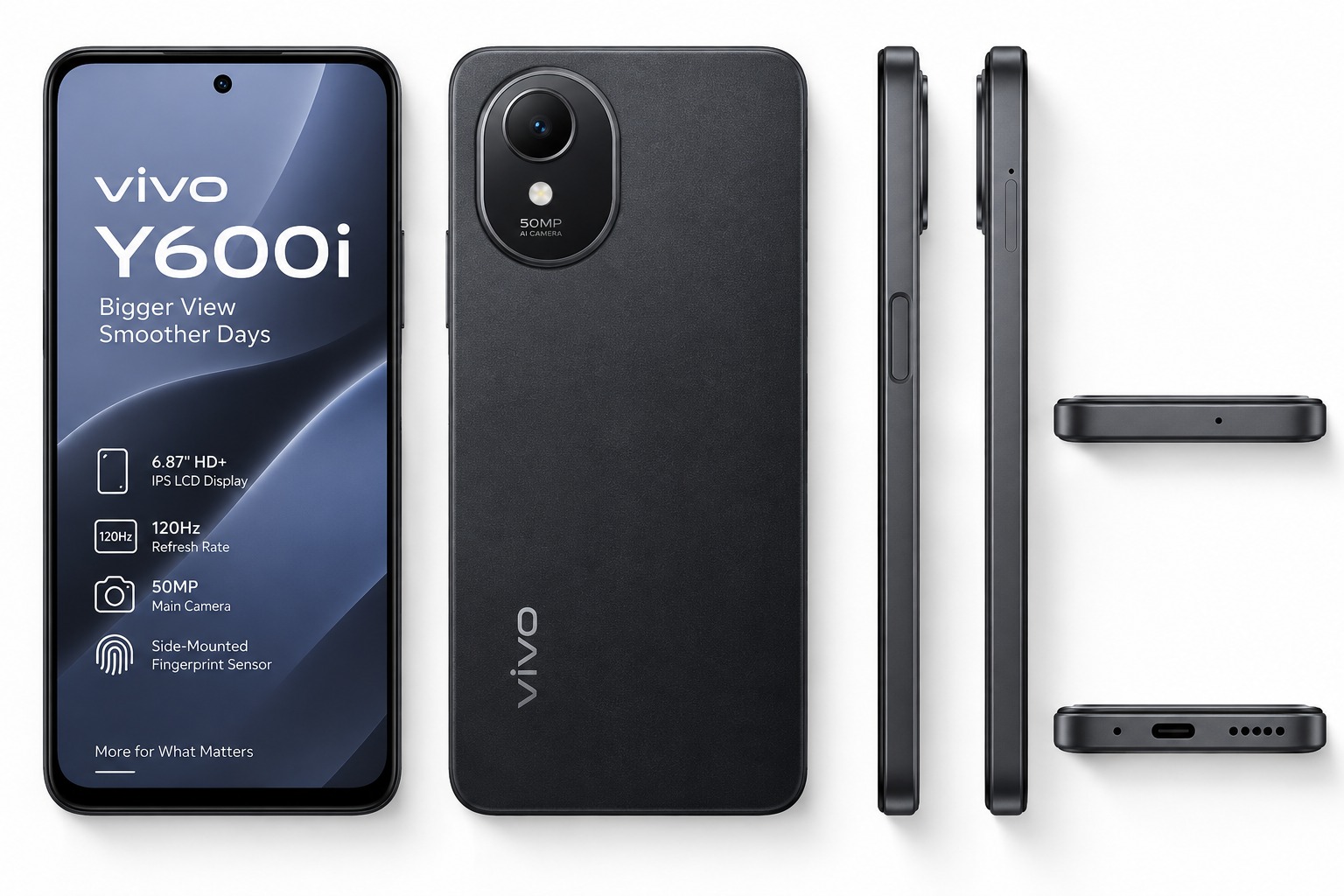
Three colour options are available at launch: Baby’s Breath (a pale off-white), Clear Blue, and Polar Night Black (translated from Chinese). None of these are particularly bold, but they are clean and timeless. The side-mounted fingerprint sensor is integrated into the power button — a sensible placement that works reliably in daily use. There is an IR blaster onboard, which is a nice legacy touch for Android users who still control TVs and AC units with their phone.
On the downside, there is no 3.5mm headphone jack. For a budget phone targeting cost-conscious buyers, dropping the jack is a growing trend that feels like a compromise. The IP68 + IP69 dual rating is genuinely impressive at this price point — dust-tight, immersible up to 1.5m for 30 minutes, and resistant to high-pressure water jets. vivo also claims drop resistance from 1.4m. These are durability numbers you would normally expect from a phone twice the price.
Display
The Y600i carries a 6.87-inch IPS LCD with a 720 x 1592 pixel resolution (HD+), 120Hz adaptive refresh rate, and a 19.9:9 aspect ratio. The pixel density works out to approximately 254 ppi — serviceable for media consumption and social media, but don’t expect sharp text at close viewing distances. The 120Hz refresh rate makes scrolling and animations feel smooth, which partially compensates for the lower resolution.
Peak brightness is rated at 1,300 nits with 1,000 nits typical HBM (high brightness mode). In real-world terms, this means the screen should stay visible in direct sunlight, though the lower resolution and LCD panel technology mean blacks will be greyish and contrast won’t match OLED alternatives. The display uses vivo’s Diamond Shield Glass — a scratch-resistant cover that helps justify the IP68/69 durability claims. The company quotes 83% NTSC colour saturation, which is decent for an LCD but won’t dazzle.
One thing worth noting: this is a flat panel. No curved edges, no weird notches. Just a straightforward, readable display that does the job without flash.
Performance
Under the hood, the Y600i runs on the Qualcomm Snapdragon 4 Gen 2 (SM4450) — a 4nm chipset with an octa-core CPU (2×2.2 GHz Cortex-A78 + 6×1.95 GHz Cortex-A55) and an Adreno 613 GPU. This is not a gaming powerhouse. The Snapdragon 4 Gen 2 sits in the mid-range segment: fine for social media, streaming, light gaming, and day-to-day tasks, but don’t expect to run Genshin Impact at high settings for long.
The single available configuration is 6GB of RAM paired with 256GB of internal storage (UFS 2.2). There is a microSDXC expansion slot, which is a welcome feature for a budget phone — many competitors in this range still offer expandable storage. The 6GB/256GB combination is reasonable for the price, though 8GB would have been preferable for future-proofing.
Connectivity is solid: 5G support (bands 1, 3, 5, 8, 28, 38, 40, 41, 66, 77, 78 SA/NSA), dual-band Wi-Fi 5 (802.11 a/b/g/n/ac), Bluetooth 5.1 with aptX Adaptive, GPS + GLONASS + Galileo + BDS + QZSS, and a USB Type-C 2.0 port with OTG support. Notably, NFC is absent — a omission that will matter to anyone who wants contactless payments. In China this may not matter much, but for global buyers it’s a real gap.
Camera
The Y600i takes a minimalist approach to cameras. The rear is a single 50MP wide camera with an f/1.8 aperture and PDAF (phase-detection autofocus). There is no ultrawide lens, no telephoto, no macro, no depth sensor — just one camera. For a phone at this price, that’s not unusual; the question is whether that one camera does a good job.
The 50MP sensor with f/1.8 aperture should handle daylight shots reasonably well, and the PDAF helps with focus speed. HDR and panorama modes are included. Video recording tops out at 1080p at 30fps — no 4K support. On the front, an 8MP f/2.1 selfie camera handles video calls and self-portraits at 1080p/30fps as well.
The honest assessment: this is a camera setup that works for everyday snapshots, social media posting, and video calls. It won’t compete with phones that offer multi-lens systems or larger sensors. If photography is a priority, look higher up the vivo range — the vivo X500 Pro offers a completely different camera experience with its 2nm-powered triple-camera system. But for the target audience — budget-conscious buyers who want a reliable all-rounder — the single-camera approach keeps costs down without making the phone feel crippled.
Battery & Charging
This is where the Y600i earns its headline. The phone packs an 8,000mAh silicon-carbon (Si/C) lithium-ion battery — a capacity that is genuinely rare in a phone with these other specifications. For context, most budget phones in this range ship with 5,000-6,000mAh cells — the Samsung Galaxy A18 4G sticks to 5,000mAh with its promise of six years of updates. The 8,000mAh figure is a standout, and if real-world endurance tracks anywhere close to the specs, this phone could easily last two full days of moderate use.
Charging is handled by a 44W wired charger. That’s not particularly fast by 2026 standards — competitors like the Redmi 17C offer 33W, while mid-range phones commonly hit 66W-80W. But paired with an 8,000mAh battery, the math works out: a larger battery takes longer to fill regardless, and 44W is adequate. There is also reverse wired charging, allowing the Y600i to top up another phone or earbuds in a pinch.
No wireless charging is supported. Given the budget positioning and the large battery, this is understandable — wireless charging would add cost and generate more heat.
Software
The Y600i ships with Android 16 based on OriginOS 6, vivo’s custom skin. OriginOS has been evolving steadily and brings a cleaner, more Apple-inspired interface to vivo phones in China. For the Chinese market, this makes sense — the software is tailored to local apps, services, and user expectations.
The critical caveat for anyone outside China: OriginOS 6 is a China-focused OS. Google Mobile Services (GMS) are not part of the equation for China-market vivo phones. That means no Google Play Store, no Gmail, no Google Maps, no YouTube, and no Google-based apps out of the box. For Chinese users, this is a non-issue — the domestic app ecosystem (Huawei AppGallery, various APK sources, direct downloads) fills the gap. For anyone outside China considering a grey-market purchase, this is a major operational hurdle. Workarounds exist (side-loading, microG, GMS patches), but they require technical comfort and come with their own limitations.
On the plus side, the phone includes an IR blaster, which is a small but useful feature for home automation users that many competitors have dropped.
Pros and Cons
| Pros | Cons |
|---|---|
| 8,000mAh Si/C battery — rare capacity at this price | No 3.5mm headphone jack |
| IP68 + IP69 dual rating with 1.4m drop resistance | No NFC — no contactless payments |
| 120Hz adaptive refresh rate on a 6.87-inch display | Single rear camera only — no ultrawide or telephoto |
| 44W wired charging with reverse charging support | No 4K video recording — capped at 1080p |
| IR blaster for home entertainment control | No wireless charging |
| 4nm Snapdragon 4 Gen 2 — efficient and adequately powerful | OriginOS 6 with no Google services outside China |
| CNY 1,999 (~$270) for 6GB/256GB — competitive pricing | No OIS on main camera — digital stabilization only |
| Diamond Shield Glass with IP68/69 durability claims | 720p HD+ resolution — not sharp by 2026 standards |
Should You Buy This?
Buy it if:
- You want a phone that can genuinely last two days on a single charge — the 8,000mAh battery is the main selling point
- You’re buying for the Chinese market or are comfortable working around the lack of Google services
- Durability matters to you — the IP68/IP69 rating and 1.4m drop resistance are unusual in budget phones
- You want a large screen with smooth 120Hz scrolling without paying flagship prices
- You still use infrared-controlled appliances and appreciate having an IR blaster built in
- The CNY 1,999 price point fits your budget and you value battery life over camera versatility
Skip it if:
- You rely on Google apps and services and don’t want to deal with workarounds
- You need NFC for contactless payments — this phone doesn’t have it
- Camera versatility matters — the single 50MP lens won’t satisfy photography enthusiasts
- You want a sharp display — 720p HD+ on a 6.87-inch screen is adequate but not impressive
- You need NFC or 4K video recording
- You want expandable storage — the microSDXC slot handles large media libraries
Final Verdict
The vivo Y600i is a phone with a clear identity: it is a battery-first budget smartphone that sacrifices camera versatility, display sharpness, and some convenience features (NFC, headphone jack) to deliver an 8,000mAh battery at a CNY 1,999 price point. That’s a coherent trade-off, and for the right buyer it makes sense.
The 8,000mAh Si/C battery is the star of the show — a capacity that puts it ahead of rivals like the Realme 16x 5G with its 7,000mAh cell. In a segment where 5,000-6,000mAh was the standard just a year ago, vivo is pushing the envelope on capacity. Combined with IP68/IP69 durability and a 120Hz display, the Y600i offers a package that feels more robust than its price suggests. The 44W charging speed is modest, but the large battery compensates — you’re not charging this phone every night regardless.
The caveats are real and worth stating plainly. The Snapdragon 4 Gen 2 is a capable mid-range chipset but not a gaming chip. The single 50MP rear camera is functional but basic — especially when you compare it with phones like the vivo T5 5G, which adds a second camera and a faster chipset for a similar budget audience. The 720p display works but doesn’t dazzle. And for anyone outside China, the absence of Google services on OriginOS 6 is a genuine operational hurdle — not a dealbreaker for tech-savvy users who can sideload, but a real friction point for mainstream buyers.
The Y600i is not trying to be everything to everyone. It’s trying to be the phone you forget to charge — a device that keeps going because the battery is simply larger than what competitors offer at this level. For budget-focused buyers in China, that’s a compelling pitch. For the rest of the world, it’s a phone that exists in a grey area: impressive on paper for the price, but locked behind an OS that assumes you’re living in a different app ecosystem.
If vivo brings this phone to global markets with a Google-friendly OS layer, the Y600i could be a seriously interesting budget contender — and the kind of device that makes you think twice about staying connected without compromising on battery life. Until then, it’s a China-market device that will primarily matter to buyers in that region — or to enthusiasts who are curious about what an 8,000mAh budget phone looks like, even if they can’t easily buy one.