
iCAUR Crosses Over to the Philippines on Nov 24 — and the Prices Look Competitive
A little-known Chinese brand called iCAUR is finally arriving in the Philippines, and it will do so with something the local EV market is still short on: a full brand launch with confirmed prices — this Sunday, Nov 24. The move is handled by Omoda & Jaecoo Philippines, the Chery-owned arm that already sells Dacia, Jaecoo, and the Chery QEV here, so it is not a stranger to selling Chinese SUVs on local showroom floors.
iCAUR is bringing two models: the V23, a compact battery-electric SUV, and the V27, a larger range-extended electric SUV (REEV) whose 1.5-litre turbo engine works only as a generator. Both arrive at the same time, both carry RWD and AWD options, and both are aimed squarely at the segment below the Toyota Hilux and the Ford Ranger.
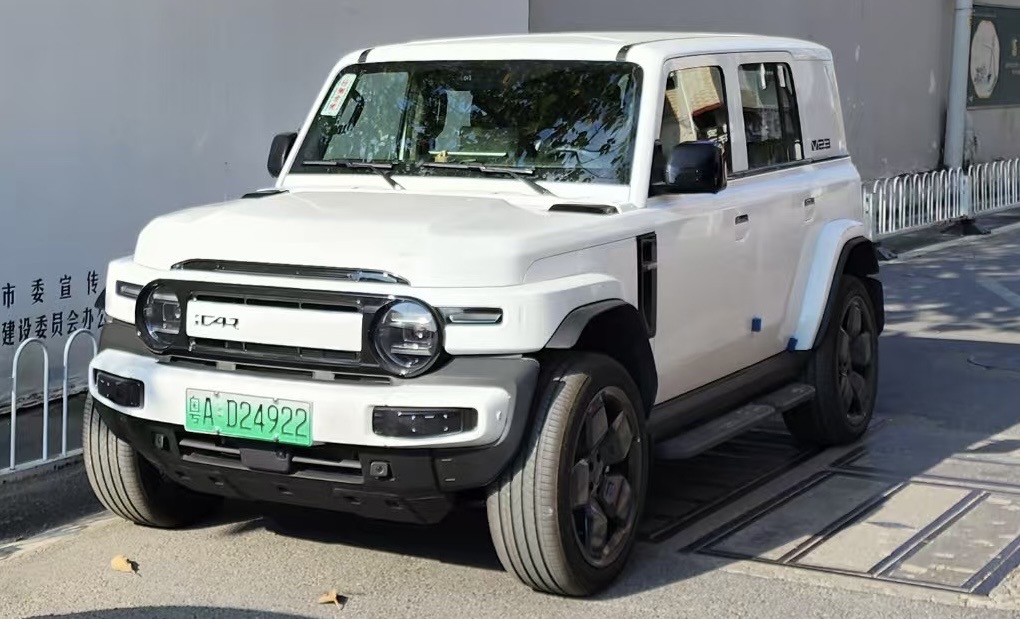
The V23 is the main story. It is a 4,220 mm compact SUV with a 59.93 kWh lithium-iron-phosphate pack that promises 360 km of NEDC range on the single-motor version and 430 km (81.8 kWh, nickel-manganese-cobalt) on the dual-motor one, which iCAUR has stretched on external road testing to about 501 km. The single-motor puts out 134 hp and 180 Nm; the dual-motor version does 207 hp and 292 Nm. Local listings already stack a 15.4-inch touchscreen and ADAS kit on the top trims.
The V27 is a different animal. Its 1.5-litre turbo generator feeds either a 20.4 kWh pack (single-motor, 95 km of electric-only range, 248 hp) or a 34.3 kWh pack (dual-motor, 150 km EV, 449 hp and 505 Nm). With the 60-litre fuel tank, the AWD variant reportedly reaches about 1,000 km combined — genuinely useful for long trips where charging stations are thin.
| V23 RWD | V23 AWD | V27 RWD | V27 AWD | |
|---|---|---|---|---|
| Layout | BEV | BEV | REEV | REEV |
| Motor | 134 hp / 180 Nm | 207 hp / 292 Nm | 248 hp / 300 Nm | 449 hp / 505 Nm |
| Battery | 59.93 kWh LFP | 81.8 kWh NCM | 20.4 kWh LFP | 34.3 kWh LFP |
| EV range (NEDC) | 360 km | 430 km | 95 km | 150 km |
| Combined range | 360 km | 430 km | 1,100 km | 1,000 km |
| Engine | — | — | 1.5L turbo (generator) | 1.5L turbo (generator) |
| Fuel tank | — | — | 60 L | 60 L |
| Drive | Rear | All | Rear | All |
| Length / wheelbase | 4,220 / 2,725 mm | 4,220 / 2,725 mm | 5,045 / 2,900 mm | 5,045 / 2,900 mm |
| Ground clearance | ~200 mm | ~210 mm | ~220 mm | ~220 mm |
Prices are still provisional — officially, they get confirmed Sunday. Indicative figures circulating put the V23 at roughly PHP 1.5 million for the single-motor and PHP 1.8 million for the dual-motor, and the V27 at around PHP 2.1 million (single-motor) to PHP 2.5 million (dual-motor). In dollar terms, using about 61.4 PHP to the dollar and 94.6 INR, that lands the V23 near $24,000–$29,000 (₹23–28 lakh) and the V27 near $34,000–$41,000 (₹32–39 lakh). These are pre-confirmation estimates; the official SRP drops Sunday, and I recommend waiting for the official price sheet before any buying decision.
| Variant (indicative) | PHP (est.) | USD (est.) | INR (est.) |
|---|---|---|---|
| V23 RWD | 1,500,000 | ~24,400 | ~23,07,000 |
| V23 AWD | 1,800,000 | ~29,300 | ~27,73,000 |
| V27 RWD | 2,100,000 | ~34,200 | ~32,32,000 |
| V27 AWD | 2,500,000 | ~40,700 | ~38,52,000 |
How they sit in Philippine roads
City driving. The V23 is the kind of car EDSA commutes were made for: instant torque, no gearbox to wrestle, and a 360 km real-world range on a single charge. Recharging overnight at home is the obvious play, and the 59.93 kWh pack is big enough that a weekend trip is more than comfortable. The V27 is the opposite case: it carries only 95–150 km of EV range, but the gasoline generator means you never plan your trip around a charging station. For Makati or BGC, either works — the V23 if you love plugging in, the V27 if you hate it.
Long-distance travel. Manila to Baguio is roughly 250 km. The V23 can do it on one charge, but on a highway run you would want to stop for a fast charge — and in practice that means a level-2 charger is the only realistic option today, since public DC hotspots on the NLEX and SCTEX are still a handful. The V27 removes that worry entirely: with 1,000 km of combined range, a driver can skip charging entirely and just fill the 60-litre tank halfway. For longer intercity trips, the V27 is the calmer choice.
Flooding. Ground clearance sits at 200–220 mm across both models. That is respectable but not high — the V23 AWD’s 210 mm is well below a vehicle’s interior, so I would hesitate before wading. The EV advantage does still apply: with no engine up front, there is no hydrolock risk, which matters in a Manila afternoon squall. Still, I would not call either vehicle a wader.
Heat. Both packs are lithium-iron-phosphate except the V23 AWD’s 81.8 kWh NCM cell, which is the thermally weaker sibling. At 36–38 °C with the air-con running, the LFP packs will hold up better; the NCM pack will need its thermal management to work harder. All versions also draw from the same electrical system as a large accessory load, so expect the cabin to warm up faster in traffic. The V27’s generator helps here too — it can power accessories when the battery is depleted, too.
What the reviewers say
AutoIndustriya’s pre-launch notes describe the V23 as a boxy SUV with strong ground clearance for its size (~210 mm) and a 15.4-inch touchscreen plus ADAS as standard on top trims. In an actual on-road test, a combined test range of 484.8 km on a single charge for the V23, and 1,188 km on a single charge plus one full tank of petrol for the V27.
Priced against the field, the V23 undercuts the BYD Seagull (from P898,000) and the MG4 Urban (P1,198,888) by a meaningful gap, and sits above the Chery QEV, which starts at P988,000. The V27, meanwhile, lands below the Mazda CX-80 PHEV (P4.18 million) and the GAC GN8 PHEV (P3.338 million), and is broadly in the same range as the Nissan Primera EV (P1.999 million promo). If the Philippine price sheet holds, the V23 is the best-value compact EV in the lineup, and the V27 is the most affordable true range-extended SUV.
| Benchmark (PH) | BEV / PHEV | Price |
|---|---|---|
| iCAUR V23 | BEV | ~P1.5M–1.8M (est.) |
| BYD Seagull | BEV | P898,000 |
| MG4 Urban | BEV | P1,198,888 |
| Chery QEV | BEV | P988,000–1,068,000 |
| iCAUR V27 | REEV | ~P2.1M–2.5M (est.) |
| Nissan Primera EV | BEV | P1,999,000 (promo) |
| GAC GN8 PHEV | PHEV | P3,338,000 |
| Mazda CX-80 PHEV | PHEV | P4,180,000 |
One caveat. iCAUR’s pre-sales — the Pioneer Edition package — run on refundable deposits of just PHP 1,000 (V23) or PHP 2,000 (V27) for 200 units per model until Nov 24, with first deliveries on Nov 25. That is a low-risk way to lock in a unit, but the vehicle is still unofficial in the Philippines: full specs, charging curves, and battery warranties will only be confirmed once the official SRP lands. If the Nov 24 prices surprise on the high side, the deposits are refundable.
Bottom line. iCAUR is not trying to beat Tesla on range or Toyota on brand weight. It is trying to give Filipinos a cheap, no-charging-anxiety compact electric and range-extended SUV whose real-world combined range is genuinely smart — and it has picked the right partner to sell it. Buyers comparing further up the segment will find the Lexus RX 450h+ Premier (P6.238 million) a far more expensive, more polished option. Wait for Sunday’s official price sheet, ignore the pre-launch numbers, and you will have a solid read on a model that could actually move the needle here.