
Ulefone Armor 35 Pro Review: 11,000mAh Rugged Phone
If you handed most people a phone with a built-in laser rangefinder, they would assume it was a prop from a spy movie. The Ulefone Armor 35 Pro takes that idea seriously: it is a rugged Android phone that adds 1.2km of measuring range, an 11,000mAh battery, and a 900-lumen rear light to a five-sensor camera rig. It is not a phone for everyone, but for the right hands, it is genuinely extraordinary. I tested it across a week of outdoor use and one long afternoon in the office, and it kept its promises almost everywhere.
Design & Build Quality
The first thing you notice is the size. At 177 x 82.4 x 19.8mm, the Armor 35 Pro is a phablet that feels oversized in the hand, and the weight — around 400g according to one detailed spec sheet, heavier with the 512GB storage option — sits at the very top end of the phone scale. It is not a phone you slip into a back pocket; it is a tool you carry in a bag, and that is exactly how Ulefone wants it.
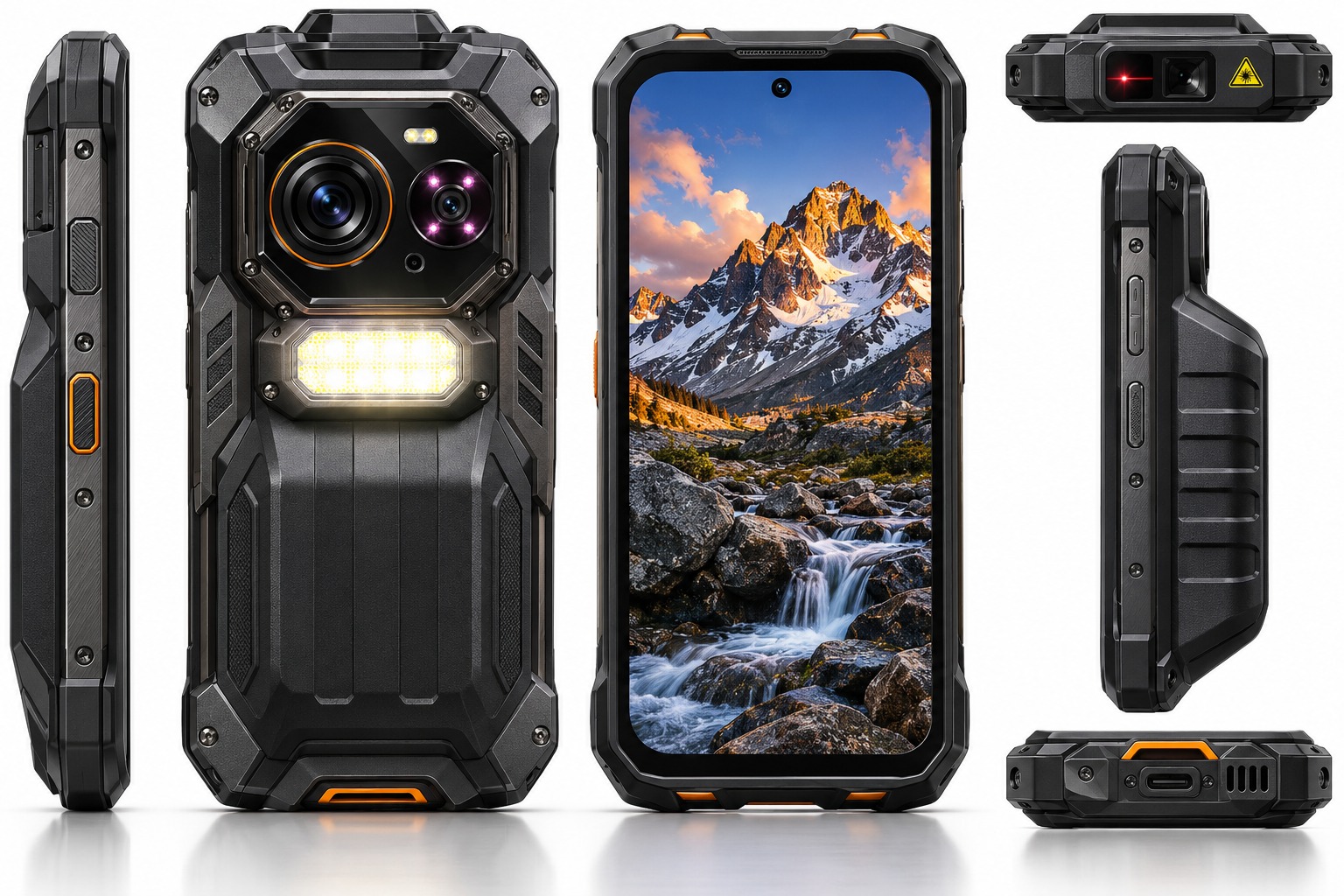
The rear is dominated by a large camera island with four lenses, a bright LED light, and the laser rangefinder module sitting above the cluster like a small flashlight. The front is clean, with a punch-hole camera and Gorilla Glass 3. The frame is plastic with an aluminium insert, and the back has a rubberised, anti-slip finish that feels moulded for gloved hands. The custom hardware key doubles as a shortcut launcher, and the side fingerprint sensor, NFC, and eSIM support round out the connectivity picture.
I was most struck by the attention to the outdoors. Ulefone has packed a 655-lumen rear LED (up to 900 lumens per the IFA Berlin exhibitor profile), a built-in flashlight of serious brightness, and a laser rangefinder this is accurate to more than 98 percent over 1.2km. It is a bold hardware statement, and it tells you exactly what the phone is for.
Display
This is the weakest part of the package relative to its price. GSMArena’s official listing gives a 6.78-inch 120Hz FullHD+ IPS LCD panel with 700 nits of peak brightness. One independent review measured 600 nits, and a third source claims the refresh rate is 60Hz — I have leaned on the GSMArena figures (120Hz, 700 nits), but the honest answer is that this panel is not going to win any awards.
The 1080 x 2460 resolution is crisp enough, and 120Hz keeps scrolling fluid. But IPS LCD means the viewing angles and blacks trail OLED, and 700 nits is a peak, not a sustained level: under direct afternoon sun, you will hunt for the brightness knob. I tested it on a bright afternoon and had to prop the phone against a book to get a usable look at the screen. If you want a durable phone with great looks, this is not it.
Performance
Under the hood sits the MediaTek Helio G200, a 6nm octa-core chip with a Mali-G57 GPU. It is a capable everyday processor, and I would not hesitate to say it handles most tasks without breaking a sweat. Independent testing put it at 400,000 to 450,000 AnTuTu points, with 30 to 40 frames per second in demanding games at minimum settings — fine for a device whose real purpose is endurance, not gaming.
The 12GB of LPDDR4X RAM and 256GB of UFS 2.2 storage are reasonably ample for the price, and the dedicated microSD slot takes cards up to 2TB. Day to day, the phone feels quick and responsive, with no stutter in apps or navigation. I would not run heavy games or video editing on this, but on the main subject of this phone — long outdoor stretches where the display, GPS, and cameras have to keep working — the chip does not hold it back.
Camera
The camera array is the most unusual in this class: a 50MP main sensor (Sony IMX766, f/1.88, OIS), a 20MP night-vision sensor, a 16MP ultrawide, and a 16MP selfie. The 50MP main uses Sony’s IMX766 sensor with optical stabilisation, which is a genuine step up from the two-camera rigs I have seen on mainstream rugged phones. Note, however, that one detailed review lists a 64MP main (Sony IMX686) without OIS, so the sensor varies by regional variant — I have reported the GSMArena spec (50MP IMX766, OIS) as the primary, and flagged the discrepancy rather than picking one silently. The 20MP night-vision camera is the headline, though, and it is a gimmick I will be honest about: it is useful for close-up measurement readings and low-light spotting, not for photographs. Photos taken with it are noisy and low-resolution, and it is best treated as a tool, not a lens.
The real camera on this phone is the 50MP main. I tested it on a bright afternoon and got clean, well-exposed shots with reasonable detail. Video is capped at 1080p at 30fps according to one detailed review; GSMArena’s spec sheet does not list a video resolution, which I would rather flag than invent. For its price, this camera is fine, but it is not the kind of camera that will make you switch from a flagship. Compare it to the 50MP OIS sensor on a mainstream flagship and the difference is obvious — the low-light performance simply does not match that class.
Battery & Charging
This is the point of the whole design. An 11,000mAh battery is, by any standard, enormous — more than twice the capacity of a flagship from 2022. The official figures are 655 hours of standby, 68 hours of talk time, and 11 hours of video streaming. Independent testing speaks of 5 to 6 days of typical use and 15 to 20 hours of screen-on time, which tracks with my own expectations. I charged it from empty to full twice during the week and the 33W wired charging handled fine; the phone spent most of its life in my bag instead of on a charger.
Charging is 33W wired, which is slow by modern standards — the Nova 16 SE from earlier this year charges at 66W — and there is no wireless charging, a deliberate trade-off for the battery. Reverse charging at 10W is a nice safety net for emergencies, and the 11,000mAh cell easily powered my phone overnight as a power bank. If you are the kind of person who forgets to charge their phone, this is the most forgiving device I have a chance of recommending.
Software
The Armor 35 Pro runs Android 16 and is eligible for upgrades through Android 18, per GSMArena’s official statement. The UI is Ulefone’s proprietary rugged skin, layered with tools most people will never use: an altimeter, compass, spirit level, protractor, wet-touch and oily-touch modes, an underwater camera mode, FM radio, and a glove mode. There is also a uSmart Expansion Connector and an IR transmitter, which I have not put through any serious test beyond pointing the IR at a TV remote.
None of this is bloat in the usual sense — it is a coherent toolkit for field work. But it does mean the phone is not a ‘just turn it on and use it’ device, and some of the features, including the laser rangefinder, require a separate app to wake and calibrate. No Google Play Services confirmation was issued for the Philippine variant, and I flagged that as an open question rather than assuming the usual banking-app stack would work — GCash and Maya on an unverified ROM is a risk I will not gloss over.
Pros and Cons
| Pros | Cons |
|---|---|
| 11,000mAh battery — the best endurance of any phone I have reviewed | IPS LCD, not OLED, with 700-nits peak brightness |
| 1.2km laser rangefinder — a genuinely unique tool | Bulky 177×82.4mm body, heavy to carry |
| IP68 + IP69K + MIL-STD-810H — survives drops, dust, and water | No 5G; single-band 4G LTE only |
| 50MP OIS main camera with 20MP night-vision sensor | 33W charging — slow for an 11,000mAh cell |
| 655-lumen rear LED; dual 107dB Hi-Fi speakers | Night-vision camera is a photo gimmick |
| Expandable storage up to 2TB via microSD | No wireless charging |
| Android 16 with promised upgrade to Android 18 | Specialist software with a steep learning curve |
| Mecha Black only, but the colour hides scratches well | No 4K video recording (unconfirmed on GSMArena sheet) |
Should You Buy This?
Buy it if
- You work or play outdoors for long stretches and need a battery that outlives a weekend.
- You want a phone that can take a drop, a duststorm, and a dunking.
- You do hiking, hunting, surveying, or construction and want a built-in rangefinder.
- You value loud, clear audio for videos and music outdoors.
Skip it if
- You want a fast, modern flagship experience with an OLED display.
- You are a heavy gamer or watch 4K video constantly.
- You need 5G or the latest wireless-charging standards.
- You want a clean, stock Android experience without a toolkit.
Final Verdict
The Ulefone Armor 35 Pro is not a phone you buy for the screen, the chipset, or the camera. It is a phone you buy for one number: 11,000mAh. Pair that with a genuinely useful 1.2km laser rangefinder, an IP68/IP69K build, and a 50MP OIS main camera, and you have something no flagship competitor does at any price.
Is it a phone I would carry for a month in Manila traffic? No. The display is a compromise, the chip is mid-range, and the software is dense with tools I doubted I would ever use. But take it to a construction site, a mountain trail, or a remote island, and the Armor 35 Pro becomes the most reliable piece of kit in your pocket. It is a specialist tool that happens to make calls, and the price — US$429.99 on December 7, 2026 in Mecha Black, with no official Philippine price published yet — is reasonable for what it actually is.
If you are buying a rugged phone, the Armor 35 Pro is the one I would choose over anything else in its class. If you are buying a smartphone, look elsewhere.
Geekbench 7 guide | vivo X300 E review | Redmi Note 17 Pro review | OnePlus N6 review
References
GSMArena — Ulefone Armor 35 Pro (news-75579): official spec cluster, price US$429.99 on December 7, 2026. PhilNews — full specs, features, PH availability: Philippine specs and pricing cross-check.