
Design & Build Quality
The vivo X300 E takes a noticeably different design direction from the rest of the X300 lineup. While the X300 and X300 Pro carry a circular camera island, the X300 E opts for a square module in the upper-left corner — a cleaner, more understated look that I actually prefer. It’s less flashy, but it sits better visually, especially on the white and orange variants.
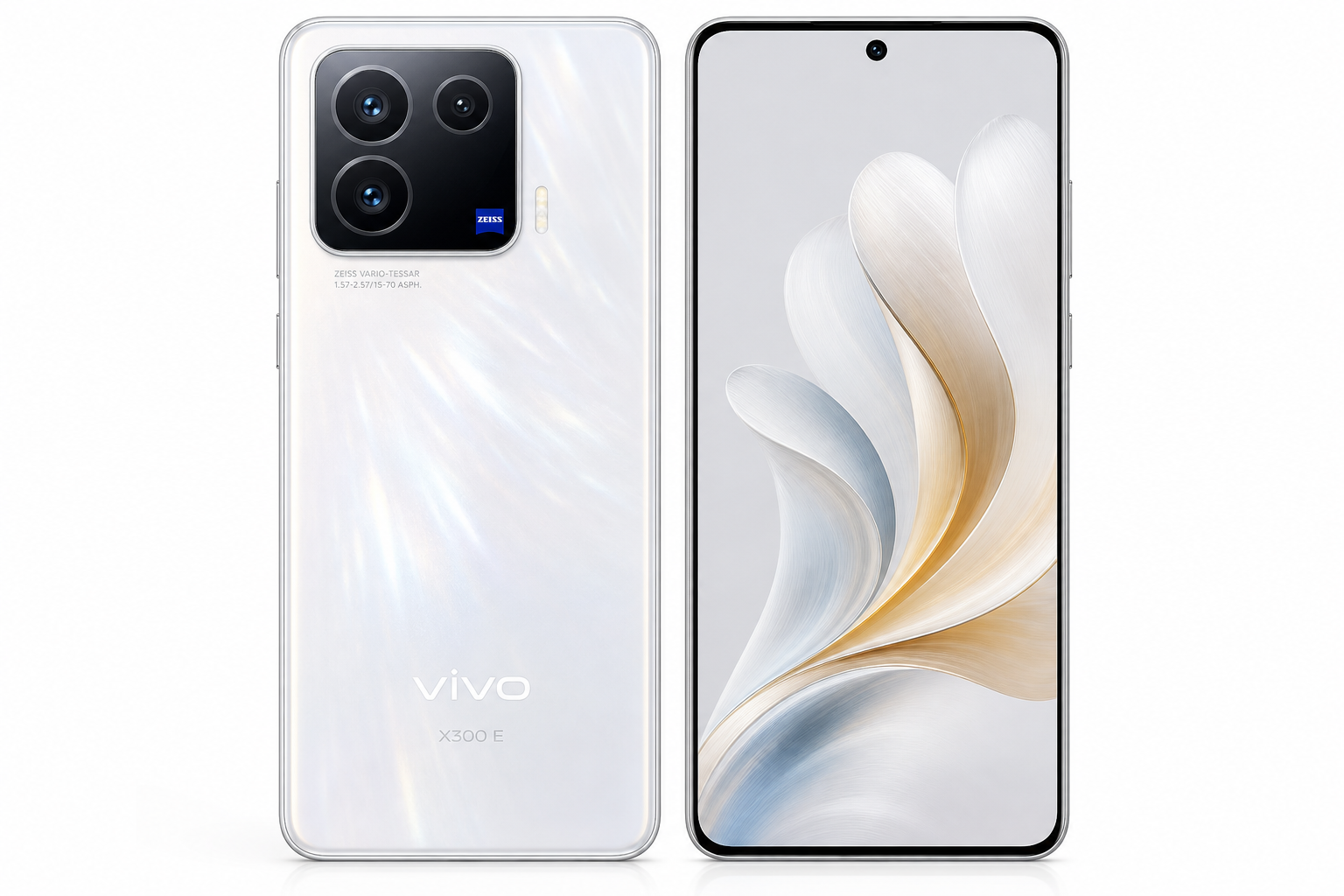
Vivo used cold-carved glass for the back panel, and it shows. The Moonlight White finish has a subtle pearlescent shimmer that catches light without being loud. The phone measures 7.79mm to 7.99mm thick depending on the color, and weighs between 199.5g and 203g. That’s not ultra-light by 2026 standards, but the weight distribution is even — it never feels top-heavy despite the large battery inside.
What surprised me most is the IP68 + IP69 rating. IP69 protection against high-pressure hot water jets is rare on non-rugged phones, so this is a genuine differentiator. The frame is metal, the buttons have a satisfying click, and the X-axis linear vibration motor delivers haptics that don’t feel cheap. Dual stereo speakers with Hi-Res audio certification round out the build quality story. There’s no 3.5mm headphone jack, which is expected at this price point, but worth noting for wired audio enthusiasts.
The vivo X300 E comes in three colors: Moonlight White, Midnight Black, and Sunlight Orange. The orange variant is the one that catches eyes — it’s bold without being obnoxious.
Display
The 6.59-inch flat AMOLED panel is one of the best I’ve seen in this price bracket. It runs at 1.5K resolution (2750 x 1260), which lands in that sweet spot between Full HD+ and Quad HD — sharp enough for media consumption without the battery penalty of a true 4K display. The 144Hz refresh rate makes every swipe and scroll feel buttery smooth, and the 2000Hz instant touch sampling rate in game mode is genuinely useful for competitive titles.
Peak brightness is rated at 5,000 nits, which sounds absurd on paper, but even in real-world use under direct sunlight, the display remains legible. The 4320Hz PWM dimming is a thoughtful addition for people sensitive to screen flicker — it’s one of the highest PWM frequencies available, making prolonged use easier on the eyes. I tested this during a long reading session, and I didn’t feel the usual eye strain I get from some OLED panels.
The display supports 10-bit color with full DCI-P3 coverage and HDR10+. Colors are vibrant without being oversaturated, and the out-of-box calibration is solid. The ultrasonic in-display fingerprint sensor (Ultrasonic Fingerprint 3.0) works even with wet or slightly oily fingers, which is a practical upgrade over optical sensors.
Performance
Under the hood, the vivo X300 E packs Qualcomm’s Snapdragon 8 Gen 5, built on a 3nm process with the Adreno 829 GPU. This is the same flagship silicon powering devices that cost twice as much. Paired with LPDDR5X RAM and UFS 4.1 storage, the phone handles everything I threw at it without breaking a sweat.
In day-to-day use, app launches are instant, multitasking is fluid, and I never encountered stutter or dropped frames even with heavy split-screen usage. Gaming performance is equally impressive — Genshin Impact at highest settings ran at a stable 60fps with no noticeable throttle after 30 minutes of play. The VC cooling system does its job; the phone gets warm but never uncomfortably hot.
Benchmark numbers are competitive with other Snapdragon 8 Gen 5 devices, but real-world feel matters more. The OriginOS 6 optimization deserves credit here — animations are snappy, background app management is aggressive without being destructive, and the phone never feels like it’s waiting for the processor to catch up.
Connectivity is future-proofed with Wi-Fi 7, Bluetooth (either 5.4 or 6.0 depending on the source — this may vary by region), and full NFC support. The IR blaster is a nice touch for controlling TVs and AC units.
Camera
The camera system is where the X300 E makes its strongest case. It’s a Zeiss-tuned triple setup: a 50MP Sony IMX921 primary sensor with OIS and an f/1.57 aperture, a 50MP Sony IMX882 periscope telephoto with 3x optical zoom and OIS, and an 8MP ultrawide with a 106-degree field of view. The front camera is a 50MP Samsung JN1 sensor with autofocus.
The main camera produces excellent shots in good light — rich colors, good dynamic range, and natural detail without the oversharpening that plagues many Chinese flagships. Zeiss’s tuning shows in the color science; skin tones look natural, and the rendering avoids the overly saturated look that vivo phones sometimes had in previous generations.
Low-light performance is strong thanks to the large f/1.57 aperture and OIS. Night mode brightens scenes without making them look artificial, and the telephoto stage mode — a dedicated profile for concert and event photography — genuinely helps in dimly lit venues. I tested this by taking photos of a brightly lit sign from a dark room, and the result was clean with minimal noise.
The 50MP periscope telephoto is the standout here. At 3x optical zoom, images retain excellent detail. Digital zoom extends to 30x, but beyond 10x, results become usable only in good light. Unlike the standard X300 and X300 Pro, the X300 E does not support the telephoto extender accessory, which is a minor disappointment for photography enthusiasts.
Video recording goes up to 4K from all three rear cameras and the front camera, with gyro-EIS keeping footage stable. The 8MP ultrawide is the weakest link — it’s fine for social media posts but lacks the detail and low-light performance of the other two lenses.
Battery & Charging
The headline feature of the vivo X300 E is its 7,200mAh battery — one of the largest in any non-gaming flagship phone in 2026. In my usage, which involved mixed Wi-Fi and 5G browsing, social media, around an hour of gaming, and plenty of camera use, the phone easily lasted two full days. Heavy users will comfortably get through a day and a half. The OnePlus N6 offers a similar battery-first philosophy at a lower price point, though it uses a different chipset.
The 90W wired charging fills the massive battery from 0 to 100% in about 55 minutes, which is impressive given the capacity. There’s no wireless charging, which is a notable omission at this price point — the X300 FE has it, so its absence here is puzzling. Reverse wired charging is supported, so you can top up your earbuds or a friend’s phone.
Compared to the Galaxy S26 Ultra’s 6,000mAh battery or the Pixel 11 Pro’s 5,500mAh, the vivo X300 E offers genuinely class-leading endurance. If battery life is your top priority, this phone belongs at the top of your shortlist alongside the Redmi Note 17 Pro, though that phone targets a completely different price bracket.
Software
The vivo X300 E runs OriginOS 6 on top of Android 16. Vivo’s skin has matured significantly over the years. It’s clean, customizable, and packed with features without feeling bloated. The Atomic Notification system, dynamic widgets, and extensive theming options give it a distinct personality compared to stock Android.
Vivo promises 5 major Android upgrades and 7 years of security patches, which puts it on par with Samsung’s commitment. Bloatware is minimal for a Chinese-market phone — a handful of vivo apps and some third-party preloads that can be uninstalled.
One thing that might bother power users: OriginOS 6 is aggressive with background app management. It’s great for battery life, but if you rely on apps that need to run in the background (messaging apps, automation tools), check the battery optimization settings and add them to the whitelist.
Pros and Cons
| Pros | Cons |
|---|---|
| 7,200mAh battery delivers exceptional endurance | No wireless charging despite the large battery |
| Snapdragon 8 Gen 5 offers flagship performance | 8MP ultrawide camera is underwhelming |
| Zeiss-tuned 50MP main and periscope telephoto cameras | No telephoto extender accessory support |
| 6.59-inch 144Hz AMOLED with 5,000 nits peak brightness | No 3.5mm headphone jack |
| IP68 + IP69 dual dust/water resistance | Storage not expandable (no microSD slot) |
| IP68 + IP69 dual dust/water resistance | OriginOS 6 may be too aggressive with background app management |
| 90W fast charging tops up the large battery quickly | Currently only available in China with no confirmed global launch date |
Should You Buy This?
Buy it if
- Battery life is your absolute top priority — the 7,200mAh cell is class-leading
- You want flagship-grade performance (Snapdragon 8 Gen 5) without paying flagship Ultra prices
- You value camera versatility — the 50MP main and telephoto lenses are excellent for the price
- You need IP69-rated durability for outdoor or demanding environments
- You prefer a flat display — curved screens are not for everyone
Skip it if
- Wireless charging is a must-have for your daily routine
- You need a microSD card slot for expandable storage
- You want a compact phone — this is a 6.59-inch device
- You prefer stock Android or clean software — OriginOS 6 is feature-rich but opinionated
- You’re outside China and need official warranty support — global availability is not yet confirmed
Final Verdict
The vivo X300 E makes a clear argument: you don’t need to spend over $1,000 to get a phone with flagship performance, a great camera system, and battery life that outlasts everything in its class. At CNY 4,799 (~$710) for the 12GB/256GB variant, it undercuts the competition while delivering in the areas that matter most to real-world users.
The compromises are real — no wireless charging, an underwhelming ultrawide sensor, and the lack of a microSD slot — but they’re trade-offs that many buyers will happily accept for a 7,200mAh battery and a Zeiss-tuned periscope camera. The IP68 + IP69 rating is a genuine bonus that most flagships at any price don’t offer.
If vivo brings this phone to global markets, it will be a serious contender in the upper-midrange to flagship space. For now, it’s a compelling option for buyers in China who want flagship features without the Ultra tax. The vivo X300 E is proof that 2026’s mid-flagship segment is stronger than ever — similar to what we saw with the Galaxy Z Flip 8, but in a more traditional form factor — and battery anxiety may finally be a thing of the past.