
The Product That Almost Worked
Ollie wasn’t trying to beat Siri or Google Assistant at their own game. It was trying to play a different one entirely.
The text-based AI assistant launched with a simple, almost radical premise: what if your family’s digital helper didn’t need to mine your data to be useful? Built around email, calendar, meal planning, and bill payments, Ollie quietly achieved something no other mainstream consumer AI app had managed — SOC 2 compliance, verified through an independent audit. That meant your family’s schedule, your kids’ school events, your grocery lists, never became training fodder for a larger model.
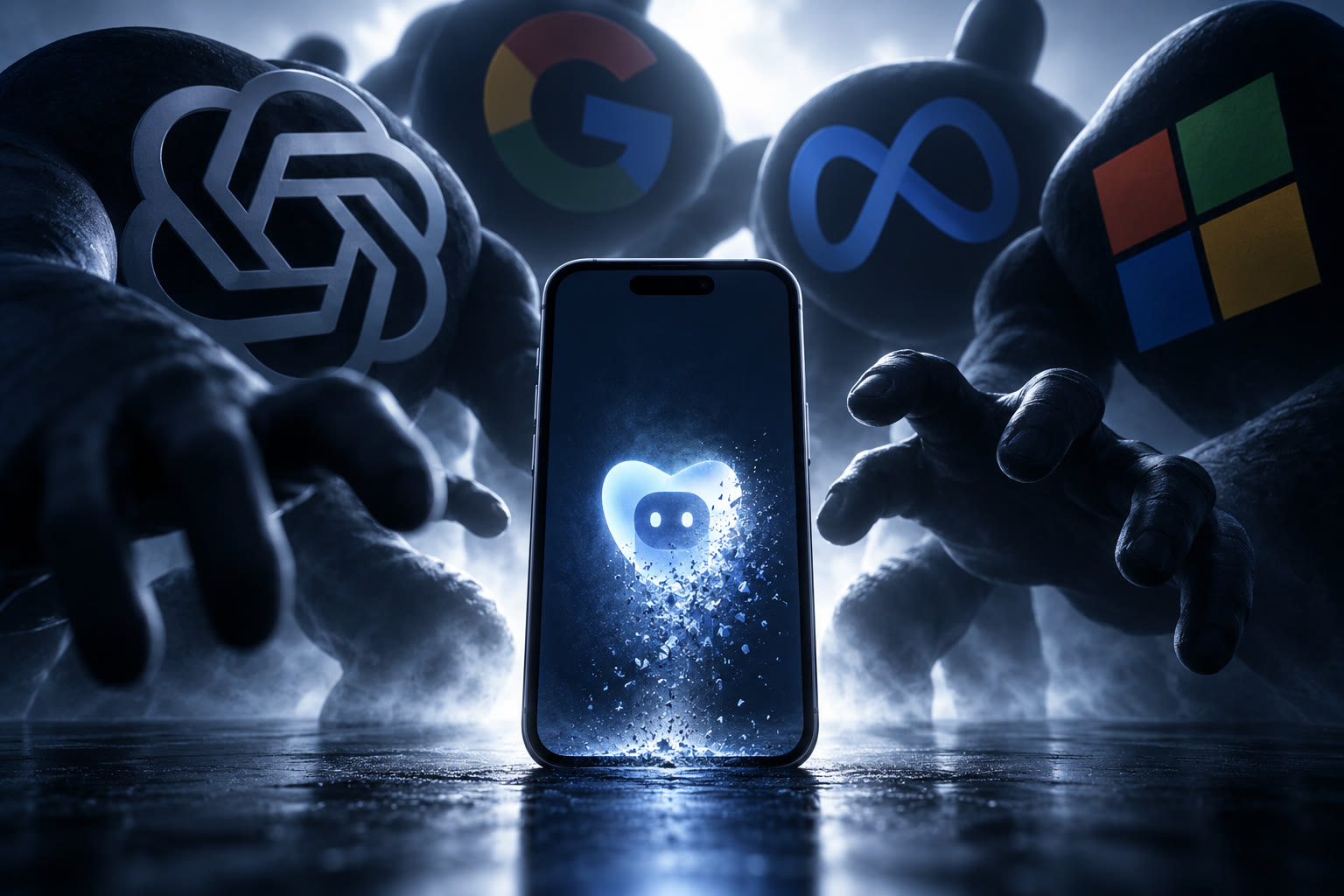
On Friday, October 30, co-founder and CEO Bill Lennon announced that Ollie will shut down on November 6. Six weeks after raising a $7.5 million seed round led by Khosla Ventures (TechCrunch, September 2026), the company is closing. Subscribers are being told to export their data and expect refunds. The farewell letter is already live at ollie.ai/farewell.
I read the announcement three times. Not because the news was surprising, but because the timeline was brutal. Six weeks. From a Khosla-backed seed to a shutdown notice with one week of user notice. That is not a failure of product vision. That is a failure of market oxygen. — the same pattern I explored in AI’s $3 trillion question, where capital concentrates on infrastructure plays while thin application wrappers starve.
What Ollie Actually Was
Before we dissect the death, let’s be clear about the life. Ollie was a subscription-based, text-message AI assistant. No dedicated app of its own — it ran over SMS or a simple chat interface. It connected to your email and calendar, handled appointment bookings, suggested meal plans, tracked bill payments, and was preparing to roll out household budgeting. For families, that last part alone is a gaping hole in the current market. Google Calendar tells you where you need to be. Nothing tells you what you’re going to feed everyone when you get there.
The privacy architecture was real. Ollie did not sell user data. It did not share with third parties. It did not train models on your content. The SOC 2 certification was not a marketing checkbox — it was a documented, audited commitment. When you logged in, Ollie opened a cloud browser session and sent you a link rather than asking for your password. That is a different engineering culture than the one that dominates consumer AI.
The Competition That Didn’t Play Fair
Lennon’s quote is worth repeating in full: “We got close, but ultimately couldn’t keep up. With Muse, Instinct, and others entering the space, it became harder to stand out, grow, and raise the capital we needed to succeed.”
Muse and Instinct are well-funded AI assistants from large labs. They do not have Ollie’s privacy constraints. They can absorb data from millions of users to improve their models, which makes the product better in ways that show up in benchmark comparisons and app-store reviews. Ollie’s SOC 2 compliance meant it could not do that. The company was trying to win a war of attrition against opponents who had infinite ammunition and no conscience about using it.
This is the uncomfortable truth that the tech press rarely says out loud: privacy is a cost center when your competitors treat user data as a free asset. Ollie’s subscription model meant every new user required revenue to sustain. Muse and Instinct could afford to grow at a loss because their backers saw data acquisition as the real product. You cannot outcompete a company that is not selling you a service — it is selling you to itself.
The Funding Trap
Six weeks is not a lifecycle. It is a media cycle. Ollie’s seed round was announced in early September. By late October, the company was dead. What changed in those six weeks? Probably nothing structural. The product was the same product. The team was the same team. The market was the same market.
What likely changed was the conversation with the next round of investors. Once the seed money burned through runway and the growth numbers came in below what venture capitalists expected for an AI-native company, the follow-on conversation probably went silent. VCs in this era do not write second checks to privacy-first assistants that grow slowly because they refuse to exploit their users. They write checks to companies that hit hockey-stick adoption curves, and the fastest way to hit those curves is to lower your privacy standards. I saw this same dynamic in Meta’s new commercial terms, where the company simply declared that business content could be used for AI training unless you opted out.
I have sat on both sides of that table. As an ICT manager running a government division, I evaluate tools that promise efficiency. The tools that win are rarely the ones that ask for less data. They are the ones that deliver more convenience today. Privacy is a future-tense benefit — it pays off when something goes wrong. Convenience is present-tense. Every product manager knows which one gets funded.
What Users Should Do Now
If you are an Ollie subscriber, stop waiting for the automated export. Request your data now. The company says it will send instructions, but shutdown timelines have a habit of accelerating when the server bills stop getting paid. Export your family’s calendar events, meal plans, and contact lists. Know your refund window.
For everyone else, this is a moment to audit your own dependencies. What AI assistants do you use daily? Which ones have SOC 2 or equivalent certification? Which ones have published data-retention policies that say they will not train on your content? If you cannot answer those questions in under two minutes, you are one acquisition or terms-of-service update away from becoming Ollie’s next customer. The same trust gap shows up when AI agents walk into live systems — the question is never whether the platform respects you. It is whether it can protect you from itself.
The Bigger Lesson
Ollie’s death is not evidence that privacy-focused AI cannot work. It is evidence that privacy-focused AI cannot work as a thin consumer wrapper in a market dominated by foundation-model giants.
The survival path for privacy-first tools is not subscription apps that compete on convenience. It is infrastructure — local models, local inference, self-hosted backends. I have written before about running a local AI assistant with Survival LLM. That approach does not need to raise venture capital because it does not need to acquire users at scale. It only needs to work reliably for the people who care enough to install it. If you want to see what that looks like in practice, I walked through setting up Survival LLM as a personal offline knowledge base — no cloud, no data sharing, just a model that lives on your machine.
The consumer AI assistant market is splitting into two tiers: massive platforms that train on your data because they can, and local or self-hosted tools that respect your data because you are the only user. Ollie tried to occupy the middle ground — a hosted service with privacy promises — and got crushed. There is no shame in that. The shame is on an industry that makes “respecting user privacy” a suicide note instead of a baseline expectation.
On November 6, Ollie goes dark. The servers will shut down. The SMS channel will go silent. The SOC 2 certificate will become a historical footnote. But the question it raised — whether an AI assistant can be useful without being parasitic — does not die with a startup. It just moves closer to home.
If You Are Building Something Similar
Read the room. The venture capital environment of 2026 rewards scale, speed, and data accumulation. If your product’s core differentiator is that it does less with user data than your competitors, you are not building a feature. You are building a fundraising obstacle. Either find a business model that does not require VC scale (self-hosted, open core, community-supported) or accept that you are competing with opponents who have a structural advantage you cannot match.
Ollie’s founders are not naive. They built something real. But real products still need real markets, and the market for privacy-first hosted AI assistants turned out to be smaller than the market for AI assistants that treat privacy as a PR problem rather than a product feature.
That is the lesson. Not that privacy failed. But that privacy alone was never going to be enough against well-funded competitors who had no such scruples.