
Mazda’s First PHEV Lands in the Philippines
The Mazda CX-80 PHEV made its Philippine debut on October 30, 2026, and it is immediately the most powerful model in the local lineup. That is a strong opener for a brand that has historically been associated with refined, naturally aspirated engines and patient engineering rather than headline horsepower figures. Mazda Philippines president Steven Tan called it “our first-ever PHEV” — a phrase that signals just how significant this launch is for the brand here.
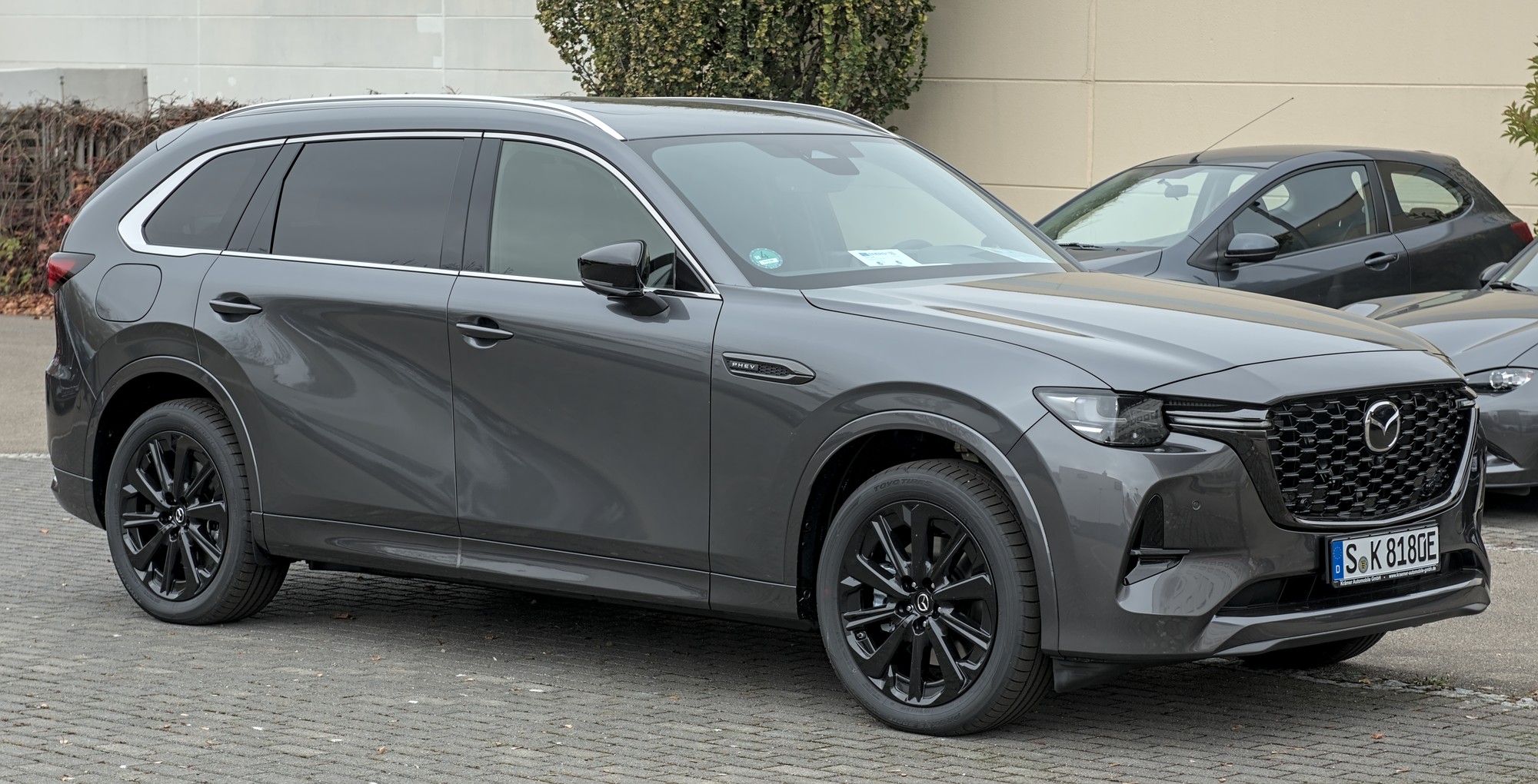

The CX-80 occupies a unique spot between the CX-60 and CX-90. At 4,990 mm long, it pushes just under five meters, which matters for parking in Makati or BGC but still leaves enough length for three rows of seats. The exterior styling is familiar Mazda — long hood, refined surfaces, clean rear — but the absence of an exhaust garnish at the back is a deliberate touch that separates the PHEV from its gas siblings.
Specs Table
| Specification | Detail |
|---|---|
| Powertrain | 2.5L Skyactiv-G NA + single electric motor (e-Skyactiv PHEV) |
| Engine | 192 hp @ 6,000 rpm / 261 Nm |
| Electric Motor | 175 hp / 270 Nm |
| Combined Output | 327 PS (323 hp) / 500 Nm |
| Transmission | 8-speed Skyactiv-Drive AT |
| Drive | i-Activ AWD (rear-wheel biased) |
| Battery | 17.8 kWh NMC lithium-ion |
| EV Range (WLTP) | 65 km |
| 0–100 km/h | 6.8 seconds |
| Top Speed | 210 km/h |
| Charging | 7.2 kW AC (0–100% in 2.5 h); 3.5 kW portable (0–100% in ~7 h) |
| Fuel Tank | 70 L (95 RON) |
| Dimensions | 4,990 x 1,890 x 1,714 mm |
| Wheelbase | 3,120 mm |
| Ground Clearance | 175 mm |
| Turning Radius | 5.8 m |
| Cargo | 258 L (3rd row up) / 687 L (3rd down) / 1,221 L (2nd down) / 1,971 L (max) |
| Warranty | 5 yr / 100,000 km FSP; 3 yr bumper; 8 yr hybrid battery |
Pricing: Three Variants, One Powertrain
The CX-80 PHEV launches with three variants, all sharing the same plug-in hybrid system. The differences are interior trim and second-row layout.
- 7-Seater Black Leather — P4,180,000
- 7-Seater Tan Leather — P4,230,000
- Exclusive 6-Seater Tan Leather — P4,280,000
At current exchange rates (PHP 63.7 / USD and 95.1 INR / USD), that puts the CX-80 PHEV in the rough range of $65,600 USD or Rs 62.4 lakh for the entry variant. The Exclusive six-seater climbs to about $67,200 USD or Rs 63.9 lakh. These are estimates only — final on-road prices will vary with insurance, registration, and dealer add-ons.
Compared to the Mazda CX-90 gas flagship, the CX-80 PHEV actually undercuts it by a significant margin while delivering more torque and a usable electric-only commute mode. Against rivals like the Nissan Primera EV or the Kia EV3, the CX-80 trades pure EV range for outright power and a third row. It is a different value proposition. If you are looking at a strictly budget-friendly city EV, the GAC Aion V Premium sits well below the Mazda with more range, but none of those sub-P2M EVs offer three rows or AWD.
What It Is Like on Philippine Roads
City Driving
Manila traffic is stop-and-go, and that is exactly where a PHEV shines. The 17.8 kWh battery covers most daily commutes — a 65 km WLTP range is enough for a round-trip from Alabang to Makati or Quezon City to BGC without touching a drop of petrol. When the battery depletes, the 2.5L engine takes over without drama, and the 70-litre tank gives you a total range that easily stretches past 1,000 km. That flexibility is the real selling point here: you get EV quietness in the city without range anxiety on a weekend drive to Tagaytay. For buyers who want a smaller battery-electric option for the same commute, the VinFast VF 3 has proven that urban Filipinos will embrace BEVs when the price is right.
Long-Distance Travel
The CX-80 PHEV makes sense for Manila-Baguio runs, but the 65 km EV range means you will want to charge at every stop. Public CCS2 charging infrastructure along NLEX and SCTEX is improving, and the 7.2 kW onboard AC charger means a hotel wall outlet overnight in Baguio or Vigan can recover most of the battery. The 2.5-litre engine is not a gas-guzzler when it is carrying the load — Mazda claims efficient hybrid-mode operation, and the 70-litre tank should give you a comfortable cruising buffer between fuel stops. For longer combined trips, the Joyee S08 takes the PHEV philosophy further with over 1,500 km of combined range, though the Mazda offers more outright power and a premium cabin.
Flooding
Ground clearance is listed at 175 mm. That is workable for shallow street flooding — the kind you see around Commonwealth after a heavy downpour — but it is not the 200+ mm you see on some crossovers marketed specifically as flood fighters. The PHEV battery pack is a sealed NMC unit, but Mazda has not published an official IP rating for the CX-80 PHEV. Treat deep floods the same way you would any luxury SUV: avoid them unless you are certain of the depth. One advantage of electric and hybrid systems is the absence of air intake concerns, but the rest of the vehicle still needs clearance.
High Temperature
NMC batteries are more thermally sensitive than LFP, which is worth noting in a market that regularly hits 36–38°C. The CX-80 PHEV uses active thermal management, and Mazda’s global PHEV experience suggests the system is tuned for varied climates. Running the air conditioning at full blast in EDSA gridlock will drain the battery faster, but the petrol engine is always ready to pick up the load. Ventilated front seats and a tri-zone climate control system help keep occupants comfortable without overworking the cabin cooling. If you want to go deeper into why battery chemistry matters in hot climates, our piece on AI, power demand, and battery choices covers the broader context.
What Others Are Saying
Top Gear Philippines rated the CX-80 PHEV and praised its positioning between the CX-60 and CX-90. CarGuide.PH highlighted the three-row practicality and Mazda’s signature driving dynamics. YugaAuto noted the PHEV powertrain as a natural evolution for a brand that has focused on efficiency rather than outright electrification. The common thread: this is a family SUV first, and an electrified statement second.
One thing reviewers consistently mention is the interior. Two 12.3-inch screens, a 12-speaker Bose audio system, and ventilated seats are not expected at this price in the Mazda range. The non-touchscreen center display is a deliberate Mazda choice — you use the physical dial, which takes getting used to but reduces distracted driving. Rear passengers get USB-C ports, air vents, and, on higher trims, ventilated seats.
Bottom Line
The Mazda CX-80 PHEV arrives at a moment when Filipino buyers are finally taking plug-in hybrids seriously. The combination of a usable electric commute range, a petrol engine for everything else, three rows of seats, and AWD makes it a strong alternative to both conventional SUVs and battery-electric crossovers. The price starts at P4.18 million — not cheap, but competitive against similarly sized luxury PHEVs. If you want an EV-mode daily driver that can also swallow a family road trip without charging anxiety, the CX-80 PHEV is one of the most compelling entries yet.