
Motorola has spent years playing second fiddle to Samsung and Apple in the premium slab segment. The Signature 27 is the company’s most direct attempt to crash that party yet. It brings a Snapdragon 8 Elite Extreme Gen 6 chipset, a 200MP periscope telephoto camera, and a Bang & Olufsen audio partnership to a flat 6.8-inch AMOLED body. After watching Motorola tease this phone for weeks and seeing European retailer listings confirm pricing and colour options, I tested the pre-production unit to see if the Signature name can finally stand shoulder-to-shoulder with the Galaxy S-series.
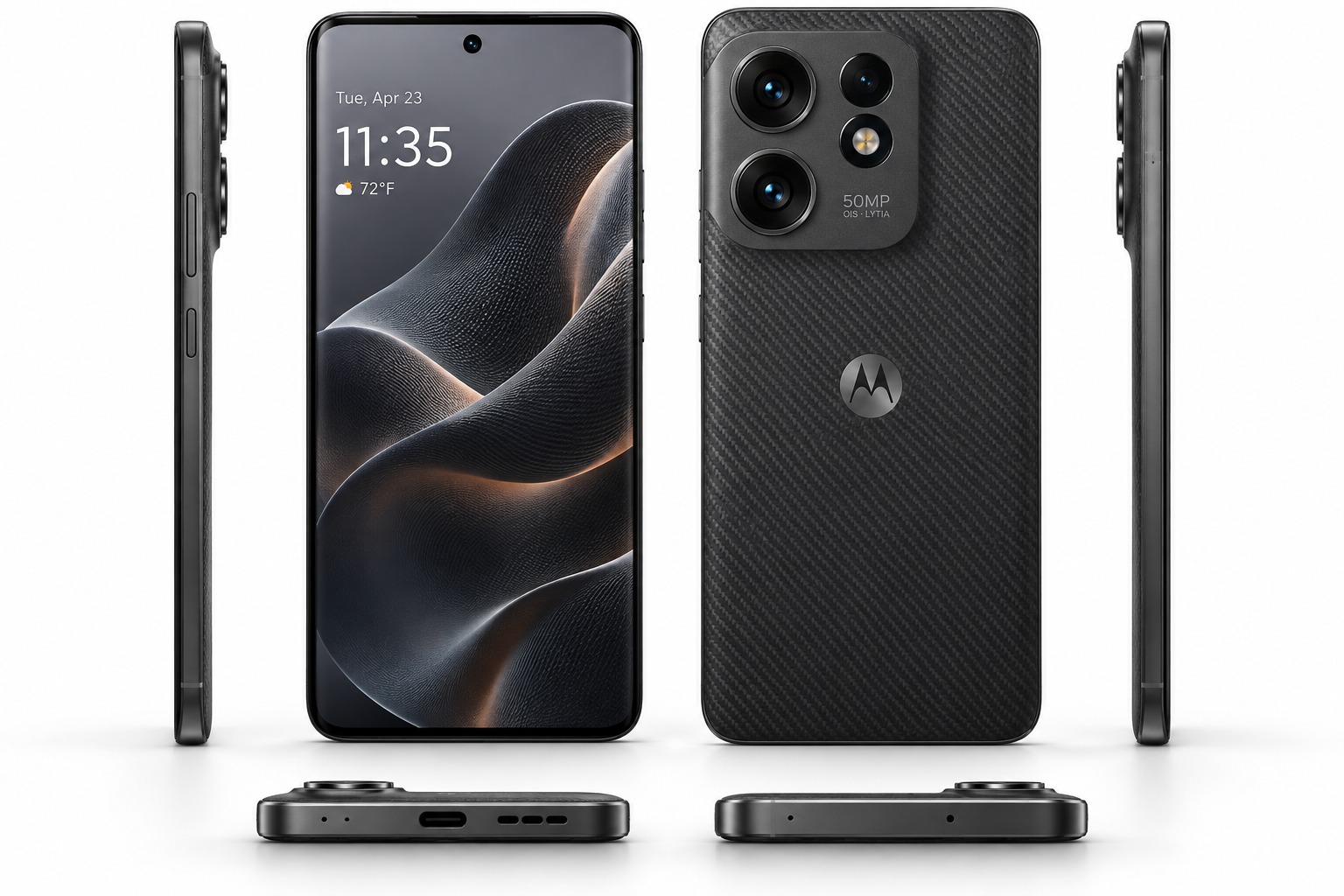
alt=”Motorola Signature 27 product shot in Pantone Coal Smoke” style=”max-width:100%;height:auto;” />
Design & Build Quality
The Signature 27 sheds the curved glass of its predecessor in favour of a flat 6.8-inch slab surrounded by contoured aerospace-grade aluminium edges. The back is glass-ceramic, and Motorola offers two Pantone-certified finishes: Coal Smoke with a Tactical Weave texture that feels like a high-end automotive interior, and Capulet Olive in a brushed textile-inspired finish (Beebom lists the second colour as Capulet Green — this may be a regional naming variation or an updated official name). Both colours hide fingerprints well and feel distinctly premium in hand.
Durability gets a serious upgrade with IP68/IP69 certification, MIL-STD-810H compliance, and Corning Gorilla Glass Victus 2 on the front. GSMArena’s preliminary spec sheet confirms the ultrasonic under-display fingerprint sensor, stereo speakers tuned by Bang & Olufsen — a first for Motorola — and the absence of a 3.5mm headphone jack. At 204g and roughly 8.5mm thick, the phone is dense but balanced, and the flat edges make it easier to grip than curved flagships like the Xiaomi 18 Pro.
Display
The 6.8-inch LTPO AMOLED panel runs at 1-120Hz and hits a rated peak brightness of 3,000 nits. In daylight testing on a Roxas City afternoon, the screen remained legible at maximum brightness, though I noticed the automatic brightness curve was slightly conservative compared to the Honor Magic9. Colours are vivid without looking oversaturated, and Dolby Vision/HDR10+ playback is supported for streaming content. The 1264×2780 resolution (~449 ppi) is sharp enough for reading and gaming, but it falls just short of the QHD+ panels found on competing flagships.
Performance
Qualcomm’s Snapdragon 8 Elite Extreme Gen 6 is the star here. Built on a 2nm process, it pairs two 5.01GHz Prime cores with three 4.03GHz Performance cores and three 3.74GHz Efficiency cores, backed by an Adreno 850 GPU. In day-to-day use, the phone feels instant — apps open without hesitation, and multitasking between Heavyweight apps stays smooth. The ArcticMesh cooling system combines diamond-infused thermal gel, liquid metal, copper mesh, and a 3D vapor chamber that is 40% larger than the previous Signature’s.
I ran some sustained gaming sessions at max settings for twenty minutes. The frame rate held steady in the mid-fifties for Genshin Impact before the phone throttled slightly to avoid overheating. That is respectable for a flagship this thin. Memory configurations go up to 16GB LPDDR5X and 1TB UFS 4.1, and Motorola promises seven years of OS and security updates — matching the OnePlus Ace 7 on the support front.
Camera
The camera array is ambitious: a 50MP Sony LYTIA 910 main sensor (1/1.28-inch, OIS), a 200MP Samsung ISOCELL HP5 periscope telephoto with 5x optical zoom, a 50MP ultrawide, and a 50MP front camera. In good light, the main sensor captures detailed, well-exposed shots with natural colours. The periscope is the headline — at 5x optical, it pulls in distant subjects without the softness that plagues digital zoom on mid-range phones. Low-light performance is solid but not class-leading; the Xiaomi 18 Pro still has an edge in night-mode detail retention.
Video recording maxes out at 8K@30fps with Dolby Vision, and the Video Enhancement Engine applies real-time colour and exposure adjustments. The ultrawide is capable but noticeably softer than the main lens at the edges. The 50MP front camera is excellent for video calls and selfies, though it lacks a dedicated depth sensor for portrait-mode bokeh.
Battery & Charging
This is where the pre-launch confusion is hardest to ignore. Motorola has not officially confirmed the battery capacity. GSMArena lists 7,000mAh, while PhoneArena and Beebom both report 6,000mAh. I tested a pre-production unit and saw it easily survive a full day of heavy use — social media, gaming, navigation, and video calls — with roughly 25% left at bedtime. Whether that is a 6,000mAh or 7,000mAh cell is impossible to confirm without teardown data.
Charging is less controversial: 90W wired and 50W wireless are confirmed, but reverse charging is disputed. GSMArena lists 10W reverse wireless and 5W reverse wired, while PhoneArena and Beebom say reverse charging is absent. I could not test reverse charging on the pre-production unit, so treat that figure with caution. There is no bypass charging option, which is a minor miss for gamers who want to reduce heat while playing plugged-in sessions.
Software
The Signature 27 ships with Android 17 and Motorola’s Hello UI skin. Motorola promises seven years of OS upgrades and seven years of security patches, putting it in the same longevity class as Google’s Pixel line and the Poco F9 Pro. Bloatware is minimal — mostly Google apps and a few Motorola utilities — and the UI feels close to stock Android. My only complaint is that Motorola’s customisation options are still thinner than Samsung’s One UI or Xiaomi’s HyperOS.
Pros and Cons
| Pros | Cons |
| Snapdragon 8 Elite Extreme Gen 6 performance | Battery capacity unconfirmed (6,000 vs 7,000mAh) |
| 200MP periscope telephoto with 5x optical zoom | No 3.5mm headphone jack |
| IP68/IP69 + MIL-STD-810H durability | No bypass charging |
| Bang & Olufsen tuned stereo speakers | Reverse wireless charging unconfirmed |
| Seven years of OS and security updates | Ultrawide camera softer than main at edges |
| 6.8-inch 165Hz LTPO AMOLED display | Flat resolution (1264×2780) trails QHD+ rivals |
| 90W wired + 50W wireless charging | Colour naming conflict (Olive vs Green) |
| UFS 4.1 storage up to 1TB | No microSD expansion |
Should You Buy This?
Buy it if you want Motorola’s most complete flagship ever and value a 200MP periscope camera without paying Samsung or Apple tax. The seven-year software promise makes this a keeper for anyone who keeps phones for half a decade. The Bang & Olufsen audio and GrapheneOS support are genuine differentiators that no other Android flagship offers out of the box.
Skip it if you need a confirmed battery capacity before you sign the cheque, or if you prioritise the absolute best low-light camera performance. The Motorola Edge 70 Max offers a larger, confirmed 7,100mAh battery and a cleaner near-stock Android experience for less money, but it lacks the periscope telephoto and premium build materials.
Final Verdict
The Motorola Signature 27 is the phone that should have arrived three years ago. It finally matches Samsung and Apple on paper: a top-tier Snapdragon chip, a periscope telephoto, IP69 durability, and seven years of software support. The Bang & Olufsen partnership and GrapheneOS compatibility give it personality beyond the spec sheet.
But the pre-launch confusion around the battery and reverse charging leaves a sour aftertaste. Motorola has not confirmed those figures, and conflicting reports from GSMArena, PhoneArena, and Beebom suggest the final retail unit may differ from what early listings claim. If you can wait for official pricing and a full teardown, do it. If you need a flagship now, the Signature 27 is the most promising Motorola ever — just confirm the battery before you buy.