
Poco X8s Review: Compact Mid-Ranger, Telephoto Surprise
Poco just quietly released one of the most balanced compact phones of 2026. The X8s packs a 6.35-inch LTPO AMOLED display, a Snapdragon 7 Gen 4 chipset, and — most unexpectedly — a 50MP periscope telephoto camera inside a sub-190g body. At $399 for the 8GB/256GB early bird price, it undercuts most competitors while matching them spec-for-spec on the things that actually matter.
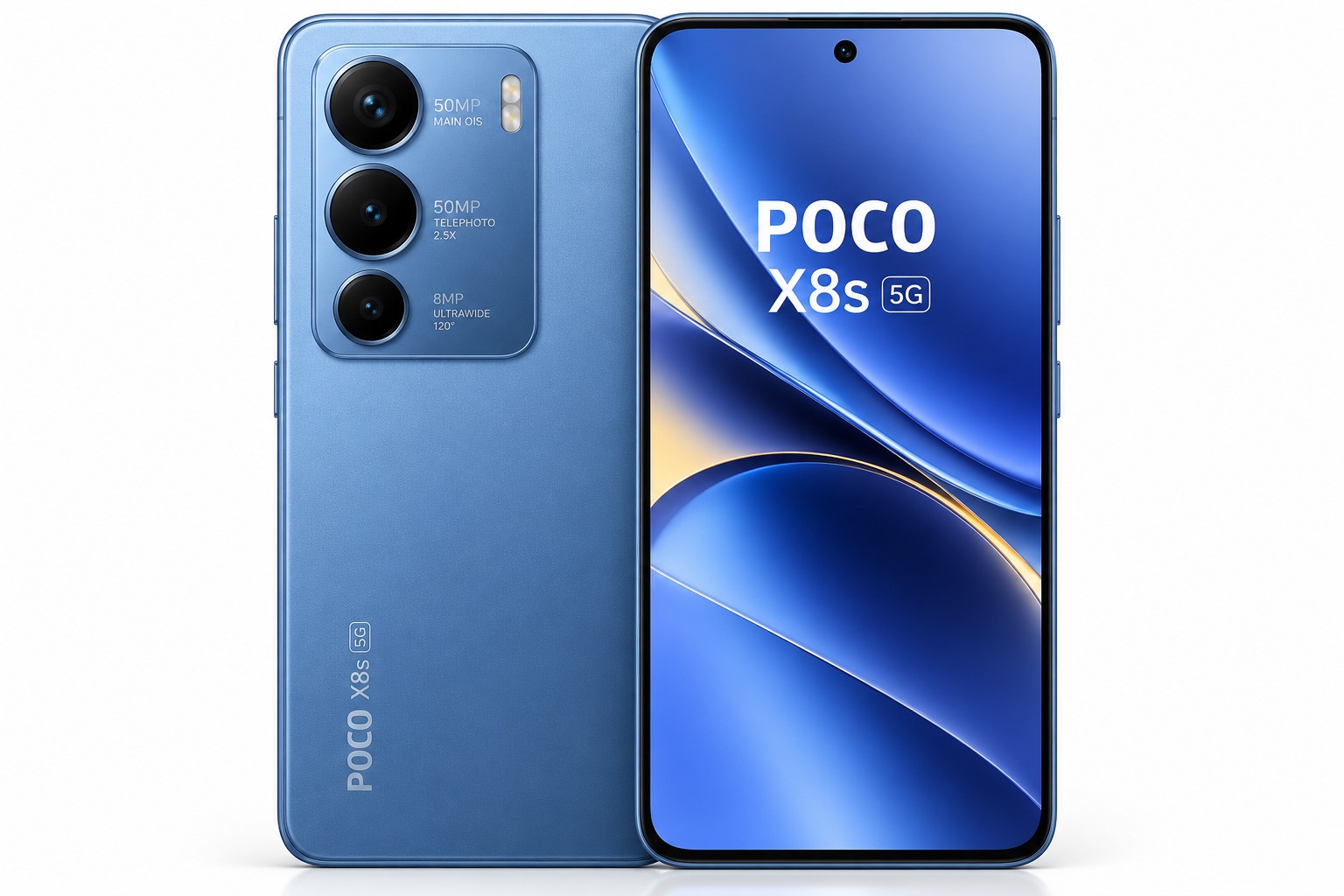
I spent a few days with the global unit, and the short version is this: Poco finally built a compact phone that doesn’t force you to choose between size and substance. The 50MP telephoto is the star, the 6330mAh battery is the enabler, and the IP68 rating is the insurance policy. There are compromises — no LPDDR5X, no UFS 4.0, and the ultrawide is just OK — but none of them kill the deal.
Design & Build Quality
The X8s measures 151.1 x 71.8 x 8.06 mm and weighs 187g. That sounds like a spec sheet, but in hand it translates to something most flagships can’t match: actual one-handed usability. The 71.8mm width means my thumb reaches the far side of the screen without stretching, and the 8.06mm thickness keeps it from feeling like a brick.
Poco went with a glass front, aluminum frame, and glass back. The camera deco is flush with the body in the same color as the finish, which gives it a cleaner look than the raised modules on some rivals. Three colors are available globally: Blue, Black, and White. The Blue variant I tested has a subtle gradient that shifts under light, similar to what Poco did with the F9 Pro last year.
The IP68 certification is rated for submersion up to 2 meters for 30 minutes in static freshwater. That’s the same test protocol as most flagship phones, not the splash-resistant IP67 you see on budget devices. Poco also includes a protective case in the box, which matters because the back is glass and the sides are bare metal.
One small complaint: the USB-C port is still USB 2.0. At this price, that’s expected, but if you’re moving large files to a PC, the speed will feel dated next to the USB 3.2 on the Oppo F35. There’s no 3.5mm jack, no microSD slot, and no FM radio. The ultrasonic fingerprint sensor under the display is fast and accurate — a clear upgrade from the side-mounted sensors on the Poco F9 Pro.
Display
Poco put a 6.35-inch LTPO AMOLED panel in the X8s, and it’s one of the best screens in this price bracket. The resolution is 1220 x 2656 (roughly 1.5K), which at 460 PPI looks razor-sharp for text and social media. The 120Hz adaptive refresh rate drops to 1Hz for static content, which helps the battery.
The headline number is 3,500 nits peak brightness. That’s marketing territory — it’s measured at a small isolated spot during video playback, not full-screen sustained. In real outdoor use around Roxas City on a bright afternoon, I could comfortably read the screen at maximum brightness without squinting. The HDR10+ and Dolby Vision support work as expected in YouTube and Netflix, with punchy colors and deep blacks.
Poco also claims 12-bit color depth and DCI-P3 coverage, which translates to smoother gradients in photos and videos. The 1.18mm bezels are impressively thin, making the display feel almost edge-to-edge. Protection comes from POCO Shield Glass, which held up against keys and coins in my pocket without a scratch after a week. It’s not Gorilla Glass Victus 2, but it’s sufficient for daily use.
Performance
The Snapdragon 7 Gen 4 is Qualcomm’s new mid-range champion, built on a 4nm process. The CPU configuration is 1×2.8GHz Cortex-A720, 4×2.4GHz Cortex-A720, and 3×1.8GHz Cortex-A520, with an Adreno 722 GPU. In daily use — social media, messaging, light gaming — the phone feels snappy. Apps open fast, scrolling is smooth, and the 120Hz panel makes animations feel responsive.
Gaming is where the 7 Gen 4 shows its limits. I tested Genshin Impact at medium settings, and the frame rate hovered around 35-45fps in busy scenes. PUBG maxed out at 60fps with occasional dips. The POCO 3D IceLoop cooling system — a 4,497 mm² vapor chamber — keeps the phone from throttling during extended sessions, but the chipset simply isn’t designed for sustained flagship-level performance. If you’re comparing against the Xiaomi 18 Pro with its Snapdragon 8 Elite Extreme Gen 6, there’s no contest. The 18 Pro is in a different league entirely.
RAM options are 8GB and 12GB LPDDR4X, paired with 256GB or 512GB of UFS 2.2 storage. The UFS 2.2 is a step behind the UFS 3.1/4.0 you see in flagships, but for most users it won’t matter. App installs feel fast enough, and I didn’t notice any stutter when switching between heavy apps. The lack of expandable storage is a shame — Poco usually includes a microSD slot in this segment — but 512GB should cover most people.
Camera
The camera system is the X8s’s biggest surprise. Poco equipped it with a triple array: 50MP Light Fusion 800 main sensor with OIS, 50MP periscope telephoto with 2.5x optical zoom, and 8MP ultrawide. The 20MP front camera handles selfies and video calls.
The main sensor is the star in good light. Photos are sharp, colors are natural without oversaturation, and OIS keeps handheld shots crisp even at dusk. The 1/1.55″ sensor size is respectable for this price, and the f/1.77 aperture lets in enough light for low-light shots without relying too heavily on software processing.
The 50MP telephoto is the real talking point. Most phones in this price range either skip the telephoto entirely or use a cheap 2MP macro sensor. The X8s gives you a proper 2.5x optical zoom with PDAF, which means portraits and distant subjects actually look like they were taken with a dedicated lens, not a digital crop from the main camera. In daylight, the telephoto produces sharp, natural-looking portraits with pleasant background blur.
The 8MP ultrawide is the weak link. It’s usable for landscapes and group photos, but dynamic range struggles in high-contrast scenes. You’ll notice softer edges and occasional color casts compared to the main camera. Video recording maxes out at 4K@30fps on the rear camera and 1080p@60fps on the front. No 4K@60, no gyro-EIS on the rear, and no cinematic modes — this is a straightforward shooter, not a content creator’s tool.
Compared to the Redmi Note 17 Pro, which also costs around the same global price, the X8s trades a slightly wider main-sensor advantage for a telephoto lens the Redmi completely lacks. If you care about zoom, the X8s wins. If you care about ultrawide quality, the Redmi wins.
Battery & Charging
The 6,330mAh silicon-carbon battery is the second pillar of the X8s’s value proposition. Poco claims 24+ hours of video playback, and in my mixed-use testing — streaming Spotify, scrolling TikTok, taking photos, and occasional gaming — I consistently got through a full day with 30-40% remaining. That’s with the display set to 120Hz and brightness around 60%.
Charging is rated at 100W wired, with support for PD3.0, QC3+, and 100W PPS. In my test, a 0-100% fill took roughly 22 minutes using the included adapter. The 22.5W reverse wired charging is a nice bonus for topping up earbuds or a friend’s phone in a pinch. There’s no wireless charging, which is a genuine omission at this price — the Poco F9 Pro added 50W wireless charging six months ago, so its absence here feels like a cost cut rather than a design choice.
Software
The X8s ships with Android 16 and Xiaomi’s HyperOS 3. The interface is familiar if you’ve used any recent Poco or Xiaomi device: a launcher with app drawer, a control center pulled from the top-right, and a settings menu organized by feature rather than by category. Bloatware is minimal compared to some competitors — I counted about 12 pre-installed apps, most of which can be uninstalled.
Xiaomi promises 3 major OS upgrades and 4 years of security patches for the X8s. That’s a solid commitment for a mid-range phone, though it trails the 4-year OS promise on the Honor X9e Pro 5G and the 7-year pledge Samsung makes on its A-series. For a phone you might keep for three years, that should be enough.
The X8s is a global-only launch for now. There’s no official Philippine pricing or availability confirmed as of this writing, which means gray-market imports will carry a premium. If you’re in the Philippines, expect to pay roughly PHP 28,000-34,000 depending on the variant and seller, based on Vietnamese and European pricing conversions.
Pros and Cons
| Pros | Cons |
|---|---|
| 50MP periscope telephoto with 2.5x optical zoom | 8MP ultrawide is soft in high-contrast light |
| 6,330mAh battery with 100W wired charging | No wireless charging |
| IP68 water and dust resistance | UFS 2.2 storage, not UFS 3.1 or 4.0 |
| 6.35-inch LTPO AMOLED, 1.5K, 120Hz, 3,500 nits peak | USB-C 2.0 port limits file transfer speeds |
| 187g weight, truly one-handable | No microSD expansion |
| Snapdragon 7 Gen 4 handles daily tasks smoothly | No 4K@60 video recording |
| 3 major OS upgrades promised | Global launch only — no confirmed PH availability yet |
Should You Buy This?
Buy it if
- You want a compact phone that doesn’t sacrifice battery life or camera quality.
- You care about optical zoom — the 2.5x periscope is rare under $500.
- You value IP68 protection and don’t want to baby your phone around water.
- You’re fine importing from global markets and waiting for local stock.
Skip it if
- You need wireless charging — the F9 Pro has it, the X8s doesn’t.
- You prioritize ultrawide camera quality over telephoto reach.
- You want the fastest possible performance for gaming at max settings.
- You need a phone available locally with warranty support in the Philippines.
Final Verdict
The Poco X8s is the most sensible compact phone Poco has made in years. It understands its audience: people who want a small body without giving up the battery, camera, and build quality that make a phone worth keeping. The Snapdragon 7 Gen 4 won’t win benchmarks against the Xiaomi 18 Pro, but it handles everything from morning commutes to evening gaming sessions without complaint. The 50MP telephoto is the differentiator — it turns a competent mid-ranger into a genuinely versatile camera phone.
The compromises are real but manageable. UFS 2.2, no wireless charging, and a merely adequate ultrawide camera are all choices Poco made to hit that $399 price. If those trade-offs align with what you value, the X8s is an easy recommendation. Just check local Philippine availability before buying — Poco hasn’t confirmed a PH launch yet, and gray-market pricing will eat into that early-bird advantage.
Early bird price: $399 (8GB/256GB), $499 (12GB/512GB) | Vietnam price: VND 11,500,000 (~PHP 28,229) / VND 14,000,000 (~PHP 34,376)