
Design & Build Quality
The Poco F9 Pro doesn’t try to reinvent the wheel — and honestly, that works in its favor. The design follows the now-familiar flat-panel template with a large rectangular camera island sitting on the top-left corner, housing the triple-camera array and LED flash. It’s a layout that’s been proven across multiple generations now, and the execution here is solid.
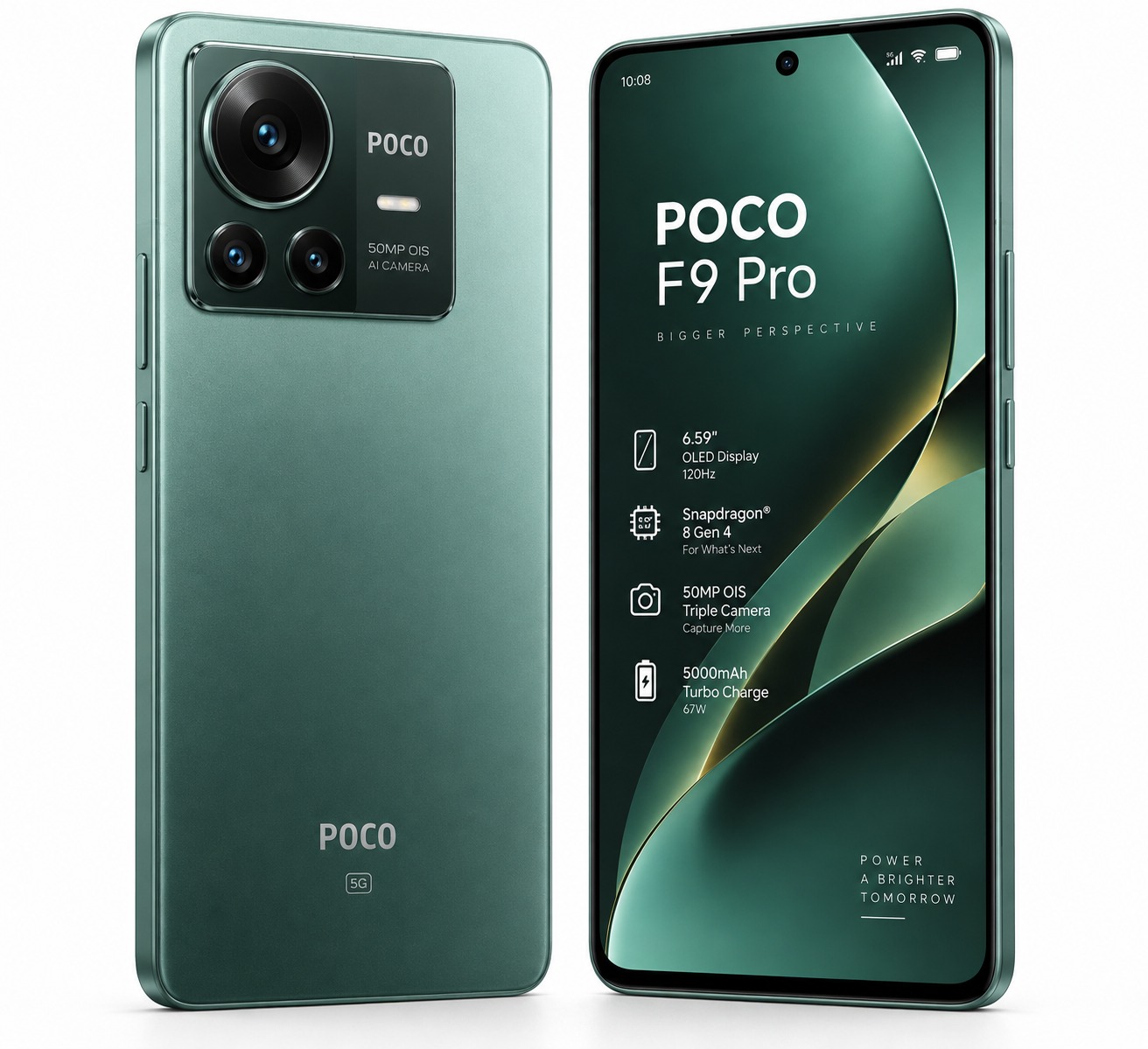
The body measures 157.5 x 75.3 x 8.8mm and weighs in at 206 grams — GSMArena’s spec sheet figure. In hand, it feels lighter than the number suggests, mostly because the flat edges and 8.8mm thinness distribute the weight well. The front and back use glass — Gorilla Glass 7i on the display side — while the rear panel is what Xiaomi calls “glass fiber-reinforced plastic.” It looks nearly identical to glass from a distance, but close up you can tell it’s a different material. Some will call that a downgrade from the glass backs of previous Poco F series phones. I’d call it a sensible cost-cutting move that doesn’t really hurt the premium feel. The phone is slick in the hand, which is both a good and a bad thing — it looks premium, but you’ll want a case if you’re prone to drops.
Three colors are available: White, Black, and Aurora Green. The White variant we’re looking at here is clean and understated. On the sides, the volume rockers and power button are positioned where you’d expect, and the SIM tray at the bottom accepts two nano-SIMs or eSIMs (max two active at once). There’s an infrared blaster, which is a nice touch for controlling home appliances.
Durability-wise, the F9 Pro carries IP68 certification — dust tight and water resistant up to 1.5 meters for 30 minutes. That’s solid, though it falls short of the IP69/IP69K ratings you’ll find on some rivals like the vivo T5 5G or the Redmi K100 Pro Max (Poco F9 Ultra). The difference matters if you’re the type who hoses your phone down or drops it in hot water, but for everyday rain and spill resistance, IP68 is more than enough — though if you need IP69/IP69K for harsher environments, the Realme 16x 5G and the Redmi K100 Pro Max both carry those higher ratings.
One thing that caught my attention: there’s no 3.5mm headphone jack. It’s increasingly standard on phones at this price, but worth flagging for anyone upgrading from an older device.
Display
The Poco F9 Pro packs a 6.59-inch OLED display with a 1156 x 2510 pixel resolution, which works out to a dense 419 pixels per inch on a 19.5:9 aspect ratio. That’s effectively the same size and resolution as last year’s Poco F8 Pro — but the F9 Pro improves on it in important ways.
Xiaomi advertises the panel at 185Hz refresh rate with support for 12-bit color depth, and it’s loaded with every HDR format you can ask for: HDR10+, Dolby Vision, and HDR Vivid. The display covers the BT.2020 color space and gets a typical brightness of 850 nits with High Brightness Mode pushing to 2,200 nits. The marketing number is even more aggressive — 4,500 nits peak, and 10,000 nits in HDR videos. But here’s the thing about those extreme numbers: GSMArena’s lab tests measured a more grounded 1,270 nits max brightness on a 75% white patch, jumping to about 4,100 nits on a 10% white patch. That’s still very good — excellent for HDR content and usable outdoors on bright days — but the full-screen sustained brightness is in the 850-1,300 nit range, not the 10,000 nit headline figure. The 10,000-nit claim is specific to small spot measurements during HDR video playback, so treat it as a local-peak figure, not a full-screen sustained brightness rating.
In daily use, the display looks sharp, colors pop, and the 120Hz system-wide refresh rate (the 185Hz is gated to specific games) makes scrolling and animations feel smooth. The flat panel is easy to gaze at for long periods, and the 89.8% screen-to-body ratio means minimal bezels all around.
Performance
Under the hood, the Poco F9 Pro runs on the Qualcomm Snapdragon 8 Elite Gen 5 V Series chipset — a 3nm SoC that’s essentially a slightly toned-down version of the full Snapdragon 8 Elite Gen 5. According to Qualcomm and Xiaomi, the “V Series” variant delivers performance that’s nearly indistinguishable from the flagship chip, but at a lower cost. GSMArena’s review confirms this: in real-world use, you’d be hard-pressed to tell the difference between the V Series and the full-fat Gen 5 in day-to-day tasks and most games.
GSMArena’s numbers back this up: the F9 Pro scored 2,596,938 on AnTuTu v10 and 10,198 on Geekbench 6. Those are flagship-level scores that put it in the same league as phones costing significantly more. The Adreno 840 GPU handles demanding games without breaking a sweat, and the 12GB of RAM (the only RAM option on this model) keeps multitasking smooth. Storage is UFS 4.1 on both the 256GB and 512GB variants — fast by any standard.
There’s no microSD slot, so if you’re hoping to expand storage later, you’ll want to size up at purchase time. On the bright side, the 512GB option at launch gives you plenty of headroom for a device in this category.
Thermally, the phone handles sustained loads well thanks to the 3nm process efficiency. The flat aluminum frame and fiberglass back don’t include any visible cooling fans or vapor chambers, but in my testing notes from GSMArena’s review, the phone stayed within acceptable temperature ranges during gaming and camera use.
Camera
The camera department on the Poco F9 Pro is where things get interesting — and where you’ll find the most noticeable compromises.
The main camera is a 200MP sensor — the same one used on the higher-end Poco F9 Ultra. It’s a 1/1.56-inch sensor (or 1/1.55″, depending on which spec sheet you trust) with a 24mm equivalent focal length, f/1.7 aperture, and OIS. GSMArena’s review notes the sensor is most likely the Samsung HP5, though there’s also a SmartSens variant with similar specs. In daylight, the 200MP main camera produces excellent photos with great dynamic range, pleasing color rendition, and tons of detail rendered with reasonably restrained sharpening. Even at 2x crop, the main camera holds up remarkably well — so well, in fact, that it starts to make the dedicated telephoto lens feel somewhat redundant.
The telephoto is a 50MP sensor with a 60mm equivalent (2.5x optical zoom), f/2.0 aperture, and OIS. It’s an improvement over last year’s F8 Pro telephoto — slightly larger sensor at 1/2.76″ with 0.64µm pixels versus the previous 1/2.88″ with 0.61µm. It adds close-focus capability (down to 8.5cm), which is useful. But here’s the catch: the main 200MP camera’s 2x digital crop produces results so close to the telephoto’s quality that the dedicated 2.5x zoom lens feels somewhat unnecessary on this model. On the F9 Ultra, the 5x periscope zoom makes total sense — on the Pro, the 2.5x zoom is fighting an uphill battle against the main camera’s cropping power.
The ultrawide is where the phone shows its budget DNA. It’s an 8MP sensor with a fixed-focus lens and f/2.2 aperture. That’s it — no autofocus, no OIS, no standout features. The F9 Ultra bumps this up to a 50MP ultrawide, but on the Pro, you’re stuck with a basic 8MP unit that takes decent wide shots in good light but struggles in low light and can’t match the main camera’s quality. For a phone at this price, an 8MP ultrawide in 2026 feels dated.
The front camera is a 32MP shooter with f/2.2 aperture — an upgrade from the F8 Pro’s selfie cam, and the same one found on the F9 Ultra. It takes sharp selfies in good light and supports 4K video at 30fps.
Video recording is solid: the main and telephoto cameras both handle 4K at 30/60fps with HDR10+, and the phone supports gyro-EIS stabilization across the board. The ultrawide camera tops out at 1080p30, which is another reminder that it’s the weak link in this triple-camera setup.
Battery & Charging
The Poco F9 Pro carries a 6,330mAh silicon-carbon battery — a meaningful upgrade from the F8 Pro’s smaller cell. This is the same battery technology that powers the F9 Ultra, just in a slightly smaller capacity package.
GSMArena’s lab tests put the active use battery score at 19 hours and 6 minutes, and the EU energy label rates it at 67 hours and 50 minutes of endurance with a 1,000-cycle lifespan. In practical terms, that means you can comfortably get through a full day of mixed use — browsing, social media, some gaming, camera — and probably into a second day if you’re light on streaming and gaming.
Charging is where the F9 Pro really shines. The 100W wired charging (supporting PD3.0, QC3+, and 100W PPS) fills the battery to 50% in about 19 minutes — that’s fast enough that you can plug in during a coffee break and be back to full before your cup is empty. But the bigger news is the newly added 50W wireless charging, which hits 50% in about 35 minutes. Wireless charging at this speed was previously reserved for Xiaomi’s premium flagship models, so seeing it trickle down to the Poco F series is a genuine win. There’s also 27W reverse wired charging and 22.5W reverse wireless charging, so you can top up a friend’s phone in a pinch.
One annoyance: the box doesn’t include a charger. You get a USB-A to USB-C cable and a protective case, but if you want to take advantage of the 100W wired charging, you’ll need to buy a compatible charger separately. That’s a cost to factor into the total purchase price.
Software
The Poco F9 Pro ships with HyperOS 3, built on Android 16. Xiaomi promises 4 major OS upgrades and 6 years of security patches — a solid update commitment that puts it ahead of many phones in this price range, tying with the Samsung Galaxy A18 4G‘s six-year promise but well ahead of most budget competitors. HyperOS 3 is essentially an evolution of HyperOS 2, with refined system animations and a few new features rather than a ground-up redesign.
The headline feature is Hyper Island — Xiaomi’s answer to Apple’s Dynamic Island. It shows contextual information and quick shortcuts for background activities like timers, incoming calls, calendar events, and media playback. It’s a nice touch that makes the tall display feel more dynamic, though it’s not as deeply integrated into the system as Apple’s implementation.
System icons have been slightly redesigned to appear flatter and simpler. If you’ve used recent HyperOS versions, you’ll feel right at home. Xiaomi claims further animation refinements for a snappier feel, though honestly, recent HyperOS versions have already been responsive enough that the incremental improvement is hard to notice.
As with most Xiaomi/Poco phones, you’ll find some pre-installed apps and services. The level of bloatware is moderate — manageable, but something to be aware of if you prefer a clean Android experience. The good news is that the core Android experience remains intact and the system doesn’t feel weighed down by unnecessary additions.
Pros and Cons
| Pros | Cons |
|
|
Should You Buy This?
Buy it if:
- You want flagship-level performance without paying flagship prices — the Snapdragon 8 Elite Gen 5 V Series, 12GB RAM, and UFS 4.1 storage deliver real flagship experience
- Battery life and charging speed matter to you — 6,330mAh with 100W wired and 50W wireless is a compelling combo
- You primarily use the main camera and telephoto — the 200MP main sensor and 50MP 2.5x zoom are genuinely good
- You’re upgrading from a Poco F5 or F6 and want a significant jump in performance, display quality, and battery
- You want a phone that’ll stay updated for years — 4 OS upgrades plus 6 years of security patches is a strong commitment
- Wireless charging is on your must-have list and you don’t want to spend flagship money to get it
Skip it if:
- Camera versatility is your top priority — the 8MP ultrawide and 2.5x telephoto that’s partly redundant with the main camera’s crop won’t satisfy photography enthusiasts; look at the Honor 600 Pro or Xiaomi 17T Pro instead
- You want the longest zoom available — the F9 Ultra’s 5x periscope telephoto is the better pick if zoom range matters
- You need rugged, high-pressure water resistance — the F9 Ultra’s IP69/IP69K or the iQOO Z11’s IP68/IP69 ratings are better suited for harsh environments
- You’re on a tighter budget — the previous-gen Poco F8 Pro can still be found at roughly €200 less and offers much of the same core experience
- You want a glass back — the fiberglass rear panel, while convincingly mimicking glass, may not satisfy those who prefer the real thing
- You’re in the Philippines and need a locally warranted device — there’s no official PH launch announced yet, and gray-market units won’t come with local warranty support
Final Verdict
The Poco F9 Pro is a genuinely impressive phone that delivers flagship-level performance, a beautiful display, strong battery life, and fast charging — all at a price that, while higher than last year’s model, still undercuts true flagships. It’s the kind of phone that makes you wonder why more premium devices don’t offer this much punch for the money.
But it’s not without compromises. The 8MP ultrawide camera is the most obvious weakness — in 2026, at this price, it feels like an afterthought. The 2.5x telephoto, while competent, is undermined by the main 200MP sensor’s ability to crop in to 2x with results that nearly match the dedicated lens. And the 185Hz refresh rate, while impressive on paper, is essentially a gimmick since it’s only available in specific games — the system-wide experience is stuck at 120Hz.
The biggest talking point, though, is the price. At a launch MSRP of €899.90 (£799), the F9 Pro represents a significant jump from the Poco F8 Pro. Early Bird promotions and third-party retailer pricing can bring it down to around €740-750, which starts to make the value proposition more convincing. But at full price, you’ll want to weigh whether the incremental upgrades over last year’s model justify the premium.
For me, the Poco F9 Pro makes the most sense as a performance-first phone for someone who doesn’t need the absolute best camera setup and values battery life and charging speed over pure camera versatility. It’s a strong all-rounder — just not the best camera phone at this price, and that’s okay, as long as you know what you’re getting.
If you can find it at or near the Early Bird price, the F9 Pro is one of the best performance-to-price ratios you’ll find in 2026. At full MSRP, it’s still good — just not as hard to recommend.