
Redmi is about to drop the biggest battery it has ever put in a flagship, and it lands in three days. The Redmi K100 Pro Max launches in China on August 11 with a confirmed 9,070mAh cell, an expected 200MP main camera, and the same Bose 2.1 audio setup that made the K90 Pro Max a sleeper hit for media junkies. I spent the morning covering the iQOO 15T with its 8,000mAh battery, and the K100 Pro Max is coming for that crown with 13% more capacity on paper. This is a full spec deep-dive based on what Redmi has officially confirmed through its Weibo teasers, cross-checked against GSMArena’s preliminary spec sheet, Gizmochina, and News18. Hands-on impressions will follow once retail units ship, but there’s already plenty to unpack.
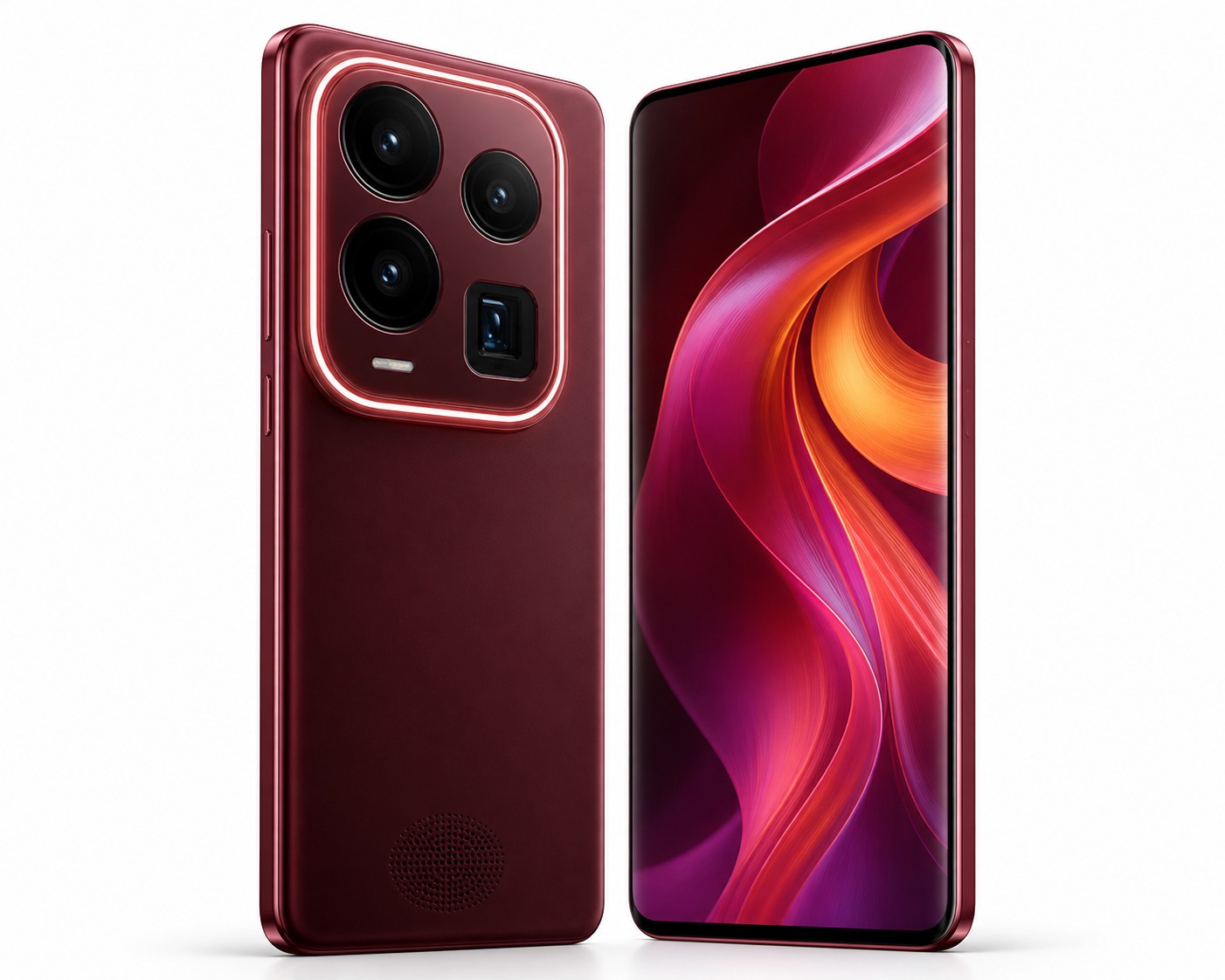
Design & Build Quality
The K100 Pro Max keeps the design language of the K90 Pro Max instead of reinventing the wheel. Redmi confirmed a flat 6.9-inch front with ultra-narrow bezels, a curved metal frame with color-matched finishing, and the now-familiar integrated camera island on the back. The new party trick is a floating light ring around the camera module that syncs with music, calls, notifications, and Xiaomi’s AI assistant. It’s a gimmick on paper, but the same trick has worked well on gaming phones, and it’s the kind of subtle glow you actually notice in a dark room.
The headline color is Cabernet Sauvignon Red, a deep burgundy that Redmi showed off at ChinaJoy and matched with a red metal frame. A Gold White variant also appeared in official renders, and GSMArena’s preliminary listing suggests black and blue options too. Durability is expected to match the K90 Pro Max’s IP68/IP69 rating, which means it survives both submersion and high-pressure water jets. Redmi hasn’t published weight or dimensions yet, and I’d expect the 9,070mAh cell to add heft. The K90 Pro Max measured just 7.9mm with 7,560mAh, so this one will likely cross 220g. That’s the price of battery-first engineering.
Display
Redmi confirmed a 6.9-inch flat AMOLED with a 185Hz refresh rate and 2K resolution — a step up from the K90 Pro Max’s 120Hz panel. The company claims up to 4,500 nits of peak brightness, but treat that as a local-peak marketing figure rather than a full-screen number; the same claim on the Huawei Nova 16 SE turned out to be measured at an isolated spot during video playback. The panel uses M11 luminescent material, supports Dolby Vision, HDR Vivid, and HDR10+, and has 2,560Hz PWM dimming for people sensitive to flicker.
Redmi also introduced what it calls a Super Pixel solution with a dedicated D2 display chip. The marketing line is that it delivers better clarity than a 2K panel while consuming less power than a 1.5K one, with a 20% improvement in luminous efficiency and a full RGB lossless pixel arrangement. Some of that is hype, but the underlying approach — using the display chip to drive pixel-level processing so the GPU doesn’t have to — is a legitimate way to save battery during long scrolling and reading sessions. The 185Hz figure itself is mostly headroom; real-world UI smoothness beyond 144Hz is hard to notice, but gaming at high frame rates will appreciate it.
Performance
Under the hood is the Snapdragon 8 Elite Gen 5 (SM8850), the same silicon that powers the Galaxy Z Fold8 Ultra, paired with 12GB or 16GB of RAM and up to 1TB of UFS 4.1 storage. That makes it the direct Snapdragon rival to this morning’s iQOO 15T, which leans on a MediaTek Dimensity 9500 Monster Edition instead. A Geekbench listing for a K100-series unit with the model number M511CD scored 3,429 single-core and 10,461 multi-core with 16GB of RAM on Android 16. Those numbers sit right in the expected range for the Gen 5 chip — comfortably flagship territory, though not a huge jump over the K90 Pro Max, which used the same chipset.
What’s interesting is how Redmi tuned it. Gizmochina reports early gaming tests show stable frame rates across multiple titles, with the company claiming further refinements to the Snapdragon 8 Elite Gen 5’s performance curve compared to previous implementations. The K100 Pro sibling — with its Snapdragon 8 Elite Gen 5 V variant and 3D circulating cold-pump cooling — scored 4.09 million on AnTuTu according to Redmi’s official claim, so expect the Pro Max to land in a similar ballpark. Thermal management is the open question. A 9,070mAh battery in a thin chassis means heat has nowhere to go under sustained load, and the K100 Pro’s 3D cold-pump cooling is a reminder that keeping these chips cool at full tilt is a real engineering problem. I’ll hold judgment until we can run our own benchmark loop.
Camera
The camera is where the K100 Pro Max makes its biggest generational leap. The setup is a triple module headlined by a 200MP main sensor with OIS — a first for the Redmi K line — joined by a 50MP periscope telephoto with 5x optical zoom and telemacro support, and a 50MP 102-degree ultrawide. That replaces the K90 Pro Max’s 50MP-everywhere triple array, and the jump in main-sensor resolution should give noticeably better detail in good light. Redmi already confirmed the 200MP sensor with OIS on the K100 Pro, and the Pro Max is expected to carry the same configuration per GSMArena’s preliminary sheet.
The periscope with telemacro is the sleeper feature. 5x optical zoom is useful, but a telephoto that also focuses as close as 10cm gives you true macro shots without the useless 2MP macro lens most mid-rangers hide. Video tops out at 8K@30fps with gyro-EIS, and the 32MP front camera handles 4K selfie video. I’d want to test low-light behavior before calling it a flagship camera — 200MP sensors with pixel binning are only as good as the image processing behind them — but on paper this is the most complete Redmi K camera system yet.
Battery & Charging
Here’s the headline: 9,070mAh of silicon-carbon capacity, confirmed by Redmi, with 100W wired charging, 50W wireless charging, 27W wired reverse, and 22.5W wireless reverse. That’s a 20% capacity bump over the K90 Pro Max’s 7,560mAh, and it puts the K100 Pro Max among the largest batteries in any mainstream flagship. For context, the iQOO Z11 I reviewed last week packs 9,020mAh, and the iQOO Z11 is a mid-ranger — this Redmi is a full flagship with a battery that rivals it.
The charging setup is genuinely complete: fast wired, fast wireless, and reverse charging in both flavors. 100W wired should refill this monster in under 40 minutes based on the K90 Pro Max’s performance with the same wattage on a smaller cell, and 50W wireless is rare at this price tier. One honest caution: silicon-carbon batteries can have a smaller usable capacity than their rated number depending on the voltage curve — OnePlus 13 owners saw this last year — so real-world endurance needs an independent test. Still, even a conservative 8,500mAh of usable capacity would give two full days of heavy use and three on lighter days. For a flagship, that’s the whole point.
Software
The K100 Pro Max runs Android 16 with HyperOS on top, and the Geekbench listing confirms 16GB of RAM with Android 16 as the base. HyperOS 3 is the current China-market version, though Gizmochina notes it remains to be seen whether the phone ships with HyperOS 4 out of the box. Here’s the catch for Filipino buyers: this is a China-market phone, and the China ROM ships without Google Play Services. GCash, Maya, and most local banking apps will not run out of the box — you’d need to sideload Google services manually, and an OTA update can break that setup. I flagged the same issue on the iQOO 15T this morning, and it applies equally here. Update commitments for the K series in China have historically been good — three to five years of Android and security updates — but Redmi hasn’t officially detailed the K100 Pro Max’s support window yet, so I won’t guess.
The audio story deserves its own paragraph. Redmi kept the Bose 2.1 speaker system with a physical woofer on the back, now described as Bose 2.1 stereo with 24-bit/192kHz Hi-Res support and LHDC 5.0 Bluetooth audio. A rear woofer is weird until you hold the phone in landscape for a video or a game — then it genuinely moves air. It’s the K series’ most distinctive feature and the reason media lovers keep coming back. There’s no 3.5mm headphone jack, and no microSD slot, so the 256GB base storage decision matters.
Pros and Cons
| Pros | Cons |
|---|---|
| 9,070mAh battery — among the biggest in any flagship | China-only launch; no confirmed PH release date |
| 100W wired + 50W wireless + dual reverse charging | China ROM without Google services out of the box |
| 200MP main with OIS + 50MP 5x periscope with telemacro | No 3.5mm jack and no microSD slot |
| Bose 2.1 speakers with rear woofer — unique in the segment | Expected ~CNY 5,000 price is a real step up from the K90 Pro Max’s CNY 3,999 launch |
| 185Hz AMOLED with 2K resolution and a dedicated display chip | 4,500 nits peak brightness is a local-peak marketing figure |
| Snapdragon 8 Elite Gen 5 with up to 16GB RAM and 1TB storage | Weight and dimensions unrevealed — likely over 220g |
| IP68/IP69 durability rating expected | Final retail pricing and update commitment unconfirmed |
Should You Buy This?
Buy it if
- You want flagship performance that never runs out of battery — the 9,070mAh cell is the class leader
- You watch a lot of video or game on your phone and want speakers that actually sound like speakers
- You want a complete charging setup: fast wired, fast wireless, and reverse charging for your earbuds or watch
- You’re comfortable with the gray-market reality of importing a China-only flagship, including the Google-services workaround
Skip it if
- You rely on GCash, Maya, or PH banking apps and don’t want to fiddle with sideloaded Google services
- You need a local warranty and official support — a gray-market unit has neither
- You’re on a budget; the expected ~CNY 5,000 price (roughly PHP 45K at current rates) is a big ask versus the Poco M8 Power’s battery-first value
- You want the best camera money can buy — 200MP on paper doesn’t guarantee flagship photo quality, and the periscope maxes out at 5x
Final Verdict
The Redmi K100 Pro Max is Redmi betting that battery can carry a flagship, and it’s a bet I mostly buy. Nine thousand milliamps is a statement in a market where 6,000 to 7,000 is the new normal, and pairing it with a 200MP camera, 5x periscope, and a Bose 2.1 audio setup makes this the most complete K-series phone Redmi has built. The component-cost crunch that pushed Redmi to launch the Pro and Pro Max first — before the standard K100 — is the same global memory shortage I wrote about that’s pushing every gadget’s price up. That context explains the steep price jump: the flagship-killer era is giving way to flagship-priced Redmis.
Who is this for? Power users who hate chargers, media consumers who want their phone to double as a speaker, and anyone who has looked at the benchmark numbers for Snapdragon 8 Elite Gen 5 and wanted it in a battery-first package. The iQOO 15T I reviewed this morning is the direct competitor — similar chip, similar camera ambitions, 8,000mAh instead of 9,070mAh — and the choice between them will come down to audio, wireless charging, and which gray-market importer you trust more.
The honest caveats stand: no Google services out of the box, no local warranty, unconfirmed final pricing, and a body that’s probably heavy. But if Redmi delivers the endurance its official numbers promise, the K100 Pro Max becomes the answer to a simple question: why should a flagship die by noon? It shouldn’t. On August 11, we’ll see if the spec sheet survives contact with reality.