
Battery-first phones have quietly taken over the mid-range this year. The iQOO Z11 is one of the boldest entries yet: a 9,020mAh cell squeezed into a body just 8.3mm thick, paired with a 144Hz AMOLED and Qualcomm’s Snapdragon 7s Gen 4. It launched in Malaysia on May 5, and iQOO just confirmed the India debut for August 20 — with a different design and hardware than the global unit. That split makes the Z11 one of the more interesting mid-rangers to untangle in 2026, and a timely pick given how much component prices have been climbing this year.
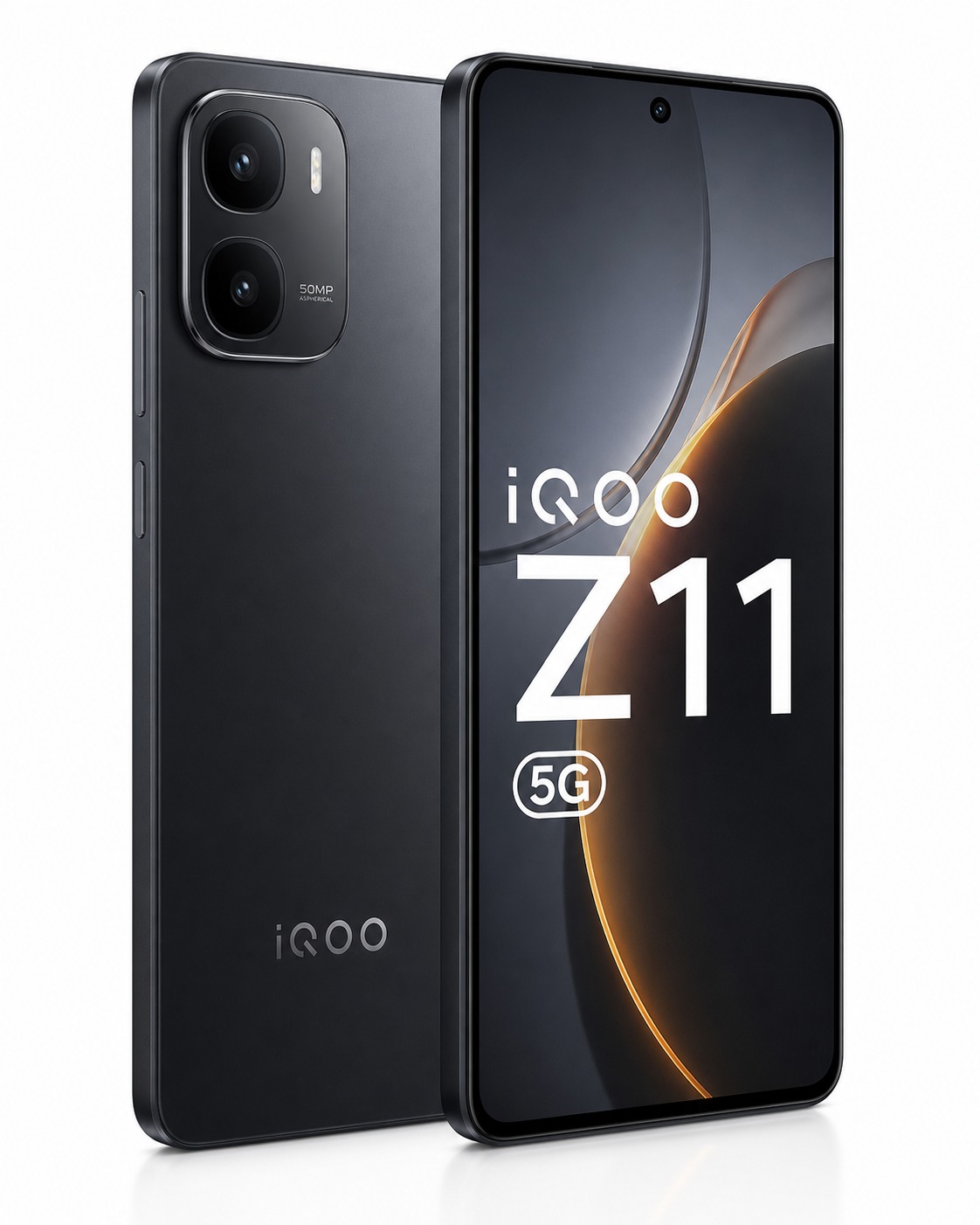
Design and Build Quality
The Z11 follows the flat-edged, squared-off look that iQOO has been using across its lineup, and honestly, it’s a good look. The brushed metallic rear finish comes in Cosmic Black or Glacier Blue, and under decent lighting it reflects light with a polish that reads more expensive than the price tag. In duller conditions it can look a bit plain, but it never feels cheap in hand.
At 163.7 x 76.2 x 8.3mm and 213g, there’s noticeable heft — much of it coming from that massive battery. It stays comfortable for extended use, which is more than I can say for some other big-cell phones that feel like bricks. The frame and rear are plastic, but the build quality is reassuringly sturdy, and the under-display fingerprint sensor is quick and consistent once you enroll a couple of profiles.
Durability is a genuine highlight. The Z11 carries IP68/IP69 ratings — dust-tight, immersible up to 1.5m for 30 minutes, and able to shrug off high-pressure water jets. In a rainy commute or a sudden downpour, that’s real peace of mind, and it’s rare to see at this price point.
Display
The 6.83-inch AMOLED is one of the phone’s strongest cards. It runs a 1.5K resolution (1,260 x 2,800) at roughly 450ppi with a 144Hz refresh rate, 10-bit color, and full DCI-P3 coverage. Scrolling feels buttery, colors are vibrant without looking oversaturated, and contrast is excellent for video and photo editing.
iQOO rates the panel at 800 nits of manual brightness, a 2,000-nit global peak, and 5,000 nits of local peak brightness that kicks in under specific conditions like strong sunlight or HDR playback. I’d treat that 5,000-nit figure as a marketing number — it’s a local peak, not something the whole screen sustains — but the display is genuinely usable outdoors, which is what matters.
The China version of the Z11 runs a 165Hz panel; the global unit settles at 144Hz. You’ll be hard-pressed to notice the difference in real use. One thing worth noting: this is a flat display, which gamers and anyone who’s been burned by accidental edge touches will appreciate.
Performance
Under the hood sits the Snapdragon 7s Gen 4, built on a 4nm process with one 2.7GHz prime core, three 2.4GHz performance cores, and four 1.8GHz efficiency cores, paired with an Adreno 810 GPU. You get 8GB or 12GB of RAM with 128GB or 256GB of UFS 3.1 storage — no microSD slot, so choose your storage tier carefully.
Benchmark numbers are a mixed bag. On AnTuTu the chip lands around the 1.0–1.2 million range depending on the device and test — iQOO itself claims 1.2 million for the Z11. On Geekbench 6 you’re looking at roughly 1,222 single-core and 3,145 multi-core. But as with any mid-range SoC, the real question is how it feels day to day, and here the Z11 delivers. App launches are quick, multitasking stays fluid, and I didn’t hit any noticeable slowdowns during normal use. If you want to dig into benchmark methodology, my Geekbench 7 guide walks through what these scores actually mean.
Gaming is respectable. In tests with Arknights: Endfield and Where Winds Meet, the phone held above 50fps on medium settings with frame rate limits removed, with occasional dips in demanding scenes but nothing that ruined playability. iQOO’s Monster Mode pushes the hardware harder when you want it, at the cost of heat and battery drain. Thermal management is surprisingly good — outside of synthetic stress tests, temperatures stayed in check even during long gaming sessions.
For context, the Z11 sits a clear step above its sibling, the Z11x, which uses the Dimensity 7400 Turbo and an LCD panel. The standard model is the one that gets the premium AMOLED, the faster chip, and the bigger battery — if you’re choosing between the two, the extra money for the Z11 buys a meaningfully better screen and more headroom.
Camera
Here’s where the Z11 shows its mid-range roots. The rear setup is a 50MP main sensor (f/1.8, with OIS and PDAF) plus an auxiliary lens that handles depth. There’s no ultrawide and no telephoto, which limits your shooting flexibility compared to rivals like the vivo X300 E with its triple Zeiss array.
In good light, the main sensor performs admirably — detailed shots with pleasing dynamic range, and traces of vivo’s imaging expertise clearly bleeding through. Portrait mode is the standout: edge detection is generally accurate and the depth effect looks more natural than what most phones in this segment produce. The 32MP front camera handles selfies and video calls well, and both front and rear can record 4K at 30fps.
Low light is inconsistent. Some night shots come out surprisingly good with respectable detail; others suffer from aggressive noise reduction that smears fine detail. Digital zoom beyond 2x is best avoided entirely — quality falls off quickly and shots look soft. If camera versatility is your priority, this is the Z11’s clearest compromise.
Battery and Charging
This is the phone’s headline act. The 9,020mAh silicon-carbon battery is one of the largest cells in any mainstream phone this year, and it shows. In typical use — social media, messaging, occasional gaming, constant connectivity — the Z11 comfortably stretches to multiple days between charges. Lowyat’s testing measured just over 19 hours of continuous video streaming, while iGeekPhone’s endurance run hit 11 hours 39 minutes under heavy use. Either way, you’re looking at a phone that doesn’t need to live next to a charger.
Charging is quick too. The bundled 90W adapter takes the phone from 17% to 100% in around 50 minutes in independent testing, and GSMArena quotes 50% in about 37 minutes. There’s 7.5W reverse wired charging for topping up earbuds or a watch, and bypass charging lets the charger power the phone directly during gaming — a nice touch for anyone who plays plugged in. No wireless charging here, which is a fair trade at this price.
Battery-focused buyers should also look at the Poco M8 Power or the Oppo A7 Pro Max with its 10,000mAh cell — both strong battery-first alternatives depending on your budget.
Software
The Z11 runs OriginOS 6 on top of Android 16. It brings its own visual identity and a pile of features, but beyond the look, there’s little here that fundamentally changes the experience. The one real annoyance is bloatware — there’s a lot of it out of the box, and while most can be removed, it feels unnecessary on a phone that should be about simplicity.
iQOO promises three generations of OS upgrades and five years of security updates, which is reasonable for the segment. The “60-month smooth experience” claim is a lab-tested marketing line rather than a guarantee, but the hardware headroom suggests the phone should age acceptably.
Pros and Cons
| Pros | Cons |
|---|---|
| Massive 9,020mAh battery with multi-day endurance | No ultrawide or telephoto camera |
| 90W fast charging plus bypass and reverse charging | Heavy bloatware on OriginOS 6 |
| Excellent 144Hz AMOLED, bright enough outdoors | No microSD expansion and no 3.5mm jack |
| IP68/IP69 dust and water resistance | Inconsistent low-light photography |
| Reliable day-to-day performance with good thermals | No wireless charging |
| Premium look and feel for the price | 12GB variant pricing feels steep |
Should You Buy This?
Buy it if
- You want a phone that genuinely lasts two or more days on a charge
- You game on mobile and want smooth frame rates without flagship prices
- You value durability — the IP68/IP69 rating is a rare bonus here
- You want a flat, high-refresh AMOLED for media and everyday use
Skip it if
- Camera versatility matters — no ultrawide or telephoto is a real limitation
- You need expandable storage or a headphone jack
- You prefer a lighter phone; 213g is noticeable
- You’re waiting for the India unit — it’s a different phone with different hardware
Final Verdict
The iQOO Z11 isn’t the flagship killer iQOO used to chase. It’s a well-rounded mid-ranger that gets the essentials right: dependable performance, an excellent display, and battery life that puts most phones in its class to shame. The camera is the weakest link, and the bloatware is annoying, but neither undermines what this phone does best.
For the Philippines, there’s no official iQOO Z11 release yet. The Malaysia pricing converts to roughly PHP 23,000–27,000 for the 8GB/256GB and 12GB/256GB models, so expect importers and gray-market sellers to land somewhere in that neighborhood. And if you’re in India, note that the August 20 unit is a different beast — a curved display, a Pixel-style camera bar, and rumored Dimensity 7500 Turbo with a 7,000–8,000mAh cell, per iQOO’s own teaser and GSMArena’s reporting.
At its core, the Z11 is a battery-first phone for people who are tired of charging anxiety. If that’s you, and you can live with the camera compromises, it’s an easy recommendation. If you need more photographic range, the vivo X300 E or the Redmi Note 17 Pro might serve you better.