
iQOO has never been shy about chasing gamers, but the 15T is a different kind of swing. It’s the brand’s first T-series phone, and it swaps the Snapdragon chip found in the regular iQOO 15 for MediaTek’s new Dimensity 9500 “Monster Edition” — a chip tuned in partnership with iQOO specifically for sustained frame rates. On top of that, you get the biggest battery iQOO has ever put in a flagship, an 8,000mAh cell, and the brand’s first 200MP camera.
The catch? It launched in China on May 20, 2026, and it’s staying there — no global or India release has been announced. That matters for anyone in the Philippines thinking of importing one, and I’ll get to that. But as a gaming phone first and a daily driver second, the 15T makes a strong argument that the “battery-first flagship” formula doesn’t have to mean budget hardware.
Design & Build Quality
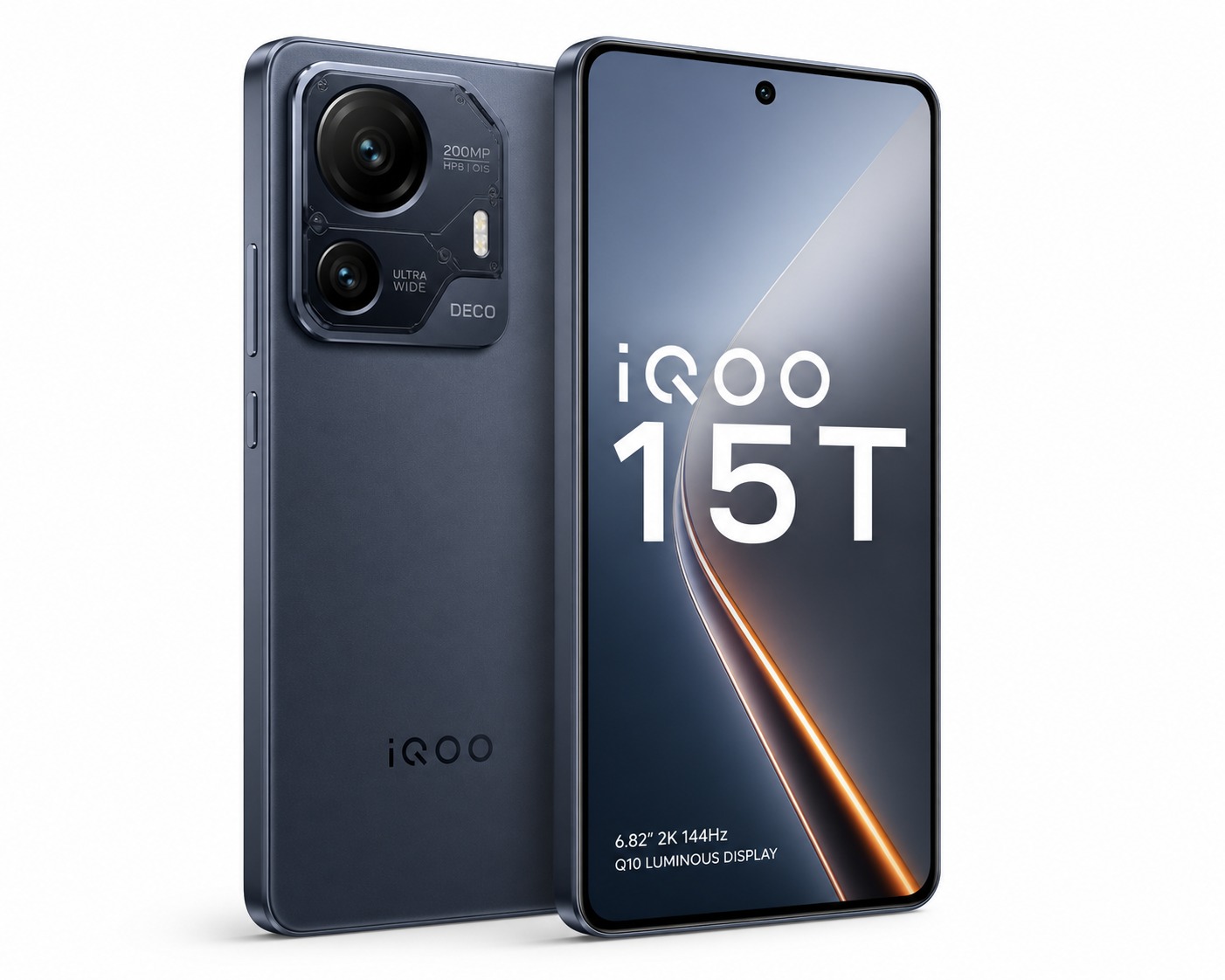
The 15T inherits the “DECO” camera module design language from the pricier iQOO 15 Ultra. It’s a rectangular island in the upper-left of the back, housing two lenses plus the flash — clean and deliberate, not decorative. Around the frame, iQOO uses a low-temperature matte finish that resists smudges and keeps heat away from your fingers during long sessions.
Three finishes are available: Qingyun (a new dark blue-grey), the Legend Edition with its classic motorsport-inspired stripe, and the Racing Edition with a sleeker performance look. The Racing Edition is the lighter build at 216g and 8.25mm thick; the other two sit at 223g and 8.40mm. That’s heavy by flagship standards, but it’s the price you pay for 8,000mAh in a flat slab — and honestly, 223g is reasonable for this battery.
Durability is a genuine highlight. The 15T carries IP68 and IP69 ratings, meaning it survives dust, submersion, and high-pressure hot water jets. That’s the same dual-rating we’ve seen on the ruggedized battery champs like the Redmi Note 17 Pro, which is unusual company for a phone with this much processing power. There’s also a 3D ultrasonic in-display fingerprint sensor — fast, reliable, and works even with slightly damp fingers.
Display
Up front is a 6.82-inch 2K+ “Everest” display, built on BOE Q10+ luminescent materials. It’s an 8T LTPO AMOLED panel with a 3,168 × 1,440 resolution and a 1Hz–144Hz adaptive refresh rate. HDR10+, 1.07 billion colors, and full DCI-P3 coverage are all here. At 510 PPI, text and game UI are razor sharp.
Brightness is a spec-sheet monster: 1,800 nits in high-brightness mode and a claimed 4,500 nits peak. A quick reality check before anyone quotes that number — 4,500 nits is a local peak, the kind of figure measured on a tiny portion of the panel in specific conditions, not sustained full-screen brightness. The 1,800-nit HBM figure is the one that matters for outdoor visibility, and that’s genuinely excellent for a phone in this class. Under the Philippine sun, this panel stays readable.
For eye comfort, iQOO includes 2,592Hz high-frequency PWM dimming, circularly polarized light tech, and DC-like dimming. That combination is a real selling point for anyone who gets headaches from low-frequency OLED flicker. Touch response is handled by a dedicated ultra-sensory chip with 4,000Hz instantaneous sampling — gaming-grade input latency, which shows iQOO knows exactly who this phone is for.
Performance
This is the headline act. The Dimensity 9500 Monster Edition is a custom version of MediaTek’s flagship built with iQOO’s own Q3 e-sports co-processor onboard. The core layout: one 4.21GHz C1-Ultra core, three 3.5GHz C1-Premium cores, and four 2.7GHz C1-Pro efficiency cores, fabbed on TSMC’s 3nm process with a Mali-G1 Ultra MC12 GPU. iQOO claims the “Monster super core engine” delivers up to 34% better stable frame rates under sustained load.
Numbers back the talk. The average AnTuTu v11 score sits around 3,815,522 across submitted results, with the GPU alone contributing roughly 1.44 million points. Early Chinese reviews land in the 3.5–3.8 million range — comfortably flagship territory, trading blows with the Snapdragon 8 Elite Gen 5 phones of the same era. If you want to compare it against your current phone, the Geekbench 7 guide I wrote covers the full routine.
The Q3 co-processor does the real work for gamers. It enables 2K resolution scaling across 11 popular titles, 144FPS super-frame interpolation in over 140 games, and even dual-client execution — 2K resolution at 144FPS simultaneously in six major FPS titles. Hardware-accelerated ray tracing covers four top-tier mobile games. A leaked gaming test showed the 15T holding 60FPS on Genshin Impact at extreme settings for around 30 minutes without major drops.
The honest caveat: thermals. One review noted the device climbing past 50°C during intensive stress testing, with CPU temperatures approaching 59°C under heavy sustained load. That’s not unusual for a phone pushing this much silicon, but it’s worth knowing — long competitive sessions will warm the frame, and the “8K cooling” system has limits. Day-to-day use, browsing, social media, and video playback stay cool and smooth.
Camera
The 15T is the first iQOO flagship with a 200MP main camera — a 1/1.56-inch sensor with an f/1.88 aperture, OIS rated to CIPA 4.5, and 4x lossless zoom. The second shooter is a 50MP ultrawide with f/2.0 aperture and macro support. Around front, a 16MP punch-hole camera handles selfies and video calls.
Before the marketing team celebrates: this is a dual-camera setup, not the triple array on the regular iQOO 15. There’s no telephoto and no periscope. The “4x lossless zoom” comes from the high-res sensor’s crop, not dedicated glass — useful, but not the same as the 50MP periscope on the iQOO 15. For a phone this expensive, the missing telephoto is the most honest criticism I can level at the hardware. If zoom reach matters to you, you’ll want a phone with dedicated telephoto glass — the 15T simply isn’t that phone.
What iQOO does bring is 200MP detail, all-focal-length portrait modes, Live Photo overlays with three styling profiles, and a solid 4K video package. The 50MP ultrawide doubles as a macro shooter, which is a nice touch. Real-world photo quality beyond the spec sheet is still being established — the phone is young and Western reviewers haven’t had units long — so treat image quality claims with caution until more hands-on testing lands.
Battery & Charging
Here’s where the 15T justifies its existence. The 8,000mAh silicon-carbon “Blue Ocean” battery is the largest iQOO has ever shipped in a flagship — and most 2026 flagships top out at 7,000mAh or less. This is a two-day phone for normal use, and a full-day phone even for heavy gaming, streaming, and hotspot duty. That’s the same battery-first philosophy that makes phones like the iQOO Z11 and vivo S2 so compelling, just scaled up to flagship silicon.
Charging is 100W wired — iQOO claims a five-minute top-up buys about three hours of short-video playback, and a full charge from empty takes roughly an hour. The phone also supports reverse wired charging to top up earbuds or a friend’s phone. iQOO’s Global Direct Drive Power Supply 2.0 lets you game while plugged in without cooking the battery, routing power straight to the board instead of cycling the cell — a genuinely smart feature for competitive players.
But there’s no wireless charging. At all. That’s a deliberate size and weight decision — adding the coil would push the 8.25mm chassis and 216g weight higher — and it’s the clearest trade-off the 15T makes. If you’re already invested in wireless charging stands, this phone will not fit your routine.
Software
The 15T runs OriginOS 6 on top of Android 16. The interface is smooth, customizable, and carries the usual vivo/iQOO polish — stacked card layouts, dynamic glow effects, and a game-centric “Game Box” that can push a live stream in about three seconds with built-in highlight clipping and privacy filters.
Here’s the big caveat for Filipino buyers, and I want to be direct about it: this is a China-market unit running the China ROM, which does not include Google Play Services out of the box. No Play Store, no Gmail, no Google Maps — and critically for us, apps like GCash, Maya, and most Philippine banking apps rely on Google services and may not run or may refuse to start without them. A manual GMS setup exists (via Settings → More Connections → Android Auto → Google Basic Service Management), and gray-market sellers often pre-install it, but it’s not an official, guaranteed path — OTA updates can occasionally break it. The 15T also has no eSIM support, so you’re on physical nano-SIMs only.
On the update promise, vivo’s China-market support terms are murkier than its global commitments — I couldn’t verify a specific number of OS updates for the 15T from an official source, so I’m flagging it as unconfirmed rather than guessing. Also worth noting: the global OriginOS 6 rollout announced this year narrows the gap between China and international versions, but a China-only phone is still a China-only phone.
Pros and Cons
| Pros | Cons |
|---|---|
| 8,000mAh battery — the biggest in any 2026 flagship class | No wireless charging at all |
| Dimensity 9500 Monster Edition with Q3 chip for sustained gaming | No telephoto or periscope — dual camera only |
| First iQOO 200MP camera with OIS and 4x lossless zoom | China-only launch; no official PH or India availability |
| Brilliant 2K 144Hz LTPO display with 2,592Hz PWM dimming | China ROM ships without Google Play Services |
| IP68 + IP69 dual dust/water resistance | No eSIM support |
| 100W wired charging with bypass charging for gaming | Thermals climb past 50°C under sustained stress |
| 3D ultrasonic fingerprint sensor | Update commitment unverified for China market |
Should You Buy This?
Buy it if
- You’re a mobile gamer who wants flagship-tier frame rates and all-day-plus battery in one phone
- You’re comfortable importing from China and setting up Google services manually
- You value a bright 2K display, IP68/IP69 durability, and a 200MP main camera over wireless charging
- You want a phone that doesn’t need a power bank — this is a genuine two-day device
Skip it if
- You need wireless charging, a telephoto camera, or eSIM — all missing here
- You rely on GCash, Maya, or bank apps and don’t want to troubleshoot GMS on a China ROM
- You want official warranty support and local service centers in the Philippines
- You don’t game much — the regular iQOO 15 or a global phone might serve you better
Final Verdict
The iQOO 15T is the answer to a very specific question: what does a flagship look like when battery life is the non-negotiable? You get the fastest MediaTek silicon of the generation, a 2K 144Hz display that’s genuinely excellent, a 200MP camera, and an 8,000mAh cell that most flagships simply don’t offer — all in a flat, IP68/IP69-rated slab with a gaming-grade co-processor.
Those wins come with real compromises. No wireless charging, no telephoto, no eSIM, and a China ROM that will frustrate anyone who needs Google services without setup work. The price — CNY 4,099 for the 12/256GB model (around ₱37,000 at current rates, with first-sale discounts reportedly dipping toward CNY 3,799) — puts it in flagship territory where those omissions sting. And with memory prices driving up component costs across the industry, the broader shortage isn’t making premium phones cheaper.
Who is this phone for? A specific kind of buyer: someone who games seriously, hates carrying power banks, and is willing to handle the gray-market realities of a China-only device. For everyone else, the 15T is a fascinating showcase of what iQOO can do with MediaTek — and a preview of the 16-series rumors already promising even bigger batteries. It’s not a phone for everyone. It’s a phone for a very particular gamer who knows exactly what they want.