
Design & Build Quality
The Oppo F35 5G is built like a tank disguised as a flower. The back panel carries a holographic floral pattern that shifts in the light — it won’t win awards for subtlety, but it feels grippy and resists fingerprints well. At 205 grams and 8.8mm thick, it’s not exactly light, but the weight distribution is even enough that it doesn’t feel unwieldy during long scrolling sessions.
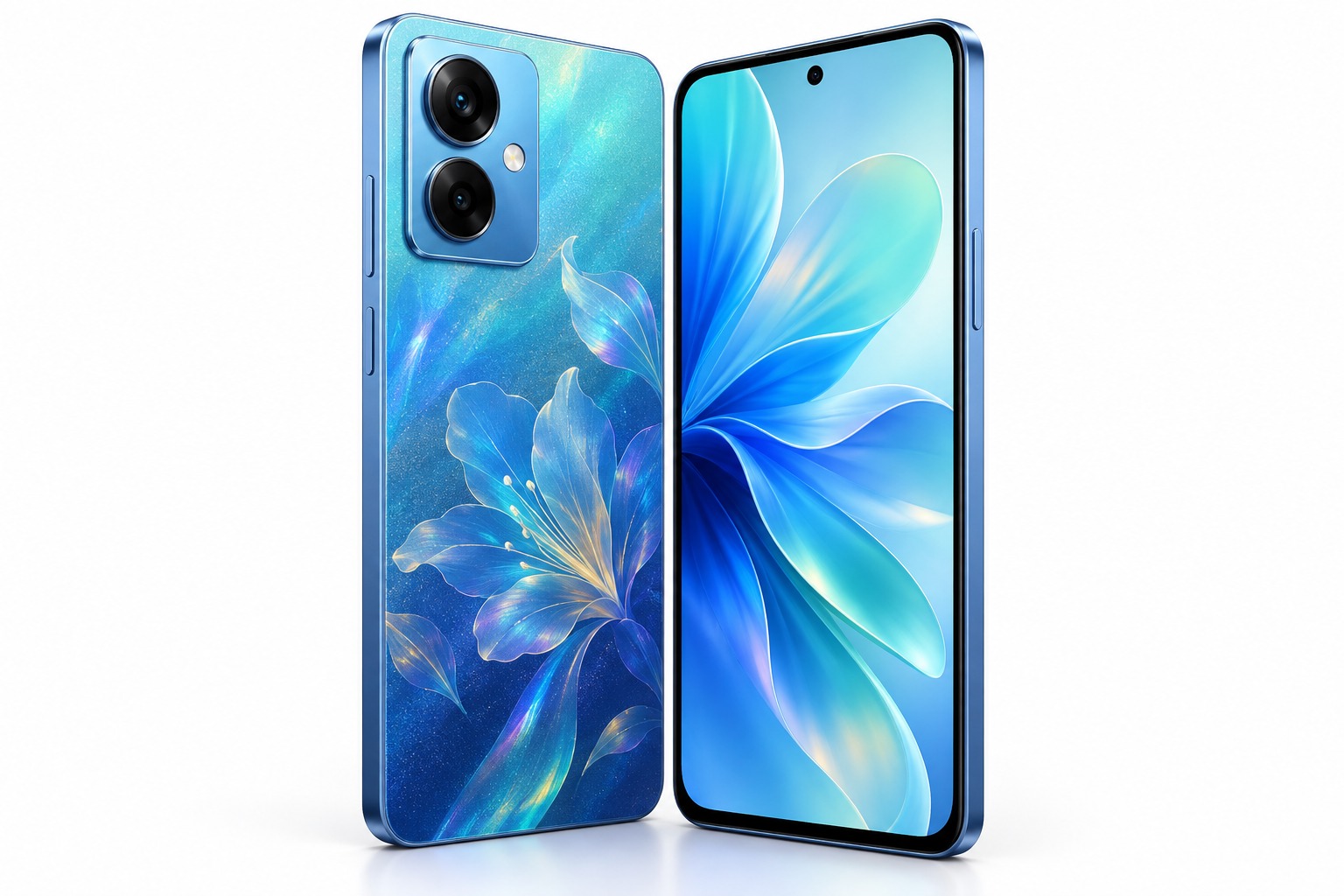
What genuinely impresses is the durability package. The F35 carries IP66, IP68, IP69, and IP69K ratings — the same set as the Oppo F35 Pro — along with MIL-STD-810H compliance. IP69K means it can withstand high-pressure water jets, a rating that even most flagship phones skip. The “Rainstorm Touch” feature claims to work in rainfall up to 1,000mm/h, which sounds like marketing until you realize it’s just a fancy way of saying the touchscreen won’t freak out in the rain.
The frame is plastic, which is expected at this price, and the glass front is unspecified — likely some form of strengthened glass. The phone comes in three colors: Mist Pink, Titanium Grey, and Wave Blue. I tested the Wave Blue variant, which has a nice gradient that shifts from deep blue to teal depending on the angle. It’s not the most premium-looking phone in hand, but it feels solid and well-assembled.
Display
The 6.57-inch AMOLED display runs at FHD+ (1080×2372) with a 120Hz refresh rate. It’s a solid panel for the price — colors are punchy, blacks are deep, and the 120Hz makes scrolling feel smooth. Peak brightness is rated at 1,400 nits, which is adequate for indoor use but can struggle under direct sunlight. I found myself squinting a bit when using it outdoors at noon, which is a common issue at this price point.
Compared to the F35 Pro’s 6.78-inch 1.5K 144Hz panel, the standard F35’s display is a clear step down. The resolution difference is noticeable if you put them side by side, and the Pro’s 2,160Hz PWM dimming is missing here. But for most users, this display is perfectly fine for social media, streaming, and gaming. The lack of HDR support is a minor disappointment for streaming, but again, expected at this price.
Performance
The Dimensity 6360 Max is a 6nm chip that sits in the lower mid-range tier. AnTuTu scores hover around 651,333, which puts it behind the Snapdragon 6 Gen 3 (~868,311) and the Dimensity 7300 (~985,594). In daily use, though, the phone feels snappy enough. Apps open quickly, animations are smooth, and multitasking with 6GB or 8GB of LPDDR4X RAM is handled without major hiccups.
Gaming is where the chipset shows its limits. BGMI runs at 60 FPS on Smooth graphics, and Call of Duty: Mobile can manage 60 FPS on Low or Medium. The gameplay is playable, but minor frame drops creep in during intense moments. If you’re a casual gamer, you’ll be fine. If you’re trying to climb the competitive ladder in MLBB at max settings, look elsewhere — the iQOO Neo12 with its Snapdragon 8 Elite Gen 5 is a completely different league.
The F35 uses UFS 2.2 storage, which is slower than the UFS 3.1 in the Pro model. App installs and file transfers take a bit longer, but it’s not a dealbreaker. The microSDXC slot is a welcome addition — expandable storage is increasingly rare in 2026, and it’s a genuine advantage over the F35 Pro, which lacks a card slot.
Camera
The rear camera setup is a 50MP main sensor (f/1.9, 1/2.0″, PDAF) paired with a 2MP depth sensor. No ultrawide, no telephoto — just the basics. The main camera takes decent photos in good lighting, with accurate colors and reasonable dynamic range. Low-light performance is average at best; night mode helps but can’t match phones with OIS. The Motorola Edge 70 Max with its larger sensor and OIS is a noticeable step up in low-light photography.
The 50MP front camera is the surprise here. It has a 100-degree field of view, autofocus, and an AI auto wide-angle switch that widens the frame when it detects more people. For selfies and video calls, this is one of the better front cameras at this price. Video recording tops out at 2.5K at 30fps on both front and rear cameras — not 4K, but perfectly adequate for social media content.
Battery & Charging
This is where the F35 earns its keep. The 8,000mAh battery is massive — 14% larger than the F33 series’ 7,000mAh cell — and Oppo claims it can retain over 80% capacity after 1,800 charging cycles, which translates to roughly six years of use. In my testing, the phone easily lasted a full day and a half with moderate use. Heavy users will still end the day with 30-40% left. The vivo S2 FE with its 10,000mAh battery is the only phone in this price range that beats it on pure capacity.
The 80W SUPERVOOC charging is fast enough — 0 to 100% in about 55 minutes. There’s no wireless charging, which is expected at this price, but the wired speed makes up for it. Reverse wired charging is supported, which is a nice bonus for topping up earbuds or another phone in a pinch.
Software
The F35 runs ColorOS 16 based on Android 16. It’s clean, feature-rich, and generally well-optimized. The AI features — AI Recording, AI Ultra-Clear Documents, AI Call Guard — are useful rather than gimmicky. Bloatware is minimal, and most pre-installed apps can be uninstalled. The OnePlus 16 runs a similar ColorOS experience, which makes sense given the Oppo-OnePlus merger.
One thing to note: the F35 Pro runs ColorOS 16.5, while the standard F35 is on ColorOS 16. The difference is minor, but it’s worth knowing if you’re deciding between the two. Oppo hasn’t specified the update commitment for the F35, which is a concern — the F35 Pro also lacks a clear update promise, and in 2026, that’s a genuine oversight for a phone meant to last six years.
Pros and Cons
| Pros | Cons |
|---|---|
| 8,000mAh battery with 6-year durability promise | Dimensity 6360 Max struggles with heavy gaming |
| IP69K + MIL-STD-810H durability at mid-range price | No ultrawide or telephoto camera |
| 50MP front camera with autofocus and 100° FOV | UFS 2.2 storage is slower than competitors |
| microSDXC expandable storage (rare in 2026) | Single speaker, no stereo sound |
| 80W SUPERVOOC fast charging | Display brightness struggles in direct sunlight |
| ColorOS 16 is clean and feature-rich | Plastic frame feels less premium than glass |
Should You Buy This?
Buy it if
- Battery life is your top priority
- You need a durable phone that can handle rain, dust, and drops
- You want a reliable daily driver for social media, streaming, and light gaming
- You value expandable storage via microSD
- You’re on a budget around ₹38,000-43,000 (~$400-450)
Skip it if
- You’re a serious mobile gamer who needs high frame rates
- You want the best camera system at this price
- You need wireless charging
- You prefer a lighter, more compact phone
Final Verdict
The Oppo F35 5G is a phone that makes a clear trade: it gives you exceptional battery life and rugged durability in exchange for middling performance and a basic camera system. At ₹38,999, it’s not trying to compete with the F35 Pro or flagships — it’s trying to be the phone that lasts two days on a charge and survives a drop in the rain without a case.
If that sounds like your kind of phone, the F35 delivers. The 8,000mAh battery is genuinely impressive, the IP69K rating is a rare find at this price, and the 50MP front camera is a nice touch for selfie enthusiasts. Just don’t expect it to run Genshin Impact at max settings — that’s what the Pro model (or a Snapdragon 8-series chip) is for.
For users who prioritize endurance and toughness over raw power, the Oppo F35 is one of the most compelling options in the mid-range segment right now. It’s not flashy, but it’s the kind of phone you can rely on — and in 2026, that’s worth a lot.