
OnePlus Ace 7 Pro Review: The Fan Is the Whole Point
OnePlus does something on October 29 that it has never done in its entire run as a phone maker: it puts a fan inside one. The OnePlus Ace 7 Pro launches in China this Thursday at 7PM local time, and OnePlus has spent the last week talking about almost nothing else — the fan, the airflow, the tower fins, the frame rates.
That is either a genuine engineering answer to a real problem, or an expensive way to make a phone that sounds like a small laptop. Three days before launch, with most of the spec sheet still unconfirmed by the company, here is what we actually know, what is still rumor, and who this phone is really for.
Confirmed vs Unconfirmed: What OnePlus Has Actually Said
OnePlus has confirmed the launch date, the Pro’s chipset, the cooling system, the design, and the colors. Everything else — battery, charging, cameras, price — is still leak territory. Here is the honest split.
| Spec | What is being reported | Status |
|---|---|---|
| Launch date | October 29, 2026, 7PM CST, China | Confirmed by OnePlus |
| Chipset | Snapdragon 8 Elite Gen 5 (SM8850) | Confirmed by OnePlus |
| Cooling | Built-in fan, dual-airflow, tower-fin heat sink | Confirmed by OnePlus |
| Colors | Three finishes, incl. Windbreaker, Midnight Black | Official reveal; English names vary by translation |
| OS | Android 17 with ColorOS 17 | Confirmed for China |
| Display size / refresh | 6.78-inch flat 1.5K OLED, 185Hz | Unconfirmed by OnePlus; GSMArena spec page |
| Display resolution | 1272×2800 (GSMArena) vs 1272×2772 (leaks) | Disputed — see Display |
| Main camera | 200MP with OIS | Tipster-sourced, not confirmed |
| Telephoto | 50MP periscope, 3.5x optical, Samsung JN5 | Tipster-sourced, not confirmed |
| Front camera | 16MP | Unconfirmed |
| Battery | 9,000mAh silicon-carbon | Rumored, not confirmed |
| Charging | 100W or 120W wired | Rumored, not confirmed |
| Wireless charging | Not confirmed for the Pro | Unconfirmed |
| IP rating | IP68 / IP69K | Listed for the series on GSMArena |
| Price | Not announced | Unconfirmed |
Design & Build Quality
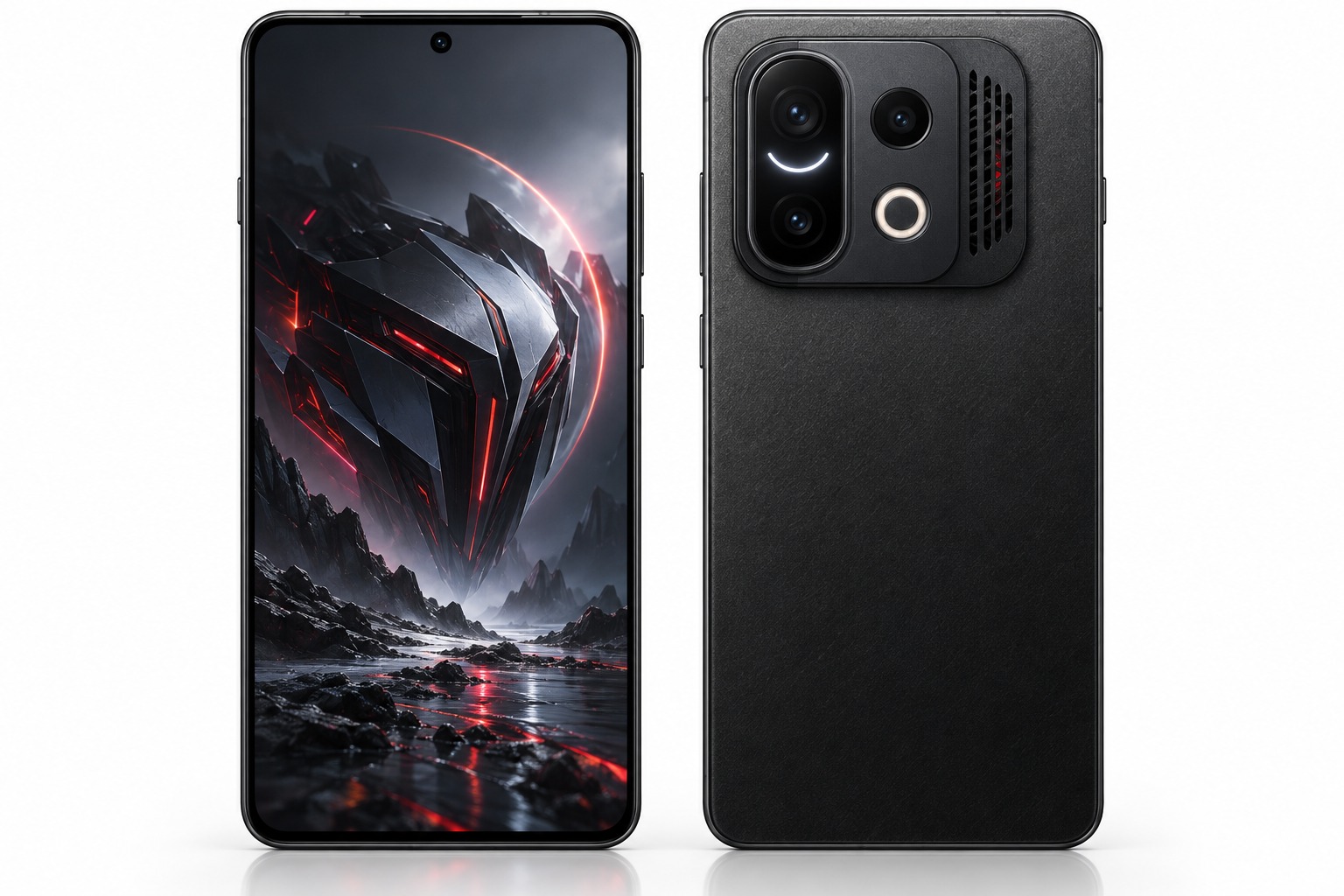
The design is the part OnePlus showed off properly, and it is stranger than the spec sheet suggests. The rear camera assembly is called the Storm Island — a flat, metal, square-ish housing whose edges follow the curve of the outer frame. The unusual part is that an oval air intake is built directly into the module, so the fan breathes through the camera island instead of needing a separate vent cut into the body.
Below the main lens sits a crescent-shaped light with what OnePlus calls a starlight-gradient breathing effect. It stays hidden under the surface when it is off and lights up for gaming or notifications when you want it to. Whether that reads as tasteful or as gamer furniture is a matter of taste; the module is large enough that you will notice it either way.
The back is fiberglass with a fine matte AG finish, chosen to resist fingerprints and everyday scuffs. The frame is flat metal with straight edges and a textured finish, sitting flush with the rear panel rather than stepping down to it. It is a squared-off, symmetrical shape — closer to the OnePlus 16 than to anything curved.
Three finishes are coming. GSMArena lists them as black, white, and silver, while the official Chinese material names them Windbreaker, Polar Night Black, and Flowing Light White — the English translations vary by outlet. The series carries an IP68/IP69K rating per GSMArena’s spec page, which means it survives high-pressure water jets, not just immersion. There is no 3.5mm headphone jack, no FM radio, and no microSD slot, and the port is USB-C 2.0 rather than 3.x. Stereo speakers and an IR blaster are both present. Dimensions and weight have not been published.
Display
The Ace 7 Pro is expected to use a 6.78-inch flat OLED panel at 1.5K resolution with a 185Hz refresh rate, an upgrade from the Ace 6’s 165Hz. OnePlus has said the phone can hit 185fps in Delta Force, which is a frame-rate claim rather than a panel claim, but it lines up with what the leaks have been saying.
There is one genuine conflict to flag. GSMArena’s spec page lists the panel at 1272×2800, while most launch-leak roundups carry 1272×2772. That is a small difference — roughly one row of pixels, likely a rounding or panel-revision discrepancy — but it is not the same number, so treat the exact resolution as unsettled until a unit is on a bench. Either way you are looking at roughly 450ppi, which is sharp enough that the difference is academic in use.
On the feature side the panel is listed with HDR10+, Dolby Vision, and HDR Vivid, plus PWM dimming and Crystal Shield Glass protection. The front is a symmetrical flat panel with a centered circular punch-hole for the 16MP selfie camera. One roundup also mentioned the series could support 240Hz, with 185Hz described as the guaranteed minimum — treat that as a rumor, not a spec.
Performance
This is the part OnePlus actually put its name on. The Ace 7 Pro runs the Snapdragon 8 Elite Gen 5, model SM8850, on a 3nm process — the same chip that powered the OnePlus 15, and the same one inside the iQOO Neo12. The standard Ace 7, by contrast, gets a variant OnePlus calls the 8 Elite Gen 5 V. One reader on GSMArena’s launch article argued the V is simply the Chinese-market name for what ships globally as the 8 Elite Gen 6; that is a forum comment, not a company statement, so file it as unverified.
Early numbers are encouraging. A Geekbench 7 listing tied to the Ace 7 Pro’s model number scored up to 3,112 single-core and 10,451 multi-core, and a separate Geekbench 6 leak showed 3,627 and 11,016 with 16GB of RAM on Android 17. Those are strong figures for a phone that will almost certainly undercut the flagship tier.
The real story is cooling. OnePlus calls it a dual-path Glacier Air Cooling System, and the engineering is more interesting than the marketing name. One airflow channel pulls air across the chipset and pushes hot air out through the side and upwards, away from your hands. A second channel circulates cooler air across the rear panel, which addresses the thing gaming phones usually ignore: your palms get sweaty and uncomfortable long before the chip throttles.
Inside, there are tower-style metal fins borrowed from desktop graphics-card coolers, a dedicated temperature sensor, and a fan-control algorithm that adjusts on the fly. OnePlus positioned the intake so your fingers do not block it during landscape play. The company claims the arrangement cuts gaming temperatures by up to 10°C — but as Notebookcheck noted, OnePlus has not published the testing conditions or a comparison baseline, so that number should stay in quotes until independent testing puts a unit under sustained load.
OnePlus also says its Wind Chaser Game Kernel is integrated into the chip’s architecture at the factory level rather than bolted on in software. Memory goes up to 16GB of LPDDR5X and 1TB of UFS 4.1 storage.
Camera
Camera specs are the least confirmed part of this phone, so read this section with that in mind. The expected setup is a 200MP main sensor with optical image stabilization paired with a 50MP periscope telephoto offering 3.5x optical zoom, reportedly built on Samsung’s ISOCELL JN5. A 16MP front camera sits in the punch-hole.
Against the Ace 6, that is a meaningful jump. The Ace 6 shipped a 50MP Sony IMX906 main and an 8MP ultrawide — no telephoto at all. The Ace 7 Pro would be the first phone in this line to offer a real optical zoom, and at 3.5x it lands in the useful middle ground between a portrait focal length and a long reach. Video is listed at 4K at 30, 60, or 120fps with both gyro-EIS and OIS, and the rear array includes a color spectrum sensor for white-balance work.
OnePlus says the Pro uses imaging algorithms carried over from Oppo’s flagship phones, which is the same pipeline that produces the Oppo Find X10 Pro Max‘s triple 200MP system. That is a credible promise on paper and unproven in this chassis.
Honest flag: none of the camera hardware has been confirmed by OnePlus. Every figure above traces back to tipster posts and spec aggregators, and the aggregators disagree with each other — one lists a 50MP front camera, which conflicts with the 16MP front camera in the GSMArena spec sheet and the launch-leak cluster. I have gone with the cluster that matches the official display and chipset information and discarded the outlier, but the front camera in particular is not settled.
Battery & Charging
The Ace 7 Pro is rumored to carry a 9,000mAh silicon-carbon battery, up from 7,800mAh on the Ace 6. OnePlus has not confirmed that number, and neither the capacity nor the charging speed is official.
Charging is the murkiest part. Leaks point to either 100W or 120W wired, and GSMArena’s spec page lists 100W wired plus bypass charging — the feature that routes power around the battery while you are plugged in and gaming, which keeps heat down and is genuinely the most useful thing here for long sessions. If the Pro lands at 100W, that is a step back from the Ace 6’s 120W.
Wireless charging is not confirmed for the Pro. One leak-oriented spec page lists 50W wireless and reverse wireless charging, but that same page lists a 50MP front camera and a chipset OnePlus has already contradicted, so I would not put money on the wireless figure. Expect wired-only until a spec sheet says otherwise.
For scale, the Honor Win2 ships 10,100mAh with a fan of its own, and the Honor X9e Pro 5G goes to 11,000mAh. The Ace 7 Pro’s 9,000mAh would be competitive without being class-leading.
Software
The Ace 7 Pro ships Android 17 with ColorOS 17, and OnePlus’s own design-reveal material confirms both phones run ColorOS rather than OxygenOS. That is worth calling out for anyone who bought a OnePlus for the clean software. The brand has been folding OxygenOS into ColorOS for a while now, and this launch continues that transition in China.
What is not announced is the update commitment. OnePlus has published no OS-upgrade or security-patch terms for the Ace 7 Pro, so do not assume the four-plus years that the flagship line has offered. That is a real gap for a phone that will likely be bought by people who keep devices for three or four years.
The Philippines angle is the honest downside. OnePlus has announced a China launch only, with no date, price, or availability for the Philippine market. Importing a China-market unit means ColorOS without Google Play Services by default, no local warranty, and uncertain band support. If you were counting on picking this up at a local store, there is nothing to count on yet.
Pros and Cons
| Pros | Cons |
|---|---|
| First OnePlus phone with an active cooling fan — dual airflow plus tower fins | Almost nothing confirmed by OnePlus: battery, charging, cameras, and price are all still rumors |
| Snapdragon 8 Elite Gen 5 confirmed, a genuine flagship chip | 100W charging would be a downgrade from the Ace 6’s 120W |
| 200MP main plus a 50MP 3.5x periscope — a real zoom the Ace 6 never had | A fan means moving parts, and long-term dust and bearing reliability is unproven |
| 6.78-inch flat 1.5K OLED at 185Hz with Dolby Vision and HDR10+ | No wireless charging confirmed for the Pro |
| 9,000mAh silicon-carbon battery, if the rumor holds | China-only launch so far, with no Philippine price or date |
| IP68/IP69K rating and an ultrasonic in-display fingerprint scanner | Ships ColorOS instead of OxygenOS — a real shift for long-time OnePlus buyers |
| Bypass charging keeps the battery out of the loop during plugged-in gaming sessions | The display resolution is disputed between 1272×2800 and 1272×2772, so the exact panel is unsettled |
Should You Buy This?
Buy it if
- You game on your phone for hours at a time. The fan, the tower fins, the landscape-optimized intake, and bypass charging all exist for exactly this use case.
- You want flagship silicon without flagship pricing. The Snapdragon 8 Elite Gen 5 is one generation behind the top tier but far from slow, and the Ace line has always undercut the number series.
- You want a periscope zoom in this price bracket. The Ace 6 had no telephoto; the Pro is expected to add a 3.5x optical one.
- You are comfortable with a China-first phone. If you understand what importing means for warranty and software, this is an easier decision.
Skip it if
- You need a phone this month with a local warranty. There is no Philippine launch, no Philippine price, and no Philippine availability.
- Wireless charging matters to you. Nothing has been confirmed, and the base Ace 7’s spec page shows no wireless at all.
- You are still happy with an Ace 6. You get 120W charging, a proven body, and no fan to wonder about.
- You want a quiet phone. A fan is a fan. Even at low speed it is a sound you will hear in a silent room.
- You want OxygenOS or stock Android. ColorOS 17 is what is shipping, and the transition is not going backwards.
Final Verdict
The OnePlus Ace 7 Pro is a strange and honestly quite likeable idea. Rather than chasing a bigger number on a benchmark chart, OnePlus looked at what actually goes wrong when you game on a phone for two hours — the heat in your palms, the throttle, the sweat — and put a fan in the camera module to fix it. The engineering is coherent: dual airflow, tower fins, a sensor and algorithm to drive it, and bypass charging so the battery stays out of the heat path. That is a thoughtful answer to a real complaint, not a gimmick bolted on for a keynote.
The honest caveat is that OnePlus has confirmed remarkably little. The chipset and the cooling system are real. The 9,000mAh battery, the 100W-or-120W charging, the 200MP main camera, the 50MP periscope, the exact display resolution, and the price are all still rumor. Buyers who need certainty today have nothing to be certain about, and the 10°C temperature claim in particular should stay in quotation marks until someone independent puts a unit under load.
Who is this phone for? Someone who games hard on a phone, who wants a Snapdragon 8 Elite Gen 5 and a real optical zoom without paying OnePlus 16 money, and who does not mind that the phone is launching in China first. If that is you, the Ace 7 Pro is worth watching on Thursday — and the fan is the reason.
If you would rather have a finished, confirmed, locally available phone right now, the OnePlus Ace 7 we reviewed earlier this month is the safer bet, and the Honor Win2 is the closest thing to this phone that already has a full spec sheet and a fan of its own. The Ace 7 Pro is the more interesting device. It is just not yet a finished one.