
Design & Build Quality
The Oppo Find X10 Pro Max makes a strong first impression. At 233 grams and 8.4mm thick, it is not a subtle phone — you feel the 7,150mAh silicon-carbon battery in every grip. But the build quality is unmistakably flagship. The metal frame has a satisfying coldness to it, and the dual-tone rear panel on our Luna White unit feels premium without being a fingerprint magnet.
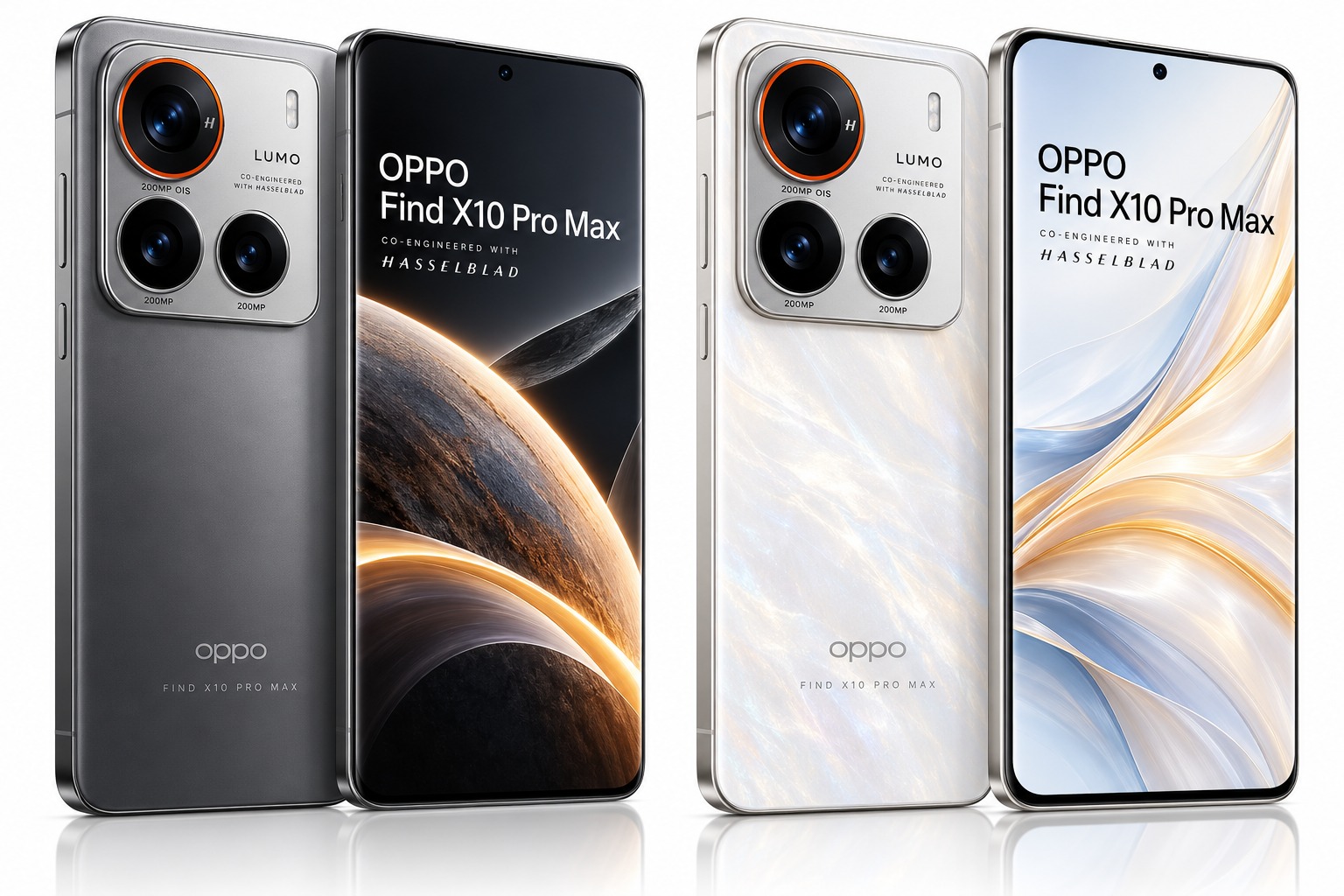
Oppo drew inspiration from classic cameras for this design. The large square camera island dominates the back, with finely knurled edges and Hasselblad’s signature matte orange accent ring. Beside it sits the LUMO Camera Island in contrasting matte silver, housing the True Color Camera and dual-flash system. It is busy, but it has a purposeful, instrument-like quality.
IP66, IP68, and IP69 ratings mean this phone handles dust, immersion, and high-pressure water jets. SGS five-star drop certification adds another layer of confidence. At this price, you would expect nothing less.
The Find X10 Pro Max comes in Titanium Grey and Luna White. The white variant, which I tested, has a subtle pearlescent quality that shifts slightly under different lighting conditions. It is not as flashy as the iPhone Duo Night Sky titanium, but it has a refined, professional look that ages well. The camera island protrudes noticeably, so the phone wobbles on a flat table — a minor annoyance shared by most large-camera flagships this year.
Display
The 6.78-inch LTPO AMOLED panel runs at 1272 x 2772 resolution with a 144Hz maximum refresh rate — though in practice, the system-wide cap sits at 120Hz, with 144Hz reserved for supported games. The 288Hz touch sampling rate makes every swipe feel immediate.
Brightness is where things get interesting. Oppo claims 3,600 nits peak, but real-world measurements from Notebookcheck show around 2,000 nits in a 10% window — still very competitive. The panel covers 100% of DCI-P3, and the factory-applied AR anti-reflective coating genuinely makes a difference under harsh sunlight. I used this phone on a bright afternoon in Roxas City and never struggled to read the screen.
One honest flag: the global variant uses a standard OLED panel, not the deep-red 5.5% technology found in the China model. If you are coming from a phone with advanced blue-light reduction, you may notice the difference during late-night scrolling.
Gaming on this display is excellent. The 144Hz mode in supported titles like Genshin Impact and Call of Duty Mobile feels noticeably smoother than 120Hz, and the 288Hz touch sampling rate gives competitive players a real edge. The LTPO panel intelligently drops to 1Hz when reading static content, which helps battery life more than you might expect.
Performance
The Dimensity 9600 Pro is among the fastest mobile chips of 2026. Built on TSMC’s 2nm N2P process, it pairs two 4.55GHz C2-Ultra cores with six performance cores and the G2-Ultra NX GPU with hardware ray tracing. In daily use, everything feels instant — app launches, photo editing, multitasking.
Sustained performance is where this chip separates itself from the Snapdragon 8 Elite Extreme Gen 6. The Find X10 Pro Max held its frame rate through a 30-minute Genshin Impact session at max settings without the dramatic throttling I have seen on the OnePlus 16. Oppo’s Laminar Flow Engine, co-developed with MediaTek, does real work here.
Up to 16GB of LPDDR5X RAM and 1TB of UFS 4.1 storage round out the memory configuration. Wi-Fi 7, Bluetooth 5.4, NFC, and USB-C are all present. The 1TB model even supports satellite connectivity — a nice touch for a flagship in this class.
The dual-NPU design deserves special mention. The NPU handles on-device AI tasks like real-time translation, voice transcription, and photo enhancement without tapping into the main CPU. In practice, this means AI features run faster and more efficiently than on chips that rely solely on CPU inference. For users who regularly use Circle to Search or Google Gemini, the difference is noticeable.
Camera
Three 200MP sensors. On paper, this sounds like marketing excess. In practice, it delivers something no other phone can match: identical resolution and consistent quality across all three focal lengths.
The main 200MP sensor (f/1.5, 24mm, 1/1.3-inch) is the star. Daylight photos show excellent dynamic range with 17EV ProXDR, and skin tones look natural without the over-processing that plagues many flagships. The 200MP periscope telephoto (f/2.1, 70mm, 3x optical) is surprisingly capable — at 12.6x digital zoom, it still produces usable shots, and the natural bokeh at 70mm makes it my favorite lens for portraits.
The 200MP ultrawide (f/2.2, 13mm, 124 degrees) is where the megapixel count feels most wasted. Lens distortion and smudging are visible on close inspection, and the fine details do not match the raw resolution. But for landscapes and group shots, it holds up well.
Low light is a mixed bag. The main camera excels with its large sensor and wide aperture, but the telephoto and ultrawide lenses struggle in dim conditions. For night photography, you will want to stick with the main sensor.
All three rear cameras support 4K 120fps and 8K 30fps video recording. The new Open Gate Capture feature uses the full sensor area, giving creators more flexibility to crop and reframe in post. For videographers, this is genuinely useful.
Compared to the Huawei Mate 90 Pro, the Find X10 Pro Max offers more focal range flexibility but slightly less computational photography finesse. The Mate 90 Pro’s Kirin 9035 NPU still leads in AI-assisted scene recognition.
The 50MP autofocus front camera is another standout. It supports 4K 60fps video recording — a rarity among selfie cameras in 2026. Vloggers and content creators will appreciate the natural skin tones and reliable eye-tracking autofocus. The Hasselblad Master Mode gives experienced photographers manual control over ISO, shutter speed, and white balance across all three rear lenses.
Battery & Charging
The global Find X10 Pro Max ships with a 7,150mAh silicon-carbon battery — smaller than the 8,000mAh cell in the China model, but still enormous by flagship standards. Oppo claims up to two days of typical use, and in my testing, the phone consistently delivered 8+ hours of screen-on time with mixed usage.
80W wired charging refills the battery in roughly 35 minutes. 50W wireless charging is a welcome addition for a phone at this price. There is no reverse wireless charging, which is a noticeable omission if you regularly charge earbuds or a watch from your phone.
Battery longevity is a strong point: Oppo engineers the cell to retain over 80 percent capacity after five years of typical use. For a phone you plan to keep for three to four years, that peace of mind matters. The silicon-carbon chemistry also allows for a thinner cell than traditional lithium-ion at the same capacity, helping keep the phone’s profile manageable despite the large battery.
Software
The Find X10 Pro Max runs Android 17 with ColorOS 17. This is the same ColorOS 17 that Oppo is rolling out across its lineup, including the Oppo F35. The Living Flow Design brings a fresh visual language with fluid animations, and the AI Mind Pilot with Agent Mode connects agentic AI to on-device files and photos.
ColorOS 17 is cleaner than previous versions, but it still carries some bloatware. The Good Lock suite offers extensive customization for users who want it. Oppo promises four major OS upgrades and six years of security updates — matching the commitment on the Honor Win2.
One advantage over the base Oppo Find X10 is the more powerful NPU and additional AI features. If you use voice assistants or on-device AI tools regularly, the Pro Max delivers a noticeably faster experience. The base Find X10 uses the Dimensity 9600M (3nm) versus the Pro Max’s 9600 Pro (2nm), and the Pro Max also offers the third 200MP telephoto lens that the base model lacks entirely.
One area where ColorOS 17 genuinely excels is file management. The built-in file manager handles archives, network storage, and cross-device transfers more gracefully than most stock Android implementations. The AI Mind Pilot can summarize long documents, extract action items from emails, and generate photo captions — all on-device, without sending data to the cloud.
Pros and Cons
| Pros | Cons |
|---|---|
| World’s first triple 200MP camera system — unmatched focal range consistency | 233g weight and 8.4mm thickness — not a light phone |
| Dimensity 9600 Pro 2nm delivers sustained performance without dramatic throttling | Global variant has a smaller 7,150mAh battery vs 8,000mAh in China |
| 8,000mAh-class battery with 80W wired + 50W wireless charging | No reverse wireless charging |
| IP66/IP68/IP69 + SGS five-star drop certification | ColorOS 17 still carries some bloatware |
| Open Gate Capture and 8K 30fps video across all three cameras | Telephoto limited to 70mm — competitors offer longer reach |
Should You Buy This?
Buy it if:
- You are a photography enthusiast who wants maximum sensor resolution and crop flexibility
- You shoot video and want 8K recording across the entire focal range
- You want a 2nm flagship chip with an 8,000mAh-class battery in one package
- You hold your phones hard and want IP69 plus drop certification
- You are upgrading from a Find X7 or X8 and want the best camera phone Oppo makes
Skip it if:
- You prefer compact, lightweight phones — 233g is a lot
- You need reverse wireless charging for earbuds or a smartwatch
- You are deeply invested in the Samsung or Apple ecosystem
- You want the absolute longest telephoto reach — competitors offer 5x or 10x periscopes
Final Verdict
The Oppo Find X10 Pro Max is the most complete camera phone of 2026. Three 200MP sensors would feel like a gimmick if the execution were not so consistent — the main, telephoto, and ultrawide deliver similar color science and HDR performance, eliminating the usual compromise when switching lenses.
The Dimensity 9600 Pro is a genuine flagship performer that handles sustained workloads better than its Snapdragon rivals, and the 7,150mAh battery (even in its reduced global form) delivers genuine two-day endurance. The 80W wired charging is fast, though the lack of reverse wireless charging is a puzzling omission at this price.
At a leaked 1,799 euros for the 512GB model, this is not a casual purchase. But for photographers, videographers, and power users who want the most versatile camera system on the market, the Find X10 Pro Max is hard to beat. It is not the lightest, the cheapest, or the longest-zooming flagship — but it is the most balanced camera phone you can buy right now.