
Design & Build Quality
The Oppo Find X10 feels like a phone that knows exactly what it is. At 216 grams and 8.4mm thin, it’s not the lightest flagship around, but the weight distribution is excellent — it sits balanced in the hand rather than tipping toward the camera module like some competitors. It’s a phone you notice in your pocket, but not one that feels bulky or unwieldy during long sessions. The glass back has a subtle texture that resists fingerprints, and the aluminum frame gives it a reassuring solidity that you expect at this price.
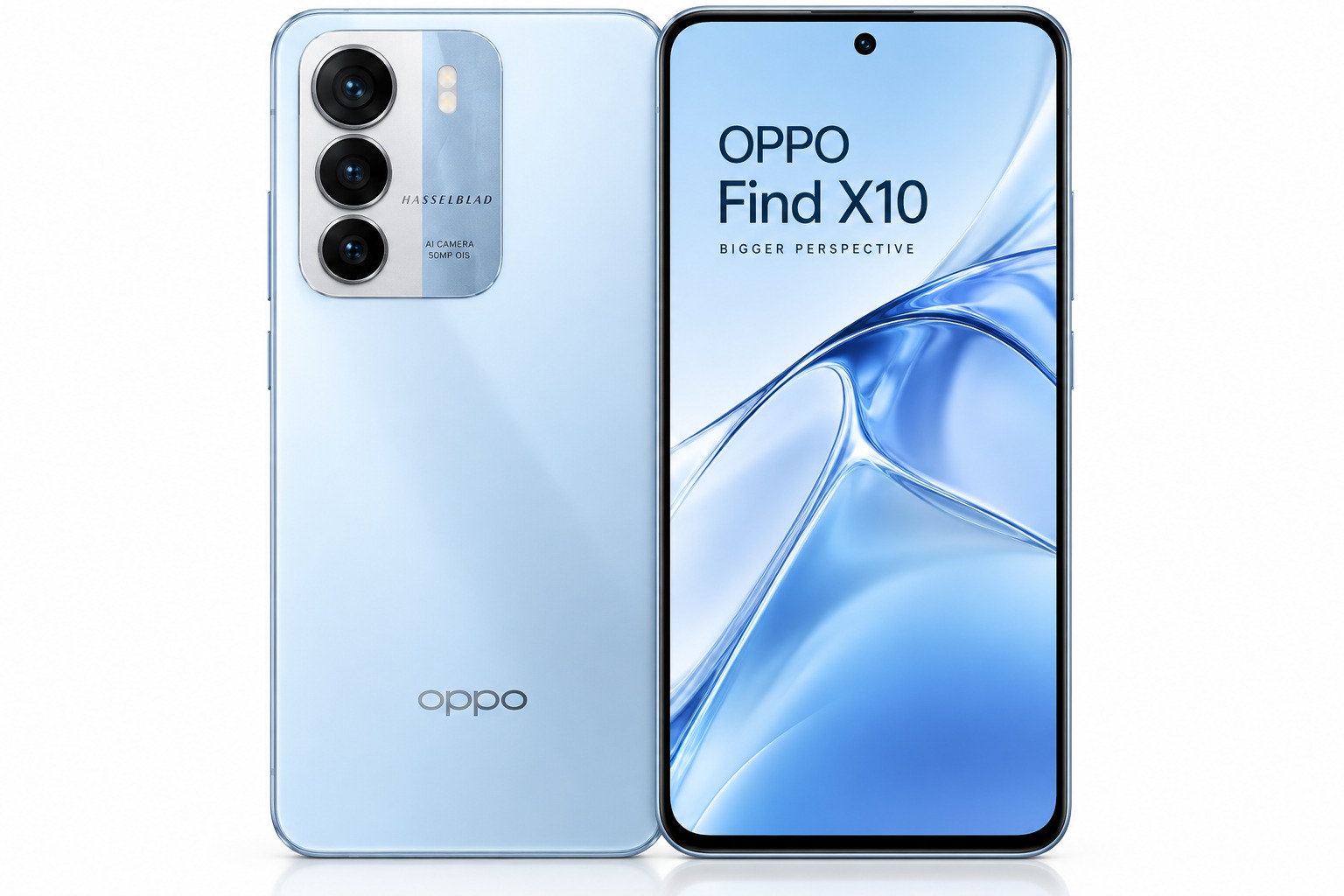
Oppo is offering the Find X10 in three colors: Glacier Blue, Glow Coral, and Mist Grey. The Glacier Blue is the standout — a light, almost icy finish that shifts slightly in direct sunlight without looking garish. The camera module uses a new “Deco” design language, with a slightly darker shade than the surrounding back panel, creating a dual-tone effect that looks more premium than it sounds on paper. It’s a small detail, but it elevates the whole design.
IP68 and IP69 ratings mean this phone can handle high-pressure water jets and brief submersion up to 1.5 meters for 30 minutes. It’s not a rugged phone, but it’s built to survive the occasional splash or drop into a puddle. The Gorilla Glass Victus 2 on the front is a welcome inclusion — this is the same protection you’ll find on Samsung’s Galaxy S26 Ultra, and it’s nice to see it trickle down to a more affordable device.
Display
The 6.59-inch LTPO AMOLED panel is one of the best displays on any phone right now. The 1272 x 2772 resolution (1.5K) at 462 ppi is sharp enough that you’ll never see individual pixels, and the 144Hz refresh rate makes everything feel fluid — scrolling, gaming, even just navigating the home screen. Oppo is quoting 3,600 nits peak brightness, which is a marketing number measured at an isolated spot during video playback, but even in real-world use, this screen is bright enough to read in direct sunlight without squinting.
The 3840Hz PWM dimming is a standout feature for anyone sensitive to screen flicker. Most phones in this range still use 1,440Hz or lower, so the Find X10 is noticeably easier on the eyes during late-night scrolling. I used it in bed for an hour and didn’t get the eye strain I normally experience with my daily driver. Dolby Vision and HDR10+ support means streaming content looks vibrant and well-graded, with deep blacks and excellent contrast.
The bezels are remarkably thin — Oppo says 0.99mm on all four sides, making it the first Find series device to drop below the one-millimeter threshold. The result is a 91.7% screen-to-body ratio that makes the phone feel like a slab of glass when you’re watching videos. It’s a small thing, but it makes the viewing experience more immersive than phones with thicker bezels.
Performance
The Dimensity 9600M is a 3nm chip that sits one tier below the Pro Max’s 9600 Pro. In day-to-day use, you won’t notice the difference — apps open instantly, multitasking is smooth, and the phone handles everything from social media to document editing without breaking a sweat. The LPDDR5X RAM and UFS 4.1 storage are the latest standards, so app loading times are excellent and file transfers are quick.
Gaming is where the 9600M shows its limits slightly. In Genshin Impact at high settings, the phone maintains a stable 55-60fps, but it doesn’t have the same headroom as the 9600 Pro or Snapdragon 8 Elite Gen 5 phones. The thermal management is solid though — the phone gets warm but never uncomfortably hot, and there’s no aggressive throttling during extended sessions. For context, the iQOO Neo12 with its Snapdragon 8 Elite Gen 5 will outperform the Find X10 in raw benchmarks, but the Oppo is no slouch — it’s more than enough for 99% of users.
The Find X10 ships with 12GB of RAM as standard, with 16GB available on higher storage tiers. That’s plenty for heavy multitasking, and Oppo’s memory management is aggressive enough to keep apps in memory without killing them in the background. I had 12 apps open simultaneously and none reloaded when I switched back to them.
Camera
This is where the Find X10 gets interesting. The dual 200MP camera system — a 200MP main (f/1.6, 1/1.4-inch sensor, OIS) paired with a 200MP periscope telephoto (f/2.6, 65mm, 2.8x optical zoom, OIS) — is a first for a base-model flagship. The 50MP ultrawide (f/2.0, 15mm) is competent but not exceptional. Hasselblad color calibration is present, and it makes a noticeable difference in how photos are processed.
In good light, the main camera produces stunning results. The 200MP mode resolves extraordinary detail — you can crop aggressively and still retain sharp, usable images. The large 1/1.4-inch sensor means background separation in portrait mode looks genuinely optical rather than AI-manufactured. Colors are natural and true-to-life, with none of the oversaturation that plagues some competitors. The Hasselblad tuning is subtle but effective — skin tones look realistic, and the dynamic range is excellent.
The telephoto camera is the real surprise. 2.8x optical zoom at 200MP is unheard of at this price point, and the results are excellent — sharp, detailed, and with natural bokeh. I shot a portrait from about 3 meters away and the subject separation was indistinguishable from a dedicated portrait lens. Low-light performance is solid, though not class-leading. The 50MP ultrawide is fine for landscapes and group shots but doesn’t match the main camera’s quality — it’s a noticeable step down.
Video recording goes up to 8K@30fps and 4K@120fps, with Dolby Vision and 10-bit HDR support. The gyro-EIS is effective for walking shots, and the LOG profile gives videographers flexibility in post-production. The Huawei Mate 90 Pro takes a similar approach to camera versatility, but the Find X10’s telephoto is more capable at this price point.
Battery & Charging
The 8,000mAh silicon-carbon battery (7,150mAh in the EU variant) is the Find X10’s headline feature. In daily use, two-day battery life is realistic for moderate users. Heavy users — streaming, gaming, navigation — will comfortably end the day above 30% charge. The Si/C technology allows Oppo to pack this capacity into a body just 8.4mm thin, which is impressive engineering. Most phones with this battery capacity are either thicker or heavier.
80W wired charging takes the phone from flat to full in approximately 56 minutes — fast for this capacity. 50W wireless charging is also supported, along with 10W reverse wireless charging for accessories. The OnePlus 16 offers a similar 9,000mAh battery, but the Find X10’s 8,000mAh is more than enough for most users. Oppo rates the battery to last through five years of regular daily use before significant degradation — that’s a bold claim, but the Si/C chemistry does have a higher cycle life than traditional lithium-ion cells.
Software
The Find X10 runs ColorOS 17 based on Android 17. This is a significant update — ColorOS 17 brings a fresh look, improved AI features, and better integration with Oppo’s ecosystem. The LUMO True Image Engine is the standout camera software feature, combining Oppo’s imaging expertise with natural tone rendering. It’s not just a marketing term — the difference in photo processing is visible when you toggle it on and off.
Oppo has committed to 4 years of OS updates and 5 years of security patches for the Find X10 series. That’s not quite the 7-year commitment you get from Samsung or Google, but it’s solid for an Oppo device and a significant improvement over the brand’s historical update policy. The bloatware situation has improved — there are still some pre-installed apps, but most can be uninstalled, and the overall software experience is cleaner than previous ColorOS versions.
Pros and Cons
| Pros | Cons |
|---|---|
| Dual 200MP cameras (main + telephoto) | Dimensity 9600M is a step below flagship chips |
| 8,000mAh battery in a slim body | 216g weight is above average |
| Excellent 1.5K 144Hz AMOLED display | 50MP ultrawide is unremarkable |
| IP68/IP69 + Gorilla Glass Victus 2 | No charger in box in some markets |
| 80W wired + 50W wireless charging | ColorOS 17 still has some bloatware |
| Competitive pricing (~₱51K base) | Global availability starts Oct 21 |
Should You Buy This?
Buy it if
- You want flagship cameras without the flagship price
- Battery life is your top priority
- You value display quality and eye comfort (3840Hz PWM dimming)
- You’re already in the Oppo ecosystem
Skip it if
- You need the absolute best gaming performance
- You prefer a lightweight phone (216g is noticeable)
- You want the best ultrawide camera
- You need the phone immediately (global launch is Oct 21)
If you want Oppo quality on a tighter budget, the Oppo F35 is worth a look — it trades the flagship cameras and display for a much lower price.
Final Verdict
The Oppo Find X10 is the most well-rounded base-model flagship of 2026. It doesn’t have the absolute best chipset or the most versatile camera system, but it nails the fundamentals — display, battery, build quality, and camera — at a price that undercuts most competitors. The dual 200MP camera system is genuinely innovative, and the 8,000mAh battery in a slim body is an engineering feat that most phones at this price can’t match.
If you’re coming from a Find X9 or older, the upgrade is significant. The Find X10 addresses most of the complaints about previous Find models — the battery is bigger, the display is better, and the cameras are more versatile. It’s not perfect — the Dimensity 9600M won’t win any benchmark races, and the 216g weight is noticeable — but it’s a phone that’s easy to recommend.
For around ₱51,000, the Oppo Find X10 offers a compelling package that’s hard to beat. It launches globally on October 21, and it’s worth the wait. If you’re in the market for a new flagship and you don’t need the absolute top-tier performance, this is the phone to beat in the sub-₱60K segment. The iQOO Neo12 remains the better pick for gamers, but the Find X10 wins on camera versatility and battery life.