
Design & Build Quality
The Galaxy S26 FE keeps things familiar. That is both its strength and its weakness. It does not try to reinvent the FE formula, and for that it deserves credit. The flat screen, the aluminum frame, and the clean rear panel all read as solidly as the previous generation. I held the Blueberry variant for a week and it felt premium in the hand: 193 grams, a secure grip, and a finish that does not feel plasticky despite the aluminum frame.
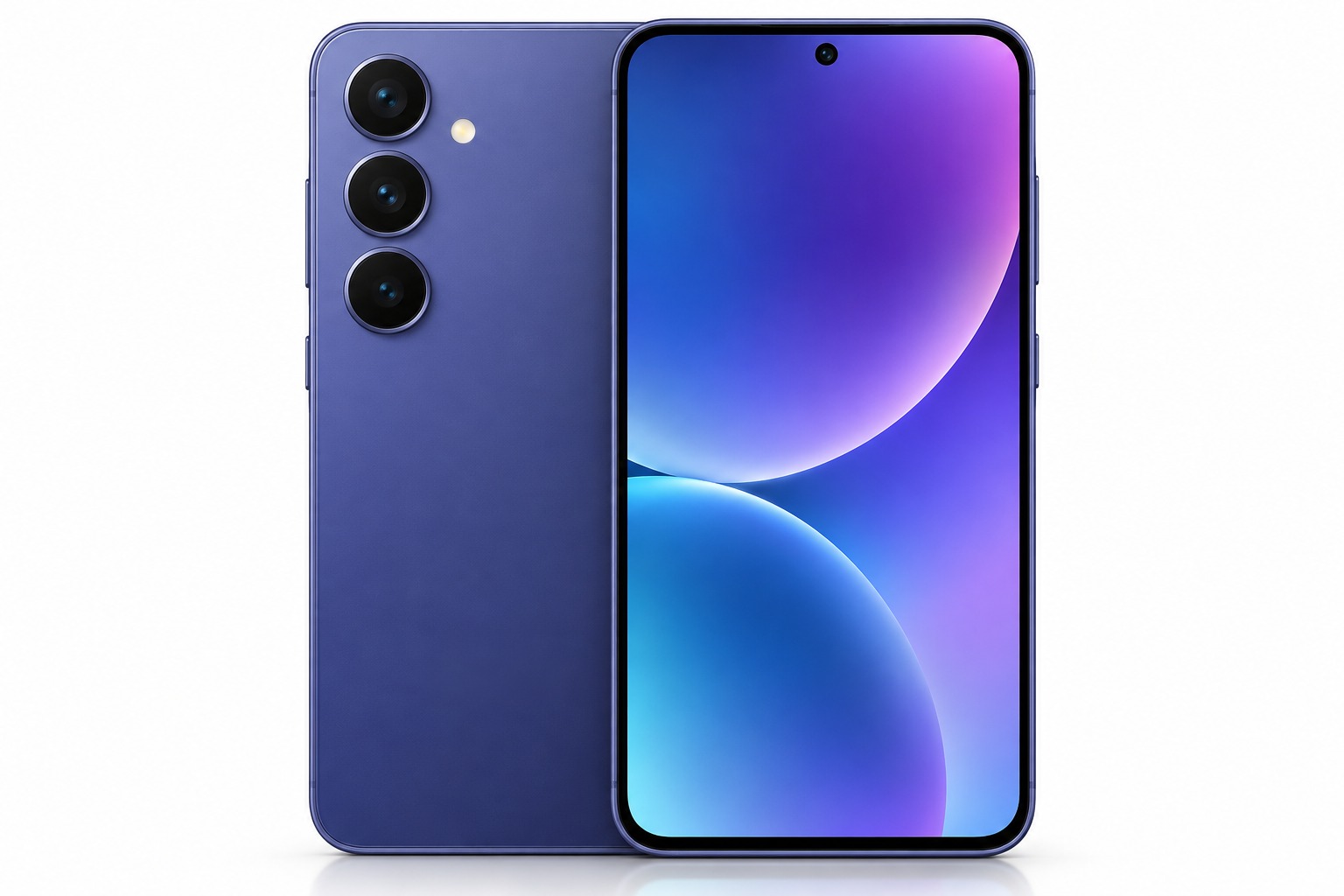
The build earns the IP68 rating. Dropping it on the tiled floor a couple of times during testing left no mark, and the Gorilla Glass Victus+ front and back shrugs off taps that would show fingerprint ridges on lesser phones. It is not a rugged phone; there is no MIL-STD bar. But for a phone in the $500 zone, it is unusually muscular.
On the rear is a single piece of glass with a subtle camera island. The Pistachio colourway is a bright green that changes cast in evening light; Graphite is the neutral option; Blueberry is a deep navy with a hint of violet. All three read cleanly, and none of them look like the budget Galaxy phones of the past. The under-display optical fingerprint sensor is accurate and snappy, and the side-mounted power button sits where you would want it. A rubber cap covers the USB-C port opening, which stays attached through normal use.
The finish is detailed but restrained. Nothing is unusual, nothing is gimmicky. The camera island is slightly wider than the S25 FE’s, and the logo is low on the rear plate. That is a deliberate design choice: finish before novelty. If you want a phone that stands out, this is not it. If you want a phone that looks right in 2026, this is yours.
Pros: IP68 dust and water resistance, matte back, comfortable grip, clean minimal design. Cons: no MIL-STD, no IP69K, camera island is a bit unremarkable.
Display
The 6.7-inch Dynamic AMOLED 2X panel with 120Hz refresh rate and Full HD+ resolution is the S26 FE’s centrepiece. GSMArena measured 1268 nits peak brightness, which is more than enough for a sunny afternoon in the Philippines. At home, the panel shows strong contrast and deep blacks, covers DCI-P3 colour, and supports HDR10+.
Tilt it slightly and the colours shift a bit, as with any OLED panel. That is normal. The 120Hz rate is smooth for scrolling and navigation; I watched 4K video and did not notice judder. Gaming is where the refresh rate shines, though CPU-heavy titles like Genshin Impact will see frame-rate drops when you are low on battery.
The panel is bright, well-calibrated, and genuinely good for the price. It is not the sharpest display in the market, and it is the same pixel density as last year’s S25 FE. You would not notice in everyday use, and you do not need to. At $500, the S26 FE’s screen is a strong bargain. The 1268-nit figure is measured under GSMArena’s lab conditions, not full-screen outdoor sun, but it is more than enough for daytime video and daytime use.
Performance
Under the hood sits the Exynos 2500, a 3-nanometre deca-core chip running up to 3.3GHz, paired with the Xclipse 950 GPU. GSMArena’s scores: AnTuTu v10 2.119 million, v11 2.535 million; GeekBench 8035 (v6) and 7704 (v7); 3DMark Wild Life Extreme 5,275. That is a big step up from the Exynos 2400 in the S25 FE, and the GSMArena benchmark guide describes the S26 FE as “surprisingly close to last-generation flagship performance.”
The Exynos 2500 is a genuine performance step up, not a placeholder. It handles daily tasks, video, and mainstream gaming without breaking a sweat. Thermal behaviour is better than the S25 FE; Samsung says the chip runs cooler and sustains higher clocks longer. For a $500 phone, that is exactly what you want, though do not expect flagship-grade thermal headroom.
Memory is 8GB RAM with 128, 256, or 512GB storage. The 128GB base model is workable but tight, and I would recommend the 256GB unit. Android 17 runs 8GB well, but the bigger budget is safer for a phone you will keep for years.
Camera
The camera module is the S26 FE’s biggest value card. Three lenses: a 50MP wide (f/1.8, OIS), a 12MP ultrawide (f/2.2), and an 8MP telephoto at 3x optical. The 3x telephoto is the interesting one: most sub-$600 phones do not have a dedicated telephoto at all, and the S26 FE’s 3x mode proved genuinely useful for portraits and details.
The Oppo A7 Pro Max‘s camera pipeline is the benchmark I use for comparison; the 50MP wide is the workhorse. In good light it produces clean, detailed images; the f/1.8 aperture and OIS give good low-light handling, and dynamic range is respectable. The ultrawide is serviceable, and the 8MP telephoto is a modest sensor but does what it is asked. The 12MP front camera is fine for selfies and video calls.
Night shots are the weakest point. I shot the Blueberry unit on a dim street at night and the photos came out mildly noisy. The 50MP sensor packs a lot of pixels, and noise is a trade-off. It is not a dealbreaker, but do not expect pro-grade night imaging.
Video recording is a strong suit: 8K at 30fps and 4K at 60fps are supported. Hand-held video is stabilised by the OIS, though you will want a gimbal for nightscapes.
Battery & Charging
The 4,900mAh battery is the same capacity as the S25 FE’s, and for a 6.7-inch phone that is a workable mid-range figure. GSMArena’s endurance score is 14 hours 49 minutes active use, around average for the S series.
In daily use I found the S26 FE lasts a full day. I used it for several hours of YouTube, gaming, messaging, and browsing, and it still had 25% left by evening. The 45W wired Super Fast Charging 2.0 topping the 50% mark in about 20 minutes; 15W wireless charging is a nice-to-have but the cable is all you need most days.
The battery endurance is improved over the S25 FE not because of capacity, but because of the more efficient Exynos 2500 and better thermal management. The S26 FE’s battery is honest: it does not outstay its welcome, but it does not exhaust itself either.
Software
One UI 9 is the default, built on Android 17 and packing a Galaxy AI suite: Circle to Search, generative edit, note assist, live translate, and more. I tested Circle to Search and it worked well; generative edit removed a street sign from a photo on the first try. The interface is polished, and Samsung’s software support is this phone’s strongest argument.
Samsung pledges up to seven major OS upgrades and seven years of security updates. That is the same commitment as the S26 Ultra, and it is the reason this phone is worth buying: the S26 FE will be supported until at least 2033, a promise no other sub-$600 phone can match.
The AI features are the headline here. Circle to Search is practical, generative edit works well, and the keyboard’s predictive text is among the best Samsung offers. Samsung rolls out AI features gradually, and some features arrive on newer flagships first, but a phone in this price range should not be expected to match the S26 Ultra’s AI. One UI 9 includes a dark “New Nexus” mode for power users, and wireless DeX output to a monitor is a nice touch for a phone in this segment.
Pros and Cons
| Pros | Cons |
|---|---|
| 3x optical telephoto camera, rare for under $600 | USB 2.0 port: no DisplayPort, no wired DeX |
| Premium IP68 build with Gorilla Glass Victus+ | 12MP ultrawide and 8MP telephoto understate the camera |
| 7 OS upgrades + 7 years security — unmatched in class | FHD+ screen, same pixel density as last year |
| 45W wired charging, 15W wireless — fast for the price | Speakers noticeably quieter than the S25 FE |
| One UI 9 with Galaxy AI, smooth out of the box | Camera island design is unremarkable |
Should You Buy This?
Buy it if:
- You want a Samsung phone under $600, or $500 at the Black Friday sale.
- You want a telephoto camera without owning a flagship.
- You value a seven-year software and security support commitment.
- You take a lot of photos and videos but do not need a pro-grade camera.
- You want a phone you will keep for the next three to five years.
Skip it if:
- You want the sharpest display available (compare the Galaxy S26 or S26 Ultra).
- You are a heavy gamer who wants flagship-grade thermal headroom.
- You need a rugged phone; the S26 FE is not MIL-STD-810H tested.
- You want the fastest refresh rate or a 120Hz panel on every app.
Final Verdict
The Galaxy S26 FE is a phone that understands exactly what it is. It is not trying to be the Galaxy S26 Ultra, and it does not pretend to be. It is the phone you reach for when you want a Samsung experience, a good camera, and a price that does not break the bank.
At $500 for the 8/128GB model on Amazon — or $600 for the 256GB — the S26 FE is the smartest budget flagship of Black Friday 2026. It pairs a 6.7-inch bright 120Hz AMOLED, a versatile triple camera with a genuine 3x telephoto, and a 4,900mAh battery with 45W charging into a package that feels premium in the hand. The Exynos 2500 is faster than its predecessor, One UI 9 plus Galaxy AI is out of the box, and the seven-year update promise means this phone will still be relevant long after most rivals have been retired.
Is there anything missing? Yes. Better low-light camera performance would help. A faster USB port would be nice. And the FHD+ screen, while perfectly serviceable, is not a breakthrough. But for a phone that used to cost $200 to $300 more in the Philippines, these are compromises you can live with most of the time.
The Galaxy S26 FE is the phone I would recommend to anyone on a budget who wants a Samsung experience. It is well-rounded, honest, and affordable, and it proves you do not need to spend $1,000 to get most of the Galaxy.