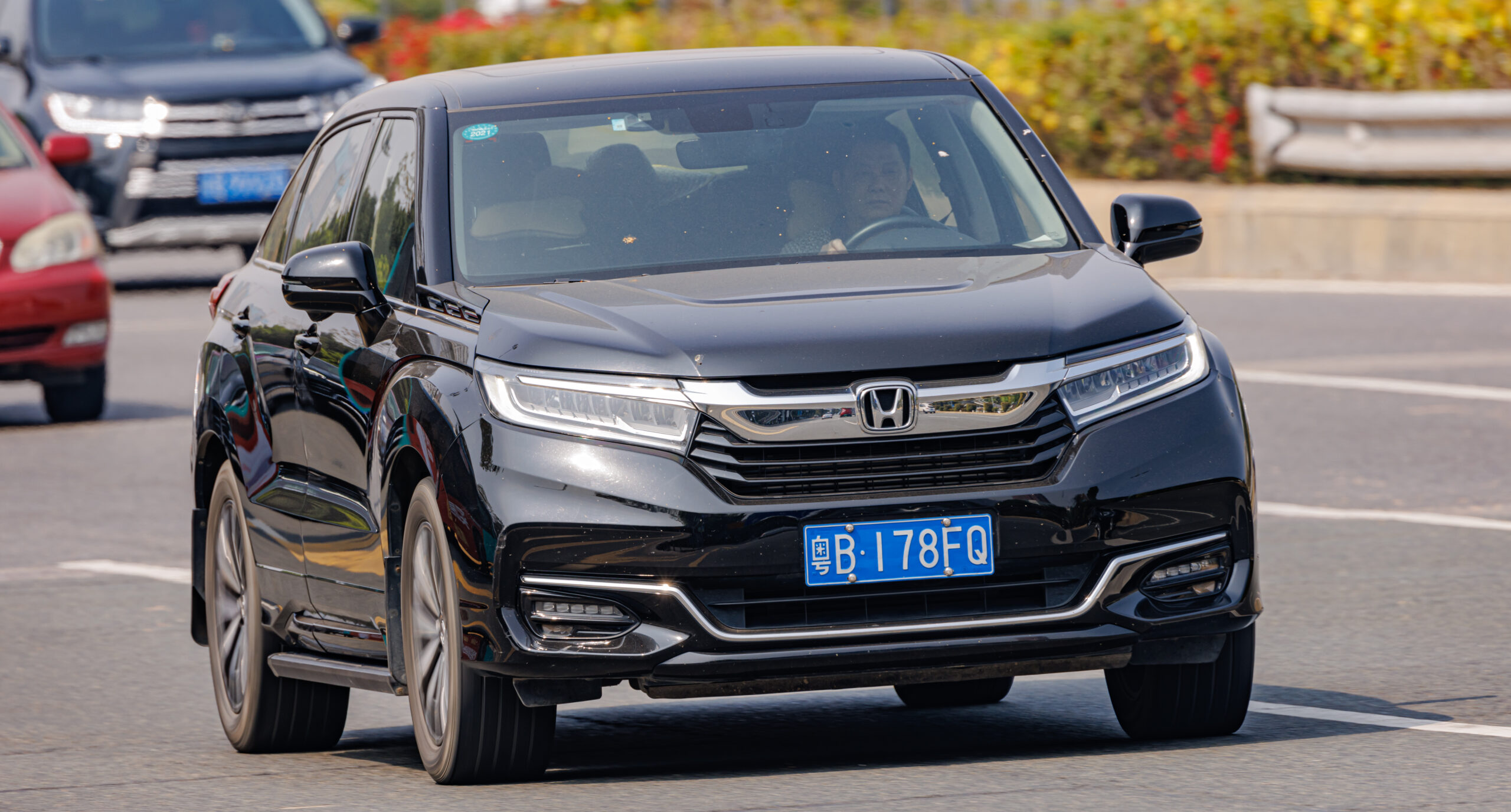
It is not every day that a Japanese automaker changes how it treats hybrids. On Friday, November 20, Honda did exactly that. The all-new Avancier, a three-row SUV, world-premiered online carrying a fresh design language, a new badge, and a next-generation hybrid system that the company says will spread across up to 15 models by 2030.
I have watched Honda’s hybrid strategy for years — first as a buyer comparing crossovers, and now as a manager who treats a car like a budget you cannot afford to waste. The Avancier reads less like a single product and more like a posture, and it is worth reading carefully before the Philippines gets its first news about it.
What Broke Cover on Friday
The global debut reached Japan, China, Thailand, Australia, and New Zealand first, with more markets to follow. Honda is already a homegrown name here — the HR-V, Civic, and CR-V are staples of Filipino driveways — and Top Gear Philippines noted that the Avancier could become the first Honda hybrid to carry the new “H mark.”
For Filipino buyers, the timing is worth watching. The Avancier is a larger, more upright alternative to the CR-V, with a three-row cabin and a cabin that leans hard into technology. It is also a signal: Honda is no longer treating hybrids as a stopgap. The new system is the centrepiece, and everything else follows from it.
Next-Gen Honda Hybrid, in Plain Terms
Honda’s disclosure was deliberately thin on numbers, but clear on architecture. The Avancier now runs on a reengineered Honda Hybrid platform with a two-motor hybrid system, S+ Shift technology for smoother shifts, and a new DualPower eAWD setup that independently drives the front and rear axles through separate motors.
That DualPower eAWD detail matters in the Philippines. Instead of an engine-driven rear differential, the rear axle is driven by an electric motor the driver can switch between. The car can send torque to the axle that needs it, without the mechanical complexity of a traditional part-time AWD. It is a subtle piece of engineering, but it is exactly the kind of feature that shows up in the wet-season driving papers.
Honda also confirmed over-the-air software updates and a Motion Management System that keeps the onboard computer and connectivity current. Features that read less like a 2027 crossover and more like a smartphone on wheels, and that suits a country that has come to expect updates from its gadgets.
Specs at a Glance
| Component | Detail |
|---|---|
| Powertrain | Next-gen Honda Hybrid, two-motor |
| Drive type | Front-wheel drive; DualPower eAWD option |
| Electric-only range | Not yet disclosed by Honda |
| 0–100 km/h | Not yet disclosed by Honda |
| Top speed | Not yet disclosed by Honda |
| Body style | Three-row SUV, 7 seats |
| Design | New “Grand Journey” motif, new H-mark badge |
| Launch markets | Japan, China, Thailand, Australia, New Zealand |
| Philippines | No SRP or delivery date announced yet |
The table above lists what Honda has confirmed and flags the rest. Motor output, 0–100 km/h, top speed, and Philippine pricing have not been announced. I will not invent them.
Pricing — Nothing Official for the Philippines Yet
There is no SRP for the Avancier in the Philippines, and Honda Philippines has not announced one. Its own coverage described the all-new Avancier as “expected to be a more affordable model relative to Honda’s current lineup,” which lets buyers treat the price as a range, not a figure.
In practical terms, a budget-conscious household cannot firm up numbers yet. The earlier-generation Avancier sat in a similar price band to the HR-V and small crossovers, so the new model is expected below the CR-V, where the Philippines’ best-selling SUV is priced near two million pesos. When the SRP drops, it will be a promotion, not a baseline — the same pattern the country saw with the Kia PV5 Cargo when it arrived at a sub-two-million peso price point.
For a household without a home charger, a self-charging hybrid is a different conversation from a pure electric vehicle. The Avancier keeps the engine running when the battery is low, which mutes the usual EV caution about charging infrastructure. That convenience is the whole point of the design.
If you are comparing brands, the AVANCIER sits in the same conversation as the Kia PV5 Cargo, which I covered in detail for Filipino businesses.
What This Means for Filipino Drivers
The Avancier is a preview of an entire Honda strategy, not just one car. The company plans to launch up to 15 next-generation hybrid models globally by the end of the fiscal year ending March 31, 2030. That is a product blitz, not a single release, and it is the clearest signal yet that Honda is doubling down on electrification through its hybrid core.
For the Philippines, the more immediate signals are commercial. Honda has one of the largest dealer networks in the country, and demand for crossovers and SUVs remains strong. A hybrid that keeps fuel costs down and never suffers from range anxiety fits the country’s reality: EDSA traffic, a patchy fast-charging network, and long stretches of highway without a charging pole.
Japanese brands are already stepping on the accelerator in the Philippines. Nissan, for one, has been pushing its China-developed EVs into local showrooms with the Primera electric sedan and the Navara Pro plug-in hybrid — the Nissan lineup that kept entering the country this year. The Avancier is Honda’s answer to that same pressure.
For the longer view on where batteries go next, my earlier take on why batteries might be the answer to the grid’s power hunger is worth a read.
City Traffic
Metro Manila’s stop-start commute is where a hybrid earns its keep. Early observers of the next-gen system pointed to S+ Shift for smoother, faster transitions between the electric and gasoline motors — useful when you are crawling along EDSA at twenty kph and need power the moment the light turns green. There is no waiting for a charging cable, no fixed range limit, and no need to plan a route around a charger.
Honda’s DualPower eAWD also shows up on slick routes. Because the rear motor can be applied independently from the front motor, the system can send torque where it is needed — helpful on a rainy day in Iloilo or a muddy farm road outside Manila, where a traditional part-time AWD is the only option on cheaper crossovers.
If you are wondering how the city looks for electric vehicles, the EV Charging in the Philippines guide explains why adoption is still catching up to the hardware.
Long-Distance and Mixed Routes
On a Manila–Baguio run of roughly 250 km, the hybrid’s strength is predictability. The car will do electric-only at low speed and use the engine on the highway, so a driver does not need to worry about finding a charger every 150 km. That predictability matters when a family has three stops in a single day.
For the same reason, the Avancier is less suited to the pure-electric test that the BYD Seagull or the Atto 3 are built for. It is a compromise car in one sense: it sacrifices the pure-electric range that draws buyers to EVs, in exchange for the freedom of never being stranded without a drop of fuel.
Heat, Battery, and the Real-World Trade-Off
The Philippines runs hot, and a hybrid battery adds an air-conditioning load on top of every AC unit in the car. Honda says the next-generation system is designed with thermal management in mind, though I have not tested one yet and will not claim the cooling approach is better than any competitor’s. What I can say is that a hybrid battery in a tropical climate is a long-term consideration: liquid-cooled cells in a sealed pack last longer in heat than exposed cells. For flooding, the Avancier’s ground clearance has not been disclosed by Honda. The self-charging design avoids the petrol engine’s hydrolock risk; still, a 150 mm dip is the difference between a puddle and a breakdown on Manila’s potholed streets.
Like all EVs, the Avancier will spend a few years in the sun before the real-world data arrives. Honda’s 15-model plan means the company will be forced to compare notes on durability, and that is the honest part of this story: the numbers we have today are promises, and the numbers that matter are the ones from five years of local use.
Bottom Line
The all-new Honda Avancier is a thoughtful advance, not a revolution. It keeps the engineering Honda does best — reliable, low-maintenance, easy to live with — and dresses it in a new design language that points to a hybrid-heavy future.
For now, Filipino buyers should treat the Avancier as a signal, not a purchase. Delivery dates, Philippine pricing, and final variant line-ups will follow as the car moves into Japan, Thailand, and Australia. If you are watching Honda’s lineup, this is the headline to hold onto.