
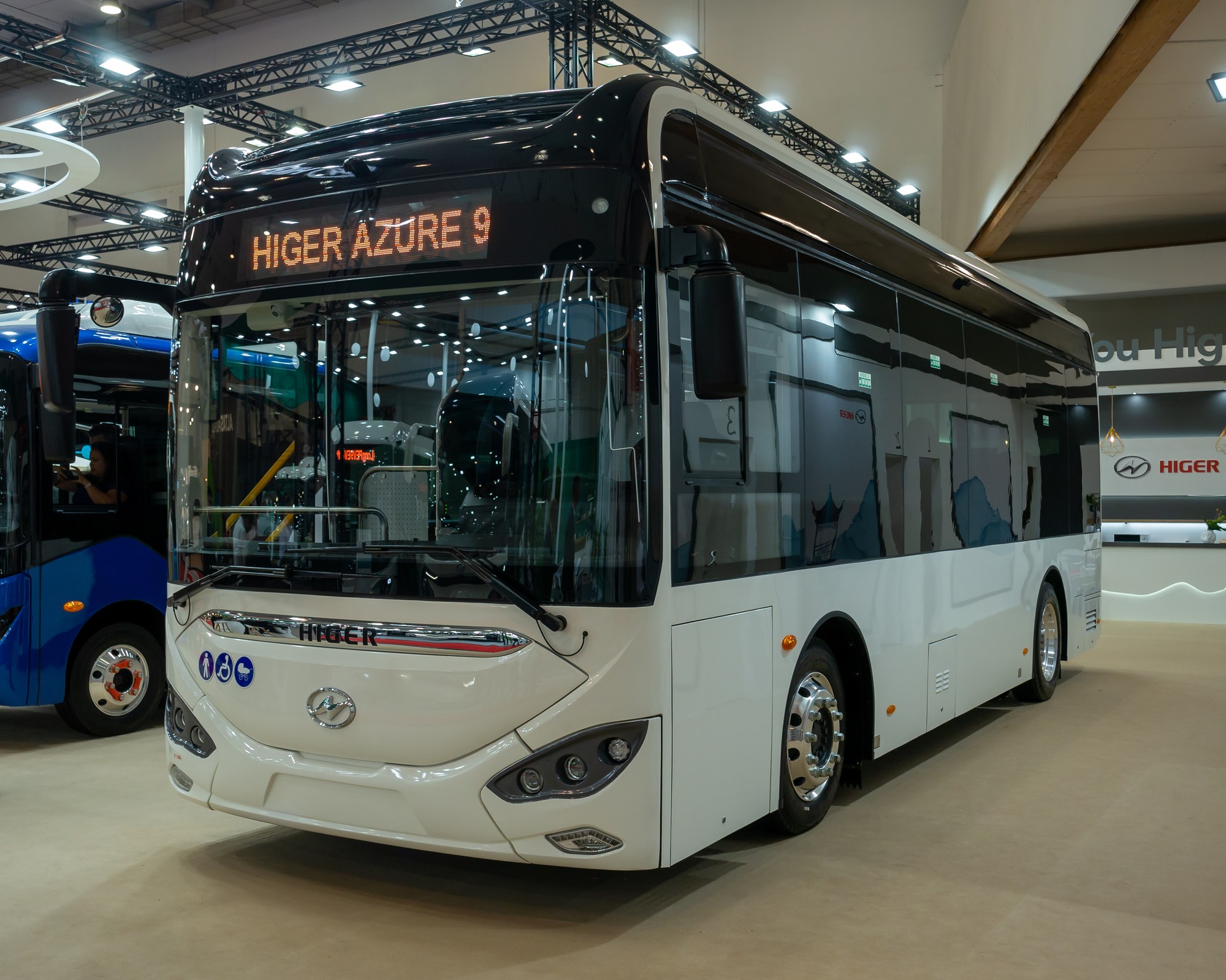

Naga’s electric leap
One more consideration for long-haul Bicol travel: the Higer V9’s 250–300 km range assumes mild weather and a light cabin. In the tropics, expect AC load plus humidity to trim that figure, and a one-hour top-up at the Naga terminal is a realistic evening turnaround for a return trip. Charging infrastructure beyond the pilot hub is still thin — that is the one dependency to watch.
Five days after the ASEAN EV Conference wrapped in Manila, a Bicolano company pushed the Philippine electric-vehicle story past cars and into buses. Solarex Transportation, a Philippine-registered public transport operator, inaugurated its first all-electric bus fleet at the Solara Complex in Naga City on November 5, 2026. The network serves the inter-provincial Daet–Naga–Legazpi corridor and marks the first time a Philippine city hosts the central charging node for a regional electric bus service.
This is not a celebrity launch or a government subsidy headline. It is a business decision from a group that had to make the economics work on Philippine roads, with Philippine heat, Philippine floods, and a grid that still leans on diesel.
The buses under the fleet
The fleet runs Higer V9 electric coaches. Each unit is fitted with CATL battery systems and can travel an estimated 250 to 300 kilometers on a single charge. That range matters here: the Daet–Naga–Legazpi leg is long enough that a conventional intercity diesel bus would normally burn several tanks of fuel between refills.
Inside, the coaches carry the markers of modern transit. Reclining seats, air suspension, full climate control, individual reading lights, and device charging ports. A quiet electric drivetrain means no tailpipe emissions and no vibration from a charging diesel engine at the curb.
Solarex is also digitizing the commuter experience. An in-house mobile app handles cashless ticketing, online booking, and a passenger rewards program. The broader bet is that the app keeps riders inside the electric system rather than letting them fall back to shared jeepneys and motorcycles.
Public transport is the Filipino EV test case
For Filipino commuters, EVs are not a luxury showroom category. They are the answer to congestion, to flooded roads, and to the daily grind of riding motorcycles and old utility vehicles in traffic. Buses are where the technology meets the daily commute.
Consider the worst of Philippine weather. A fully electric bus keeps its battery pack high and dry, and it does not care whether the road it sits on is underwater. The tunnel is battery chemistry plus tropical heat plus the weight of Filipino passengers, and running air conditioning in the tropical sun pulls power straight from the battery. A 250–300 km range still gives comfortable room for the Daet–Naga–Legazpi leg and a return trip. Long-distance travel between cities, once the domain of diesel coaches, becomes a charging-stop puzzle rather than a fuel-stop one.
That is exactly why the charging node in Naga matters. By locating the primary charging terminal in the city, Solarex turns Naga into the operational heart of Bicol’s first inter-provincial electric bus network. For a region that has waited years for reliable public transport, that is a quietly significant development.
What the national numbers say
Solarex is one operator, but it is riding a wave. The Department of Energy reports that electric vehicles accounted for nearly one in every four vehicles sold nationwide from January to August 2026, with 66,685 EVs sold in that window — 20,716 hybrids, 29,649 plug-in hybrids, and 16,320 battery electric vehicles. Registered EVs passed 80,960 in August 2026, and registrations surged 130 percent year-on-year, driven in part by global energy supply disruptions.
Local infrastructure is scaling with the adoption. As of the end of August 2026, there were 1,876 DOE-recognized charging stations nationwide and 949 DOE-recognized EV models on the market. The government’s Clean Energy Scenario targets a 50 percent EV fleet share by 2040, backed by the Electric Vehicle Industry Development Act and the Comprehensive Roadmap for the Electric Vehicle Industry.
What to watch
Three numbers deserve attention. First, the real-world range of the Higer V9 under Philippine conditions — battery chemistry plus tropical heat plus the weight of Filipino passengers. Second, how quickly the Naga terminal can actually charge the fleet, and whether the CATL battery fast-charges as marketed. Third, whether the in-house app grows a rider base, because a bus network without riders is only a cleaner way to move empty seats.
For now, the Naga launch is a working proof that electric public transport can run on Philippine roads. It is also a reminder that EV adoption here is not driven by flagship sedan launches alone, but by operators who solve the daily reality of getting people from one city to the next.
Personal note: I have watched a decade of Philippine transport decisions end in “the next big thing,” only to stall at execution. A self-booking, cashless bus network with a central charging node is a different kind of bet — one that asks commuters to change habits. Whether it survives its first rainy season will say more about the Philippines’ EV road than any press release.
EV Charging in the Philippines is already tracking the growth of the national charging network, and the Kia PV5 Cargo shows how commercial fleets are treating electric vans as practical tools. For a cross-section of the electric sedan wave, see the Nissan Primera EV coverage.