
Mazda CX-80 PHEV Philippines: Mazda’s First Plug-In Hybrid Goes on Sale at P4.18M
Mazda Philippines has plugged into the country’s electrified market for the first time. The Mazda CX-80 e-Skyactiv PHEV is the brand’s first plug-in hybrid electric vehicle: a 2027 three-row SUV that arrives in three trim levels starting at PHP 4,180,000. It pairs a 2.5-liter petrol engine with a 17.8 kWh electric motor, putting out 327 horsepower and 500 Nm of torque — the most powerful Mazda ever offered in the Philippines.
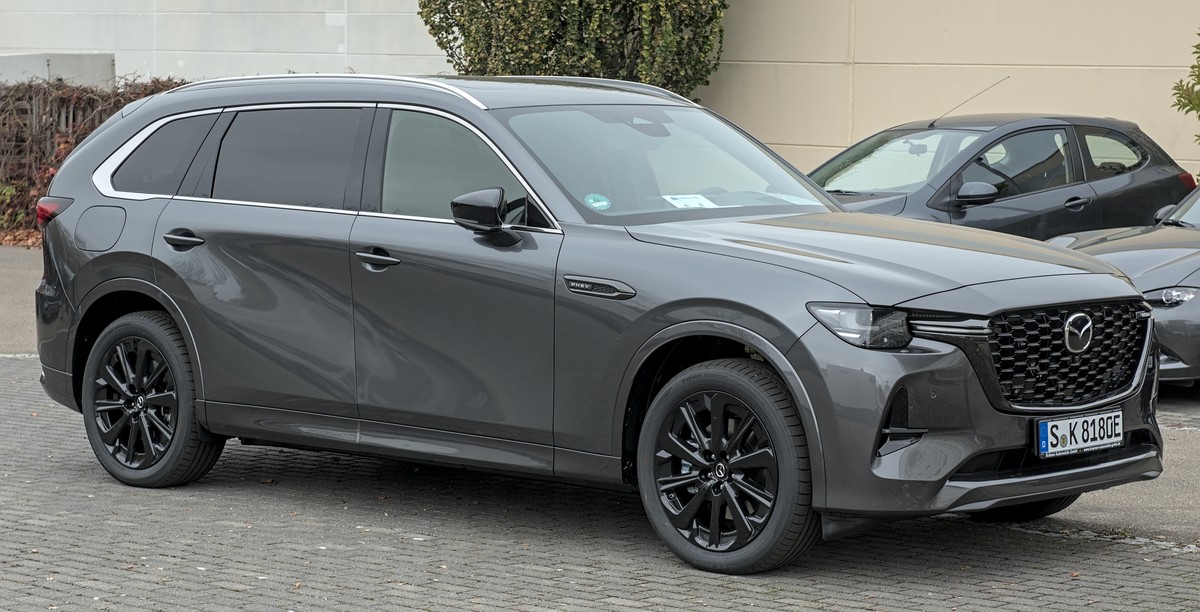

| Specification | Mazda CX-80 PHEV |
|---|---|
| Engine | 2.5L Skyactiv-G I4 direct-injection (192 PS / 261 Nm) |
| Electric motor | 175 PS / 270 Nm |
| Combined power | 327 PS / 500 Nm |
| Battery | 17.8 kWh lithium-ion (NMC) |
| EV range | Up to 65 km (WLTP) |
| Charging | 7.2 kW AC (approx. 2.5 hrs); no DC fast charging |
| 0-100 km/h | 6.8 seconds |
| Dimensions | 4,990 x 1,890 x 1,714 mm; 3,120 mm wheelbase |
| Ground clearance | 175 mm |
| Drivetrain | Mazda i-Activ all-wheel-drive (rear-biased) |
The CX-80 is not merely a badge-engineered import. It is Mazda Philippines’ most potent model to date, and its arrival signals the brand leaning into motorists who want electrification without the range anxiety of a pure battery-electric car. The 17.8 kWh lithium-ion pack is small by BEV standards, but it is large enough for short city errands to be fully recharged on a standard 220-volt outlet.
City driving. The CX-80 shines in Manila traffic. Instant electric torque aids from a standstill, and the 65 km of EV range covers a weekend of short trips — the latest mall run, school runs, grocery runs, and the daily commute to BGC — without touching the petrol engine. The 8-speed Skyactiv-Drive automatic pairs with the i-Activ all-wheel-drive system for grip on pockmarked EDSA lanes and provincial roads. Tight Makati and BGC parking still demands care, though rear sensors and a 360-degree view monitor help.
Long-distance travel. This is where the CX-80 is clever. A full tank of petrol plus a charged battery gives a combined reach that comfortably covers the roughly 250 km Manila-Baguio run and beyond. The 65 km EV mode serves city hops; the petrol engine handles the highway miles. Mazda Philippines opened orders in late October, with first deliveries before year-end.
Floods. The CX-80 clears 175 mm of ground — comfortable for most city puddles but not a flood vehicle. The battery sits above the floor and carries no submersion rating. Filipino drivers should treat the CX-80 as a city-and-highway tool, not a wading vehicle.
Heat. The battery is liquid-cooled, a sensible choice for a 36-38-degree Metro Manila afternoon. NMC chemistry is less thermally stable than the LFP chemistry found in many entry EVs, so expect the thermal management system to work hard during long AC-heavy runs. Real-world range will dip in sustained heat and heavy traffic, a normal trade-off documented across every plug-in hybrid on the market.
Pricing.
| Variant | PHP | USD (approx.) | INR (approx.) |
| 7-Seater Black | 4,180,000 | $65,650 | ₹6.14 lakh |
| 7-Seater Tan | 4,230,000 | $66,430 | ₹6.22 lakh |
| 6-Seater Exclusive Tan | 4,280,000 | $67,220 | ₹6.29 lakh |
Rates: 1 USD = 63.67 PHP and 1 PHP = 1.469 INR, fetched live Nov 19, 2026.
How does the CX-80 stack up against the competition? Against the Lexus RX 450h+ Premier (PHP 6.238M + PHEV) it is well under half the price, though the Lexus offers a larger battery, DC fast charging, and a more premium cabin. Against the iCaur V23 compact BEV SUV (estimated P1.5M-1.8M), the CX-80 costs more but offers an AWD system and a much larger total range. And against the slice of the EV market that already has home charging, entry battery-electric cars remain cheaper — but the CX-80 needs no charging point to work.
EV charging in the Philippines is still catching up, with public DC stalls concentrated in major malls and travel routes. For buyers who charge at home, the 7.2 kW wallbox option is the sweet spot: a full battery in about two and a half hours.
The CX-80 is also worth comparing with Lexus RX 450h+ Premier, which split the premium three-row PHEV space in a different direction — more electric content, far more price, and a cabin built for long-distance comfort. The CX-80 sits below it as the pragmatic, budget-friendly PHEV sibling.
New EV entrants continue to test the Philippine market, from the iCaur V23 and V27 to the growing line of Chinese and Japanese EV SUVs. The CX-80 adds a Japanese-brand voice to that mix, and its no-works charging requirement may well be the deciding factor for families without a wallbox at home.
For city dwellers with home charging, the CX-80 PHEV is a well-rounded entry into Mazda’s lineup: quick, refined, and capable of genuine electric commutes. Without a home charger, it behaves much like a modern self-charging hybrid, and the 327-horsepower total makes it one of the most enjoyable Filipino SUVs to drive. Either way, Mazda has delivered something the country has been waiting for — a Filipino-made electrified option that fits how Filipinos actually drive.