
For most of its life, the Galaxy S26+ has been the awkward middle child of Samsung’s lineup — bigger and pricier than the vanilla Galaxy S26, but missing the Ultra’s camera hardware and S Pen. Then this week, something interesting happened. Samsung’s European pricing took a tumble, and in the fallout the Plus suddenly became the cheapest S26 you can buy — at €770 for the 256GB model, it now undercuts its own little brother, per GSMArena’s weekly deals roundup. I reviewed the vanilla S26 this morning, and that price inversion completely changes the way you have to read this phone.
Design & Build Quality
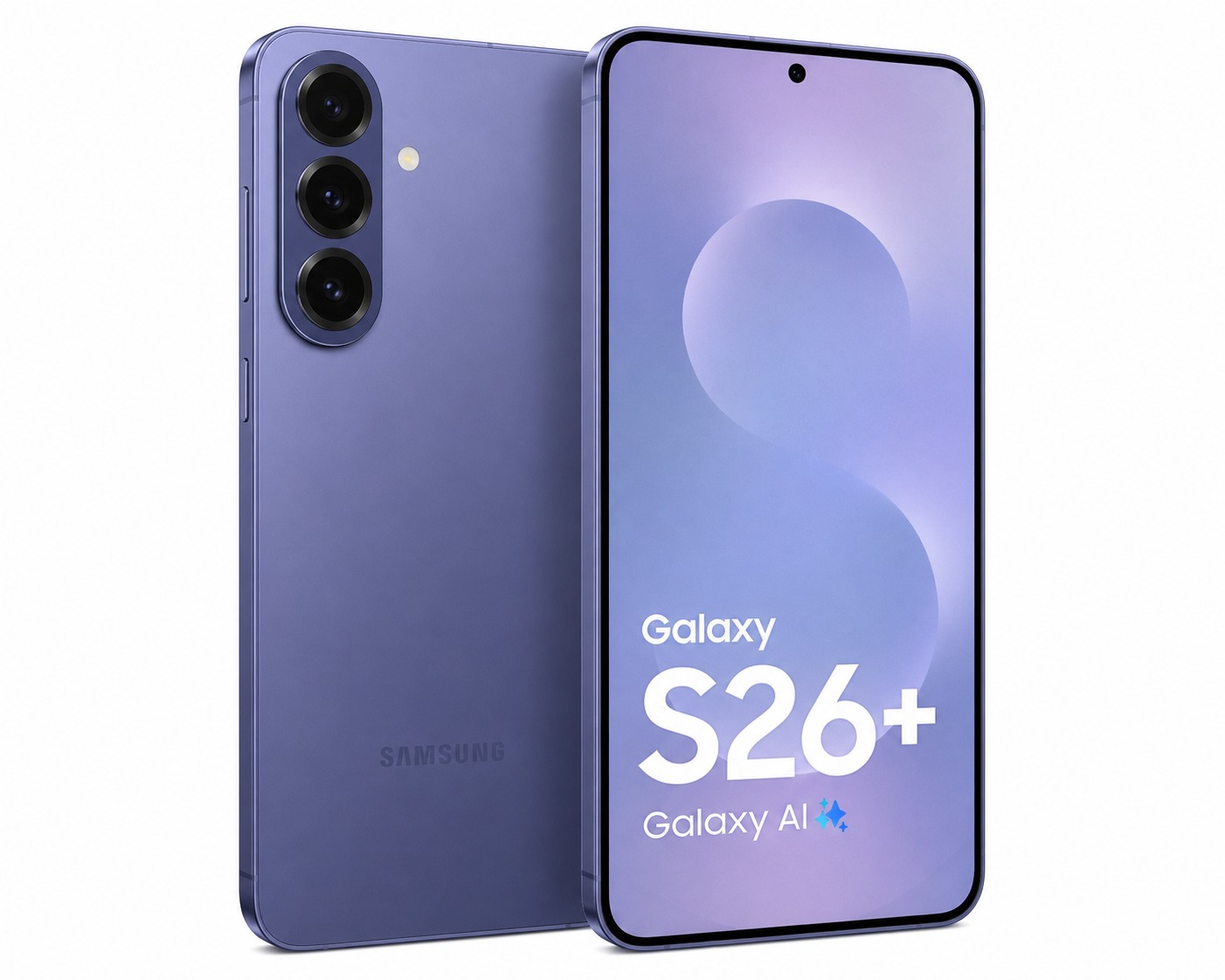
The S26+ is a big, confident slab: 158.4 x 75.8 x 7.3mm and 190g. You know it the moment you pick it up — this is the phone that sits comfortably in one hand but makes you stretch your thumb across the top of the screen. The frame is flat, Armor Aluminum 2, wrapped in Gorilla Glass Victus 2 on both front and back. Samsung trusted this aluminum so much that even the Ultra dropped titanium this year, so the Plus is in good company.
The one visible change over the S25+ is the camera island. Instead of three free-floating lenses, the S26+ gets a joined vertical bump housing all three cameras — subtle, but enough that your old S25+ case won’t fit. Colors include Cobalt Violet, Sky Blue, Black and White, plus Silver Shadow and Pink Gold as online exclusives. The ultrasonic fingerprint reader under the display remains fast and accurate; I had zero complaints in a week of use.
Display
Samsung didn’t touch the panel, and honestly, it didn’t need to. The 6.7-inch Dynamic LTPO AMOLED 2X at 1440 x 3120 (QHD+) is still one of the best screens on any phone, and it’s the clearest reason to step up from the vanilla S26, which stays at 1080p. Sharpness at 516ppi is a real, visible jump for text and photos.
GSMArena’s lab measured 1,498 nits in a 75% window and 2,596 nits at the peak — Samsung advertises up to 2,600 nits — so bright outdoor visibility is not a problem. The refresh rate scales from 120Hz down to 1Hz when content is static. ProScaler and mDNIe processing sharpen upscaled content and smooth color gradients. One familiar Samsung compromise remains: HDR10+ and Ultra HDR are supported, but there’s no Dolby Vision, and Samsung still won’t do high-frequency PWM dimming.
Performance
This is where the S26+ gets complicated, because your experience depends on where you live. The US, China and Japan get the Snapdragon 8 Elite Gen 5. Everyone else — including the Philippines — gets Samsung’s new Exynos 2600, built on a 2nm process with a 10-core setup (1x 3.80GHz C1-Ultra, 3x 3.25GHz, 6x 2.75GHz) and the Xclipse 960 GPU, paired with 12GB of LPDDR5X RAM and fast UFS 4.X storage.
The Exynos 2600 is a solid chip, not a spectacular one. In Geekbench 6 it hit 3,250 single-core and 10,982 multi-core — the multi-core figure actually matches the Snapdragon 8 Elite Gen 5 inside the S26 Ultra, but single-core barely edges last year’s Snapdragon 8 Elite. On AnTuTu v11 it scored 3.14 million, right around last year’s phones. GSMArena’s verdict was blunt: Europe and Asia are “once again on the wrong side of the divide.” Day to day it doesn’t matter — nothing you throw at this phone will stutter — but the chip is one of the few upgrades this year, and it’s an underwhelming one.
The good news is sustained CPU performance, which surprised the lab with how little it throttled. GPU is a different story: in the 3DMark stress test the phone dropped to about half its peak under sustained load, so long gaming sessions will see frame dips. Playing through an hour of heavy titles, the chassis stayed warm rather than hot — acceptable, if not class-leading.
Camera
The camera hardware is the S26+’s most honest weak point: it’s essentially the same triple setup Samsung has used for years. The main shooter is a 50MP ISOCELL GNG (1/1.56-inch, f/1.8, OIS), joined by a 10MP 3x telephoto and a 12MP ultrawide with fixed focus. In daylight, the main camera delivers excellent dynamic range, natural colors and a likeable pop — grain creeps into darker areas, but it’s never distracting. The 2x crop mode is solid in good light. The ultra-wide is great outdoors and gets murky indoors.
There are real quirks. The telephoto’s minimum focus is 22cm — worse than the vanilla S26’s 17cm — so close-ups of documents or food are better done at 2x on the main lens. The new Night mode relies entirely on auto-detection, and it simply doesn’t kick in often enough; when it does, results range from excellent to weird color casts. You can restore a proper dedicated Night mode through the Camera Assistant app, but that’s a separate download and a step most people will never take. Against the Pixel 11 Pro XL‘s point-and-shoot night handling, the S26+ loses that battle.
Selfies are the highlight: a 12MP sensor with autofocus and a wider 23mm lens than last year captures more of the frame with excellent sharpness and dynamic range. Video is versatile — 8K30 and 4K60 across all cameras, 10-bit HDR, LUTs and Horizon Lock — but the 120fps 4K mode and APV codec remain Ultra exclusives.
Battery & Charging
At 4,900mAh, the S26+ matches last year’s capacity, yet it’s the battery section that makes this phone worth considering. GSMArena’s active use score hit 16 hours 25 minutes — a huge jump over the S25+’s 14:26 and right on par with the S26 Ultra. Realistically, heavy users finish the day with juice to spare, and lighter users can stretch toward two days.
Charging is the S26 family’s sore spot. The Plus gets 45W wired — a big step up from the vanilla’s 25W, and the reason I’d steer people away from the small phone — but it still takes about an hour for a full charge: 38% in 15 minutes, 69% in 30. The Galaxy S26 Ultra jumped to 60W (84% in 30 minutes), and rivals like the OnePlus 15 charge a 7,300mAh battery in 41 minutes. Wireless charging climbs to 20W with Qi2.2 support, and there’s 4.5W reverse wireless for your buds. Samsung’s charging limiters — including the smart overnight 80% routine — remain excellent battery longevity tools.
Software
The S26+ ships with Android 16 and One UI 8.5, and Samsung’s support promise is still the best in Android: seven major OS upgrades and seven years of security patches. The Pixel 11 now matches that number, but Samsung’s track record of actually delivering those updates is unrivalled.
One UI 8.5 is a refinement rather than a revolution. Bixby gets genuinely better natural language and can now jump you straight to the right settings screen when you describe a problem. Perplexity integration (“Hey Plex”) can execute multi-step app tasks. Now Brief and the new Now Nudge surface contextual suggestions from your messages — processed on-device unless you opt into sharing. Circle to Search handles multiple objects at once, and the Gallery’s AI screenshot search is genuinely handy. Photo Assist’s natural-language edits are a mixed bag in practice, and most of these features depend on language support that varies by region, so temper expectations depending on where you are.
Pros and Cons
| Pros | Cons |
|---|---|
| QHD+ LTPO display — one of the best panels on any phone | Camera hardware essentially unchanged for years; telephoto min focus is a disappointing 22cm |
| 16:25h battery life — class-competitive at last | 45W charging still trails the S26 Ultra (60W), OnePlus 15 (120W) and Poco F8 Ultra (100W) |
| 45W wired + 20W Qi2.2 wireless beats the vanilla S26 | Night mode is auto-only by default; you need Camera Assistant for a dedicated mode |
| UWB, Bluetooth 6.0, Wi-Fi 7 and DeX — full flagship connectivity | Exynos 2600 single-core barely beats last year’s chips; GPU throttles hard in stress tests |
| Seven years of OS updates and security patches | No Dolby Vision, no high-frequency PWM, no 4K120 or APV video |
| Excellent selfie camera with autofocus and a wider lens | No charger in the box; no microSD slot; IP68 only when rivals offer IP69 |
Should You Buy This?
Buy it if
- You want a large flagship Samsung without paying the Ultra tax — QHD+ display, 45W charging, UWB and 16-hour battery for under €800 in Europe.
- You keep phones for years and want the best update commitment in Android.
- Battery endurance and a big, bright, sharp screen matter more than camera hardware bragging rights.
Skip it if
- You want the best cameras at this price — the Pixel 11 Pro XL and OnePlus 15 are stronger, and even the S25 Ultra (now heavily discounted) outguns it.
- You live in the Philippines and want value: the official price of ₱74,990 is unchanged since launch, so the EU price crash doesn’t help you locally.
- Fast charging is non-negotiable — an hour to full still feels slow in 2026.
Final Verdict
The Galaxy S26+ is the phone Samsung made hard to recommend for exactly eight months, and then the price drop fixed it. At €770 for 256GB — cheaper than the vanilla S26 in Europe right now — you’re getting a genuinely complete flagship: the best display in the family outside the foldables, proper 45W charging, UWB, Bluetooth 6.0, and battery life that finally competes with the best. The honest caveats are unchanged: tired camera hardware, an underwhelming Exynos for everyone outside the US, and a Night mode that makes you work for good low-light shots.
In the Philippines the math is different. At ₱74,990 (12/256) and ₱88,990 (12/512), per YugaTech’s official S26 series pricing, the Plus still sits exactly where it always has: ₱16,000 above the vanilla S26 and ₱12,000 below the S26 Ultra — my Top 10 Phones to Buy in 2026 roundup still calls the Ultra the better buy at that gap. But if you’re shopping in Europe, or you simply want the big-screen S26 experience without the Ultra’s bulk, the price drop just made this the easiest recommendation in Samsung’s lineup.
Verdict: the S26+ is the phone the vanilla S26 should have been — bigger screen, faster charging, better endurance — and after this week’s price cuts, it’s the best-value phone Samsung sells. Buy it for the display, the battery and the seven-year support; just don’t expect miracles from the camera or the charger.