
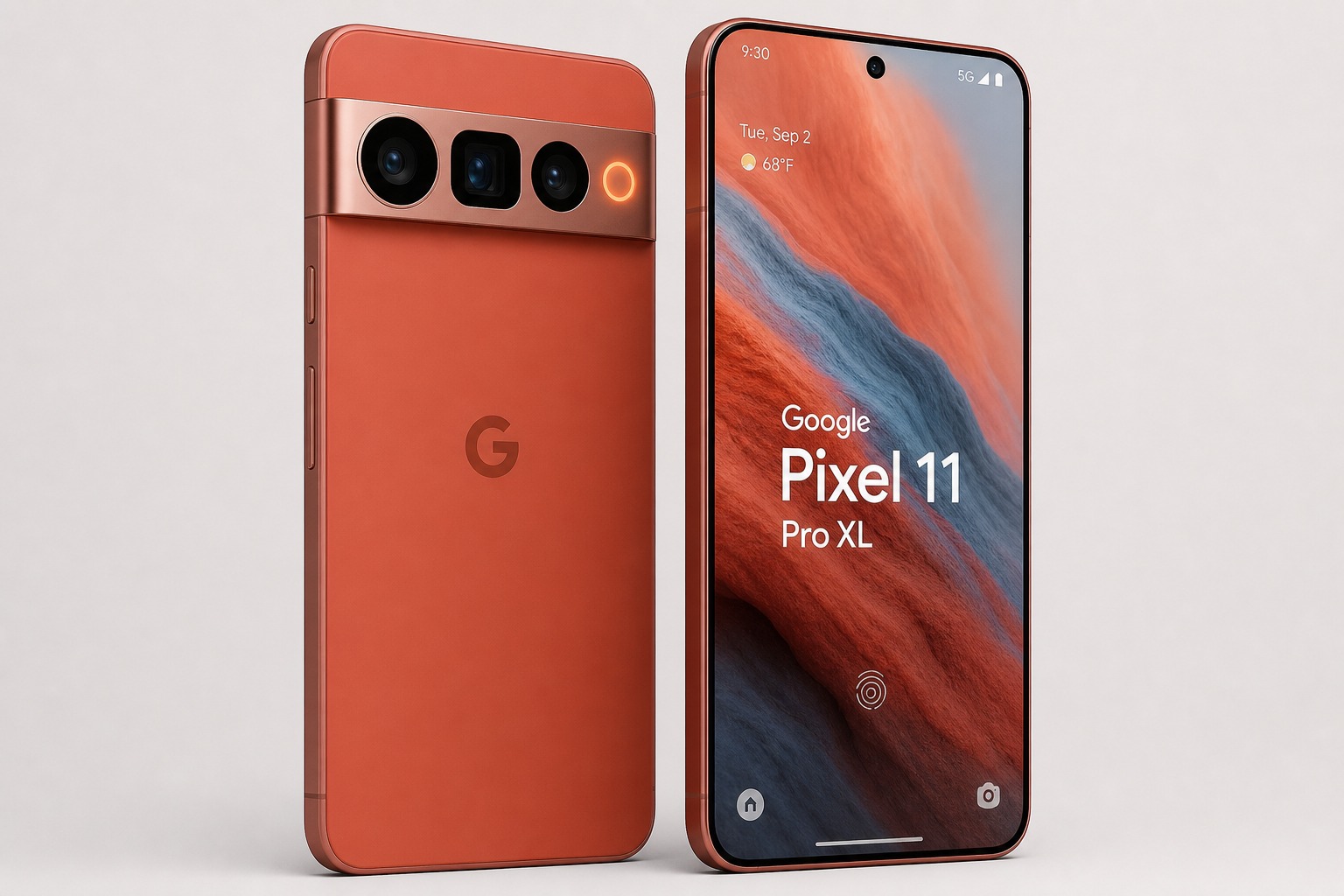
Google finally gave the big Pixel a proper upgrade list this year, and it starts with the screen and ends with the charger. The Pixel 11 Pro XL — announced August 12 alongside the rest of the Pixel 11 family — is the largest slab in the lineup: a 6.8-inch Super Actua display, the same 50MP camera system as the smaller Pro, a 5,115mAh battery, and 45W wired charging, the fastest Google has ever put on a Pixel. Pre-orders are live now, and open sales start August 20.
Here’s the thing I keep coming back to, though: this phone costs $1,299 — around ₱79,600 at current rates — and it ships with 12GB of RAM at that price. That’s 4GB less than the Pixel 10 Pro XL offered at $1,119 last year. Google is betting the screen, the camera, and the AI features make you forget about the memory. Part of that is the global memory shortage pushing prices up across the industry, which I covered here a while back — but it still forces a conversation about value that the Pro XL doesn’t always win.
Design & Build Quality
The Pro XL keeps the flat-sided, rounded-corner Pixel look, sized up to 162.7 x 76.5 x 8.5mm and 226g. That’s heavy enough that you feel it in a pocket, but reasonable for a 6.8-inch flagship — lighter than the Galaxy Z Fold8 Ultra’s 239g, and the aluminum frame is matte on the Obsidian colorway and polished on Canyon, Olive, and Fog.
The camera bar is the biggest visual change. The glass covering the lenses, microphone, and autofocus sensors now runs all the way to the right edge of the bar, which makes the back look symmetrical in a way earlier Pixels never quite managed. Sitting beside the flash is the new HiLight ring — a small LED that glows when a favorite contact calls or when Gemini is working. More on that later.
Durability is a real story this year. The Pro XL uses Gorilla Glass Victus 2 front and back, topped with an 800nm anti-scratch coating that Google claims makes the display “more than twice as scratch-resistant” than before. IP68 water resistance is still there. What’s not there: a 3.5mm headphone jack or a microSD slot. Both are standard Pixel sacrifices at this point, but they’re worth repeating for anyone coming from an older phone.
Display
This is the best screen Google has ever shipped, and it’s not close. The 6.8-inch QHD+ LTPO OLED runs at 2,992 x 1,344 (486ppi, 20:9) with a 1–120Hz refresh rate — and it’s the only Pixel 11 slab that gets QHD+ this year. The vanilla Pixel 11 and the Pixel 11 Pro both stay at FHD+; the XL is where Google keeps the resolution crown.
Under the glass is Samsung’s new M16 OLED panel, which improves brightness and color accuracy while drawing less power. Google rates it at 2,400 nits for HDR content and claims a 3,600-nit peak. Take that peak number with a grain of salt — that’s a local peak on a small portion of the panel in specific conditions, not sustained full-screen brightness. What I can say from the family’s display tech: in direct sunlight, this should be one of the most legible phones money can buy.
Performance
Inside sits the Tensor G6, with a single 4.11GHz Cortex C1-Ultra core backed by six C1-Pro cores and a PowerVR CXTP-48-1536 GPU. Google says the TPU gets a 50% boost, and the on-device AI headroom is the whole point of the chip. One correction worth making: early coverage — including some of the pre-launch hype — claimed this would be Google’s first 2nm chip. Google confirmed it stays on a refined 3nm process, the same die size as last year’s G5. It’s still a meaningful efficiency push, just not the node jump some expected.
There’s another quiet change under the hood: after years of Samsung Exynos modems, the G6 uses a MediaTek modem for the first time since Tensor existed. The stated goal is fixing the signal-hunting power drain Pixels have been criticized for. Real-world battery and thermal results will have to wait for independent testing, but the modem change is the kind of thing that shows up in day-to-day use if it works.
RAM is where the controversy lives. The base tier starts at 12GB of LPDDR5X, with 16GB reserved for the 512GB and 1TB versions. That’s a downgrade from the Pixel 10 series, where 16GB was standard across the board, and it happened right as the industry — Samsung included — started trimming memory to survive the memory price spike. Storage is UFS 4.0, with zoned UFS on the top tiers, and there’s no card slot to fall back on.
For gaming, the honest take from reviewers who’ve handled the phone: the Tensor G6 needs to prove it can hang with the Snapdragon 8 Elite Gen 5 inside the Galaxy S26 Ultra at this price. Google’s chip has always been about AI and camera work over raw frames. That’s fine — but at $1,299, “fine” isn’t the bar anymore.
Camera
The Pro XL carries the same rear camera system as the Pixel 11 Pro: a 50MP f/1.68 main sensor (1/1.3-inch), a 48MP f/1.7 ultrawide with autofocus and a 123-degree view, and a 48MP f/2.8 periscope telephoto at 5x optical. The telephoto is the hardware star this year — a larger sensor and optics that Google says pull in around a third more light than the previous generation’s. Combined with Pro Res Zoom, the XL reaches 120x digital territory, up from 100x.
Software keeps doing the heavy lifting. Instant Night Sight is up to 4.5x faster (~3x on average), Camera Looks bring Fujifilm-style recipes baked at the sensor level, and Magic Capture rounds out the creative suite. Video gets an 8K mode at 24/30fps — new for the Pro series — alongside 4K at 60. The front camera jumps to a 42MP f/2.2 ultrawide with autofocus and a 103-degree view, which makes group selfies and vlogging genuinely usable.
Then there’s HiLight. It replaces the temperature sensor that Pixels have carried for years, and in an Android Authority open thread, 79% of voters said they’d rather keep the thermometer. I get it — the thermometer turned out to be genuinely useful for fever checks on trips, and HiLight, right now, only lights up for favorite contacts and active Gemini sessions. Google says Messages support is coming. It’s a feature with promise and a thin launch state, and it cost us a sensor people actually used.
Battery & Charging
The Pro XL packs a 5,115mAh cell — a small step down from the 5,200mAh in the Pixel 10 Pro XL. Google claims “more than 24 hours” of battery life, and the efficiency gains from the new panel, modem, and 3nm process could make that real. But no independent endurance tests exist yet, and last year’s Pixel 10 scored only around 12 hours of active use in GSMArena’s testing. I’d treat the claim as optimistic until real numbers land.
Charging is the headline hardware change: 45W wired on the Pro XL, per GSMArena’s launch coverage — Google’s own spec sheet doesn’t state a wattage, interestingly. The vanilla Pixel 11 is confirmed at 30W even when plugged into Google’s 45W brick, so the XL is the model that finally makes that charger worth buying. That matters because the charger isn’t in the box. Wireless charging jumps to 25W Qi2.2 on every Pixel 11, and Google’s Pixelsnap charger — now $35 — finally runs at full speed across the lineup.
45W still trails the Chinese flagships where 80W, 90W, and even 120W charging is the norm — the iQOO Z11, for one, does 90W — but for a Pixel, it’s a genuine first. The trade-off conversation is simple: Google finally caught up to its own needs, not to the 90W crowd.
Software
Android 17 ships out of the box, with 7 major OS upgrades promised — taking it through Android 24 in 2033. That’s a decade-class commitment, the longest in the business alongside Samsung’s. The new Titan M3 security chip adds post-quantum cryptography to the package.
Gemini Intelligence is the big software story: agentic features that can order groceries or book rides, powered by cloud Gemini models and on-device Gemma. Proactive Assistance replaces Magic Cue with richer flight and reservation recall. Speech-to-text now filters filler words while you dictate. Quick Share works with Apple’s AirDrop now — genuinely useful for mixed iPhone-and-Android households here in the PH.
One quiet downgrade worth flagging: Google now includes only 6 months of Google AI Pro with the phone, half of what the Pixel 10 series offered. It’s not a dealbreaker — the core assistant features work without it — but it’s another small value trim on a phone that’s getting more expensive.
Pros and Cons
| Pros | Cons |
|---|---|
| Brilliant 6.8-inch QHD+ LTPO display with 3,600-nit peak | 12GB RAM at $1,299 — down from 16GB last year |
| 45W wired charging — the fastest on any Pixel | No charger included in the box |
| 5x periscope with a bigger sensor and 120x Pro Res Zoom | Thermometer removed to make room for HiLight |
| 7 major OS upgrades through Android 24 | No official PH release; gray-market prices and no local warranty |
| 25W Qi2.2 wireless charging across the whole lineup | 5,115mAh battery is smaller than last year’s 5,200 |
| MediaTek modem and 3nm Tensor G6 efficiency push | Gaming still trails Snapdragon 8 Elite Gen 5 rivals |
| HiLight notification ring and anti-scratch display coating | Google AI Pro cut to 6 months, down from 12 |
Should You Buy This?
Buy it if
- You want the biggest, sharpest Pixel screen and don’t mind the size.
- You shoot from the stands or across the room — 120x Pro Res Zoom is the travel zoom champion.
- You’re willing to import a flagship and skip the PH warranty for the best Android camera system.
- You plan to keep a phone for five or more years and want updates until 2033.
Skip it if
- 12GB of base RAM bothers you on principle — wait for the 16GB tier or grab the Galaxy S26 Ultra at ₱86,990 with a proper PH warranty.
- You want to buy locally: there’s no official PH release, and gray-market units run ₱85K–90K with no service center support.
- Battery endurance is your top priority — the Redmi K100 Pro crowd with 8,580mAh laughs at 5,115mAh.
- You’re on a budget: the vanilla Pixel 11 at $899 and the Pro at $1,099 are the smarter buys this generation.
Final Verdict
The Pixel 11 Pro XL is the most complete big Pixel Google has built. Best display in the lineup, first real charging upgrade in years, the best camera system Android offers, and a software commitment that outlasts most people’s phone ownership. If the Pixel 10 Pro XL was your phone and you’ve been waiting for a reason to jump, this is it.
But it’s also the most expensive Pixel ever, at a moment when Google is trimming RAM, halving the AI Pro perk, and charging you for the privilege of a 45W charger that isn’t included. The S26 Ultra at ₱86,990 — with Snapdragon muscle, a bigger battery, and official PH support — makes the gray-market math on the XL uncomfortable. The Galaxy Z Fold8 Ultra at ₱123,990 shows how much premium Samsung charges for a foldable; the XL lands in a weird middle: not a foldable, but priced like one.
For Filipinos, the honest advice is timing. If you want the best camera Android and you’re fine importing, the XL at $1,299 (about ₱79,600 direct) is a real flagship — just budget for gray-market markup and zero local warranty. If you want peace of mind, the S26 Ultra at ₱86,990 official is the safer ₱80K-class flagship, and the Pixel 11 Pro Fold is the flex for people who want both big screens and Google’s cameras.
Google is betting that AI, the camera, and that gorgeous display carry the price. The polls say 73% of enthusiasts are cold on this generation’s value. The XL is a great phone that costs a lot of money — whether it’s worth it depends entirely on whether you can get one at a sane price, with a warranty, in the Philippines.