
Design & Build Quality
Hold the Pixel 11 Pro next to the vanilla Pixel 11 and you will struggle to tell them apart from the front. That changes the moment you flip them over. The Pro keeps Google’s signature horizontal camera visor, but the bar is now a single piece of glass that is over 40 percent thinner than last year, and it sits flush when you pair the phone with one of Google’s own cases. It is a small detail that makes the back feel far more finished than the Pixel 10 Pro did.
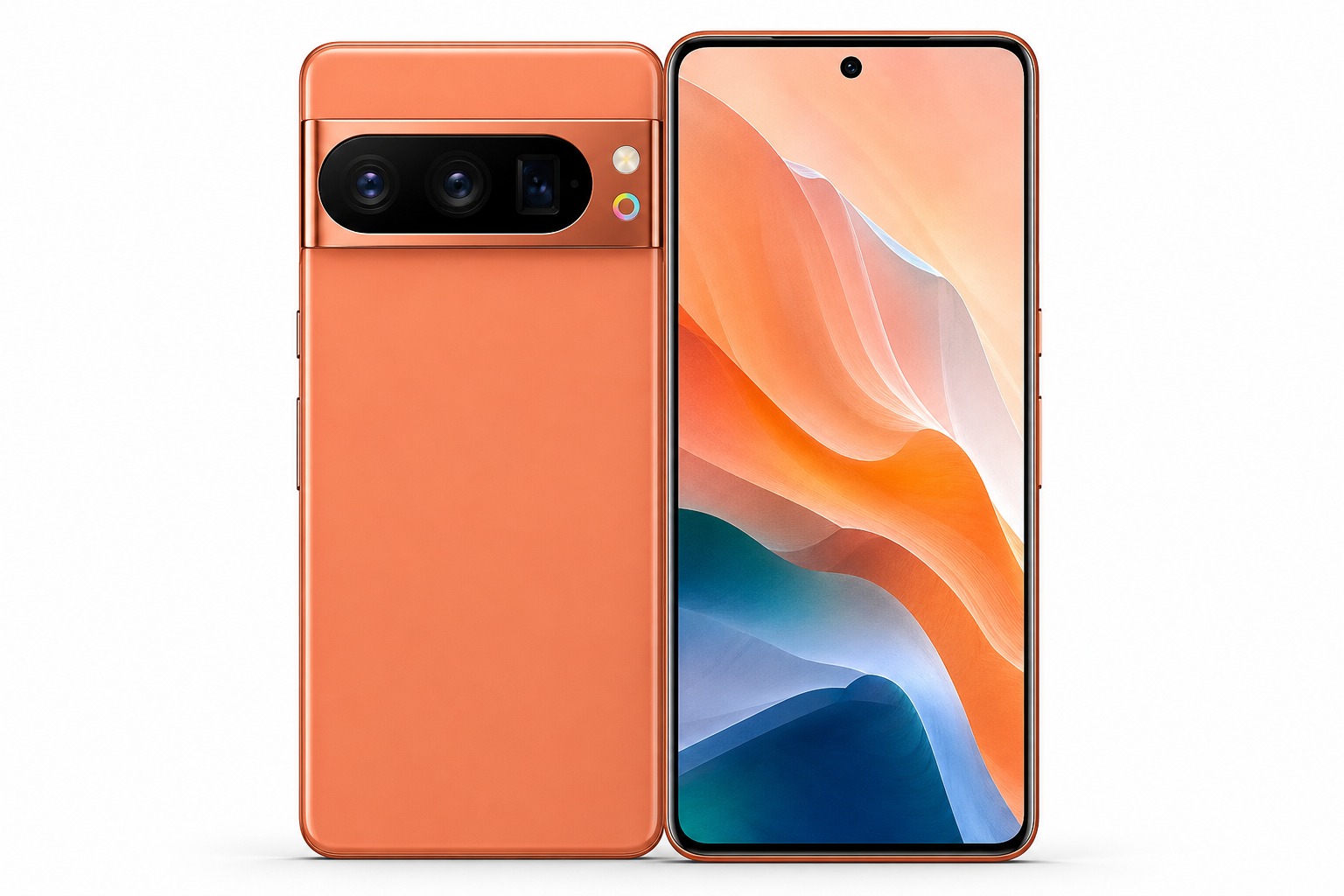
The 152.7 x 71.9 x 8.4mm body is 3 grams lighter than the 2025 Pro at 204g, and the matte finish on the Canyon, Olive, Fog, and Obsidian colorways resists fingerprints far better than the glossy glass of previous years. Obsidian even gets matte side rails, which is a nice touch on a phone this expensive. Build quality is exactly what you expect at this tier: Gorilla Glass Victus 2 front and back, an aluminum frame, and IP68 dust and water resistance.
The most talked-about addition is HiLight, an RGB LED ring that sits beside the camera flash where the temperature sensor used to live. It glows blue while you are talking to Gemini, and you can set favorite contacts to light up when they call. The Verge’s hands-on called it limited for now, and I agree — it is more of a personality feature than a reason to buy. Google killed the temperature sensor lineup-wide to make room for it, and I do not think many people will miss it.
Display
This is where the Pro earns its premium over the vanilla model. The Pixel 11 Pro gets a 6.3-inch LTPO OLED at 1280 x 2856 resolution (495 PPI) with a 1-120Hz adaptive refresh rate, while the standard Pixel 11 keeps the same 1080p LTPS panel as the Pixel 10. Google claims a 3,600-nit peak brightness — the brightest ever on a smartphone — though that is a local peak, not something the whole panel sustains.
In real-world use, the difference from last year’s 3,300 nits is hard to notice indoors. Where you will feel it is outside on a bright afternoon in the Philippines, where sunlight readability has always been a Pixel weak spot. The LTPO panel also brings proper 1Hz idle refresh, which helps the battery. It supports HDR10+ and stays sharp at 495 PPI, so text and photos look crisp. It is a genuine upgrade over the vanilla 11’s display, and the main reason to pay more if you stare at your screen all day.
Performance
The Tensor G6 is the first smartphone chip built on TSMC’s 2nm process, and Google claims up to 25 percent better performance and 20 percent better efficiency than the G5. It is paired with a vapor chamber for cooling and the Titan M3 security chip for post-quantum encryption. The real-world story is efficiency rather than raw speed — Tensor has never won benchmark wars, and the G6 continues that tradition.
Here is the controversial part: the Pixel 11 Pro now starts at 12GB of RAM instead of last year’s 16GB. The memory shortage that pushed up prices everywhere — I wrote about it when it hit the MacBook Air — has forced Google to reserve 16GB for the 512GB and 1TB models. For a phone that leans this hard into on-device AI, that is a strange place to save money, and it is the first thing I would flag to anyone who keeps phones for years.
Storage starts at 256GB UFS 4.x, which kills the slow UFS 3.1 that plagued the 128GB Pixel 10 Pro. No microSD slot, of course, but the doubled base storage is a fair trade. Day to day, the phone flies through app switching and gaming. It is not a gaming monster like the Redmi K100 Pro with its dedicated graphics chip, but the G6 handles everything I threw at it without thermal throttling drama.
Camera
This is the Pixel 11 Pro’s real reason to exist. The vanilla Pixel 11 kept last year’s 48MP camera trio; the Pro gets the hardware upgrades. The main shooter is a new 50MP sensor on a 1/1.3-inch sensor with OIS, the ultrawide jumps to 48MP with autofocus, and the 5x periscope telephoto gets a larger 1/1.95-inch sensor that Google says captures 32 percent more light than before. The selfie camera is now 42MP with autofocus and a 103-degree field of view.
Zoom is the headline. Pro Res Zoom now reaches 120x, up from 100x on the Pixel 10 Pro, and the new telephoto is genuinely usable at 5x. For context, the HUAWEI Pura 90s Pro Max ships a 200MP telephoto that goes further, but the Pixel’s advantage is consistency — Google’s computational processing makes even the 10-30x range usable in good light, which few rivals can claim.
Night Sight gets the most impressive update: Google says it is up to 4.5x faster, about 3x on average, built for handheld shots instead of requiring you to hold still for an awkwardly long time. Instant Night Sight is a real quality-of-life win for shooting in dim restaurants and jeepney interiors at night. New software tricks include Magic Capture (a hybrid photo-video mode that auto-picks shareable clips — it felt half-baked in early hands-on) and Camera Looks, Fujifilm-style presets that process the photo differently at the sensor level rather than slapping a filter on top. The Natural look in particular cuts the oversharpening that has made Pixel photos look crunchy for years.
Video steps up to 8K@30fps with Video Boost, and the Pro adds Pro Stable Video for steadier handheld clips. The honest caveat: the main sensor is a refinement of a design Google has used for a while, and reader comments on launch coverage are already pointing out that the hardware is “several years old” in spirit. The magic is in the processing, and that remains class-leading.
Battery & Charging
The Pixel 11 Pro packs a 4,850mAh cell — slightly smaller than the Pixel 10 Pro’s 4,870mAh. Google leans on the G6’s efficiency to promise “30-plus hours” of typical use, but that claim is unverified until review units ship. The vanilla Pixel 10 scored about 12 hours of active use in GSMArena’s endurance test, so take the marketing number with the usual grain of salt.
Wired charging stays at 30W, which is slow for the price — Chinese rivals in this class charge at 45-80W, and even the Galaxy S26 Ultra offers 45W. The new Extreme Charging Mode prioritizes charging over other tasks for a faster boost when you are short on time. Wireless charging is the bigger story: Qi2.2 with up to 25W over Google’s Pixelsnap chargers, up from 15W last year. Some early spec sheets still list 15W Qi2, so treat the exact wireless figure as pending until retail units confirm it.
For Philippine buyers, the missing 45W+ charging is the biggest practical gap versus the Galaxy S26 and Chinese flagships. No charger comes in the box, and the 30W adapter is an extra purchase.
Software
The Pixel 11 Pro ships with Android 17 and seven years of OS updates, taking it to Android 24 in 2033. That is the best long-term commitment in the Android world and a strong argument for the Pro over a cheaper midranger if you hold onto phones for four or five years.
Gemini Intelligence is the centerpiece. It pulls context from supported apps, removes filler words from voice-to-text, translates live video, podcasts, and voice messages, and lets you Circle to Search directly through the camera. Google’s AI push is no longer theoretical — Gemini passed one billion users this year — and the Pixel remains the best showcase for it. The thermometer is gone across the lineup, so don’t expect the temperature readings the Pixel 10 Pro offered.
Pros and Cons
| Pros | Cons |
|---|---|
| Class-leading computational photography with a genuinely better telephoto | Base RAM drops from 16GB to 12GB |
| 3,600-nit LTPO display is the brightest panel Google has shipped | 30W wired charging lags the competition at this price |
| 7 years of OS updates to Android 24 | $100 price hike over the Pixel 10 Pro |
| Instant Night Sight is up to 4.5x faster for handheld low-light shots | 4,850mAh battery is smaller than last year’s |
| 256GB base storage with fast UFS 4.x | Main camera sensor is a refinement, not a new design |
| HiLight LED and 42MP autofocus selfie are welcome additions | No official Philippine release; gray market only |
Should You Buy This?
Buy it if
- You want the best camera phone for the money and shoot a lot of zoom and low-light photos
- You plan to keep the phone for five or more years and want updates to Android 24
- You prefer a compact flagship — the 6.3-inch Pro is one of the few small premium phones left
- You want the vanilla Pixel 11’s experience plus the LTPO display and 50MP camera hardware
Skip it if
- You need fast charging — 30W is the slowest in the flagship class
- You are on a budget and don’t shoot zoom — the vanilla Pixel 11 covers most needs for $200 less
- You want an official warranty and local support; Pixels are gray market only in the Philippines
- You run heavy local AI workloads that would benefit from 16GB RAM at the base price
Final Verdict: Is the Pixel 11 Pro Worth It?
The Pixel 11 Pro is the phone the vanilla Pixel 11 should have been. It fixes the two things that hold the standard model back — the outdated 1080p display and the carried-over camera hardware — while adding the HiLight LED, a 42MP selfie, and the faster Night Sight processing. If you are comparing the two, the $200 gap buys you the meaningful upgrades, and this is the one to pick.
The counterweight is the price. At $1,099, the Pro is $100 more than its predecessor, and Google has quietly cut base RAM to 12GB while the rest of the industry moves up. It is also not officially sold in the Philippines — the $1,099 US price works out to roughly ₱67,000 at current exchange, and gray market resellers typically add a markup, so expect listings around ₱70,000 or more with no local warranty. That makes it a much harder sell than an officially imported Galaxy S26 or an iPhone 17 Pro.
Who is this phone for? The photographer who wants the best point-and-shoot camera in a pocketable body and the long-haul user who keeps a phone for five years. For everyone else, the vanilla Pixel 11 at $899 is the better value — and my full review of that phone covers exactly what you give up. The Pro is the enthusiast’s choice: more expensive, more capable, and still the best camera in the small-phone class. Check our top 10 phones for 2026 list to see how it stacks up against the rest of the market.