
The HUAWEI Pura 90s Pro Max lands in the Philippines on August 20 with a camera system nobody else is selling right now: a 200-megapixel periscope telephoto built on a 1/1.28-inch RYYB sensor, the first of its kind in the industry. It is a genuinely exciting imaging phone. It is also a phone where the chipset feels two tiers below the price tag, and where Google services are still missing out of the box. That combination makes it one of the most interesting, and most polarizing, flagships to hit PH shelves this year.
Huawei prices the Pro Max at ₱79,999 in the Philippines, with the smaller Pura 90s Pro starting at ₱54,999. Smart has opened pre-orders through its postpaid plans, and open sale starts August 20. I went through GSMArena’s full lab review, Huawei’s official spec sheets, and the local launch materials so you know exactly what ₱80,000 buys you, and what it doesn’t.
Design & Build Quality
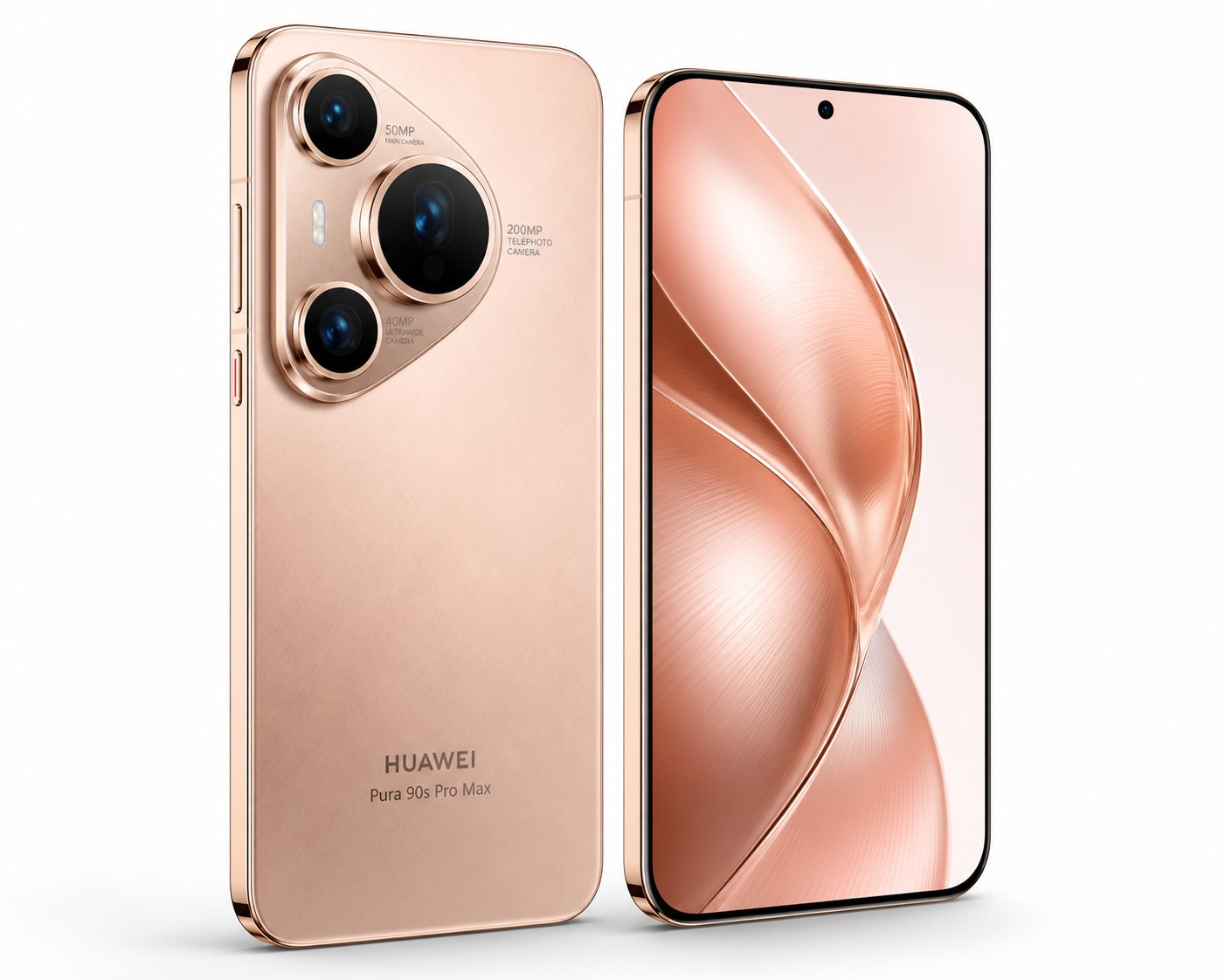
You will not mistake the Pura 90s Pro Max for anything else. The camera island is a triangular, volcano-shaped block that rises about half a centimeter off the back glass, with three separate rings for the 50MP main, the 200MP telephoto, and the 40MP ultrawide. It looks like a piece of modern architecture. It also means the phone never lies flat on a desk, though GSMArena says it doesn’t wobble, with or without a case.
The rest is standard flagship fare: glass front and back over a polished aluminum frame, 164 x 77.1 x 8.1mm, and 231 grams. That puts it in the same heavyweight class as the iPhone 17 Pro Max. The frame is polished and slippery, and the black version picks up fingerprints like a forensic exhibit, so a case is basically mandatory.
Durability is a genuine highlight. The Pro Max carries IP68 plus IP69 ratings, meaning it shrugs off immersion up to 2 meters for 30 minutes and survives high-pressure water jets. For context, the Samsung Galaxy Z Fold8 Ultra we reviewed earlier this month only manages IP48. The front uses Kunlun Glass with an anti-reflective, anti-fingerprint coating, and Huawei claims the usual drop and scratch resistance.
Colorways are where Huawei had fun. Orange Ocean and Blaze Purple get what Huawei calls an industry-first dual-tone gradient mid-frame, described with the kind of vacation poetry you’d expect from a holiday-themed flagship. Blush Gold and Graphite Black are calmer. There’s a side-mounted fingerprint reader on the power key; one small oddity for a 2026 flagship is that Huawei still hasn’t moved to an under-display sensor.
Display
The 6.9-inch LTPO OLED is a big, bright, beautiful panel: 1,308 x 2,880 resolution at 460ppi, 10-bit color, a dynamic 1-120Hz refresh rate, 300Hz touch sampling, and high-frequency PWM dimming. GSMArena measured 1,192 nits of brightness on a 75% white patch and a 1,777-nit peak on a small highlight. That’s a solid number, though not the class leader, and the minimum brightness drops to a comfortable 1 nit for late-night scrolling.
HDR streaming works if you know the trick: the phone supports HDR10, and reviewers got both YouTube HDR and Netflix FullHD HDR10 running through the GBox environment we’ll get to in the software section. In bright daylight, the anti-reflective coating genuinely helps, which matters more in the Philippines than anywhere else.
Performance
Here’s the honest part, and it’s the reason I’d hesitate before spending ₱79,999: the Kirin 9030S is not flagship silicon. It’s built on a 5nm-class process, with one Taishan V124 big core at 2.7GHz, three mid cores, and four little cores. The Maleoon 935F GPU is rated at roughly half the performance of the 9030 Pro’s GPU.
The benchmark numbers tell the story. Geekbench 6 comes in around 1,336 single-core and 4,522 multi-core, which matches the Snapdragon 7 Gen 4 inside the Motorola Edge 70, a mid-ranger. AnTuTu 11 lands near 1.29 million, and 3DMark Wild Life Extreme sits at 1,606. Under sustained load, the phone retains only 48% of its CPU performance and 61% of its GPU performance, meaning heavy gaming sessions will throttle noticeably.
GSMArena put it bluntly in its review: performance is the phone’s biggest weakness, “nowhere near flagship, more like mediocre mid-range.” Day-to-day use, messaging, social media, and camera work all feel fine, since the phone has 12GB of LPDDR5X RAM and fast UFS storage. But if you’re coming from a Snapdragon 8 Elite phone, or even the Tensor G5 Pixel 10, you will feel the difference. It’s the price you pay for Huawei’s fully homegrown silicon story.
Camera
This is where the Pro Max earns its keep. The headline act is the 200MP periscope telephoto on a 1/1.28-inch RYYB sensor, which Huawei says is the first RYYB 200MP telephoto in the industry, and it ties for the largest sensor in any telephoto camera. It offers 4x optical zoom at an equivalent 89mm, hardware-level OIS rated for up to 7 stops of stabilization, and up to 20x lossless zoom that even works while recording video. The Oppo Find X9 Ultra has the same class of sensor but only 3x zoom, so the Pura’s reach is genuinely special.
The main camera is a 50MP shooter with a variable f/1.4 to f/4.0 aperture, OIS, and a 1/1.28-inch sensor. Huawei’s local materials talk about a 3-in-1 Ultra Lighting Prism and up to 16 EV of dynamic range, and the 2nd Gen True-to-Colour engine. The 40MP ultrawide has autofocus and doubles as a macro camera, and the 13MP front camera is an autofocus ultrawide. Video tops out at 4K 30fps on both ends with gyro-EIS, which trails the top video shooters on paper but is fine for social content.
Early hands-on testing from GSMArena suggests the camera handles tricky lighting particularly well, especially high-saturation neon scenes and mixed lighting, which is the kind of thing you shoot on an EDSA night out. The AI tools are useful rather than gimmicky: Smart Remove for deleting objects, Best Expression for group shots, and Building Straightener for the classic Filipino tourist photo. Huawei PH also advertises AI De-Glare for window reflections and AI Move for repositioning subjects.
If photography is the whole game, this is a top-three camera phone in its price class, right up there with the Galaxy S26 Ultra and the Xiaomi 17 Ultra. It’s a big step up from the Pura 90 we reviewed last year, which leaned on battery and value; the 90s Pro Max is the line returning to pure imaging ambition. It’s a different philosophy from the Redmi K100 Pro Max, which puts its 200MP sensor on the main camera; the Pura puts its biggest sensor on the zoom lens, and that’s the right call for a phone that wants to replace a camera.
Battery & Charging
The Philippine unit carries the 6,000mAh typical cell, while the European model ships with a smaller 5,500mAh battery. In GSMArena’s lab tests of the EU unit, the phone posted a very good 13 hours and 2 minutes of active use, with strong call, web browsing, and video streaming results, though gaming runtime was only average.
Charging is where the marketing and the lab disagree. Huawei claims the Pro Max hits 85% in 30 minutes on its 100W SuperCharge, and it supports 80W wireless plus 18W reverse wired and reverse wireless charging. In GSMArena’s independent test, the phone hit 60% in 30 minutes and needed 61 minutes for a full charge, slower than the Pura 80 Ultra’s 42 minutes with a similar battery and charging setup. So treat “85% in 30 minutes” as the best case; real-world results trail it. There’s a 100W charger in the retail box in most markets, though Huawei notes charger contents vary by market, so confirm the PH bundle when you pre-order.
Software: EMUI 16 and the Google Question
The Pro Max runs EMUI 16 on an Android 16 core. It’s the first time in years Huawei’s global software has sat on a modern Android base, and it brings Celia AI with a one-command mode that can chain multiple tasks, like adding an event, sending an invite, and saving a grocery list, in a single sentence. Air gestures, smart sensing, split-screen, and pop-up multitasking are all here. There’s also an IR blaster, so the phone doubles as a universal remote, which is genuinely handy in a Filipino household with five remotes on the coffee table.
Here’s the catch, and it’s the biggest one. EMUI 16 ships with Huawei Mobile Services, not Google Mobile Services. No Play Store, no Google apps out of the box. Huawei PH says local essentials like GCash, BDO, and BPI are available through AppGallery, and GSMArena’s review successfully ran Google apps through GBox, a virtual environment that includes the Play Store, and found they “operate as expected.”
Still, banking apps and virtual environments are a notoriously risky mix. Anything tied to Google Play Services, from ride-hailing maps to e-wallet push notifications, can misbehave, and some banks actively block virtualized environments. In a country where GCash and Maya are basically daily life, this is the question you must answer before spending ₱80,000. The nova 16 SE we reviewed carries the same fundamental trade-off on HarmonyOS, so the caveat is consistent across Huawei’s 2026 lineup. Note also that Huawei hasn’t confirmed how many years of OS updates the Pura 90s will receive, which is a real unknown for a phone this expensive.
Pura 90s Pro vs Pro Max
If the Pro Max is too rich, the Pura 90s Pro shares the same Kirin 9030S chip, EMUI 16, IP68/IP69 build, and 6,000mAh battery, but trims the extras. Here’s how they compare:
| Spec | Pura 90s Pro | Pura 90s Pro Max |
|---|---|---|
| Display | 6.6-inch LTPO OLED, 120Hz | 6.9-inch LTPO OLED, 120Hz |
| Telephoto | 50MP, f/2.1, 4x optical | 200MP, f/2.6, 4x optical |
| Ultrawide | 12.5MP | 40MP with macro |
| Wired charging | 66W | 100W |
| Wireless charging | 50W | 80W |
| Weight | 213.5g | 230.5g |
| PH price | ₱54,999 (256GB) | ₱79,999 (512GB) |
The Pro is the smarter buy for most people; the Pro Max exists for people who want the biggest telephoto sensor on any phone. There’s a ₱25,000 gap between them, and that gap is entirely about the camera and charging speed.
Philippine Pricing and Pre-Order Deals
Huawei PH’s official pricing is ₱54,999 for the Pura 90s Pro 256GB, ₱64,999 for the 512GB Pro, and ₱79,999 for the Pro Max 512GB. Pre-orders run until August 19, with the official launch on August 20.
Smart’s postpaid listings show lower straight-payment device prices: ₱58,800 for the Pro Max and ₱34,700 for the Pro, or monthly device installments of ₱2,758 and ₱1,629 over 24 months. Those figures are the device component of a Smart postpaid plan, not the SRP, and the plan fee is on top, so read the fine print before comparing them against the retail prices.
Huawei’s own pre-order bundle is worth up to ₱31,997: a WATCH FIT 4 Pro (₱13,999), a Pura Exclusive Gift Box (₱3,999), and premium services worth up to ₱8,999. Bank cardholders can get up to ₱5,000 off, Huawei Online Store vouchers are worth ₱4,000, and Shopee, Lazada, and TikTok Shop vouchers give ₱2,000 off. Smart postpaid pre-orders get the watch, gift box, and HUAWEI Care+ coverage, with FreeArc Buds added on Infinity plans.
Pros and Cons
| Pros | Cons |
|---|---|
| 200MP RYYB telephoto is the best zoom camera on any phone | No Google Play Services out of the box |
| Variable f/1.4-4.0 main camera with 16 EV dynamic range | Kirin 9030S performs like a mid-range chip |
| IP68/IP69 durability beats most flagships | Heavy sustained loads throttle to ~50% |
| 6,000mAh battery with strong endurance | Charging slower than claimed: 61 min to full in tests |
| 100W wired, 80W wireless, reverse charging | No under-display fingerprint sensor |
| Native 5G returns on a global Huawei | Software update commitment unconfirmed |
| Distinctive design with dual-tone gradient mid-frame | ₱79,999 buys a camera, not a chip |
Should You Buy This?
Buy it if
- Photography is your main hobby and you want 4x optical zoom quality that rivals dedicated cameras.
- You’ve already lived without Google services, or you’re comfortable with GBox and AppGallery.
- You want a flagship that survives rain, flooding, and construction-zone dust, which is most of Metro Manila.
- You value the distinctive design and don’t mind a phone that can’t lie flat on a desk.
Skip it if
- GCash, Maya, or your bank app is non-negotiable and you won’t risk a virtual environment.
- You play heavy games or want flagship-level raw performance for your money.
- You plan to keep a phone for four or five years and need a confirmed update commitment.
- You want the best value at ₱80K, because the mid-range silicon is hard to swallow at that price.
Final Verdict
The HUAWEI Pura 90s Pro Max is a camera company’s flagship wearing a smartphone’s body. The 200MP telephoto is genuinely best-in-class, the variable aperture main camera is flexible in ways most rivals aren’t, and the IP68/IP69 build is the toughest on any mainstream flagship this year. If you shoot a lot, nothing in this price range reaches further or stabilizes better.
But I can’t pretend the compromises are small. The Kirin 9030S delivers mid-range performance in a phone priced like a flagship, charging is slower than the marketing suggests, and the missing Google services remain the single biggest question for Filipino buyers. GCash and Maya are not optional conveniences here; they’re how the country pays for things.
So this is a phone for a specific buyer: someone who knows exactly why they want the best telephoto camera on the market, has already made peace with the Huawei app ecosystem, and is paying for imaging, not silicon. Everyone else should check our top 10 phones to buy in 2026 first, because at ₱79,999, the Pura 90s Pro Max demands that you love it, not just like it. It’s the most beautiful, most capable camera phone you might not be able to live with.