
Battery capacity has become the arms race of 2026. In the last month alone I’ve reviewed phones with 8,000mAh, 9,000mAh, and even 10,000mAh cells, and now Huawei wants a seat at that table. The nova 16 SE, announced in China on August 5, packs an 8,500mAh silicon-carbon battery into a body that’s just 8mm thick — and it adds tricks most of the battery-first crowd doesn’t have: an 8,000-nit OLED, two-way satellite messaging, and a Kirin chipset that actually performs like a proper mid-ranger.
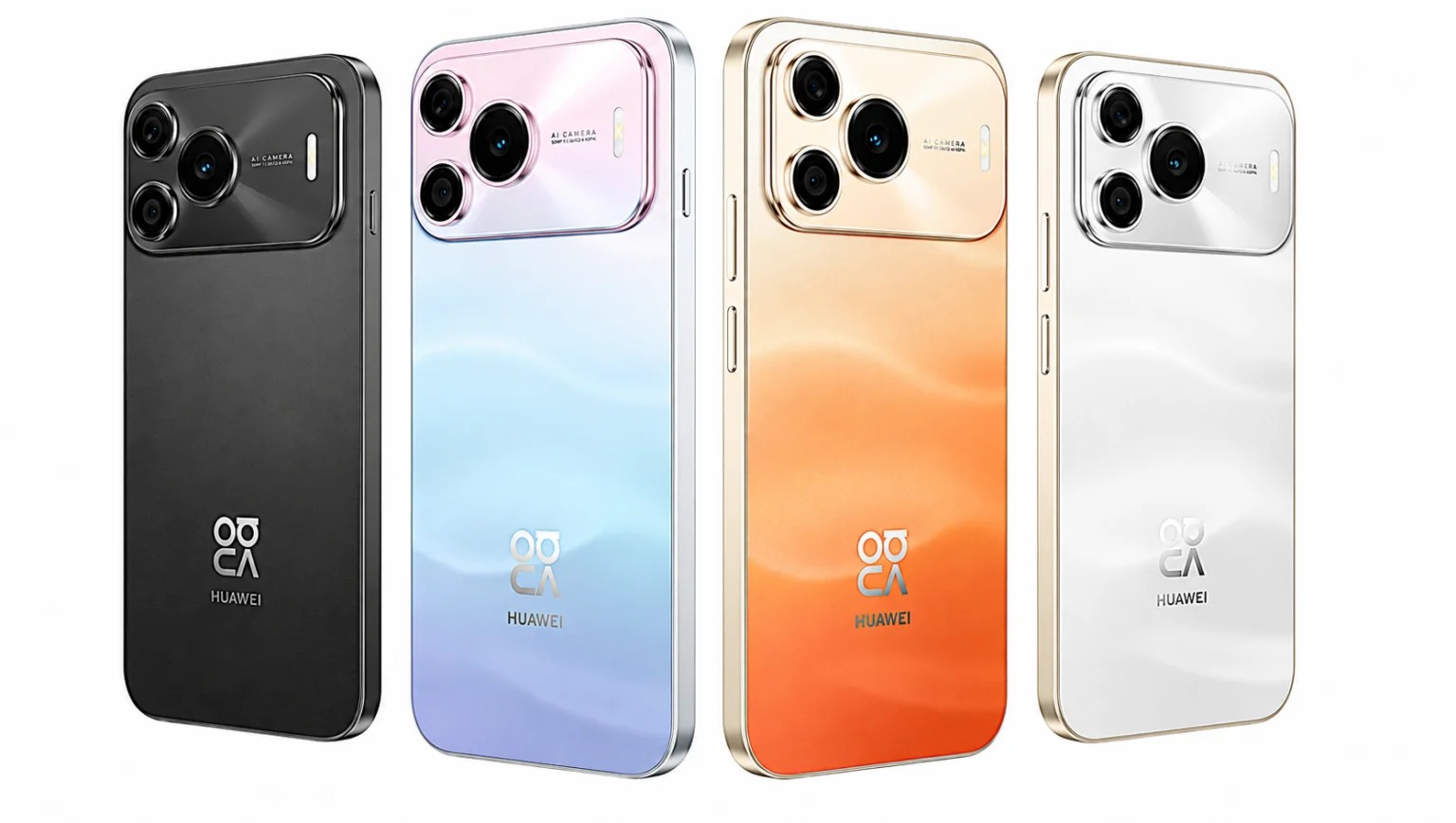
The SE name is a return for Huawei — the last one was the nova 12 SE in 2024 — and this lands as the fifth, and likely final, member of the nova 16 family. It’s a China-only launch for now, so treat any peso figure as a direct conversion rather than a local SRP. With that out of the way, let’s see what an 8,500mAh Huawei actually looks like on paper.
Design & Build Quality
The nova 16 SE measures 163.3 x 78 x 8mm and weighs 229 grams — chunky by 2026 standards, but that’s the price of a phone this big on battery. In hand it feels dense and solid.
Huawei went with a flat frame and rounded corners, and the rear carries a camera island with three openings: the main lens, the color sensor, and the flash. The materials story is an aluminum alloy frame with a fiberglass back panel, though GSMArena’s listing reads slightly differently — a reminder that early spec sheets from China sometimes disagree until retail units ship.
You get four finishes: Starry Black, Sky White, Dawn Orange, and Sakura Sky, with gradient-tinted backs that carry the visual language of the rest of the nova 16 series. The side-mounted fingerprint scanner is physical and fast, and there’s an IR blaster up top — a feature that’s quietly disappearing from phones at every price. There’s no 3.5mm headphone jack, which is increasingly common even in budget hardware, but you do get dual stereo speakers rated as super-linear units.
The durability story is the interesting one. Notebookcheck and Gizmochina both list IP66, IP68, IP69, and IP69K ratings — the same quadruple certification we saw on the Oppo A7 Pro Max — while GSMArena’s launch story simplified it to IP65. The multi-rating claim is the more specific one, and if it holds, this is one of the most water-resistant battery phones on the market.
Display
The 6.84-inch flat OLED is the second headline feature. It runs at 2756 x 1272 (Huawei calls it 1.5K), with a 120Hz refresh rate, 10-bit color, 300Hz touch sampling, and high-frequency PWM dimming — Huawei’s own materials say 2,160Hz, while a couple of outlets list 1,440Hz, so take the exact figure with a grain of salt. Either way, flicker-sensitive readers should be comfortable here.
Then there’s the 8,000 nits claim, and I want to be straight about it: GSMArena footnotes it as a local peak brightness “measured at an isolated spot during video playback only.” It’s not full-screen sustained brightness — no panel holds 8,000 nits across the whole display. What it does mean is punchy HDR highlights and strong outdoor visibility. Having squinted at phones under the Philippine sun for years, I’d call that a meaningful advantage, even if the marketing number deserves a skeptical eyebrow.
Aluminosilicate glass protects the panel, and at roughly 90% screen-to-body ratio, the flat design doesn’t feel dated.
Performance
Under the hood is the Kirin 8020 — the same chip that powers the nova 16z — an octa-core part with one 2.29GHz prime core, three 2.05GHz performance cores, four 1.3GHz efficiency cores, and a Maleoon 920 GPU. Huawei calls it its “latest mid-range chipset,” and the numbers back that up.
AnTuTu v11 scores for sibling Kirin 8020 devices sit around 1.02 to 1.16 million, with Geekbench 6 results near 1,389 single-core and 4,125 multi-core. Those figures come from other nova and Pura models since the SE is brand new, but the chip is identical, so expectations should carry over.
Here’s why that matters: the big-battery segment has mostly been a slow-phone club. The Galaxy F70 Pro’s Snapdragon 6 Gen 3 scores around 570,000 to 626,000 in AnTuTu, and the Oppo A7 Pro Max’s Snapdragon 4 Gen 5 lands near 976 single-core and 2,250 multi-core in Geekbench. The nova 16 SE is meaningfully faster than both — the quickest of the battery kings by a comfortable margin. If you want to benchmark it yourself once units ship, my Geekbench 7 guide walks through the whole process.
Storage comes in 128GB, 256GB, or 512GB with no microSD slot, and RAM is the odd gap — Huawei hasn’t officially disclosed it, though pre-launch listings pointed to 12GB. Treat that as unconfirmed. The Maleoon 920 GPU is the weakest link: fine for daily use and light gaming, but don’t expect flagship frame rates on heavy titles. The chip also supports 5G-Advanced (5A) networking, which is future-proofing more than anything you’ll feel today.
Camera
The rear setup is a 50MP RYYB main camera with an f/1.9 aperture, a 1/1.56-inch sensor, dual-pixel PDAF, and OIS, paired with a 1.5MP Red Maple color sensor. RYYB is Huawei’s signature move — it swaps green pixels for yellow to capture more light — and the Red Maple unit is a multispectral sensor that exists purely to improve color reproduction. Huawei says it’s the first color-camera setup in a pocket-friendly phone.
The front is a 32MP f/2.2 selfie shooter, and both cameras record 4K at 30fps with gyro-EIS. There’s 10x digital zoom, but no optical telephoto — and here’s the honest catch: no ultrawide either. The “dual camera” is main plus color sensor, not main plus ultrawide. That’s the biggest camera compromise on the spec sheet, because the rivals in this price band — the Redmi Note 17 Pro included — nearly all ship a wide-angle lens.
You also get AI-assisted modes carried over from the nova 16 family: AI photo editing, AI composition help, and Xiaoyi assistant integration. The main sensor with OIS should handle low light well, and the color sensor’s whole job is to make those RYYB shots look natural instead of oversaturated. Until review units land, the camera verdict is “promising on paper, unproven in practice.”
Battery & Charging
This is the main event. The nova 16 SE carries an 8,500mAh silicon-carbon cell — a spherical, high-energy-density unit that Huawei says delivers the longest backup of any nova SE phone. It’s the same battery family as Huawei’s hugely popular Enjoy 90 Pro Max, and the chemistry is what lets Huawei fit this much capacity into an 8mm-thick body.
Charging is 66W wired plus 5W reverse wired. 66W isn’t the fastest in class — the Oppo A7 Pro Max does 80W and some rivals push 100W+ — but it’s adequate for a cell this size; expect a full charge in comfortably over an hour. Early reviews claim two to three days of typical use, which tracks with the capacity, though I’d wait for independent endurance tests before promising anyone a specific number — battery claims are reliably optimistic.
In context, the nova 16 SE sits right in the middle of the battery-king lineup I’ve covered recently: the Poco M8 Power packs 8,000mAh, the Redmi Note 17 Pro 9,000mAh, and the Oppo A7 Pro Max a staggering 10,000mAh. Huawei’s 8,500mAh isn’t the biggest — but it’s the only one of the group with a proper mid-range chipset and satellite messaging.
Software
The nova 16 SE runs HarmonyOS 6.1, and this is where the conversation gets serious outside China. HarmonyOS is built on Huawei’s own architecture, not Android — no Google Play Services, no Android app compatibility on the China-market unit. You get AppGallery, the Xiaoyi assistant, and deep integration across Huawei’s watches, earbuds, tablets, and laptops.
For Philippine buyers, that’s the single biggest reason to think twice. GCash, Maya, and most local banking apps are Android apps — they won’t run out of the box, and neither will Google’s core apps. If you’re already importing Huawei devices, you know the trade-offs. If you’re not, this is a fence you need to climb before you ever touch the battery.
The headline feature is two-way BeiDou satellite messaging: text and photo messages, emergency SOS, and even weather checks from areas with no cellular coverage. For anyone who treks or works in far-flung provinces, it’s a genuinely useful safety net. Huawei hasn’t published an update commitment for the nova 16 SE specifically, so I’ll flag that as unverified rather than guess.
Pros and Cons
| Pros | Cons |
|---|---|
| 8,500mAh silicon-carbon battery with 66W charging | China-only launch — no official PH price or warranty |
| Kirin 8020 is the fastest chip in the big-battery segment | No Google services — HarmonyOS 6.1 won’t run GCash or most bank apps |
| Two-way BeiDou satellite messaging with emergency SOS | No ultrawide camera — the second rear lens is just a color sensor |
| IP66/IP68/IP69/IP69K multi-ratings for dust and water | No optical telephoto — 10x digital zoom only |
| 50MP RYYB main camera with OIS and Red Maple color sensor | RAM not officially disclosed; no microSD expansion |
| 8,000-nit local peak display and 120Hz OLED | 66W charging trails the 80-100W rivals |
| Wi-Fi 7, Bluetooth 6.0, IR blaster, and stereo speakers | 229g weight and no 3.5mm headphone jack |
Should You Buy This?
Buy it if
- You want a genuine two-to-three-day phone and don’t want to sacrifice chipset performance to get it.
- You’re already in the Huawei ecosystem and comfortable with AppGallery instead of Google Play.
- You work or travel in areas with spotty coverage — satellite messaging is a real safety net.
- You’re in China, or you’re comfortable importing and skipping official PH support.
Skip it if
- Your daily apps are GCash, Maya, or a local banking app — they will not run on this phone out of the box.
- You need a wide-angle camera for group shots and travel photos.
- You want an official Philippine launch, warranty, and after-sales service.
- You’re chasing the biggest battery number — the Oppo A7 Pro Max’s 10,000mAh still rules that hill.
Final Verdict
The nova 16 SE is the most complete battery-first phone I’ve seen in this 2026 wave. Huawei didn’t just bolt a huge cell onto a budget board — it paired the 8,500mAh battery with a genuinely capable chipset, an OIS main camera, quadruple IP ratings, a bright OLED, and satellite messaging. On hardware alone, it’s the pick of the battery-king litter.
The catch is everything around the hardware: a China-market phone running HarmonyOS without Google services, no official PH price, no local support. The base 128GB model converts to roughly PHP 21,000-22,000 — competitive against the Huawei Pura 90 — but the real cost is app compatibility and warranty coverage, not the sticker.
So who is this for? Enthusiasts who already live in the Huawei ecosystem and want the definitive battery phone. Importers who know how to work around app gaps. Anyone whose next phone must survive two days off a charger without compromising performance. For everyone else in the Philippines, wait for a local launch or check whether the app gap is a dealbreaker first. The hardware deserves your attention. The ecosystem deserves your caution.