
The Galaxy Z Fold8 Ultra is the phone the foldable line has been circling for years. While the passport-style Galaxy Z Fold8 stole the spotlight at Galaxy Unpacked 2026, the Ultra is the true heir to the Z Fold7 — the book-style flagship that finally gets the battery capacity, the charging speed, and the camera hardware this form factor has always deserved. It goes on sale worldwide this week, and Samsung says the entire Z8 trio — Fold8, Fold8 Ultra, and Flip8 — already set a pre-order record in Europe.
Design & Build Quality
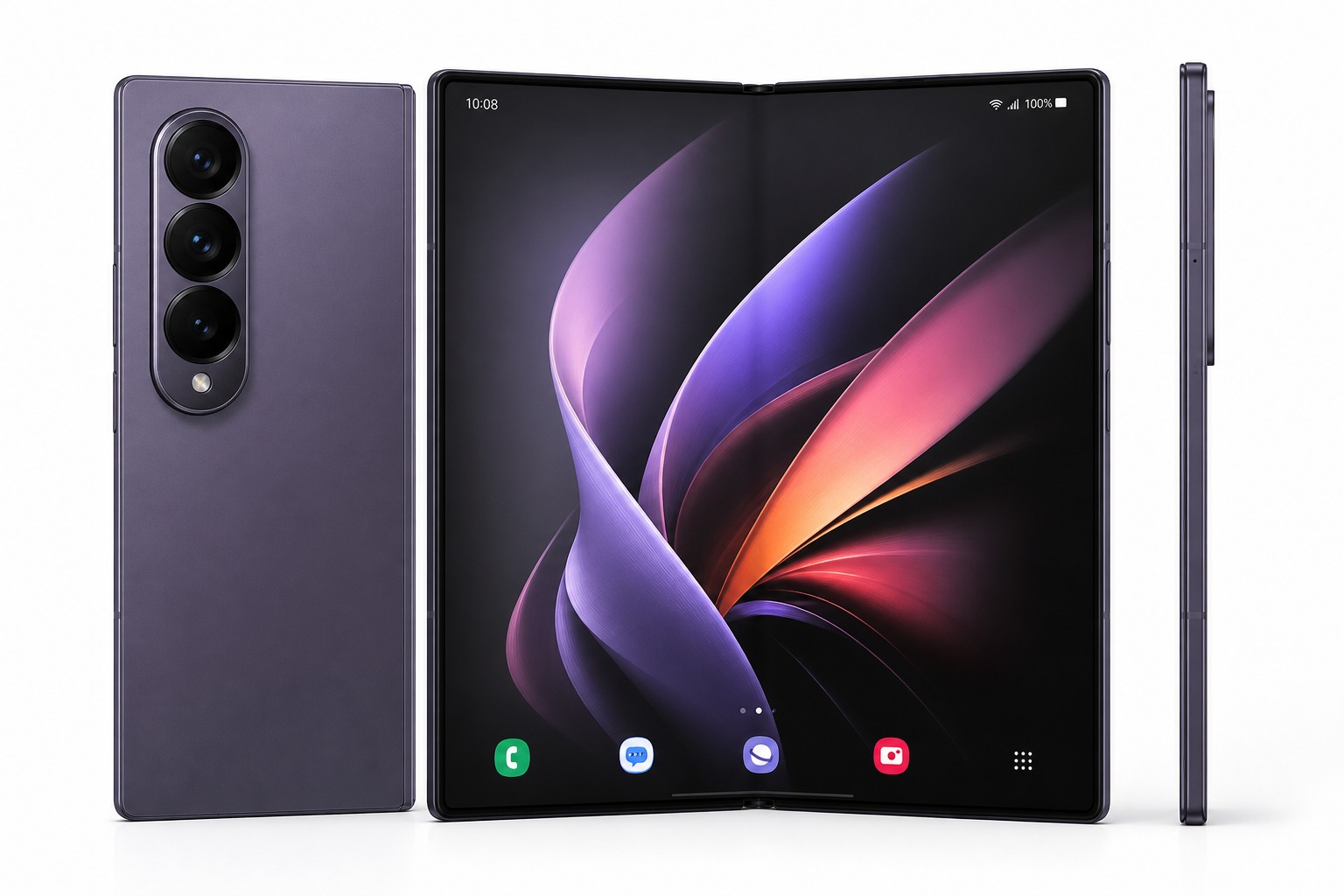
At 4.1mm when unfolded, the Z Fold8 Ultra is the thinnest Galaxy Z Fold Samsung has ever produced. Fold it shut and you get a compact 158.4 x 72.8 x 8.9mm slab that weighs 215g — the same weight as the Z Fold7, which is remarkable once you remember the battery inside grew by 600mAh. The frame is Samsung’s Advanced Armor Aluminum, the cover screen front uses Gorilla Glass Victus Ceramic 3, and the back is Victus 2.
Around the sides you’ll find a side-mounted fingerprint reader, USB-C 3.2, and stereo speakers. There’s no 3.5mm headphone jack, which I’d expect at this price tier, and no microSD slot — you pick your storage at checkout. The phone keeps the IP48 rating: officially dunkable to 1.5m for 30 minutes, with dust protection rated only for particles above 1mm, so beach trips are still a no-no.
The headline color is Violet Shadow, and it genuinely looks great in person — a deep, moody purple that reads premium. Graphite and Cream round out the lineup, with a Green Shadow finish exclusive to Samsung.com. The new Flex Titanium construction sandwiches a titanium-alloy film over an enhanced titanium plate to make the panel more resilient to pressure and impact. Samsung claims it also reduces crease visibility over time. I’ll be honest: early hands-on impressions are split. GSMArena’s demo unit still showed a fairly prominent crease — more so than on the standard Fold8 — while later full reviews describe a less noticeable crease than the Fold7’s. Expect an improvement, not a miracle.
One thing to flag before you get excited: the Z Fold8 Ultra does not support the S Pen. Samsung dropped stylus support on the Fold7 and it did not return this year, on either book-style model. If you were holding out for a flagship foldable with a digitizer, this isn’t it.
Display
Open the Ultra and you’re greeted by an 8.0-inch Dynamic LTPO AMOLED 2X panel at 2504 x 2256, a big jump from the Fold7’s 1968 x 2184. That works out to 422ppi and a squarish 9.99:9 aspect ratio that makes reading PDFs, editing spreadsheets, and split-screen multitasking feel natural. The 1–120Hz adaptive refresh rate is still there, as is Vision Booster for outdoor visibility.
Samsung rates the main display at up to 3,000 nits peak brightness. Treat that figure the way you should treat any marketing brightness number — it’s a local peak, not full-screen sustained output. What matters more in practice is the new anti-reflective coating, which GSMArena says makes the panel noticeably easier to read under direct light. The cover screen is a 6.5-inch FHD+ Dynamic AMOLED 2X at 1080 x 2520, also 120Hz, protected by Gorilla Glass Victus Ceramic 3. It’s a proper usable phone screen, not just a notification strip.
Performance
Under the hood sits the Snapdragon 8 Elite Gen 5 for Galaxy, built on a 3nm process with two 4.74GHz Oryon V3 prime cores and six 3.62GHz performance cores, backed by the Adreno 840 GPU. It’s the same chip across all regions this year — no Exynos split like the Flip8 gets outside North America. RAM comes in 12GB or 16GB with 256GB, 512GB, or 1TB of UFS 4.x storage, and Samsung fitted an expanded graphite cooling structure to keep the foldable from throttling under load.
In our Geekbench runs on other Snapdragon 8 Elite Gen 5 devices, the platform lands around 3,600–3,800 single-core and 10,700–11,500 multi-core, with AnTuTu scores in the 3.7–3.9 million range. Expect the Ultra to sit in that same ballpark, though sustained performance on a foldable is always at the mercy of thermals — thin chassis, big unfolded surface, and all. There was also an early benchmark controversy where review units blocked Geekbench from launching; Samsung said those units weren’t running final software, so I’d take any leaked pre-release numbers with a grain of salt.
Day to day, this is easily the fastest foldable I’ve seen on paper. Heavy multitasking with three apps open on the 8-inch screen, exporting 8K clips, running local AI tasks — the Ultra has headroom for all of it. The 12GB base config is plenty, but power users who keep everything open will appreciate the 16GB tier.
Camera
The camera system is where the Ultra finally separates itself from the pack. The main shooter is a 200MP sensor with an f/1.7 lens, OIS, and Quad Pixel autofocus — the same class of sensor as the S26 Ultra. Samsung even added HDR support in full 200MP mode this year. The ultrawide jumps from 12MP on the Fold7 to 50MP with an f/1.9 lens and 120° field of view, a meaningful upgrade for landscapes and group shots. The third lens is a 10MP telephoto with 3x optical zoom and OIS.
Video is a genuine highlight: 8K recording at 30fps through the new APV codec, 4K at up to 120fps, and Cine LUT for cinematic color grading straight out of the camera. Improved Nightography brightens low-light shots without turning the sky into mush.
Now the honest part. There’s still no periscope lens, so 3x optical is where the zoom story ends — PhotographyTalk put it best: the Ultra is “one lens short of a true flagship.” And while the 50MP ultrawide looks great on paper, GSMArena’s hands-on was cautious about real-world gains, noting we didn’t see dramatic improvements when Samsung made the same ultrawide jump on the S25 Ultra. Early owner impressions are mixed too — one new owner on GSMArena said they’re “really impressed” but “not sure about the camera.” The 10MP selfie cameras on the inner and cover screens are unchanged and fine, nothing more.
Battery & Charging
This is the section Fold fans have been waiting years for. The Z Fold8 Ultra packs a 5,000mAh silicon-carbon battery — Samsung’s first Si/C cell in a Galaxy Fold — a 14% jump over the Fold7’s 4,400mAh, achieved without adding weight. Wired charging finally leaves the old 25W ceiling behind: 45W gets you to about 67% in 30 minutes and a full charge in roughly an hour, helped by a new dual-path architecture that charges both cells inside the phone simultaneously. Wireless charging is 20W over Qi2.2, with 4.5W reverse wireless for topping up buds or a watch.
The endurance numbers back up the spec sheet. GSMArena’s active use score is 13:06, and its leaked EU energy label rates the Ultra at 51 hours of endurance versus 40:28 for the Fold7 — around 20% better. Smartprix’s review unit comfortably made it through a full day of mixed use with 6–8 hours of screen-on time. That finally puts a book-style Galaxy Fold on par with the candy-bar flagships instead of trailing them.
One caveat for buyers: the 45W adapter is sold separately, and the box only includes a USB-C cable. If you’re upgrading from an older Samsung, dig out your 45W charger or budget for one.
Software
The Z8 series is the first to ship Android 17 out of the box, running One UI 9 — and Samsung promises up to seven major OS upgrades. That’s the strongest longevity pledge in the foldable space, full stop.
One UI 9 leans hard into agentic Galaxy AI. Now Brief surfaces personalized morning summaries, and Now Nudge can open Multi Window automatically when it detects a conversation that needs two apps at once — a genuinely foldable-native feature. Gemini Intelligence is built in, and Gemini Notebook lets you drag files into Split View to build reports or meeting recaps. On the security side, Knox Vault and the Personal Data Engine keep on-device AI data sandboxed, and a new AI Assistant Activity dashboard shows you every action the assistant took on your behalf. Privacy Alerts now flag apps poking at background permissions before it becomes a problem.
Is all of it essential? No — agentic AI is still finding its footing, and some of these features feel like demos of tomorrow. But the foundation is solid: this is the first foldable I’d trust to run a small business from, between DeX desktop mode, UWB, and the update commitment.
Pros and Cons
| Pros | Cons |
|---|---|
| 5,000mAh silicon-carbon battery with 45W wired charging — finally competitive | 45W power adapter sold separately |
| 200MP main camera with HDR mode plus a big 50MP ultrawide upgrade | No periscope telephoto — 3x optical zoom max |
| Thinnest Galaxy Z Fold yet at 4.1mm, same 215g as the Fold7 | Crease still visible despite Flex Titanium claims |
| 8-inch 422ppi display with anti-reflective coating | No S Pen support — dropped since the Fold7 |
| Android 17 out of the box with 7 major OS updates | ₱123,990 starting price is ₱14,000 more than the standard Fold8 |
| Expanded graphite cooling keeps the Snapdragon 8 Elite Gen 5 composed | No microSD expansion — storage is fixed at purchase |
Should You Buy This?
Buy it if
- You live in split-screen view and want a real productivity workstation in your pocket.
- You’ve been waiting for a foldable whose battery and charging finally match its price tag.
- You want flagship-class 200MP main and 50MP ultrawide cameras on a book-style fold.
- Seven years of OS updates matter to you — this is the longest-supported foldable money can buy.
Skip it if
- You rely on the S Pen — Samsung removed stylus support and it isn’t coming back this generation.
- You shoot a lot of telephoto; 3x optical with no periscope will frustrate you.
- You don’t need the book format — the Galaxy Z Flip 8 covers most people’s foldable itch for ₱45,000 less.
- Your budget is tight — the passport-style Galaxy Z Fold8 starts ₱14,000 cheaper with the same chip.
Final Verdict
The Galaxy Z Fold8 Ultra answers the two complaints that have dogged Samsung’s big foldables for years: weak battery life and slow charging. Five thousand milliamp-hours of silicon-carbon cells and 45W charging transform this from a beautiful compromise into a genuinely all-day device, and the leap to a 200MP main camera with a 50MP ultrawide closes most of the gap to the S26 Ultra. It’s the most complete book-style foldable Samsung has ever shipped.
It’s not perfect, and the omissions are deliberate. No S Pen, no periscope zoom, a crease that’s improved but still there, and a price that crept up as component costs climbed — the memory shortage ripple effects are real in this generation. At ₱123,990 for the 256GB model in the Philippines, you’re paying flagship money, and the S26 Ultra or iPhone 17 Pro Max will give you sharper zoom in a more traditional package. But neither of those unfolds.
For the Filipino buyer, the timing is good: pre-orders run until August 13 with a free storage upgrade, up to ₱14,000 trade-in value, and three months of Samsung Care+, which softens the sticker shock. Just remember the charger isn’t in the box.
Who is the Z Fold8 Ultra for? The professional who lives in apps and needs a screen that opens like a laptop, a battery that lasts a business trip, and long-term software support behind it. It’s the power-maxxing choice in Samsung’s foldable lineup — and for the first time, it finally feels worth the premium.