
For years, the Galaxy Z Fold was the phone for a specific kind of tech enthusiast — someone willing to carry a tall, narrow brick that unfolded into a tablet. Samsung just rewrote that formula. The Galaxy Z Fold8, launched on July 22 at Unpacked London, is a completely different shape: a wide, passport-sized device that folds down to something that actually feels like a normal phone. And the market has responded in a way nobody predicted — the Z8 trio racked up 1.44 million pre-orders in South Korea, finally beating the Galaxy Note10’s seven-year record, with the Fold8 alone accounting for 70% of that demand.
Design & Build Quality
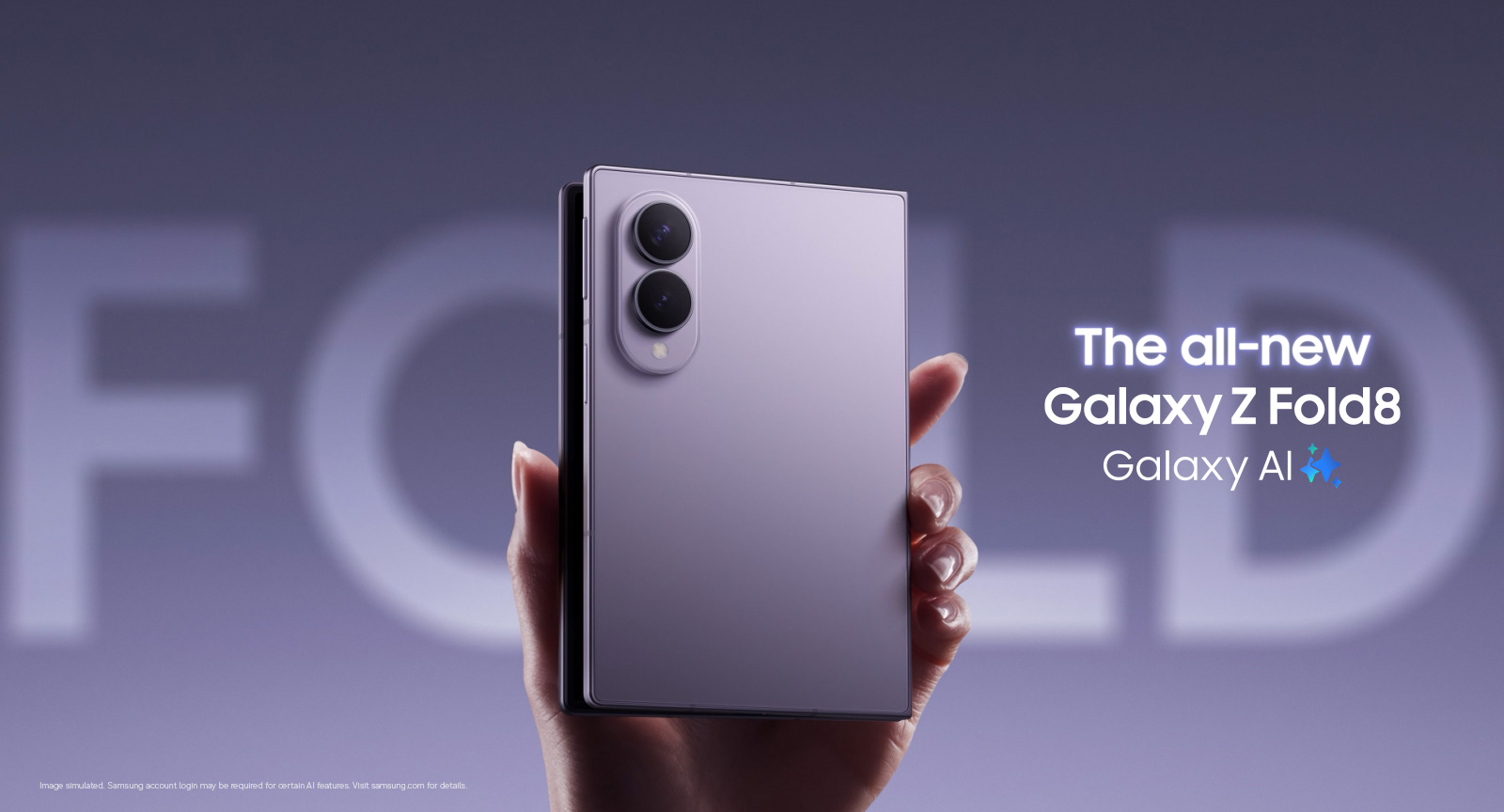
Hold the Fold8 closed and you’ll understand the hype immediately. At 81.9mm wide and 9.7mm thick, it’s built around a 10:16 cover screen — close to the proportions of a regular phone instead of the remote-control shape of previous Folds. Samsung says it’s the lightest Z Fold ever at 201g, and it genuinely feels like a flagship slab in your pocket rather than a compromise.
The build quality matches the price. You get Gorilla Glass Victus Ceramic 3 on the cover, Gorilla Glass Victus 2 on the back, an Advanced Armor aluminum frame, and an IP48 rating — dust resistance finally makes the spec sheet, though it’s rated for particles larger than 1mm rather than the full IP68 of most flagships. The side-mounted fingerprint reader sits naturally under the thumb, and early reviews praise the hinge’s smooth, damped motion.
Colors are Graphite, Cream, Lavender, and Pistachio (the last one is a Samsung online exclusive). The Lavender colorway is subtle and classy — no gimmicky gradients here. Samsung’s Flex Titanium display structure, a titanium-alloy film over a titanium plate, is what lets it stay this thin while keeping the hinge stable, and reviewers note the crease is less visible than on older Folds. If you want to see how the whole lineup was introduced, my full Samsung Unpacked 2026 recap breaks down every announcement.
Display
The cover screen is the star of this phone. At 5.5 inches with a 1248 x 1972 resolution and 428ppi, it’s not just a notification glance — you can actually type on it, and GSMArena found typing and scrolling Instagram on it to be an excellent experience. It’s a Dynamic LTPO AMOLED 2X panel with 120Hz refresh, and while its 1,468 nits of auto brightness doesn’t top any charts, it’s perfectly usable outdoors.
Unfold it and you get a 7.6-inch Foldable Dynamic LTPO AMOLED 2X with a 4:3 aspect ratio, 1828 x 2448 resolution, and a claimed 3,000 nits peak brightness. That’s not marketing fluff — GSMArena’s lab measured 3,131 nits in a 10% window and 1,525 nits with auto brightness enabled. The 4:3 ratio is the whole point: rotate it and it becomes a natural reading canvas, or keep it landscape for games and movies without the letterboxing you got on tall, skinny Folds.
Both panels handle dynamic refresh rates beautifully, dropping to 30Hz for 30fps video and even 24Hz for 24fps content — behavior most phones can’t match. The crease, thanks to Flex Titanium, is present but far less visible than on the Z Fold7 or the Galaxy Z Flip 8. At minimum brightness the main display dips to 0.9 nits, which is comfortable for late-night reading.
Performance
Inside is the Snapdragon 8 Elite Gen 5 for Galaxy, Samsung’s overclocked 3nm variant with 2×4.74GHz Oryon V3 Phoenix L cores and 6×3.62GHz Phoenix M cores, backed by the Adreno 840 GPU. There’s no performance compromise for choosing the new form factor — this is the same silicon that powers the Fold8 Ultra. My Geekbench 7 guide explains how to read these numbers if you want to test your own unit.
In benchmarks, the Fold8 posts an AnTuTu score around 2.2 million (v10) and a GeekBench 6 score of about 10,600 — firmly flagship territory. Day-to-day, the phone sails through multitasking, and the two-way and three-way split views on the big canvas are where this form factor earns its keep. Paired with 12GB of LPDDR5X RAM (16GB on the 1TB model) and fast UFS 4.x storage, there’s zero lag switching between apps or running AI features.
One honest caveat: GSMArena flagged heavy throttling and noticeable heat under prolonged loads. Push sustained gaming or long 4K renders and the phone does slow down more than the Ultra. For normal use — social media, video, browsing, light gaming — you won’t notice it, but thermal enthusiasts should temper expectations. Also note there’s no microSD slot, so pick your storage tier (256GB, 512GB, or 1TB) carefully.
Camera
Here’s where the Fold8 makes its biggest compromise, and Samsung doesn’t hide it. The rear is a dual 50MP setup: a GN3 main sensor with f/1.8 aperture and OIS, plus a 50MP ultrawide with autofocus. The main camera is essentially the one from the vanilla Galaxy S26, and the ultrawide matches the S26 Ultra’s — but there is no telephoto lens at all. On a phone that starts at ₱109,990, that’s a hard pill to swallow.
Daylight photos are genuinely good. GSMArena found excellent contrast, dynamic range, white balance, and vibrant colors, with strong portrait-mode subject detection. Detail is where it falls short — images lack the absolute sharpness you’d expect at this price, and 2x zoom shots show aggressive sharpening that makes foliage look unnatural. The 50MP mode can extract extra detail outdoors, but it gets gritty in tricky light.
The ultrawide is arguably the more impressive of the two. It has very good detail even indoors, lively colors, accurate white balance, and the autofocus capability is a real upgrade — you can shoot close-ups with it. Low light is the main camera’s weak spot, with noise creeping into shadows and a general softness that GSMArena describes as not flagship-grade.
Video is where the Fold8 punches back. You get 8K@30fps, 4K@120fps, 10-bit HDR10+, Log recording with LUTs, the pro-grade APV codec, and superb stabilization. Dual Recording lets you capture both sides at once, and My FanCam auto-tracks a subject and reframes it for social. Samsung even threw in Horizon lock. If you’re a content creator who shoots from the phone, the feature set is genuinely extensive — arguably the best part of the camera package.
Battery & Charging
The Fold8 packs a 4,800mAh silicon-carbon battery — only 200mAh smaller than the Ultra — and it delivers respectable all-day life. GSMArena’s active use score came to 13 hours 59 minutes, which comfortably covers a full day of mixed use. Samsung rates the cell to retain 80% capacity after 1,200 charge cycles, so it should age well.
Charging is the headline improvement: 45W wired, the fastest charging rating any Samsung foldable has ever shipped, with 63% in 30 minutes. Wireless is 20W with reverse wireless at 4.5W. It’s still behind Chinese competitors’ 80W-plus bricks, and Samsung doesn’t include a charger in the box — just a 3A Type-C cable — so factor that into the total cost. Still, for a Fold, this is a meaningful step up from the 25W days.
Software
The Fold8 runs Android 17 with One UI 9 and a genuinely class-leading commitment: seven major OS upgrades, per GSMArena’s spec sheet. That puts it ahead of almost everything else on the market — for context, the midrange Galaxy F70 Pro I reviewed last week promises six years. If you buy this phone for the long haul, Samsung has your back.
One UI 9 is tuned for the wide canvas — two-way and three-way split views, easy window drag-and-drop, and a customizable home screen that makes the 4:3 display feel productive. Galaxy AI is threaded throughout with photo editing, generative tools, and Gemini integration. Samsung DeX works beautifully with the USB video output, turning the Fold8 into a desktop when you need it — a feature set that keeps it relevant for years.
Pros and Cons
| Pros | Cons |
|---|---|
| New passport-style form factor that finally works as a phone | Very expensive at ₱109,990 and up |
| Lightest Z Fold ever at 201g, excellent build and hinge | No telephoto camera — dual 50MP only |
| Blazing 3,000-nit main display with 4:3 canvas | Main camera hardware underwhelms for the price |
| All-day battery with fastest-ever Samsung foldable 45W charging | Heavy throttling and heat under sustained loads |
| Seven years of OS and security updates | Speakers are average with weak stereo separation unfolded |
| Excellent video features: 8K, Log, APV codec, Dual Recording | No charger in the box, no microSD expansion |
| Record-breaking pre-orders show real consumer demand | IP48 dust rating is partial, not full IP68 |
Should You Buy This?
Buy it if
- You want a foldable that feels like a normal phone when closed — usable cover screen, pocket-friendly width
- You read, game, or watch video in landscape and want a 4:3 canvas with no letterboxing
- You value the longest possible software support and keep phones for 4-5 years
- You’re a creator who shoots a lot of video and wants 8K, Log, and pro codecs in your pocket
Skip it if
- Camera quality is your top priority — no telephoto and a mid-grade main sensor won’t satisfy you at this price
- You’re on a budget — the Fold8 Ultra is only about $200 more in the US and brings a 200MP camera with a real telephoto
- You play heavy games for hours — the thermal throttling will frustrate you
- You need expandable storage or a headphone jack
If camera is truly non-negotiable, the Z Fold8 Ultra is the traditional tall Fold with the 200MP sensor, and it’s the smarter pick for photographers. But it’s larger, bulkier, and heavier — the exact trade-off this phone exists to avoid.
Final Verdict
The Galaxy Z Fold8 is the first foldable I’d genuinely recommend to someone who doesn’t already want a foldable. The passport proportions solve the problem that kept the category niche: when closed, it’s a real phone. When open, it’s a brilliant media and multitasking canvas. The record pre-orders — 1.44 million in Korea alone, beating every Galaxy before it — suggest I’m not alone in thinking that.
Samsung made the compromise visible: the camera is mid-tier by flagship standards, and no amount of clever video features fully compensates for the missing telephoto at this price. The memory shortage squeezing component costs didn’t help either — as I wrote in my analysis of the memory price surge, premium hardware is only getting more expensive. But if you accept what it is — an immersive, beautifully built, exceptionally durable foldable with best-in-class software support — there’s very little to dislike.
This is a phone for people who live on their screens: the commuter who reads on the way to work, the traveler who wants a tablet without carrying a second device, the creator who wants to shoot and edit in one hand. It’s not the ultimate camera phone, and it’s not cheap. It is, however, the most convincing argument yet that foldables are the future of the flagship — and the fact that it’s outselling the S-series for the first time ever is proof the public agrees.