
Redmi built its name on flagship specs at midrange prices, and the K100 Pro is that philosophy hitting a new level. It launches in China on August 11 with an 8,580mAh silicon-carbon battery, a 200MP main camera with OIS that Redmi has officially confirmed, and a special glow-in-the-dark finish called Firefly Light Chaser. The catch: it is a China-only release at around CNY 4,000, and it ships with the China ROM of HyperOS, which means no Google services out of the box.
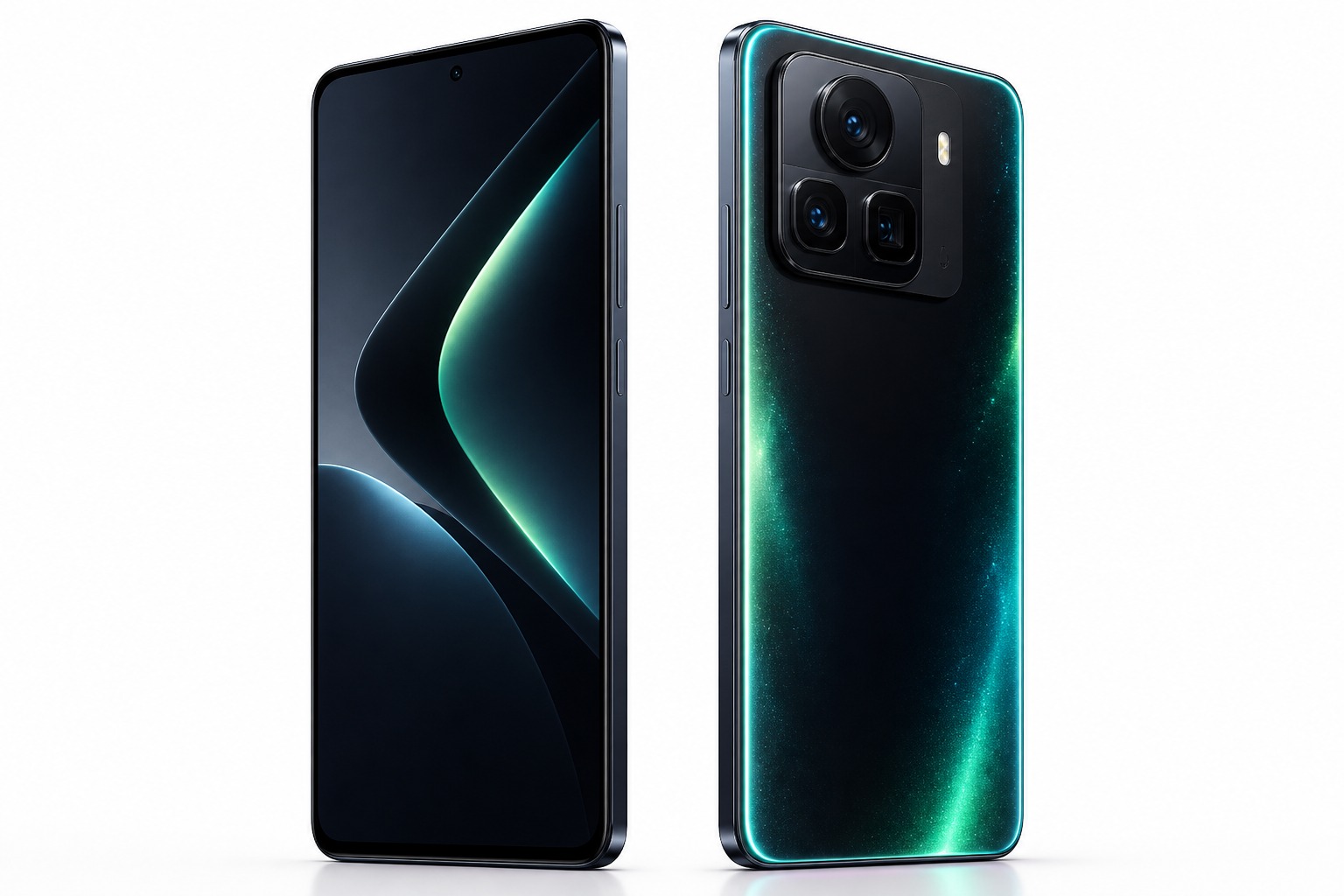
This is the middle sibling of Redmi’s new K100 trio. The K100 Pro Max takes the crown with a 9,070mAh cell and a 6.9-inch 2K panel, while the standard K100 arrives later. The Pro sits between them, and honestly, it might be the one most people should watch.
Design & Build Quality
The headline feature here is the Firefly Light Chaser finish. Redmi says the back panel absorbs light during the day and glows softly at night — a genuinely unusual touch that I have not seen from a mainstream flagship before. It is the kind of thing that makes people ask “what phone is that?” in a dark room.
There is also a White variant for anyone who prefers something subtle. The build itself is familiar Redmi flagship territory: an aluminum frame, a glass-fiber reinforced plastic back, and Xiaomi’s Dragon Crystal Glass protecting the front. The redesigned camera island sits on a floating module with a large main lens, an ultrawide, and a periscope telephoto.
GSMArena’s preliminary sheet lists IP68 and IP69 dust and water resistance, which would match the K100 Pro Max. Dimensions and weight have not been revealed yet, so expect a chunky phone — a nearly 8,600mAh battery does not fit into a slim body. My guess is you will feel it in the pocket, but that is the trade-off for this kind of endurance.
Display
Redmi confirmed a 6.59-inch AMOLED with a 185Hz refresh rate. That refresh rate is the spec that gets all the attention, but the rest of the panel matters more. GSMArena lists 2,560Hz PWM dimming, which is genuinely good news for flicker-sensitive eyes, plus Dolby Vision, HDR Vivid, and HDR10+ support.
The resolution is the one gap in the official reveal. GSMArena’s preliminary page lists 1,200 x 2,608, but that figure may belong to the Pro Max’s 6.9-inch panel — Redmi has not officially confirmed the Pro’s exact resolution yet. I would not lose sleep over it; at this size class, even a 1.5K-class panel looks sharp.
Realistically, 185Hz is mostly headroom. Most games cap out around 120-144fps, and the added smoothness in scrolling is nice but not life-changing. What matters more is that this looks like a proper flagship-grade AMOLED with narrow bezels and strong peak brightness, which the Pro Max’s 4,500-nit figure suggests the family is aiming for.
Performance
The K100 Pro runs the Snapdragon 8 Elite Gen 5 V (SM8850-1-AB). The “V” suffix is a real spec difference, not marketing — the Pro Max uses the plain Snapdragon 8 Elite Gen 5 (SM8850), and the two chips are not the same silicon. The V variant pairs two Oryon V3 Phoenix L cores at up to 4.6GHz with six Phoenix M cores, an Adreno 840 GPU, and a 3nm process.
Redmi claims 4.09 million on AnTuTu, plus a dedicated graphics chip and a 3D circulating cold-pump cooling system. That cooling matters: sustained gaming is where these silicon-carbon flagships usually get hot. The iQOO 15T with its Dimensity 9500 Monster Edition is the direct rival here, and the Z Fold8 Ultra runs the same Elite Gen 5 family — so this is a proven, fast platform, even if the V variant’s exact tuning is new.
Memory options run from 256GB with 12GB RAM up to 1TB with 16GB RAM, all UFS 4.1. There is no microSD slot and no 3.5mm headphone jack, which is now standard for this class. GSMArena commenters are split on the V chip — one asked whether it is a real upgrade over the previous generation for heavy gaming, and another just shrugged at “Snapdragon 8 Elite Gen 5? Seriously?” — but the honest answer is that we will not know how the V variant sustains performance until retail units are in reviewers’ hands.
Camera
Here is the interesting twist: the 200MP OIS main camera is officially confirmed on the K100 Pro, while the more expensive Pro Max’s 200MP is still listed as expected. The cheaper sibling got the confirmed sensor. Redmi’s Weibo posts detail a triple setup: a 200MP f/1.9 main with OIS, a 50MP ultrawide, and a 50MP periscope telephoto with 5x optical zoom that also handles 10cm macro shots.
That periscope-plus-macro combination is rare and genuinely useful. You can zoom in on a stage from the back row and then get close-up texture shots of leaves or fabric without switching lenses. The front camera is a 32MP shooter that does 4K video, and the main system records 8K at 30fps, 4K at 60fps, and slow motion up to 960fps.
The sensor hardware is confirmed, but image quality is still unverified until units ship. Redmi’s track record with 200MP sensors has been solid, and OIS on the main camera fixes the biggest weakness of high-megapixel sensors in low light. I will reserve judgment on the actual photo output, but the hardware list is exactly what a flagship-killer camera should have.
Battery & Charging
This is the K100 Pro’s biggest selling point. The 8,580mAh cell uses silicon-carbon chemistry with 26 percent ultra-high silicon-carbon content, which is how Redmi fits this much capacity into a phone at all. It is a 13 percent jump over the K90 Pro Max’s 7,560mAh, and it sits right in the battery-first conversation with the iQOO Z11 at 9,020mAh and the Poco M8 Power at 8,000mAh.
Charging is a full suite: 100W wired, 50W wireless, 27W wired reverse, and 22.5W wireless reverse. That means the phone can charge another phone wirelessly at a decent clip — a genuinely useful party trick when a friend’s phone dies on a trip. Redmi has not published official charging curves, so I would treat the 100W figure as “fast” rather than quoting a specific time to full.
One honest caution about silicon-carbon batteries: the usable capacity is sometimes lower than the marketing number, as we saw with the OnePlus 13. The battery claims are also famously optimistic until independent endurance tests run. Expect a two-day phone for normal use, but do not bank on the marketing figures.
Software
The K100 Pro runs Android 16 with HyperOS 3 — but the China ROM, and that matters a lot if you live in the Philippines. China-market HyperOS has no Google Play Services out of the box. GCash, Maya, and most local banking apps will not run without manual Google services setup, and an OTA update can break that workaround.
That is the single biggest caveat for Filipino buyers, bigger than price or warranty. It is the same story as every other China-only flagship from this generation: you are buying hardware, then fighting the software to make it work locally.
Redmi has not confirmed the update commitment for the China market yet. Given the price and hardware, I would expect a strong update promise in the global version — but the global version, likely a Poco rebrand, is only a Q1 2027 estimate at this point. For now, treat update support as an open question.
Pros and Cons
| Pros | Cons |
|---|---|
| 8,580mAh silicon-carbon battery — class-leading endurance | China-only launch; global Poco version is only a Q1 2027 estimate |
| 200MP OIS main camera officially confirmed (the Max’s is not) | China ROM ships without Google Play Services — GCash, Maya, and bank apps affected |
| 100W wired + 50W wireless + 27W/22.5W reverse charging suite | Around PHP 36K gray-market with no local warranty in the Philippines |
| 185Hz AMOLED with 2,560Hz PWM dimming | Weight and dimensions still undisclosed — likely a heavy phone |
| 5x periscope telephoto that doubles as a 10cm macro lens | 185Hz is mostly headroom; most games stop at 144Hz |
| Glow-in-the-dark Firefly Light Chaser finish | Camera quality unverified until retail units ship |
| IP68/IP69 dust and water resistance per preliminary specs | No 3.5mm jack and no microSD slot |
Should You Buy This?
Buy it if
- You want flagship performance and two-day battery life without paying Pro Max prices.
- You are okay with a China ROM and will set up Google services manually — or you mainly use Chinese apps.
- You take lots of zoom and macro photos and want both in one telephoto lens.
- You are importing anyway and already accept gray-market risk for other China flagships.
Skip it if
- You rely on GCash, Maya, or local banking apps daily and do not want to fight the ROM.
- You want a warranty and official support — the Poco global rebrand is still a year out.
- You need a lighter phone; this is almost certainly going to be heavy.
- You want proven camera quality — wait for the first real reviews after August 11.
Final Verdict
The Redmi K100 Pro is a classic flagship-killer done right: a huge battery, a confirmed 200MP OIS camera, a fast 185Hz AMOLED, and a charging suite that covers every scenario. At around CNY 4,000 — roughly PHP 36,000 gray-market — it undercuts the Pro Max while keeping most of what makes the K100 generation exciting. The glow-in-the-dark Firefly Light Chaser finish is a fun, memorable touch in a market full of identical slabs.
But the China-only launch is not a small footnote. No Google Play Services out of the box is a real barrier for Filipino users, and without a local warranty, importing this phone is a gamble that only makes sense if you already buy China flagships that way. The sibling K100 Pro Max review on Bleuken covers the bigger-battery alternative if you want even more endurance.
This phone is for the enthusiast who knows exactly what they are getting into: someone who wants maximum hardware for the money, is comfortable with gray-market imports, and can live with the software setup. If that is you, the K100 Pro looks like the value pick of the K100 generation. If you just want a phone that works out of the box with your local apps, wait for the global version — or look at the battery-first options we have already reviewed like the Poco M8 Power.
Final verdict: the hardware is the story, and the software is the asterisk. Redmi has priced it like a flagship killer, confirmed the specs that matter, and left the real-world questions — sustained thermals, actual camera quality, update support — for the launch-day reviews. I will update this review once those land.